Hydrogen Aircraft Market Size by Power Source, Platform, Passenger Capacity, Ranger, Technology, Region, Industry-Wide Analysis, Competitive Landscape Assessment & Long-Term Forecast to 2032

26.5%
CAGR (2026-2032)
344.97 USD Mn.
Market Size
306
Report Pages
122
Market Tables

Overview

The Hydrogen Aircraft Market Market size was valued at USD 344.97 Million in 2025 and the total Hydrogen Aircraft Market revenue is expected to grow at a CAGR of 26.5% from 2025 to 2032, reaching nearly USD 1788.23 Million by 2032.

Hydrogen Aircraft Market Overview:

Hydrogen Aircraft is a type of airliner that works on Hydrogen fuel. Hydrogen Aircraft uses Hydrogen as a source for internal combustion engines or Hydrogen Cells as a fuel source. Hydrogen is high in density compound that provides a cost-efficient and environmentally friendly alternative for aviation fuel. Rising environmental concerns by governments of developed nations have propelled the demand for Hydrogen Aircraft. An increase in demand for clean fuel by the civil aviation industry and a range of benefits provided by Hydrogen Aircraft over conventional aircraft have resulted in a growth in the Hydrogen Aircraft Market.
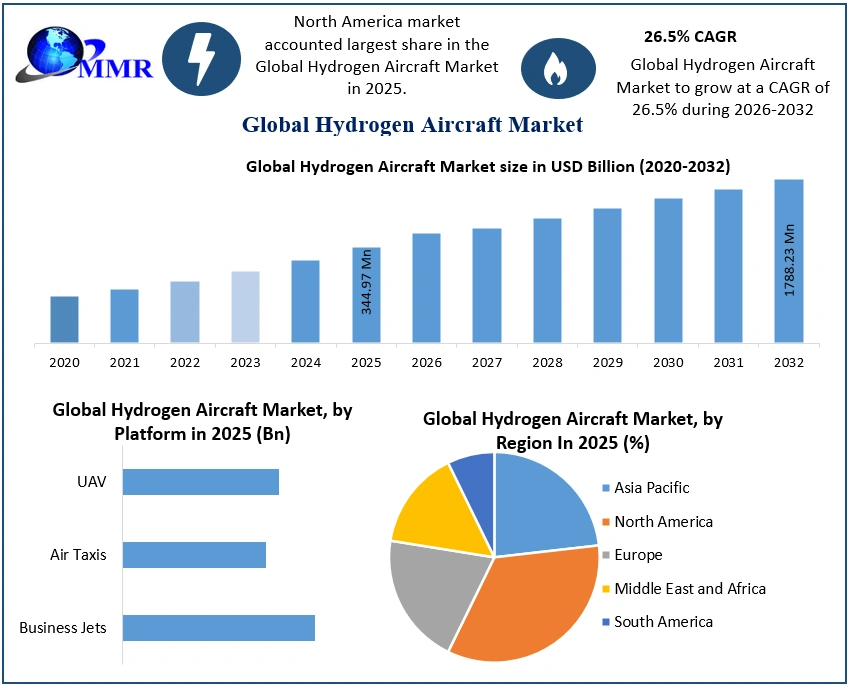
Hydrogen Aircraft Market 2025-2032

To know about the Research Methodology :- Request Free Sample Report

Hydrogen Aircraft Market Dynamics

A report by Rocky Mountain Institute published in July states that 2.5% of the carbon emission is a result of global air travel. Increased preference for a zero-carbon environment by developed nations has resulted in a rise in demand for alternatives for fossil fuels. While Biofuels have their drawbacks, Hydrogen provides a lightweight and high-density fuel medium with nearly zero carbon footprints. An increase in the number of aviation firms investing in carbon-emission-free fuel technology has resulted in a rise in demand for Hydrogen Aircraft.

Aim to achieve near to zero dependence on fossil fuels as aviation fuel by leading aircraft manufacturing and operating firms has resulted in a rising demand for a cost-efficient alternative for aviation fuel. With strategic investment in building zero-emission commercial aircraft by leading firms like

Honeywell Aerospace, Boeing, and Airbus, demand for Aircraft that run on Hydrogen is expected to increase rapidly.

More than 100 countries came into an alliance with the aim to achieve carbon neutrality by 2050 at the Paris Climate Accord in. Countries in the European Union, UAE, Saudi Arabia, South Korea, and Canada have joined an alliance aiming for net-zero carbon emission by 2050. Increased awareness by governments across the world towards carbon emission has resulted in a rise in demand for Hydrogen Aircraft.

Increased demand for fuel-efficient and environmentally sustainable commercial aircraft has resulted in a rise in demand for aircraft that work on hydrogen. To tap this market, Airbus launched 3 new concept aircraft that have 2 hybrid hydrogen turbofan engines and holds liquid hydrogen tanks underneath their wings On September 21, . These Aircraft are considered the world’s first zero-emission commercial aircraft and work on Hydrogen as their primary source of fuel.

The rising preference for cost-efficient and easy to maintain aircraft by the aviation industry has resulted in the entry of various new players in the Hydrogen Aircraft Manufacturing market. UK-based ZeroAvia, Inc. took a successful trial of their first six-seater commercial aircraft that fully works on Hydrogen Cells. This is the world’s first commercial-size aircraft that triumphantly took hydrogen fuel cell-powered flight.

Restraints:

The high cost required for building Hydrogen fuel-based infrastructure acts as the major restraining factor here.
The need for special lightweight vacuum insulated tanks to maintain fuel below its 20 K boiling point is limiting the rapid scale adaption of Hydrogen Aircraft by the Aviation industry.

Hydrogen Aircraft Market Segment Analysis:

The Hydrogen Aircraft Market is segmented

By Power Source, Convenience in using has resulted in making Hydrogen Fuel Cell dominate the power source segment in the Hydrogen Aircraft Market. More than 45% of the concept Hydrogen Aircraft built have Hydrogen Fuel Cell as its source. Increased expenditure on research for building hydrogen fuel-efficient engine that follows combustion by Lockheed Martin and other firms is observed.

By Platform, The rising preference for cost-efficient drones by the military and commercial sectors has resulted in a rapid growth in the Hydrogen operated UAVs in the forecasted period. UAVs that act as miniature Hydrogen Aircraft have observed a 5.5% increase in demand from the commercial sector in the year 2025.

By Passenger Capacity, Increased preference for cost-efficient aircrafts having passenger capacity in the range of 5-10 has forecasted to dominate the

Hydrogen Aircraft Market in the forecasted period. Hydrogen Aircraft having a capacity of 5-10 Passengers have observed an advanced booking of 150 aircraft from the Lockheed Martin Corporation by the US Air Force in 2025.

By Range, Increased demand for inter-city air travel carriers by people living in developed nations has resulted in medium-range Hydrogen Aircraft dominate the market in the forecasted period. A rise in demand for environmentally efficient air carriers has resulted in a 4% increase in demand for Hydrogen Aircraft having a range of 500 km-1500 km. by the top management officials of firms present in Europe.

By Technology, The increased research on the use of Hydrogen as an alternative for aviation fuel has resulted in the development of fully hydrogen-powered aircraft that is forecasted to dominate the civil aviation market by 2050. The rising preference for Hydrogen Fuel as a power source for aircraft has resulted in a 4.5% increase in demand for Fully Hydrogen-powered Aircraft by defense sectors of the US, Israel, and Japan in the year 2025.

The rising preference for environment-friendly aeroplanes has resulted in a 15% increase in the orders received by UK-based startup ZeroAvia in 2025, to manufacture Hydrogen Aircraft having a capacity of 4-10 Passengers and a range less than 500 Km. An increase in demand for Fuel-efficient airliners by the US defense sector has resulted in a pre-order for 25 Hydrogen Aircraft to Airbus having a range of 500 Km to 1500 Km.

Increased focus on a greener future by the global civil aviation industry has resulted in an 8.5% increase in demand for Hydrogen Aircraft in 2025 having a range of 1500 Km to 4000 Km. The rising environmental concerns by different governments have resulted in a rise in demand for Hydrogen Aircraft having long-range.

Global Hydrogen Aircraft Market
Report Coverage Details
Base Year: 2025 Forecast Period: 2026-2032
Historical Data: 2020 to 2025 Market Size in 2025: 344.97 USD Mn
Forecast Period 2026-2032 CAGR: 26.5% Market Size in 2032: 1788.2 USD Mn
Segments Covered: By Power Source Hydrogen Combustion
Hydrogen Fuel Cell
By Technology Fully Hydrogen-Powered Aircraft
Hybrid Electric Aircraft
By Platform Urban Air Mobility
    EVTOL
    Unmanned Aerial Vehicle
Business Jets
Others
By Range Up to 1000 km
1000 km to 2000 km
Over 2000 km
By Passenger Capacity Up to 4 Passengers
5 to 10 Passengers
More than 10 Passengers
By Application Commercial
Military
Cargo

Hydrogen Aircraft Market Regional Insights

The presence of an established commercial aviation sector has resulted in making North America the biggest manufacturer and consumer of Hydrogen Aircraft. Re-entry of the USA in Paris Agreement in January  has projected double-digit growth in the North American Hydrogen Aircraft Market in the forecasted period.

The established goal to reach carbon neutrality by 2050 has resulted in an 8.5% increase in the orders placed for Hydrogen Aircraft to Boeing and Airbus by different governments present in Europe. Increased preference for air carriers that leaves little to zero carbon footprints has resulted in a 6% increase in demand for Hydrogen Aircraft by corporations like Netflix, JP Morgan Chase, and Microsoft that are part of the Sustainable Aviation Buyers Alliance.

The Asia-Pacific is showing a low growth rate which is concentrated mostly in environmentally-conscious countries like Japan, South Korea, and Bhutan. The Middle East and Africa’s region is showing a growth rate of 4.8% in demand for Hydrogen Aircraft in as compared to the first decade of the 21st Century. The presence of a big aeronautical industry in countries like Israel and the zero-carbon emission goal by governments of UAE and Saudi Arabia has projected an increased growth in the Hydrogen Aircraft Market present in this region in the forecasted period.
South American Market is showing a low growth rate, the reason for which is the absence of strong aviation industry in this region.

The objective of the report is to present a comprehensive analysis of the Hydrogen Aircraft Market to the stakeholders in the industry. The past and current status of the industry with the forecasted market size and trends are presented in the report with the analysis of complicated data in simple language. The report covers all the aspects of the industry with a dedicated study of key players that include market leaders, followers, and new entrants.

PORTER, SVOR, PESTEL analysis with the potential impact of micro-economic factors of the market have been presented in the report. External as well as internal factors that are supposed to affect the business positively or negatively have been analyzed, which will give a clear futuristic view of the industry to the decision-makers.

The report also helps in understanding the Hydrogen Aircraft Market dynamics, structure by analyzing the market segments and Project the Hydrogen Aircraft Market size. Clear representation of competitive analysis of key players by product, price, financial position, product portfolio, growth strategies, and regional presence in the Hydrogen Aircraft Market make the report investor’s guide.

Exact Date Company Development Impact
26 March 2026 ICAO / World Economic Forum The Global Aviation Sustainability Outlook 2026 was released, establishing a unified industry framework for scaling hydrogen-powered flight and infrastructure. The framework accelerates capital investment and provides regulatory clarity for manufacturers moving from prototypes to commercialization.
22 December 2025 ZeroAvia ZeroAvia signed a definitive agreement with the Korean Atomic Energy Research Institute (KAERI) to develop advanced composite liquid hydrogen storage systems. This collaboration enhances fuel density and aircraft range, critical for extending hydrogen propulsion to large narrow-body aircraft.
15 October 2025 ZeroAvia The company secured a €21 million European Union grant to implement the world’s first network of hydrogen-powered commercial aircraft in Norway. This funding establishes operational viability for regional routes and validates hydrogen refueling infrastructure in a real-world aviation ecosystem.
18 June 2025 Airbus & MTU Aero Engines Airbus and MTU Aero Engines signed a Memorandum of Understanding (MoU) to jointly develop hydrogen fuel cell propulsion for the ZEROe project. The partnership combines heavy-duty engine expertise with airframe design to reach the 2035 entry-into-service target for zero-emission aircraft.
14 May 2025 RVL Aviation RVL Aviation announced the deployment of the first ZeroAvia ZA600-powered Cessna Caravan for commercial hydrogen-electric freighter operations. This marks the transition of hydrogen technology into revenue-generating cargo services, proving the reliability and cost-efficiency of fuel cell powertrains.
25 March 2025 Airbus During the 2025 Airbus Summit, the company officially selected hydrogen fuel cell technology as the primary propulsion method for its future zero-emission aircraft. This strategic pivot streamlines R&D resources toward fuel cell stacks, moving away from direct combustion for its initial commercial rollout.

Hydrogen Aircraft Market Scope: Inquire before buying

Hydrogen Aircraft Market, by Region

North America (United States, Canada and Mexico)
Europe (UK, France, Germany, Italy, Spain, Sweden, Austria, Turkey, Russia and Rest of Europe)
Asia Pacific (China, India, Japan, South Korea, Australia, ASEAN and Rest of APAC)
Middle East and Africa (South Africa, GCC, Egypt, Nigeria and Rest of ME&A)
South America (Brazil, Argentina, Columbia and Rest of South America)

Hydrogen Aircraft Market, Key Players

  1. Airbus S.A.S.
  2. Boeing Co.
  3. Embraer S.A.
  4. BAE Systems plc
  5. Bell Helicopter (Textron Inc.)
  6. Israel Aerospace Industries (IAI)
  7. GKN Aerospace
  8. Karem Aircraft
  9. Bye Aerospace
  10. Volta Volare
  11. DeLorean Aerospace
  12. ZeroAvia Inc.
  13. H2FLY GmbH
  14. Beyond Aero
  15. Stralis Aircraft
  16. Sirius Aviation
  17. Ecojet
  18. Aerodelft
  19. Apus Group
  20. Flyka
  21. Pipistrel d.o.o.
  22. Skai (Alaka’i Technologies)
  23. Urban Aeronautics Ltd.

Table of Contents

1. Hydrogen Aircraft Market: Executive Summary 1.1. Executive Summary 1.1.1 Market Size (2025) & Forecast (2026-2032) 1.1.2 Market Size (USD) and Market Share (%) - By Segments, Regions, and Country 2. Hydrogen Aircraft Market: Competitive Landscape 2.1. MMR Competition Matrix 2.2. Key Players Benchmarking 2.2.1 Company Name 2.2.2 Headquarter 2.2.3 Product Segment 2.2.4 End User Segment 2.2.5 Payload Capacity 2.2.6 Market Share (%) 2.2.7 Revenue (2024) 2.2.8 R&D Investment 2.2.9 Profit Margin 2.2.10 Technology Integration 2.2.11 Power Output (kW or MW) 2.2.12 Geographical Presence 2.3. Market Structure 2.3.1 Market Leaders 2.3.2 Market Followers 2.3.3 Emerging Players 2.4. Partnership and Collaboration Landscape 2.4.1 Overview of cross-sector collaborations between aerospace and energy firms 2.4.2 Analysis of joint R&D consortia (Clean Hydrogen Alliance, ZEROe, H2Gear) 2.4.3 Public–private partnerships for demonstration projects 2.4.4 Co-development agreements and intellectual property sharing patterns 2.5. Strategic Initiatives and Market Entry Strategies 2.5.1 M&A activities, strategic alliances, and new entrants 2.5.2 Product launch roadmaps and certification progress 2.5.3 Regional expansion and localization strategies 2.5.4 Strategic responses to regulatory and cost challenges 2.6. Patent and Innovation Intelligence 2.6.1 Patent filing trends across propulsion, tank, and cryogenic domains 2.6.2 Technology ownership distribution among top players 2.6.3 Collaboration in intellectual property development 2.6.4 Key patent families shaping the hydrogen aviation ecosystem 3. Hydrogen Aircraft Market Dynamics 3.1. Hydrogen Aircraft Market Trends 3.2. Hydrogen Aircraft Market Dynamics 3.2.1 Drivers 3.2.2 Restraints 3.2.3 Opportunities 3.2.4 Challenges 3.3. PORTER’s Five Forces Analysis 3.4. PESTLE Analysis 3.5. Key Opinion Leader Analysis For the Global Industry 4. Technology and Innovation Landscape 4.1. Evolution of Hydrogen Propulsion Technologies (Combustion vs. Fuel Cell) 4.2. Advances in Hydrogen Storage and Material Technologies 4.3. Integration of Hybrid Electric and Battery-Based Systems 4.4. Aircraft Structural Adaptations for Hydrogen Integration 4.5. Hydrogen Production Pathways (Green, Blue, Grey) and Energy Efficiency 4.6. Refueling Technology Advancements and Airport Handling Systems 4.7. Future Technology Roadmap, Patents, and Prototype Development 5. Regulatory, Safety, and Certification Framework 5.1. Global Aviation Regulatory Frameworks (EASA, FAA, ICAO) 5.2. Safety Standards for Hydrogen Handling, Storage, and Transport 5.3. Certification Pathways for New Aircraft and Retrofit Platforms 5.4. Infrastructure and Airport Compliance Regulations 5.5. Government-Led Demonstration and Funding Programs 5.6. Environmental and Emission Compliance Requirements 6. Hydrogen Fuel Ecosystem and Infrastructure Readiness 6.1. Global Hydrogen Production Capacity and Hydrogen Aircraft Availability 6.2. Role of Green Hydrogen in Decarbonizing the Aviation Value Chain 6.3. Hydrogen Storage Technologies – Cryogenic, Compressed, and LOHC Systems 6.4. Hydrogen Logistics: Distribution, Transportation, and On-Site Generation Models 6.5. Airport Refueling Infrastructure and Ground Support Adaptations 6.6. Economic Viability of Hydrogen Supply Networks at Major Airports 6.7. Cross-Sector Hydrogen Integration with Maritime and Heavy Transport 7. OEM, Supplier, and Ecosystem Mapping 7.1. Hydrogen Aircraft OEM Landscape – Established Players vs. Startups 7.2. Key Component Manufacturers: Fuel Cells, Storage, and Power Electronics 7.3. Collaboration Between Aerospace and Energy Sector Players 7.4. Tier-1 to Tier-3 Supplier Network and Localization Trends 7.5. Joint Ventures and Hydrogen Aviation Development Programs 7.6. Role of Alliances, Consortia, and Technology Partnerships 7.7. Global Ecosystem Readiness and Supply Chain Interdependencies 8. Supply Chain and Infrastructure Analysis 8.1. Hydrogen Production and Distribution Network Overview 8.2. OEM, Engine Manufacturer, and Hydrogen Supplier Linkages 8.3. Airport and Refueling Infrastructure Deployment Status 8.4. Key Public–Private Partnerships in Hydrogen Supply Chain 8.5. Bottlenecks in Logistics and Refueling Operations 8.6. Cost Structure and Value Chain Profitability Assessment 8.7. Strategic Roadmap for Scaling Production and Refueling Infrastructure 9. Economic and Cost Structure Analysis 9.1. Comparative Operating Cost – Hydrogen vs. Conventional Jet Fuel 9.2. CAPEX and OPEX Evaluation by Aircraft Platform 9.3. Fuel Price Sensitivity and Break-Even Distance Modeling 9.4. Lifecycle Maintenance and Hydrogen System Cost Implications 9.5. Infrastructure Cost Components: Production, Storage, and Distribution 9.6. Levelized Cost of Flight (LCOF) and Economic Feasibility Metrics 10. Environmental and Sustainability Impact Assessment 10.1. Well-to-Wake Emission Comparison: Hydrogen vs. SAF vs. Jet A-1 10.2. Contribution of Hydrogen Aircraft to Net-Zero Aviation Targets 10.3. Life-Cycle Assessment (LCA) of Hydrogen Aircraft and Components 10.4. Environmental Effects – Water Vapor, Noise, and Thermal Footprint 10.5. Integration with Green Airport Initiatives and Carbon-Neutral Operations 10.6. Renewable vs. Non-Renewable Hydrogen Production Pathways 10.7. ESG Reporting and Sustainability Commitments by Aviation OEMs 11. Investment, Funding, and Policy Landscape 11.1. Venture Capital and Private Equity Trends in Hydrogen Aviation 11.2. Global and Regional Government Subsidy Frameworks 11.3. Public–Private Partnership (PPP) Models in Hydrogen Infrastructure 11.4. Financial Viability of Demonstrator and Prototype Programs 11.5. Role of Green Bonds, Carbon Credits, and Climate Financing 11.6. Regional Hydrogen Investment Frameworks (EU, US, Japan, Middle East) 11.7. Involvement of Multilateral Agencies (World Bank, IEA, ICAO) in Funding 12. Research, Development, and Patent Analysis 12.1. Ongoing R&D Projects and Demonstration Flights 12.2. Patent Filing Trends (Fuel Cells, Tanks, Propulsion Systems) 12.3. Collaboration Networks Between Aerospace and Energy Firms 12.4. Emerging Research Areas: Hydrogen Turbines, Cryo-Systems, and Storage Materials 12.5. Funding and Grants from Global Hydrogen Innovation Programs 13. Collaboration Ecosystem and Industry Alliances 13.1. Joint Ventures Between Aircraft OEMs and Energy Companies 13.2. Hydrogen Consortia and Innovation Clusters 13.3. Cross-Industry Collaborations (Energy, Aerospace, Infrastructure) 13.4. Role of Universities and Research Institutions 13.5. Technology Transfer and Co-Development Models 14. Global Hydrogen Aircraft Fleet Projection & Deployment Statistics 14.1. Current Status of Hydrogen Aircraft Prototypes and Demonstrations (2020–2024) 14.2. Forecasted Fleet Size (2026–2032) by Range 14.3. Deployment Roadmap by Region (Europe, North America, Asia-Pacific, Others) 14.4. Estimated Fleet Replacement Potential for Conventional Aircraft 15. Hydrogen Fuel Consumption and Efficiency Analysis 15.1. Average Hydrogen Consumption Rate by Aircraft Class and Distance 15.2. Comparative Fuel Efficiency vs. Jet-A and SAF Aircraft 15.3. Energy Density and Payload Impact Assessment 15.4. Efficiency Gains from Hybrid Hydrogen-Electric Systems 15.5. Future Efficiency Forecast and Technological Breakthroughs 16. Statistical Overview: Hydrogen Production & Aviation Demand Linkage 16.1. Global Hydrogen Production Volume and Allocation to Aviation (2026–2032) 16.2. Percentage of Green Hydrogen Used in Aviation Applications 16.3. Correlation Between Hydrogen Cost Index and Aircraft Operating Economics 16.4. Regional Hydrogen Supply Capacity vs. Hydrogen Aircraft Demand 16.5. Forecasted Green Hydrogen Demand from Commercial Aviation by 2032 17. Comparative Benchmarking Analysis (Hydrogen vs. SAF vs. Electric Aircraft) 17.1. Comparative Energy Efficiency (MJ/kg and MJ/km) 17.2. Lifecycle Emission Analysis (CO₂, NOx, and Contrail Effects) 17.3. Cost per Passenger-Kilometer (CASK) Benchmarking 17.4. Operational Range and Refueling Time Comparison 17.5. Adoption Barriers and Infrastructure Readiness Score 18. Maintenance, Reliability & Lifecycle Data Statistics 18.1. Mean Time Between Failures (MTBF) for Hydrogen Fuel Cell Components 18.2. Reliability Metrics for Cryogenic Storage and Distribution Systems 18.3. Comparative Maintenance Hours per Flight Hour 18.4. Spare Parts Cost Trends and Supply Chain Dependencies 18.5. Lifecycle Durability Forecast of Hydrogen Propulsion Systems 19. Hydrogen Aircraft Market: Global Market Size and Forecast by Segmentation (by Value in USD) (2025-2032) 19.1 Global Hydrogen Aircraft Market Size and Forecast, By Power Source 19.1.1 Hydrogen Combustion 19.1.2 Hydrogen Fuel Cell 19.2. Global Hydrogen Aircraft Market Size and Forecast, By Technology 19.2.1 Fully Hydrogen-Powered Aircraft 19.2.2 Hybrid Electric Aircraft 19.3. Global Hydrogen Aircraft Market Size and Forecast, By Platform 19.3.1 Urban Air Mobility 19.3.2 EVTOL 19.3.3 Unmanned Aerial Vehicle 19.3.4 Business Jets 19.3.5 Others 19.4. Global Hydrogen Aircraft Market Size and Forecast, By Range 19.4.1 Up to 1000 km 1000 km to 2000 km 1000.1 Over 2000 km 19.5. Global Hydrogen Aircraft Market Size and Forecast, By Passenger Capacity 19.5.1 Up to 4 Passengers 5 to 10 Passengers 5.1 More than 10 Passengers 19.6. Global Hydrogen Aircraft Market Size and Forecast, By Application 19.6.1 Commercial 19.6.2 Military 19.6.3 Cargo 19.7. Global Hydrogen Aircraft Market Size and Forecast, by Region 19.7.1 North America 19.7.2 Europe 19.7.3 Asia Pacific 19.7.4 Middle East and Africa 19.7.5 South America 20. North America Hydrogen Aircraft Market Size and Forecast by Segmentation (by Value in USD) (2025-2032) 20.1. North America Hydrogen Aircraft Market Size and Forecast, By Power Source 20.2. North America Hydrogen Aircraft Market Size and Forecast, By Technology 20.3. North America Hydrogen Aircraft Market Size and Forecast, By Platform 20.4. North America Hydrogen Aircraft Market Size and Forecast, By Range 20.5. North America Hydrogen Aircraft Market Size and Forecast, By Passenger Capacity 20.6. North America Hydrogen Aircraft Market Size and Forecast, By Application 20.7. North America Hydrogen Aircraft Market Size and Forecast, by Country 20.7.1 United States 20.7.2 United States Hydrogen Aircraft Market Size and Forecast, By Power Source 20.7.3 United States Hydrogen Aircraft Market Size and Forecast, By Technology 20.7.4 United States Hydrogen Aircraft Market Size and Forecast, By Platform 20.7.5 United States Hydrogen Aircraft Market Size and Forecast, By Range 20.7.6 United States Hydrogen Aircraft Market Size and Forecast, By Passenger Capacity 20.7.7 United States Hydrogen Aircraft Market Size and Forecast, By Application 20.7.8 Canada 20.7.9 Mexico 21. Europe Hydrogen Aircraft Market Size and Forecast by Segmentation (by Value in USD) (2025-2032) 21.1. Europe Hydrogen Aircraft Market Size and Forecast, By Power Source 21.2. Europe Hydrogen Aircraft Market Size and Forecast, By Technology 21.3. Europe Hydrogen Aircraft Market Size and Forecast, By Platform 21.4. Europe Hydrogen Aircraft Market Size and Forecast, By Range 21.5. Europe Hydrogen Aircraft Market Size and Forecast, By Passenger Capacity 21.6. Europe Hydrogen Aircraft Market Size and Forecast, By Application 21.7. Europe Hydrogen Aircraft Market Size and Forecast, by Country 21.7.1 United Kingdom 21.7.2 France 21.7.3 Germany 21.7.4 Italy 21.7.5 Spain 21.7.6 Sweden 21.7.7 Russia 21.7.8 Rest of Europe 22. Asia Pacific Hydrogen Aircraft Market Size and Forecast by Segmentation (by Value in USD) (2025-2032) 22.1. Asia Pacific Hydrogen Aircraft Market Size and Forecast, By Power Source 22.2. Asia Pacific Hydrogen Aircraft Market Size and Forecast, By Technology 22.3. Asia Pacific Hydrogen Aircraft Market Size and Forecast, By Platform 22.4. Asia Pacific Hydrogen Aircraft Market Size and Forecast, By Range 22.5. Asia Pacific Hydrogen Aircraft Market Size and Forecast, By Passenger Capacity 22.6. Asia Pacific Hydrogen Aircraft Market Size and Forecast, By Application 22.7. Asia Pacific Hydrogen Aircraft Market Size and Forecast, by Country 22.7.1 China 22.7.2 S Korea 22.7.3 Japan 22.7.4 India 22.7.5 Australia 22.7.6 Indonesia 22.7.7 Malaysia 22.7.8 Philippines 22.7.9 Thailand 22.7.10 Vietnam 22.7.11 Rest of Asia Pacific 23. Middle East and Africa Hydrogen Aircraft Market Size and Forecast by Segmentation (by Value in USD) (2025-2032) 23.1. Middle East and Africa Hydrogen Aircraft Market Size and Forecast, By Power Source 23.2. Middle East and Africa Hydrogen Aircraft Market Size and Forecast, By Technology 23.3. Middle East and Africa Hydrogen Aircraft Market Size and Forecast, By Platform 23.4. Middle East and Africa Hydrogen Aircraft Market Size and Forecast, By Range 23.5. Middle East and Africa Hydrogen Aircraft Market Size and Forecast, By Passenger Capacity 23.6. Middle East and Africa Hydrogen Aircraft Market Size and Forecast, By Application 23.7. Middle East and Africa Hydrogen Aircraft Market Size and Forecast, by Country 23.7.1 South Africa 23.7.2 GCC 23.7.3 Egypt 23.7.4 Nigeria 23.7.5 Rest of ME&A 24. South America Hydrogen Aircraft Market Size and Forecast by Segmentation (by Value in USD) (2025-2032) 24.1. South America Hydrogen Aircraft Market Size and Forecast, By Power Source 24.2. South America Hydrogen Aircraft Market Size and Forecast, By Technology 24.3. South America Hydrogen Aircraft Market Size and Forecast, By Platform 24.4. South America Hydrogen Aircraft Market Size and Forecast, By Range 24.5. South America Hydrogen Aircraft Market Size and Forecast, By Passenger Capacity 24.6. South America Hydrogen Aircraft Market Size and Forecast, By Application 24.7. South America Hydrogen Aircraft Market Size and Forecast, by Country 24.7.1 Brazil 24.7.2 Argentina 24.7.3 Colombia 24.7.4 Chile 24.7.5 Rest Of South America 25. Company Profile: Key Players 25.01.Airbus S.A.S. 25.01.1 Company Overview 25.01.2 Business Portfolio 25.01.3 Financial Overview 25.01.4 SWOT Analysis 25.01.5 Strategic Analysis 25.01.6 Recent Developments 25.02.Boeing Co. 25.03.Embraer S.A. 25.04.BAE Systems plc 25.05.Bell Helicopter (Textron Inc.) 25.06.Israel Aerospace Industries (IAI) 25.07.GKN Aerospace 25.08.Karem Aircraft 25.09.Bye Aerospace 25.10.Volta Volare 25.11.DeLorean Aerospace 25.12.ZeroAvia Inc. 25.13.H2FLY GmbH 25.14.Beyond Aero 25.15.Stralis Aircraft 25.16.Sirius Aviation 25.17.Ecojet 25.18.Aerodelft 25.19.Apus Group 25.20.Flyka 25.21.Pipistrel d.o.o. 25.22.Skai (Alaka’i Technologies) 25.23.Urban Aeronautics Ltd. 26. Key Findings 27. Analyst Recommendations 28. Hydrogen Aircraft Market: Research Methodology

Custom Market Research Services

We Will Customise The Research For You, In Case The Report Listed Above Does Not Meet With Your Requirements