
Household Product Market - Industry Structure Evaluation, Demand Drivers Analysis, Regional Growth Analysis and Identification, Competitive Positioning Review & Global Market Size Forecast to 2032
Overview
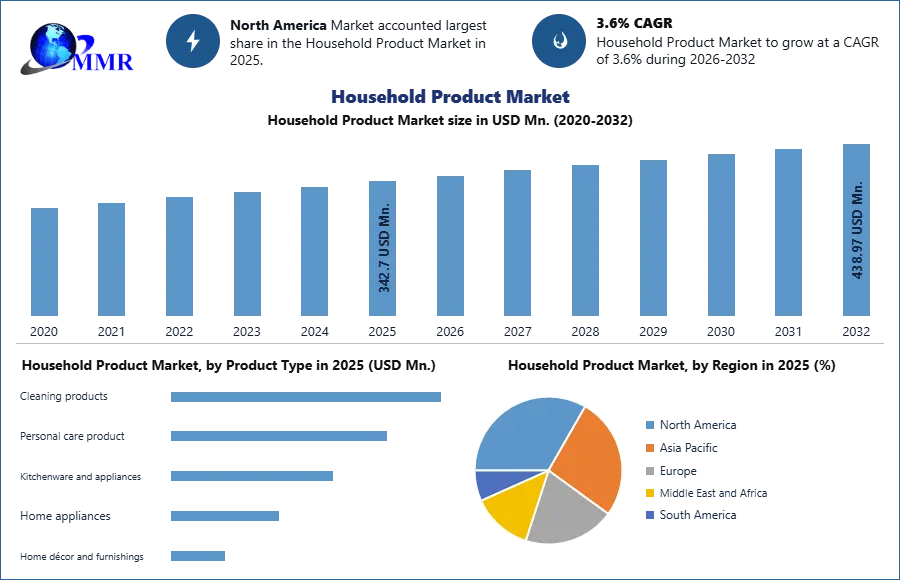
The Household Product Market size was valued at USD 342.7 Billion in 2025 and the total Household Product revenue is expected to grow at a CAGR of 3.6% from 2026 to 2032, reaching nearly USD 438.96 Billion.
Household products are goods and products used within households. Household products have a wide range of substances used in households, including cleaning products, kitchen equipment, textile washing products, general-purpose cleaners, tissue and hygiene products, and others, they are tangible and movable personal property placed in the rooms of a house, such as a bed or a refrigerator.
To know about the Research Methodology :- Request Free Sample Report
The key driving factors for the Household products market such as such as rising disposable income, increasing living standards, increased focus on health and hygiene, consumer tastes and preferences, distribution channels, and the desire for comfort. Consumers’ spending on home improvement products is also contributing to the growth of the Household products market. The trend of smart and connected appliances and technological advancements is growing in the household Product market. People are increasingly opting for automatic products that reduce manual labor and save time.
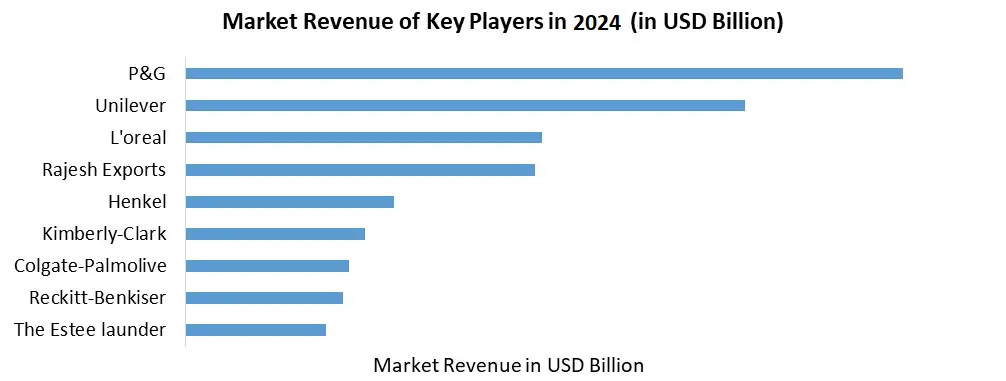
The analysis conducted by Maximize market research for the Household products market over the past 5 years and by using the data, concluded that Asia Pacific has grown at a CAGR of 4.75%, and is expected to continue during the forecast period in the global Household products market. Followed by North America, Asia Pacific is expected largest share of the Household products market. The market is dominated by key players such as Henkel AG & Co. KGaA, Colgate-Palmolive Company, Unilever PLC, Haier Group, and Reckitt Benckiser Group plc. Etc. These key players are operating in various segments of the household products market, such as cleaning products, kitchen equipment, and textile washing products, general-purpose cleaners, tissue & hygiene products, and others.
The report includes an analysis of the Middle East conflict's impact on the revenue of market leaders, followers, and disruptors. As geopolitical instability and supply chain disruptions vary across regions and trade corridors, the impact is observed differently by segments. This report covers the current short-term and long-term market effects, specifically regarding energy price volatility and logistics, helping decision-makers prepare strategic outlines for companies by region to navigate this evolving landscape effectively.
Household products Market Dynamics:
Increasing Urbanization is the driver of Household Product Market
Increasing Household Product demand is enhancing the consumption of Household Products and the market is expected to exhibit the highest growth rate during the forecast period. The rise in consumer disposable income, high living standards, and the need for comfort encourage consumers to upgrade their existing appliances to smarter versions, which is further expected to coerce the market demand. Consumers widely purchase home appliances as they offer ease, diminish efforts, and save time. People are moving to urban areas, and the demand for smaller, more convenient products increases also consumers are more likely to purchase products that help them to save space, such as multi-functional furniture. As well as the Income of consumers rising, they are willing to spend more on higher-end household products.
Lack of customer retention and product differentiation is the restraint to the household product market
Psychographic, demographic, and behavioral characteristics and product preferences may differ from person to person. Consumer behavior is primarily influenced by lifestyle and awareness standards. Consumer loyalty and product distinctiveness are difficult to maintain in the household cleaning products market. New and creative products are frequently attractive to consumers. As a result, sticking to a single product or brand is difficult. Small and medium-sized manufacturers are finding it increasingly difficult to keep up with changing consumer behaviors. There are five factors affecting client retention client satisfaction, client delight, client switching costs, client relationships, and client service standards. As per MMR report 82% of people have stopped doing business with a company because of bad customer service. 53% of customers have switched companies because they felt unappreciated. As a result, these factors decrease the growth rate of the Household Product Market.
The incorporation of technologies such as artificial intelligence, AR/VR, the Internet of Things, and robotics boost the growth of the market
The gradual adoption of advanced technologies like AI and AR/VR, the Internet of Things, and robotics reduce working time and energy. Product innovation, new product development, product differentiation, and integration of numerous value-added features are further expected to propel the market demand over the next few years. Adobe Smart Security Kit, Abode is a reliable DIY home security system with limitless smart home features. It can be used with Alexa, Google Assistant, and Home Kit, and it can also be used as a hub for Z-Wave and Zigbee devices, which are a couple of wireless home automation protocols that greatly expand the sorts of gadgets. Arlo Video Doorbell is another smart home device. It helps to detect visitors and activities in the doorway using a camera, speaker, microphone, motion sensor, and an internet connection. AI technology improves lighting and has progressed from candles to gas to electricity. The smart home is rapidly expanding. Markets are investing in AI research and development for robots. In February , Dyson invested USD 587 million in developing an R&D tech center in Singapore focused on connected tech and intelligent machines. These innovations boost the market during the forecast period.
Household Product Market Segment Analysis:
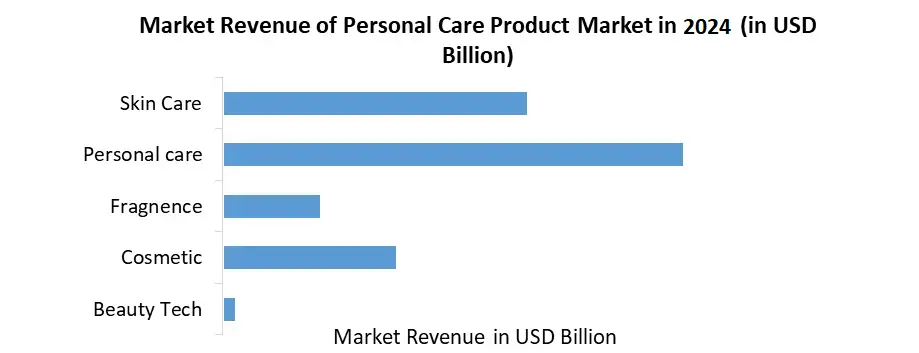
Household Product Market by Product Type, Personal care products dominated the household product market. Based on the product type household product market is classified into Cleaning products, Personal care products, Kitchenware and appliances, Home décor, and furnishings. The personal care products market generated market revenue of 625.38 billion in 2025 with a growing rate at a CAGR of 3.33%. The household cleaner market is growing during the forecast period. Rising awareness among people regarding keeping the household clean has become one of the primary driving factors for the household cleaner market growth. Additionally, the easy availability of household cleaners coupled with several variations including different fragrances is also likely to boost the market advancement.
Household Product Market by Consumer Demographic, Age and Income dominated the household market and are expected to grow during the forecast period. Based on consumer Demographics market is classified into age income and lifestyle. Age and income affect the household product market by influencing what products customers can afford and what products they need. Older consumers may be more likely to purchase products that help them with mobility and accessibility. Consumers with higher incomes they likely to purchase luxury products, thus they boost the household product market during the forecast period.
Household Product Market by Distribution Channel, Brick and mortar Retail segment contributed to the highest share of over 68% in the global market revenue in 2025. Based on the distribution channel household product market is classified into Brick-and-mortar retail, E-Commerce, and Direct sales. Brick and mortar sales continued to rise throughout 2025 and 46 % of consumers still say they prefer to shop in person rather than online. Amazon.com Inc. has opened brick-and-mortar stores to help market and its products and strengthen customer relations. Brick-and-mortar stores have an average return rate of 8.9%, compared to around 30% for online stores. Some brick-and-mortar grocery stores, such as Safeway, allow customers to shop for groceries online and have them delivered to their doorstep in as little as a few hours. Brick-and-mortar stores offer the advantage of an in-person shopping experience, which may be important when the product must be inspected by the shopper. The rising organized retail sector in emerging economies such as Malaysia, India, and China is anticipated to boost the demand for household products in the coming years. Thus, all these factors are likely to propel the growth of this segment during the forecast period.
Household Product Market Regional Insights:
North America Holds a Significant Revenue Share in the Household Product Market
The North American Household Product Market has the highest market share in 2025, with a market share of about 42%. The United States is the largest market in North America, with a market share of about 19%. The average user in the United States spent upwards of USD 765 per year on household products. The most popular major household appliances in the US such as Refrigerators and freezers, Kitchen furniture and countertops, Dishwashing machines, etc. Asia Pacific is expected to dominate the global Household Product Market during the forecast period in terms of sales and revenue. Emerging economies like India, China, and Japan are making significant investments with key players like Henkel AG & Co. KGaA, Colgate-Palmolive Company, Reckitt Benckiser Group PLC, The Procter & Gamble Company, Unilever PLC, Kao Corporation, S.C. Johnson & Son Inc., and Church & Dwight Co. Inc. These companies are major players in the global household product market and are involved in the production and distribution of different household products, including personal care products, cleaning products, and home appliances. So, these key players play a significant role in the household product market in Asia.
Household Product Market Competitive Landscapes:
13 innovations by Johnson & Johnson that inspired us in 2025
Johnson & Johnson is a leading healthcare company that made innovations to improve people's health. In 2025, the Johnson & Johnson Company announced 13 healthcare innovations that are changing cancer treatments and surgical tools for a global impact. The innovation efforts are focused on solving health challenges and driving scientific innovations that improve health. Johnson & Johnson has been recognized for its innovative spirit and approach to advancing healthcare. The innovation centers aim to foster new and creative ideas that lead to ground-breaking healthcare developments. Johnson & Johnson's innovation reflects its partnerships with other companies, such as Nanobiotix, to advance healthcare solutions. Overall, Johnson & Johnson is a key player in the healthcare industry, driving innovation and advancing healthcare solutions to improve health and good fortune.
Recent Industry Developments (2025–2026)
| Exact Date | Company | Development | Impact |
|---|---|---|---|
| 11 March 2026 | Colgate-Palmolive | The company unveiled its 2030 Strategic Growth and Productivity Plan, emphasizing AI-driven innovation and premium product tiers. | This strategy aims to secure 3%-5% long-term organic growth by addressing consumer price sensitivity through high-value innovation. |
| 05 March 2026 | Reckitt Benckiser | Reckitt reported the success of its Fuel for Growth program, achieving 5.2% revenue growth in its core portfolio during the 2025 fiscal year. | The program successfully expanded operating margins by 90 basis points, providing a stable foundation for 2026 supply chain investments. |
| 12 February 2026 | Unilever | Unilever finalized the separation of its ice cream business to focus exclusively on high-growth home care and personal care segments. | The restructuring resulted in a 4.6% increase in net profit for retained brands, sharpening the company's competitive edge in the home care market. |
| 30 December 2025 | Procter & Gamble | P&G Home Products reported a 19.1% jump in annual profit driven by robust demand for fabric care brands like Ariel and Tide. | This performance reinforces P&G's market leadership in South Asia, despite global inflationary pressures on raw material costs. |
| 29 July 2025 | Procter & Gamble | Management announced strategic price adjustments across its branded pantry staples to offset rising import tariff costs. | The move aims to maintain organic sales growth of 1% to 5% while protecting margins against volatile trade policies. |
| 15 June 2025 | Henkel AG & Co. KGaA | Henkel integrated its Consumer Brands business unit, combining laundry, home care, and hair care into a single agile division. | This merger is expected to yield annual savings of 525 million euros, accelerating R&D for sustainable cleaning technologies. |
Circular Action Alliance (CAA) Announces the Addition of Six New Founding Member Companies
Circular Action Alliance, a non-profit organization, has recently earned the distinction of being the first-ever Producer Responsibility Organization (PRO) sanctioned to manage the Extended Producer Responsibility (EPR) program for paper and packaging in the U.S. The Colorado Department of Public Health & Environment has entrusted CAA with the pivotal role of executing Colorado's Producer Responsibility Program per the State-wide Recycling Act.
Circular Action Alliance (CAA) has announced the addition of six Founding Member companies representing the retail, consumer goods, and food and beverage industries, including The Clorox Company, Colgate-Palmolive, SC Johnson, Target, The Kraft Heinz Company, and Walmart. Six new companies are joining Circular Action Alliance's existing 17 Founding Members, forming a collective of diverse brands operating under Extended Producer Responsibility (EPR) laws and covering a wide range of packaging materials.
Household Product Market Scope: Inquire before buying
| Household Product Market | |||
|---|---|---|---|
| Report Coverage | Details | ||
| Base Year: | 2025 | Forecast Period: | 2026-2032 |
| Historical Data: | 2020 to 2025 | Market Size in 2025: | 342.7 USD Mn. |
| Forecast Period 2026-2032 CAGR: | 3.6% | Market Size in 2032: | 438.97 USD Mn. |
| Segments Covered: | by Product Type | Cleaning products Personal care product Kitchenware and appliances Home appliances Home décor and furnishings |
|
| by Consumer Demographic | Age and lifestyle Income levels |
||
| by Distribution Channel | Brick and mortar Retail E-commerce Direct sales |
||
Household Product Market, by Region:
North America (United States, Canada and Mexico)
Europe (UK, France, Germany, Italy, Spain, Sweden, Austria and Rest of Europe)
Asia Pacific (China, South Korea, Japan, India, Australia, Indonesia, Malaysia, Vietnam, Taiwan, Bangladesh, Pakistan and Rest of APAC)
Middle East and Africa (South Africa, GCC, Egypt, Nigeria and Rest of ME&A)
South America (Brazil, Argentina Rest of South America)
Key Players / Competitors Profiles Covered in Brief in Global Household Product Market Report in Strategic Perspective:
- Procter & Gamble
- Amway
- Prestige Brands
- The Clorox Company
- Luxury Brand Partners
- Estée Lauder
- Colgate-Palmolive
- SC Johnson
- Henkel AG & Co. KGaA
- Unilever PLC
- Reckitt Benckiser Group plc
- Kao Corporation
- Church & Dwight Co. Inc.
- Dabur India Limited
- Godrej Consumer Products Limited
- Zep Inc.
- Nice-Pak Products Inc.
- Werner & Mertz GmbH
- The Honest Company
- McBride plc
- Ecover
- Bombril S/A
- Jelmar LLC
- Method Products PBC
- Seventh Generation
Frequently Asked Questions
1] What is the projected Household Product Market size and growth rate?
Ans. The market valuation was USD 342.7 Billion in 2025. It targets USD 438.97 Billion by 2032, exhibiting a 3.6% CAGR during the Industry Growth Drivers phase.
2] Which region leads the Household Product Market share analysis?
Ans. Asia Pacific dominates consumption and growth with a 4.75% CAGR, fueled by rising disposable incomes in emerging economies like China and India through 2026-2032.
3] Which region is the primary manufacturing hub for household products?
Ans. Asia Pacific, specifically China, leads production due to vast labor pools and supply chain integration, solidifying its status as the global Household Product Market Trends 2026.
3] Which region represents the highest consumption leader for household products?
Ans. North America, led by the U.S., remains the top consumer by value, a key factor in Household Product Market Share Analysis.
4] How is AI impacting Household Product Trends 2026?
Ans. Leading players like Colgate-Palmolive integrate AI-driven innovation to enhance premium product tiers, reducing manual labor through smart, connected appliances that offer significant time-saving consumer benefits.
5] What are the primary Household Product Market sustainability trends?
Ans. Major brands like Unilever and Clorox prioritize Extended Producer Responsibility via the Circular Action Alliance, focusing on sustainable packaging and eco-friendly cleaning technologies to satisfy regulators.
6] How do demographics influence the Household Product Industry Growth Drivers?
Ans. Rising urbanization and higher income levels drive demand for luxury, multi-functional furniture and automatic appliances, as older consumers prioritize accessibility and mobility in home products.