Home Warranty Service Market - Industry Structure Evaluation, Demand Drivers Analysis, Regional Growth Analysis and Identification, Competitive Positioning / Landscape Review & Global Market Size Forecast to 2034

9.46%
CAGR (2025-2034)
6.72 USD Bn.
Forecast Market Size
315
Report Pages
135
Market Tables

Overview

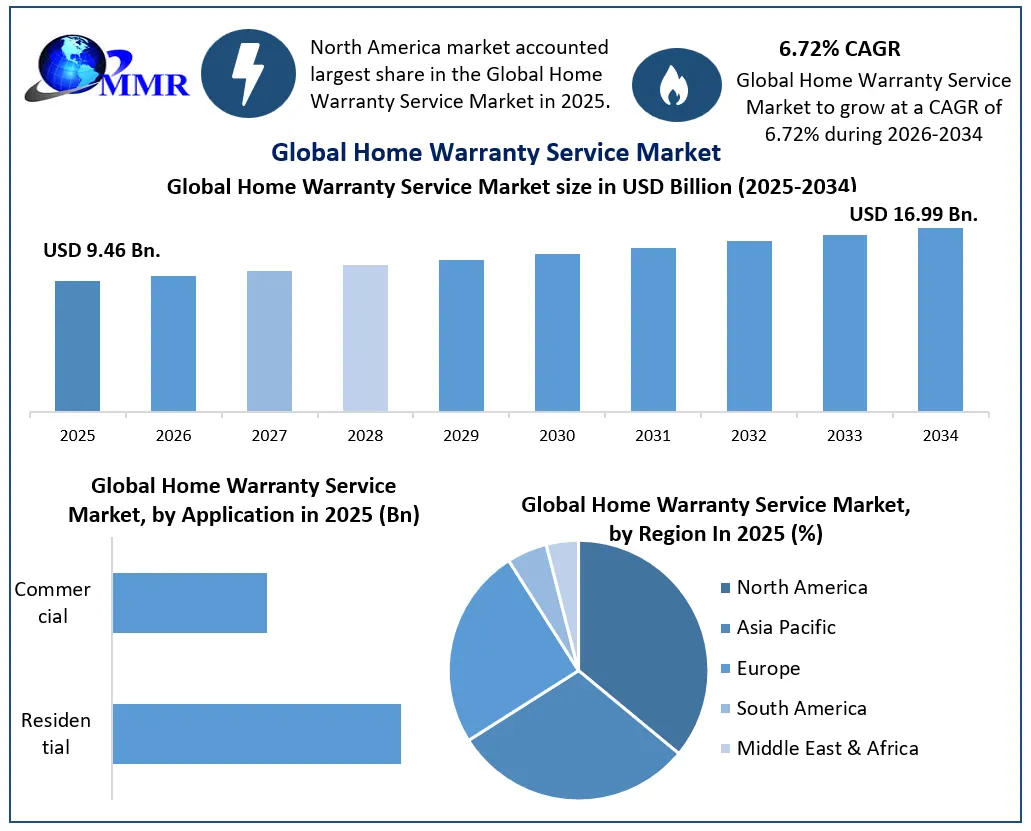
The Home Warranty Service Market size was valued at USD 9.46 Billion in 2025 and the total Home Warranty Service revenue is expected to grow at a CAGR of 6.72% from 2026 to 2034, reaching nearly USD 16.99 Billion by 2034.

Home Warranty Service Market Overview:

A Home Warranty Service is a contract that covers the repair or replacement of major home systems and appliances. Home warranties are service contracts that cover the repair or replacement of major household items, such as electrical, plumbing, and HVAC systems, water heaters, major appliances, and more.
Home Warranty Service Market Growth Outlook

To know about the Research Methodology :- Request Free Sample Report

The most common way for homeowners to acquire a home warranty is through a real estate transaction, with the seller purchasing it and offering it to the buyer. This is primarily facilitated by real estate brokers, who act as the main sales channel for home warranty companies. Due to the reassurance and high satisfaction rates associated with home warranties, renewal rates often exceed 50%. American Home Shield (AHS), the industry leader, boasts retention rates exceeding 75%, with two-thirds of its revenue stemming from existing contract renewals. Additionally, in-network service providers play a role in promoting home warranties to their customers, both existing and new, typically during repair calls, as a way to protect them from future expenses. Finally, home warranties can also be obtained directly online or through call centres.

Home Warranty Costs: Balancing Affordability and Protection in a Growing Home Warranty Service Market-

Home warranty costs vary with an average annual range of $300 to $600, while leading providers often present monthly payment options spanning $25 to $50. Service call fees, averaging between $50 and $125, are additional considerations. The pricing of home warranty plans can fluctuate based on the selected coverage level. Basic plans generally encompass vital appliances and systems like HVAC, plumbing, and electrical. Some companies offer supplementary add-ons or premium plans, expanding coverage to items such as pools, hot tubs, and roof repairs. Although these additions may elevate annual or monthly expenses, they provide more extensive protection.

Comparing Repair Costs with and Without Home Warranties
Appliance Repair Cost with Home Warranty Repair Cost Without Home Warranty
Refrigerator $50 - $100 $300
Washer $50 - $100 $310
Oven $50 - $100 $150
Plumbing systems $50 - $100 $200
Electrical Panel $50 - $100 $1,000

Home warranties serve as a practical means to curtail long-term home repair costs, given that homeowners typically incur an average annual expenditure of $2,500 to $6,000 on such repairs. The potential savings facilitated by a home warranty hinge on factors like the chosen plan and the lifespan of appliances and systems. The diverse pricing strategies and growing demand for specialized options present exciting opportunities for home warranty service market growth, ensuring the home warranty service market remains a booming haven for financial security and peace of mind.

Home Warranty Service Market Dynamics:

Home Warranty Service Market dynamics are thoroughly studied and explained in the MMR report, which helps reader to understand emerging market trends, drivers, restraints, opportunities, and challenges at global and regional level for the Home Warranty Service Market. Some of the dynamics illustrate below:

Increased Focus on Home Improvement and Maintenance:

The heightened focus on home improvement and maintenance within the Home Warranty Service Market reflects a broader trend among homeowners who are increasingly recognizing the importance of proactive property care. As more individuals invest time and resources into enhancing and maintaining their homes, there is a parallel surge in the demand for reliable and cost-effective repair solutions. This growing awareness of the need for continuous upkeep and improvement has paved the way for home warranties to emerge as an attractive option in the homeownership landscape. Home warranties, in this context, serve as a strategic and comprehensive solution for homeowners seeking a safety net against unexpected repair costs. The inclination towards home improvement projects often involves the installation or upgrade of critical systems and appliances. As homeowners invest in these valuable assets, the potential risks and costs associated with unexpected breakdowns or malfunctions become more apparent. Home warranties provide a proactive approach to mitigating these risks, offering homeowners a sense of security and financial protection.

Moreover, the increasing complexity of modern home systems and appliances, driven by technological advancements, adds another layer of significance to the role of home warranties. With sophisticated and interconnected components becoming commonplace in households, the potential repair costs can be substantial. Home warranties offer homeowners a way to navigate this complexity by providing coverage for a range of systems, including HVAC, plumbing, and electrical, as well as essential appliances. The demand for reliable and affordable repair solutions underscores the value proposition of home warranties in the current market. These warranties not only align with the proactive mindset of homeowners engaging in improvement projects but also contribute to the overall stability and longevity of home systems. By opting for a home warranty, homeowners can delegate the financial burden of unexpected repairs to a service provider, fostering a sense of assurance and allowing them to focus on the continued enhancement of their living spaces.
Homeownership Surge: A Driving Force for Home Warranty Service Market Demand

The surge in homeownership rates is a pivotal driver propelling the demand for home warranty services. With an increasing number of individuals realizing the dream of owning a home, the need for comprehensive protection against unforeseen repair costs becomes more pronounced.

Homeownership represents a significant financial investment, and homeowners are increasingly recognizing the value of safeguarding their assets through home warranties. The allure of these services lies in their capacity to shield homeowners from the financial burden of unexpected repairs to critical home systems and appliances. As homeownership rates continue to rise, the home warranty industry stands at the forefront, offering peace of mind and financial security to those navigating the responsibilities and challenges of property ownership. The symbiotic relationship between rising homeownership rates and the growing demand for home warranty services underscores the integral role these protection plans play in supporting and enhancing the homeownership experience.

Aging Home Infrastructure:

The Aging Home Infrastructure is a significant factor influencing the dynamics of the Home Warranty Service Market. As residential properties and their integral systems gradually age, the probability of breakdowns, malfunctions, and the need for repairs inevitably rises. Homeownership comes with the responsibility of maintaining and preserving the integrity of a property, and as homes mature, the necessity for reliable protection mechanisms becomes increasingly apparent. One of the key challenges associated with aging homes is the heightened susceptibility of critical systems and appliances to wear and tear. Components such as HVAC systems, plumbing networks, electrical wiring, and essential household appliances are more prone to performance issues or outright failures as they age. Homeowners, particularly those with older properties, are acutely aware of the potential financial strain and inconvenience associated with these breakdowns.

In response to this reality, there is a growing motivation among homeowners with aging properties to seek proactive solutions for safeguarding their investments. This is where home warranty services come into play as a strategic and forward-thinking option. Home warranties offer a comprehensive approach to addressing the specific challenges posed by aging infrastructure by providing coverage for repairs and replacements of critical home systems and appliances. These warranty services act as a financial safety net, shielding homeowners from the unpredictable and often substantial costs associated with repairing or replacing aging components. Rather than facing the financial burden of unexpected breakdowns on their own, homeowners can transfer that risk to a home warranty provider, mitigating the impact of aging on their home-related expenses.

Home Warranty Service Market Challenges:

The Home Warranty Service market faces several challenges that impact the industry's dynamics and service providers. One of the major challenges is the potential for disputes and disagreements between homeowners and warranty providers regarding coverage details and claim settlements. Ambiguities in policy language or misunderstandings about what is covered and what is not can lead to customer dissatisfaction and legal complications. Additionally, managing the costs associated with repairing or replacing increasingly sophisticated and expensive home systems and appliances poses a challenge for providers. As technology advances, ensuring that coverage remains relevant and cost-effective becomes an ongoing concern. Another challenge stems from the variability in home structures and systems, making it challenging to create one-size-fits-all coverage plans that suit the diverse needs of homeowners. Moreover, the industry contends with the need to address negative perceptions or misconceptions about home warranties, emphasizing transparency and effective communication to build trust among consumers.

Home Warranty Service Market Trends:

1. Customization and Flexible Plans: Homeowners increasingly prefer customizable home warranty plans that cater to their specific needs. Providers offering flexible coverage options and add-ons, allowing customers to tailor their plans according to their home's unique requirements, gained popularity.

2. Technological Advancements: The integration of technology in home systems and appliances has influenced the home warranty market. Providers are adapting to cover newer, technologically advanced systems and devices, addressing the evolving needs of homeowners.

3. Enhanced Customer Experience: Customer satisfaction and experience became focal points for home warranty providers. Companies investing in user-friendly platforms, transparent communication, and efficient claims processing aimed to differentiate themselves in a competitive market.

4. Emergence of New Market Players: The home warranty market witnessed the entry of new players, fostering competition and innovation. New entrants introduced novel approaches to coverage, pricing models, and customer service to distinguish themselves in the market.

5. Digital Platforms and Mobile Apps: The adoption of digital platforms and mobile applications became more common. Homeowners sought providers with user-friendly digital interfaces that allowed for easy plan management, claims processing, and communication with customer service.

Home Warranty Service Market Segment Analysis:

By Coverage Type:
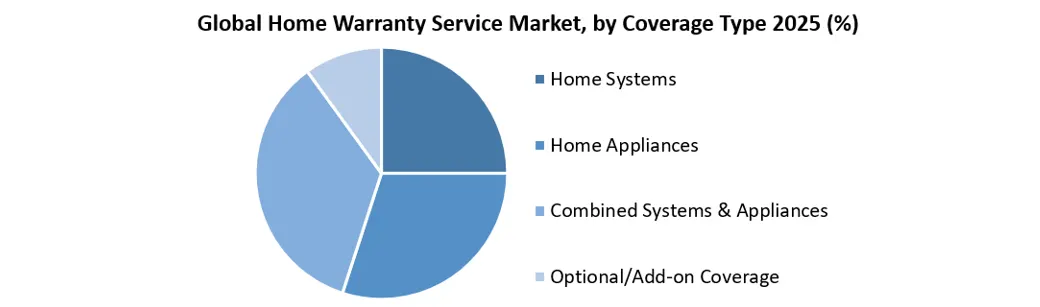
The market is segmented into home systems, home appliances, combined systems and appliances, and optional/add-on coverage. Home systems coverage protects essential residential components such as electrical, plumbing, heating, ventilation, and air-conditioning systems. Home appliances coverage includes household equipment such as refrigerators, washing machines, ovens, and dishwashers. Combined systems and appliances plans provide broader protection across both categories, while optional/add-on coverage extends protection to specific items or additional services based on customer requirements.
Home Warranty Service Market, by Coverage Type

By Plan Type:
Based on plan type, the market is divided into basic, standard, comprehensive/premium, and customized plans. Basic plans cover essential systems or appliances with limited protection, while standard plans provide broader coverage for commonly used household equipment. Comprehensive and premium plans offer extensive protection across multiple systems and appliances, often including additional benefits. Customized plans allow customers to select coverage based on property characteristics, budget, and individual protection requirements.

By Application:
The market is categorized into residential and commercial applications. Residential coverage supports individual homes, apartments, and other housing properties by protecting essential systems and appliances against unexpected repair or replacement expenses. Commercial coverage serves offices, rental properties, and other business premises that require protection for building systems and equipment to manage maintenance costs and operational disruptions.

By End User:
The market is segmented into existing homeowners, home buyers, home sellers, landlords and property investors, and property managers. Existing homeowners purchase coverage to manage unexpected repair expenses and protect household systems and appliances. Home buyers use coverage to reduce maintenance-related risks after purchasing a property, while home sellers may offer plans to strengthen buyer confidence during property transactions. Landlords and property investors adopt coverage to manage repair costs across rental portfolios, whereas property managers use these plans to simplify maintenance coordination and protect residential and commercial properties.

Home Warranty Service Market Regional Analysis:

North America holds the largest share for home warranty service market, accounting for nearly 42% of the global market in 2025. The North American Home Warranty Service Market is a mature and well-established sector, particularly prominent in the United States and Canada. Characterized by high homeownership rates and a robust real estate sector, the market is driven by a culture of preventive maintenance and a desire for financial security against unexpected repair costs. Each state in the U.S. may have specific regulations governing home warranty services, influencing providers' operational strategies. In this region, home warranties play a significant role in real estate transactions, with sellers often including them to enhance the appeal of their properties to potential buyers.

The home warranty service market's stability is further supported by the prevalence of homeowners who recognize the value of these services in ensuring the longevity and reliability of their home systems and appliances. As homeownership remains a cornerstone of the American dream, the North American Home Warranty Service Market continues to evolve, adapting to changing consumer needs and Home Warranty Service Market dynamics.

Key Takeaways from the U.S. Home Warranty Service Market:

1. Steady Growth: The U.S. home warranty industry grew at an average annual rate of 3.7% from 2020 to 2025, indicating a stable and promising Home Warranty Service Market.

2. Financial Protection: Home warranties offer significant cost savings, with homeowners without one typically spending $2,500 to $6,000 annually on repairs.

3. Affordable and Flexible: Plans are accessible, with average annual costs between $300 and $600, and can be customized with add-ons for specific needs like pools or roof coverage.

4. Faster Sales: Homes with warranties sell 11 days faster on average, highlighting their value to both buyers and sellers.

5. Limited Awareness: Despite the benefits, only 4% of American homeowners currently have a warranty, suggesting a need for increased education and marketing efforts.

Home Warranty Service Market Competitive Landscape:

The competitive landscape in the Home Warranty Service Market is characterized by a diverse array of companies navigating a complex regulatory environment. With regulations primarily established at the state level, home warranty providers face varying compliance requirements across different jurisdictions. This dynamic regulatory framework contributes to a Home Warranty Service Market where companies often operate under different legal constraints, making it challenging to define standardized practices. Despite this complexity, efforts are being made by industry organizations such as the National Home Service Contract Association (NHSCA) to promote uniform regulations and enhance industry standards. In this environment, companies strive to distinguish themselves through service quality, coverage options, pricing structures, and customer satisfaction. The competitive dynamics are further influenced by the ability of providers to adapt to evolving consumer needs, technological advancements, and the capacity to meet financial stability requirements imposed by certain states. As the Home Warranty Service Market continues to evolve, companies must navigate regulatory nuances while differentiating their offerings to stay competitive in this specialized segment of the service contract industry.

Home Warranty Service Market Scope: Inquire Before Buying

Global Home Warranty Service Market
Report Coverage Details
Base Year: 2025 Forecast Period: 2026-2034
Historical Data: 2020 to 2025 Market Size in 2025: USD 9.46 Bn.
Forecast Period 2026 to 2034 CAGR: 6.72% Market Size in 2034: USD 16.99 Bn.
Segments Covered: by Coverage Type Home Systems
Home Appliances
Combined Systems & Appliances
Optional/Add-on Coverage
by Plan Type Basic Plans
Standard Plans
Comprehensive/Premium Plans
Customized Plans
by Property Type Single-family Homes
Condominiums
Townhouses
Multi-family Homes
Rental Properties
Others
by Distribution Channel Direct-to-Consumer
Real Estate Agents & Brokers
Builders & Developers
Property Management Companies
Digital/Online Channels
Other Partners
by Application  Residential
Commercial
by End User Existing Homeowners
Home Buyers
Home Sellers
Landlords & Property Investors
Property Managers

Home Warranty Service Market, by Region:

North America (United States, Canada, and Mexico)
Europe (UK, France, Germany, Italy, Spain, Sweden, Austria, and the Rest of Europe)
Asia Pacific (China, South Korea, Japan, India, Australia, Indonesia, Malaysia, Vietnam, Taiwan, Bangladesh, Pakistan, and the Rest of APAC)
Middle East and Africa (South Africa, GCC, Egypt, Nigeria, and the Rest of ME&A)
South America (Brazil, Argentina Rest of South America)

Home Warranty Service Market, Key Players:

North America – United States
1. American Home Shield
2. Choice Home Warranty
3. First American Home Warranty
4. Cinch Home Services
5. 2-10 Home Buyers Warranty
6. Liberty Home Guard
7. AFC Home Warranty / AFC Home Club
8. Old Republic Home Protection
9. Fidelity National Home Warranty
10. Home Warranty of America
11. The Home Service Club
12. ARW Home
13. America's Preferred Home Warranty
14. Select Home Warranty
15. Elite Home Warranty
16. Achosa Home Warranty
17. Home Warranty Inc.
18. HomeMembership
19. Super
20. Residential Warranty Services
21. First Premier Home Warranty
22. Elevate Home Warranty
23. Priority Home Warranty
24. HomeServe USA
25. HSA Home Warranty

Europe – United Kingdom
1. HomeServe
2. Domestic & General
3. British Gas – HomeCare
4. Hometree
5. Others

Other, Warranty & Service Technology Competitors
1. PCMI
2. WarrantyHub
3. ServiceCentral Technologies
4. Tavant
5. Dispatch Technologies
6. Dyrect
7. Axiom Connected
8. Bruviti
9. Warrantify
10. Marilyn
11. Syncron
12. WarrCloud
13. Others

FAQs:

1. What are the growth drivers for the Home Warranty Service Market?
Ans. Rising homeownership rates is to be the major driver for the Home Warranty Service Market.

2. What is the major restraint for the Home Warranty Service Market growth?
Ans. Limited awareness, Lack of standardization are expected to be the major restraining factor for the Home Warranty Service Market growth.

3. Which Region is expected to lead the global Home Warranty Service Market during the forecast period?
Ans. North America is expected to lead the global Home Warranty Service Market during the forecast period.

4. What was the Global Home Warranty Service Market size in 2025?
Ans:
The Global Home Warranty Service Market size was USD 9.46 Billion in 2025.

5. What segments are covered in the Home Warranty Service Market report?
Ans. The segments covered in the Home Warranty Service Market report are Coverage Type, Plan Type, Property Type, Distribution Channel, Application , End User and region.

Table of Contents

1. GLOBAL HOME WARRANTY SERVICE MARKET INTRODUCTION 1.1. Executive Market Landscape and Industry Overview 1.1.1 Global Home Warranty Service Market Size Value in USD Billion, Historical Performance, and 2025–2034 Growth Outlook Analysis 1.1.2 Home Warranty Service Market Definition, Scope, Inclusion–Exclusion Criteria, and Revenue Boundary Analysis 1.1.3 Home Warranty vs Homeowners Insurance vs Manufacturer Warranty vs Extended Warranty Comparative Analysis 1.1.4 Evolution of Home Warranty Services from Traditional Service Contracts to Digitally Managed Home Protection Platforms 1.2. Global Home Warranty Service Market Dynamics 1.2.1 Global Home Warranty Service Market trends that impact potential clients 1.2.2 Home Warranty Industry Transformation and Business Model Evolution Analysis 1.2.3 Shift from Reactive Warranty Services toward Proactive Home Service Management 1.2.4 Increasing Digitalization of Warranty and Service Contract Operations 1.2.5 Rising Customer Expectations for Faster Claims and Service Resolution 1.2.6 Increasing Demand for Transparent and Real-time Warranty Service Experiences 1.2.7 Home Repair and Replacement Cost Inflation Impact on Warranty Provider Economics 1.2.8 Increasing Claims Complexity and Operational Automation Requirements 1.2.9 Emerging Warranty Technology Trends, 2026–2034 1.2.10 AI-first Warranty Administration Platform Trend 1.2.11 Autonomous Claims Processing Trend 1.2.12 Agentic AI for Warranty Operations Trend 1.2.13 Cloud-native Warranty Platform Trend 1.2.14 API-first and Composable Architecture Trend 1.2.15 Embedded Warranty Technology Trend 1.2.16 Connected Home Warranty Trend 1.2.17 Predictive Maintenance-as-a-Service Trend 1.2.18 Remote Diagnostics and Virtual Repair Trend 1.2.19 Intelligent Contractor Orchestration Trend 1.2.20 Real-time Claims Decisioning Trend 1.2.21 Personalized Warranty Plan Trend 1.3. Home Warranty Service Ecosystem and Value Chain Analysis 1.3.1 End-to-End Home Warranty Value Chain from Plan Purchase through Claim Settlement and Renewal 1.3.2 Revenue Flow across Homeowners, Warranty Providers, Contractors, TPAs, and Distribution Partners 1.3.3 Home Warranty Contract Origination and Administration Process Analysis 1.3.4 Service Request-to-Claim Approval Workflow Analysis 1.3.5 Coverage and Eligibility Verification Process Analysis 1.3.6 Contractor Selection, Scheduling, Dispatch, Diagnosis, and Repair Fulfillment Analysis 1.3.7 Repair vs Replacement Decision Process and Cost Impact Analysis 1.3.8 Parts Procurement and Replacement Appliance Fulfillment Ecosystem Analysis 1.4. Current Global Home Warranty Service Market Landscape (2026) 1.4.1 Shift from Traditional Warranty Administration toward Digital Service Platforms 1.4.2 Increasing Consumer Demand for Comprehensive Home Protection Plans 1.4.3 Growing Importance of Customer Experience and Faster Claims Resolution 1.4.4 Increasing Adoption of AI-assisted Claims Management 1.4.5 Increasing Demand for Digital Claims and Self-Service Capabilities 1.4.6 Rising HVAC, Plumbing, Electrical, and Appliance Repair Costs 1.4.7 Expansion of Contractor and Technician Networks 1.4.8 Growing Importance of Technology-enabled Contractor Management 1.5. Home Warranty Service Adoption, Contract Penetration & Operating Scale Analysis 1.5.1 Home Warranty Contract Penetration across Eligible Residential Households 1.5.2 Active Home Warranty Contract Base and Covered Household Analysis 1.5.3 New Contract vs Renewal Contract Contribution Analysis 1.5.4 Existing Homeowner vs Real Estate Transaction-driven Contract Adoption 1.5.5 Home Warranty Adoption by Property Age and System Failure Risk 1.5.6 Systems-only vs Appliance-only vs Combination Plan Adoption Analysis 1.6. Home Warranty Service Demand & Claims Intensity by Property and Asset Profile 1.6.1 Single-family Home Service Demand and Claims Intensity Analysis 1.6.2 Condominium and Townhouse Service Requirement Analysis 1.6.3 Multi-family Residential Property Warranty Operating Complexity Analysis 1.6.4 Manufactured & Mobile Home Warranty Service Requirement Analysis 1.6.5 Property Age vs Claims Frequency Correlation Analysis 1.7. Claims Management and Operational Performance Analysis 1.7.1 Home Warranty Claims Frequency Analysis by Covered Home System and Appliance 1.7.2 Average Claims Cost Analysis across HVAC, Plumbing, Electrical, and Major Appliances 1.7.3 Claims Approval vs Denial Pattern and Key Denial Reason Analysis 1.7.4 Average Claim Processing and Service Resolution Time Analysis 1.7.5 Repair vs Replacement Ratio and Cost Economics Analysis 1.7.6 First-time Fix Rate and Repeat Service Visit Analysis 1.8. Home Warranty Provider Economics, Claims Cost & Cost-to-Serve Analysis 1.8.1 Average Home Warranty Contract Revenue Analysis 1.8.2 Claims Cost per Active Warranty Contract Analysis 1.8.3 Claims Administration Cost per Service Request Analysis 1.8.4 Average Repair Cost by Covered Home System and Appliance 1.8.5 HVAC Repair and Replacement Cost Analysis 1.8.6 Plumbing Service Cost Analysis 1.8.7 Electrical Service Cost Analysis 1.8.8 Major Appliance Repair and Replacement Cost Analysis 1.8.9 Contractor Labor and Parts Cost Trend Analysis 1.9. Home Warranty Claims and Service Fulfillment Statistics 1.9.1 Annual Service Request Volume Analysis 1.9.2 Average Claims per Active Warranty Contract Analysis 1.9.3 Claims Frequency by Home System and Appliance Analysis 1.9.4 HVAC Claims Frequency Analysis 1.9.5 Plumbing Claims Frequency Analysis 1.9.6 Electrical Claims Frequency Analysis 1.9.7 Appliance Claims Frequency Analysis 1.9.8 Seasonal Claims Volume Pattern Analysis 1.10. Contract, Claims & Service Operations Statistics (USA Specific) 1.10.1 Active Contract Base and Contract Growth Analysis 1.10.2 New Contracts vs Renewals Analysis 1.10.3 Average Warranty Contract Duration 1.10.4 Average Claims per Active Contract 1.10.5 Average Service Requests per Customer 1.10.6 Average Claim Processing Time 1.10.7 Average Time from Claim Submission to Coverage Verification 1.11. Home Warranty Coverage Complexity & Claims Exposure Analysis 1.11.1 Coverage Mix across Home Systems, Appliances, and Combination Plans 1.11.2 Home Systems Coverage Claims Frequency and Severity Analysis 1.11.3 HVAC Coverage Claims Exposure Analysis 1.11.4 Plumbing Coverage Claims Exposure Analysis 1.11.5 Electrical Coverage Claims Exposure Analysis 1.11.6 Water Heater Repair and Replacement Exposure Analysis 1.11.7 Major Appliance Claims Frequency and Cost Analysis 1.12. Customer Service Expectations, Claims Experience & Retention Analysis 1.12.1 Customer Expectation for Fast Claims Processing Analysis 1.12.2 Customer Preference for Digital Claims Submission 1.12.3 Demand for Real-time Claims and Service Status Visibility 1.12.4 Customer Preference for Digital vs Call Center-led Service 1.12.5 Importance of Contractor Response Time in Customer Satisfaction 1.12.6 Impact of First-time Fix Rate on Customer Experience 1.12.7 Impact of Claim Denials and Escalations on Customer Retention 1.12.8 Customer Complaint Drivers across Claims and Service Fulfillment 1.13. Home Warranty Market Risk Analysis 1.13.1 Rising Repair and Replacement Cost Impact on Warranty Provider Economics 1.13.2 Claims Frequency and Severity Risk Analysis 1.13.3 Contractor Availability and Service Capacity Risk Analysis 1.13.4 Adverse Selection and High-usage Customer Risk Analysis 1.13.5 Fraudulent and Inflated Claims Risk Analysis 1.13.6 Customer Complaint and Reputation Risk Analysis 1.14. Regional Comparative Analysis of Home Warranty Service Market 1.14.1 Market Comparison across North America, Europe, Asia Pacific, Middle East & Africa, and South America 1.14.2 Home Warranty Adoption and Penetration by Region 1.14.3 Homeownership and Housing Stock Impact by Region 1.14.4 Residential Repair and Maintenance Ecosystem Comparison 1.14.5 Service Contractor Availability by Region 1.14.6 Digital Warranty Technology Adoption Comparison 1.14.7 Consumer Awareness and Purchasing Behavior 1.15. Research & Development Transformation 1.15.1 AI/ML-driven Warranty Management Innovation 1.15.2 Claims Automation Technology Development 1.15.3 Predictive Maintenance R&D 1.15.4 Connected Appliance and IoT Integration 1.15.5 Remote Diagnostic Technology Development 1.16. Regulatory & Compliance Analysis 1.16.1 Home Warranty and Residential Service Contract Regulatory Framework Analysis 1.16.2 Provider and Service Contract Administrator Licensing Requirement Analysis 1.16.3 State/Regional Variation in Home Warranty Regulations Analysis 1.16.4 Consumer Disclosure and Contract Transparency Requirement Analysis 1.16.5 Coverage Exclusion and Claim Handling Compliance Analysis 1.16.6 Cancellation and Renewal Regulation Impact Analysis 1.17. Investment, Partnership & M&A Analysis 1.17.1 Investment Trend Analysis across Home Warranty and Home Service Platforms 1.17.2 Technology Investment Priorities of Leading Home Warranty Providers 1.17.3 Private Equity and Strategic Investment Activity Analysis 1.17.4 M&A Activity across Warranty Providers and Home Service Platforms 1.17.5 Warranty Provider–Technology Vendor Partnership Analysis 1.17.6 Warranty Provider–Contractor Network Partnership Analysis 1.17.7 Real Estate Platform and Home Warranty Partnership Analysis 1.18. Global Home Warranty Service Market: Market size and Forecast by Segmentation (by Value USD Billion) (2025-2034) 1.18.1 Global Home Warranty Service Market Size and Forecast, By 1.18.2 Coverage Type 1.18.3 Home Systems 1.18.4 Home Appliances 1.18.5 Combined Systems & Appliances 1.18.6 Optional/Add-on Coverage 1.18.7 Global Home Warranty Service Market Size and Forecast, By Plan Type 1.18.8 Basic Plans 1.18.9 Standard Plans 1.18.10 Comprehensive/Premium Plans 1.18.11 Customized Plans 1.18.12 Global Home Warranty Service Market Size and Forecast, By Property Type 1.18.13 Single-family Homes 1.18.14 Condominiums 1.18.15 Townhouses 1.18.16 Multi-family Homes 1.18.17 Rental Properties 1.18.18 Others 1.18.19 Global Home Warranty Service Market Size and Forecast, By Distribution Channel 1.18.20 Direct-to-Consumer 1.18.21 Real Estate Agents & Brokers 1.18.22 Builders & Developers 1.18.23 Property Management Companies 1.18.24 Digital/Online Channels 1.18.25 Other Partners 1.18.26 Global Home Warranty Service Market Size and Forecast, By End User 1.18.27 Existing Homeowners 1.18.28 Home Buyers 1.18.29 Home Sellers 1.18.30 Landlords & Property Investors 1.18.31 Property Managers 1.18.32 Others 1.18.33 Global Home Warranty Service Market Size and Forecast, By Application 1.18.34 Residential 1.18.35 Commercial 1.18.36 Global Home Warranty Service Market Size and Forecast, By Region 1.18.37 North America 1.18.38 United States 1.18.39 Canada 1.18.40 Mexico 1.18.41 Europe 1.18.42 United Kingdom 1.18.43 France 1.18.44 Germany 1.18.45 Italy 1.18.46 Spain 1.18.47 Sweden 1.18.48 Russia 1.18.49 Rest of Europe 1.18.50 Asia Pacific 1.18.51 China 1.18.52 S. Korea 1.18.53 India 1.18.54 Japan 1.18.55 Australia 1.18.56 Indonesia 1.18.57 Philippines 1.18.58 Malaysia 1.18.59 Vietnam 1.18.60 Thailand 1.18.61 Rest of Asia Pacific 1.18.62 Middle East and Africa 1.18.63 Saudi Arabia 1.18.64 the United Arab Emirates (UAE) 1.18.65 Qatar 1.18.66 Kuwait 1.18.67 Oman 1.18.68 Bahrain 1.18.69 Rest of ME&A 1.18.70 South America 1.18.71 Brazil 1.18.72 Argentina 1.18.73 Chile 1.18.74 Colombia 1.18.75 Rest Of South America 2. TECHNOLOGY LANDSCAPE & WARRANTY SERVICE OPERATIONS 2.1. Technology Architecture Supporting Warranty & Service Contract Operations 2.1.1 End-to-End Technology Stack across Contract Administration, Claims, Dispatch, Field Service, Customer Communication, Payments, and Renewals 2.1.2 Technology Mapping across Home Warranty Providers, Service Contract Administrators, TPAs, OEMs, Retailers, and Service Networks 2.1.3 Integrated Warranty Platform vs Standalone Point Solution Architecture Analysis 2.1.4 Legacy Warranty Systems vs Modern Cloud-native Platform Comparison 2.1.5 API-first and Configurable Workflow Architecture Analysis 2.1.6 Technology Interoperability across Claims, Dispatch, CRM, FSM, Billing, and Analytics Platforms 2.1.7 Technology Capability Requirements by Warranty Provider Size and Operating Model 2.2. Claims Management, Decisioning & Automation Technology 2.2.1 Digital Claims Intake and Workflow Automation Analysis 2.2.2 Automated Coverage and Eligibility Verification Analysis 2.2.3 Claims Classification, Triage, and Routing Technology Analysis 2.2.4 Rules-based vs AI-assisted Claims Adjudication Analysis 2.2.5 Automated Repair Authorization and Approval Workflow Analysis 2.2.6 Repair vs Replacement Decision-support Technology Analysis 2.2.7 Straight-through Claims Processing Opportunity Analysis 2.2.8 Claims Exception and Escalation Management Technology Analysis 2.2.9 Claims Processing Time, Cost, and Accuracy Benchmarking 2.2.10 Automation Potential across the Claim-to-Resolution Lifecycle 2.3. AI, Machine Learning & Generative AI in Warranty Operations 2.3.1 AI Adoption across Warranty and Service Contract Operations 2.3.2 AI-driven Claims Triage and Adjudication Analysis 2.3.3 Machine Learning-based Claims Frequency and Severity Prediction 2.3.4 AI-based Repair Cost Estimation Analysis 2.3.5 AI-supported Repair vs Replacement Decisioning 2.3.6 AI-based Fraud and Claims Anomaly Detection 2.3.7 AI-driven Contractor Matching and Service Assignment 2.4. Service Dispatch & Contractor Network Orchestration Technology 2.4.1 Automated Service Dispatch Technology Analysis 2.4.2 Contractor Matching based on Geography, Skills, Availability, and Cost 2.4.3 Real-time Contractor Capacity and Availability Management 2.4.4 Intelligent Scheduling and Assignment Analysis 2.4.5 Contractor Network Optimization Technology 2.4.6 SLA and Response-time Monitoring 2.4.7 Contractor Performance Scoring and Quality Management 2.4.8 Service Provider Acceptance and Rejection Rate Analysis 2.5. Job & Workflow Management Technology 2.5.1 Dynamic Workflow Configuration 2.5.2 Job Lifecycle Management 2.5.3 Automated Work Routing 2.5.4 Exception & Escalation Workflows 2.5.5 Rules Engine Technology 2.5.6 Workflow Orchestration across Claims and Dispatch 2.5.7 No-code/Low-code Configuration Trends 2.6. Cloud, SaaS, API & Integration Landscape 2.6.1 Cloud/SaaS Warranty Platform Adoption 2.6.2 Legacy-to-Cloud Migration Analysis 2.6.3 API-first Warranty Technology Architecture 2.6.4 Claims–Dispatch Integration 2.6.5 Claims–CRM Integration 2.6.6 FSM and Contractor Platform Integration 2.7. Customer Interaction & Engagement Technology 2.7.1 Digital Customer Communication 2.7.2 Real-time Claims/Service Visibility 2.7.3 Customer Self-Service 2.7.4 AI Chatbots & Virtual Agents 2.7.5 Omnichannel Interaction 2.8. Technology Investment & Spending Priorities 2.8.1 Current Technology Investment Priorities 2.8.2 AI Investment Priorities 2.8.3 Claims Automation Investment 2.8.4 Dispatch Technology Investment 2.8.5 Customer Experience Technology Investment 2.8.6 Cloud Modernization Investment 2.9. Technology Requirements by Potential Client Type 2.9.1 Claims Processing Time 2.9.2 Claims Administration Cost 2.9.3 Straight-through Processing Rate 2.9.4 Contractor Assignment Time 2.9.5 Service Resolution Time 2.9.6 First-time Fix Rate 3. COMPETITIVE INTELLIGENCE & INDUSTRIAL ECOSYSTEM 3.1. Company Profiles: Key Players (Potential Client / Home Warranty & Service Contract Operator Landscape) 3.1.1 Overview 3.1.2 Business Portfolio 3.1.3 Financial Overview 3.1.4 SWOT Analysis 3.1.5 North America – United States 3.1.6 American Home Shield 3.1.7 Choice Home Warranty 3.1.8 First American Home Warranty 3.1.9 Cinch Home Services 2-10 Home Buyers Warranty 2.1 Liberty Home Guard 2.2 AFC Home Warranty / AFC Home Club 2.3 Old Republic Home Protection 2.4 Fidelity National Home Warranty 2.5 Home Warranty of America 2.6 The Home Service Club 2.7 ARW Home 2.8 America's Preferred Home Warranty 2.9 Select Home Warranty 2.10 Elite Home Warranty 2.11 Achosa Home Warranty 2.12 Home Warranty Inc. 2.13 HomeMembership 2.14 Super 2.15 Residential Warranty Services 2.16 First Premier Home Warranty 2.17 Elevate Home Warranty 2.18 Priority Home Warranty 2.19 HomeServe USA 2.20 HSA Home Warranty 2.21 Europe – United Kingdom 2.22 HomeServe 2.23 Domestic & General 2.24 British Gas – HomeCare 2.25 Hometree 2.26 Others 3.2. Company Profiles: Key Players (Warranty & Service Technology Competitors) 3.2.1 PCMI 3.2.2 WarrantyHub 3.2.3 ServiceCentral Technologies 3.2.4 Tavant 3.2.5 Dispatch Technologies 3.2.6 Dyrect 3.2.7 Axiom Connected 3.2.8 Bruviti 3.2.9 Warrantify 3.2.10 Marilyn 3.2.11 Syncron 3.2.12 WarrCloud 3.2.13 Others 3.3. Top Home Warranty Providers and Service Ecosystem Participant Analysis 3.3.1 Market Positioning of Leading National, Regional, and Independent Home Warranty Providers 3.3.2 Expansion of Home Warranty Coverage Portfolios and Premium Service Plans 3.3.3 Development of Home Warranty Provider–Contractor Service Networks 3.3.4 Partnerships with Real Estate Agents, Brokers, Builders, and Property Management Companies 3.3.5 Integration with Warranty Management, Claims Automation, and Field Service Technology Providers 3.3.6 Expansion of Digital Claims, Customer Portals, and Self-Service Capabilities 3.4. Market Share & Competitive Positioning Analysis (2025) 3.4.1 Global Home Warranty Service Market Share Analysis by Leading Providers 3.4.2 Top 5 and Top 10 Home Warranty Provider Market Concentration Analysis 3.4.3 National vs Regional Home Warranty Provider Competitive Positioning 3.4.4 Competitive Positioning by Coverage Breadth, Pricing, Service Fees, and Customer Base 3.4.5 Competitive Positioning by Contractor Network Size and Geographic Reach 3.5. Technology & Innovation Comparison Across Key Home Warranty Providers (2025) 3.5.1 Warranty and Service Contract Administration Platform Capability Comparison 3.5.2 Digital Claims Intake and Claims Automation Capability Comparison 3.5.3 AI-assisted Claims Triage and Adjudication Capability Comparison 3.5.4 Contractor Network Management and Automated Dispatch Capability Comparison 3.5.5 Field Service Management Technology Capability Analysis 3.6. Warranty & Service Technology Platform Competitive Landscape 3.6.1 Global Warranty & Service Technology Vendor Ecosystem Analysis 3.6.2 Core Warranty Management Platform Provider Analysis 3.6.3 Service Contract Administration Technology Provider Analysis 3.6.4 Claims Management Platform Landscape 3.6.5 Claims Automation & Decisioning Vendor Landscape 3.6.6 Service Dispatch Technology Provider Landscape 3.7. Service Dispatch & Network Orchestration Competitive Benchmarking 3.7.1 Automated Service Dispatch Capability Comparison 3.7.2 Intelligent Contractor Matching Capability 3.7.3 Geographic and Skill-based Assignment Comparison 3.7.4 Contractor Availability and Capacity Management 3.7.5 Service Scheduling Capability 3.7.6 Service Network Orchestration Capability 3.8. Revenue Performance & Financial Benchmarking Analysis (2025) 3.8.1 Revenue Performance Comparison of Leading Home Warranty Providers 3.8.2 Home Warranty Revenue Growth Benchmarking across Key Companies 3.8.3 Plan and Coverage Portfolio Revenue Contribution Analysis 3.8.4 Claims Cost and Service Fulfillment Cost Benchmarking 3.9. Mergers, Acquisitions & Consolidation Strategy Analysis 3.9.1 Historical M&A Activity in the Home Warranty Service Market 3.9.2 Acquisition of Regional and Independent Home Warranty Providers 3.9.3 Acquisition of Home Service and Contractor Network Companies 3.9.4 Technology Platform and WarrantyTech Acquisition Analysis 3.9.5 Vertical Integration across Warranty Administration and Service Fulfillment 4. STRATEGIC OUTLOOK 4.1. Key Findings 4.1.1 Key Home Warranty Service Market Findings 4.1.2 Key Technology Adoption Findings 4.1.3 Key Competitive Landscape Findings 4.1.4 Key Claims and Service Fulfillment Findings 4.1.5 Key Customer and Contractor Network Findings 4.2. Strategic Moves & Industry Outlook 4.2.1 AI and Claims Automation Strategic Outlook 4.2.2 Cloud-based Warranty Platform Modernization Outlook 4.2.3 Contractor Network Digitization and Field Service Automation Outlook 4.2.4 Digital Customer Experience and Self-Service Strategy 4.2.5 Predictive Analytics and Claims Cost Optimization Strategy 4.2.6 Connected Home and Predictive Maintenance Opportunity 4.2.7 Strategic Partnerships across Warranty, Real Estate, Contractors, and Technology Providers 4.3. Research Methodology 4.3.1 Market Definition and Revenue Scope 4.3.2 Primary Research Framework 4.3.3 Secondary Research Framework 4.3.4 Bottom-up Market Estimation 4.3.5 Top-down Validation 4.3.6 Company Revenue and Market Share Estimation 4.3.7 Technology Adoption Assessment Methodology 4.3.8 Claims and Service Performance Benchmarking Methodology 4.3.9 Data Triangulation and Validation 4.3.10 Forecast Methodology, 2026–2034

Custom Market Research Services

We Will Customise The Research For You, In Case The Report Listed Above Does Not Meet With Your Requirements