
Global High Heels Footwear Market By Heel Construction Type, By Footwear Style, By Heel Height, By Upper Material, By Price Range, By Primary Purchase Occasion, By End Consumer, By Distribution Channel, by Region and Forecast 2034
Overview
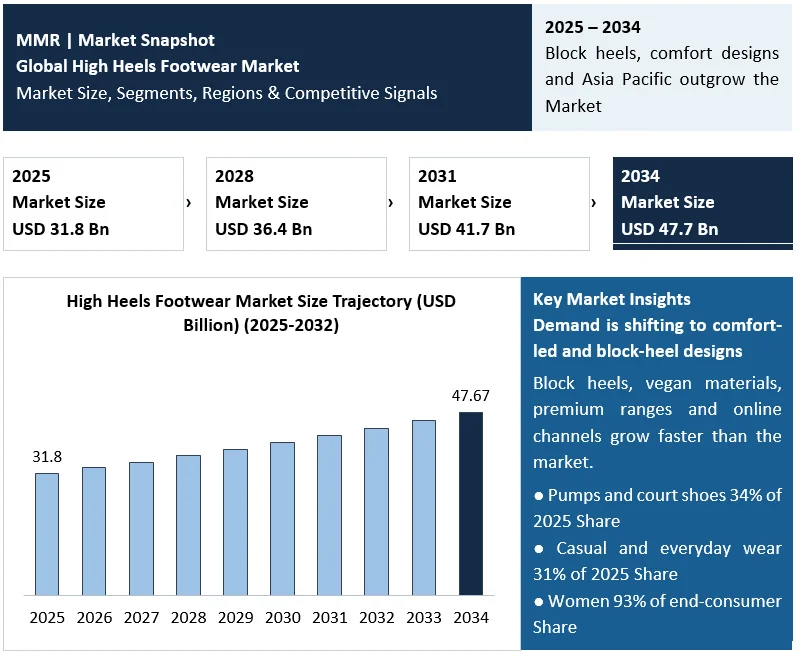
The Global High Heels Footwear Market was valued at USD 31.8 Bn in 2025 and is expected to reach USD 47.7 Bn by 2034, growing at a CAGR of 4.6% during 2026–2034.
Global High Heels Footwear Market Overview
High heels footwear covers shoes built on a raised heel, from stiletto pumps and block-heel sandals to wedges, platforms, kitten heels and heeled boots, made in leather, synthetic and textile uppers and sold through brand stores, multi-brand retailers, department stores and online platforms. Industry watchers also call it the women’s heeled shoe market, the women’s formal footwear market or the dress and Occasion Footwear Market. The category pairs a fashion statement with a real engineering problem: carrying a person’s weight on a few square centimetres of heel while still looking effortless.
This High Heels Footwear Market analysis is for footwear brands and designers, contract and private-label manufacturers, leather, synthetic-material and component suppliers, department-store and e-commerce buyers, and investors. It answers practical questions on market entry and market strategies: how stiletto, block and wedge constructions compare on price and comfort, where occasion-led consumer behaviour is heading, how tariffs and leather costs flow through to shelf prices, and which channels, segments and countries deserve capital through 2034.
Pumps and court shoes still carry the largest slice of sales, and women remain about 93% of buyers. High Heels Footwear Market growth is moving toward block and cone heels, low and mid heel heights, mules, premium and vegan materials, brand-owned e-commerce and Asia Pacific, as comfort expectations, hybrid work and social-media styling change what shoppers wear and where they buy it.
Maximize Market Research delivers a comprehensive High Heels Footwear Market Research Report covering global value and volume (million pairs) by heel construction, footwear style, heel height, upper material, price range, purchase occasion, end consumer, distribution channel and region, across 5 regions and their countries, together with a competitive landscape of 96 profiled players, strategic scenarios and growth opportunities. The market research findings, market segmentation, regional insights and competitive intelligence help manufacturers, brand owners, retailers, sourcing houses and investors decide which products, price tiers and countries to prioritise through 2034.
High Heels Footwear Market Size and Growth: Industry Outlook to 2034
The High Heels Footwear Market is sized at the finished-product level: shoes with a raised heel for women, men and youth, including pumps, sandals, boots and booties, mules and clogs, loafers and other closed-toe styles. Flats, athletic and sports shoes, flip-flops, orthopaedic footwear, shoe-care products, insoles sold separately and footwear components are excluded to prevent double counting.
Government trade and price data frame the demand backdrop. US Census Bureau statistics put US footwear imports (HS Chapter 64) at about USD 26.6 Bn in 2025, down 2.6% from 2024, with Vietnam, at roughly USD 9.7 Bn, overtaking China as the top supplier by value. The US Bureau of Labor Statistics recorded women’s footwear prices up 6.2% year on year in May 2026, when overall footwear inflation reached its fastest pace in almost four years, so value growth leans on price and mix more than on extra pairs.
To know about the Research Methodology :- Request Free Sample Report
Key Findings: Insights Shaping the Global High Heels Footwear Market
Government trade statistics, company filings and consumer price data point to the following key market research findings, highlighting High Heels Footwear Market demand, consumer purchasing trends, demand growth, revenue generation and market value creation through 2034.
1. Market Growth. Market size rises from USD 31.8 Bn (2025) to USD 47.7 Bn (2034) at a 4.6% CAGR, adding about USD XX Bn of annual revenue. Design, material, last-making and retail capacity must scale through 2034.
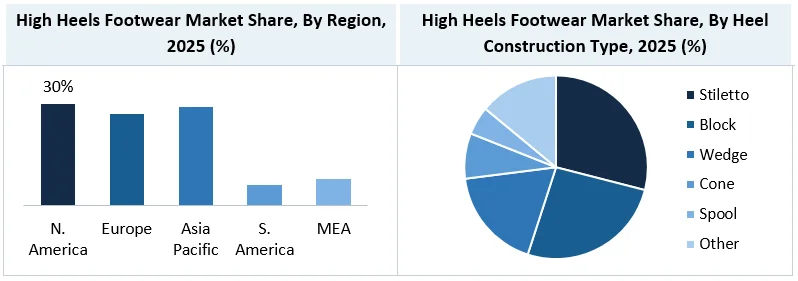
2. Stiletto leads, block heels lead growth. Stiletto heels held about 29% of 2025 value and grow at 3.7%, while block heels grow at 5.6% and cone heels at 5.0%. Wider bases and lower pitch bring daily wearers into a category once reserved for events.
3. Pumps lead styles; mules and low heels grow fastest. Pumps and court shoes held about 34% of value in 2025, mules and clogs grow at 6.4%, and low heels (below 2 inches) grow at 6.0% against 3.2% for very high heels.
4. Premium and vegan ranges outgrow mass. Premium footwear grows at 5.9% against 3.8% for mass-market, and recycled and plant-based uppers grow at 7.4%. Craft, traceable materials and designer collaborations support higher average selling prices.
5. North America is the largest region. It held about 30% of 2025 value, supported by US footwear imports of USD 26.6 Bn in 2025 (US Census Bureau). Department stores, specialty retail and e-commerce set pricing and promotion norms.
6. Asia Pacific is the fastest-growing region. It grows at a 5.8% CAGR, lifting its share from 29% to about XX% by 2034, and is expected to pass North America. China, India, Japan and South Korea lead, and India targets USD 15 Bn of leather and footwear exports
7. Online channels gain share. Online retail rises from 34% of 2025 value to about XX% by 2034, with brand-owned e-commerce the fastest channel at 8.6% CAGR. Virtual try-on, size recommendation and free exchanges shift discovery and loyalty.
8. Price inflation and compliance reshape competition. The US Bureau of Labor Statistics recorded women’s footwear prices up 6.2% year on year in May 2026, while EU REACH and US CPSIA limits add testing costs. Sourcing flexibility, scale and testing capacity favour well-capitalised brands.
9. The competitive landscape is fragmented by role. Luxury houses, fashion-footwear groups, mass-market retailers and contract manufacturers compete on brand equity, comfort credentials and digital reach.
High Heels Footwear Industry Structure and Value Chain
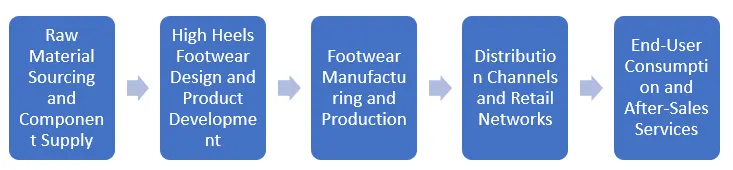
The High Heels Footwear Industry value chain includes raw material sourcing, ergonomic product design, footwear manufacturing, retail distribution and end-user consumption. Material innovation, production efficiency, e-commerce penetration, fashion trends and consumer preferences influence High Heels Footwear Market Demand.
High Heels Footwear Market Trends
1. Rising Women's Footwear Consumption: According to the U.S. Bureau of Labor Statistics (BLS), average household expenditure on women's footwear reached USD 208 in 2023, compared with USD 147 for men's footwear. This indicates a significant consumer spending base supporting High Heels Footwear Market Volume.
2. Changing Consumer Purchasing Behaviour: U.S. household footwear consumption expenditure increased from USD 444 in 2023 to USD 461 in 2024, representing 3.83% growth. Fashion preferences, occasion-based purchasing and product differentiation influence high heels footwear consumption patterns.
3. Trending Model Shifts Toward Comfort-Focused Heels: Consumer preferences are shifting toward block heels, kitten heels, platform heels and lower-height designs. These trending footwear models combine fashionable appearances with everyday usability, influencing high heels footwear production and product innovation.
4. Price Sensitivity Reshaping Market Demand: U.S. apparel and services expenditure declined 2.0% in 2024, indicating spending pressure. This supports the importance of affordable collections, promotional pricing and versatile footwear designs in influencing high heels footwear demand.
5. High Heels Footwear Production and Omnichannel Consumption Trends: U.S. shoe-store sales reached USD 34.31 billion in 2024. Manufacturers are increasingly focusing on diversified heel designs, sustainable materials, online distribution and seasonal collections to address changing footwear consumption preferences.
High Heels Footwear Market Drivers: Occasion Dressing, Bridal Spending, Comfort Engineering and Premiumisation
A heeled shoe is still the finishing piece of an outfit, and a busy calendar of weddings, office events, festivals and nights out keeps replacement demand alive. Women accounted for about 93% of 2025 value, and casual and everyday wear (31%) now sits ahead of formal and evening events (27%), which shows the heel moving from the special-occasion shelf into the weekly rotation.
Online retail held about 34% of 2025 value and will reach 43% by 2034, with brand-owned e-commerce the fastest channel at 8.6% CAGR and third-party marketplaces at 7.4%. Virtual try-on, foot scanning, size-recommendation engines and influencer-led drops let smaller labels reach buyers without department-store floor space, although fit-related returns remain a cost to manage.
Weddings, festive seasons and rising incomes add geographic breadth. Bridal and wedding wear accounts for about 11% of value at 5.2% CAGR, while Asia Pacific, growing at 5.8%, benefits from a larger middle class, organised footwear retail and expanding production: in July 2026, India’s Commerce and footwear industry is set to aim for at least USD 15 Bn of exports within five to six years, against current shipments of roughly USD 4–4.5 Bn.
High Heels Footwear Market Restraints and Challenges: Comfort Concerns, Casualisation, Tariffs and Material Costs
Comfort and health concerns are the most persistent restraint. Very high heels (4 inches and above) hold about XX% of value and grow slowest at 3.2% CAGR, because wearers increasingly weigh forefoot pain, balance and long-term joint strain against style. Hybrid work, relaxed dress codes and the popularity of sneakers, loafers and cushioned flats divert occasions that once called for a heel, making athletic and comfort footwear the main substitute threat.
Cost and trade friction compound the pressure. In the US, Footwear imports totalled USD 26.6 Bn in 2025, down 2.6%, as tariffs pushed sourcing away from China toward Vietnam. The polymers, adhesives and freight add volatility; mass-market margins thin quickly, and chemical rules such as EU REACH, which caps chromium VI in skin-contact leather articles at 3 mg/kg, add testing costs. Counterfeits and unverifiable sustainability claims are headaches for luxury and vegan lines.
Geography and operating model offer more headroom. Asia Pacific is expected to add the most value, growing at 5.8% through 2034 as China, India, Japan and South Korea deepen organised retail and cross-border e-commerce; the Middle East and Africa grow at about 5.6% on luxury malls and Gulf fashion retail, and South America at about 4.8% on Brazil’s footwear heritage. Private-label and OEM/ODM programmes, small-batch designer capsules, 3D-printed lasts and repair or recycling services extend the longer-dated option set.
High Heels Footwear Market Dynamics Analysis: Economic Factors, Demand and Supply, Competitive Forces and Regulatory Influences
1. Economic and macroeconomic factors: Consumer spending, disposable income and inflation shape discretionary footwear demand. Women’s footwear prices rose 6.2% year-on-year in May 2026 and 0.9% in October 2026 alone (BLS), so economic indicators point to price-led growth and a risk of consumer trade-down.
2. High Heels Footwear Market Demand and Supply Gap Analysis: Demand comes from weddings, office events, festivals and everyday wear, while supply is concentrated in manufacturing clusters in China, Vietnam, India, Italy, Spain, Portugal and Brazil. US footwear imports fell 2.6% to USD 26.6 Bn in 2025 as Vietnam overtook China as top supplier.
3. Consumer behavior trends and preference evolution: Shoppers pay for comfort before height, judge a pair by cost per wear, wait for seasonal promotions and ask for certified vegan materials. Heel heights are drifting downward, with low and mid heels held 58% of 2025 value.
4. Competitive forces and competitive landscape shifts: Athletic and comfort footwear are the main substitute threat, while acquisitions such as Steve Madden’s purchase of Kurt Geiger show consolidation. Brand equity, comfort credentials, sourcing flexibility and digital reach increasingly decide High Heels Footwear Market Share.
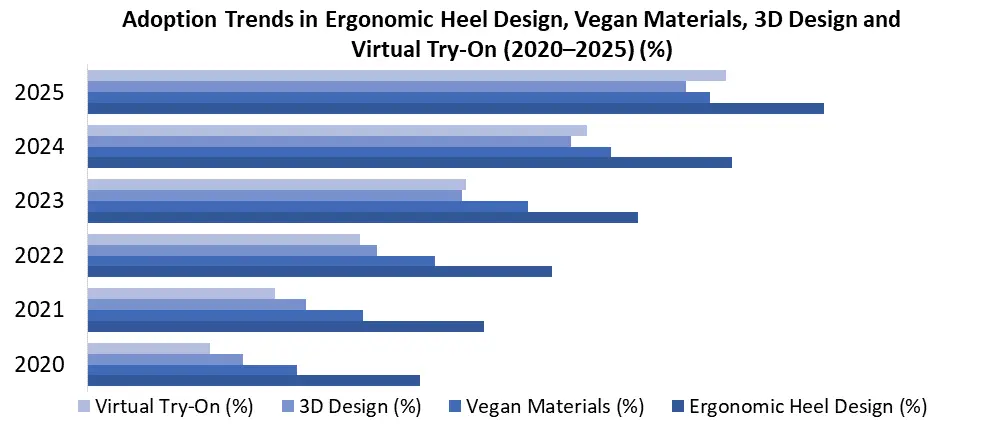
5. Technological advancements and innovation impact: 3D modelling, AI-assisted trend forecasting, foot scanning and virtual try-on compress design cycles and cut returns. About 28% of leading brands offer virtual try-on or digital size matching.
Social Media Influence, Online Shopping Penetration and Changing Consumer Preferences
1. Social Media-Driven Demand: The global social media user base reached 5.24 billion in January 2025. Instagram, TikTok and Pinterest influence high-heeled footwear consumption through influencer marketing, viral fashion trends and celebrity-inspired collections.
2. Growing Online Purchase Penetration: 77% of EU internet users purchased goods or services online in 2024. Increasing e-commerce penetration supports demand in the Digital High Heels Footwear Market.
3. Digital Consumer Engagement: 83% of EU internet users aged 16–24 shopped online in 2024. Virtual try-ons, customer reviews and personalised recommendations strengthen footwear product discovery and online purchasing confidence.
4. Changing Consumption Patterns: According to Eurostat, 70% of recent EU online shoppers purchased clothing, shoes or accessories in 2024. Increasing digital fashion consumption supports comfort-focused High Heels Footwear Production and product diversification.
5. Social Commerce Expansion: Global social media user identities increased 4.1% to 5.24 billion in January 2025. Influencer collaborations, shoppable content and targeted advertisements create opportunities for High Heels Footwear Market Penetration.
High Heels Footwear Market Innovations: Block Heels, Comfort Engineering, Sustainable Materials and Digital Retail
The High Heels Footwear Market is being reshaped by five trends: comfort-first construction, the return of block and kitten heels, premiumisation, sustainable materials and digital-first retail. Comfort-engineered heels now appear in about 35% of new collections, up from 14% in 2020, as cushioned footbeds, shank reinforcement and weight-balanced heel cores move from niche brands into the mainstream. Block and kitten heels make up about 36% of new launches, up from 18%, reflecting the pull of daily wear. Premiumisation shows up as designer collaborations, bridal capsules and made-to-order lines. Plant-based leathers and recycled linings have risen from about 7% to 24% of launches, and online selling reached about 34% of sales in 2025 from 21% in 2020.
Digital tools carry much of the innovation load. About 32% of leading brands now fit cushioned footbeds as standard, roughly 28% offer virtual try-on or digital size matching, and about 20% use recycled or bio-based components. 3D modelling, AI-assisted trend forecasting and foot scanning compress design cycles and cut returns, while chemical and labelling rules push brands to document materials. Growing consumer interest in repair and resale is nudging the industry toward circular business models, supporting High Heels Footwear Market volume growth through increased product reuse, extended footwear lifecycles and sustainable consumption practices.
High Heels Footwear Product Landscape: From Stiletto Pumps to Block-Heel and Platform Designs
Heel construction sets the character of the shoe. The stiletto, a slim heel that tapers to a small tip, is the category’s signature and held about 29% of 2025 value, yet it gives the least stability and grows at just 3.7%. Block heels, with a wide square base that spreads load across more surface, hold about 26% and grow fastest at 5.6%. Wedges (18%) offer continuous support under the arch and suit warm-weather sandals, cone heels (8%, 5.0% CAGR) bring a fashion-forward taper, and spool heels (5%) give a vintage hourglass profile. The remaining 14% covers kitten, platform-led and other constructions.
Stiletto Heels: Craft, Stability Engineering and Luxury Positioning
Stiletto heels held about 29% of the High Heels Footwear Market in 2025, roughly USD 9.2 Bn, and grow at a 3.7% CAGR. They range from classic stiletto pumps for formal dress to strappy evening sandals and signature designer collections, sold through boutiques, department stores and luxury e-commerce.
Differentiation increasingly rests on comfort as much as drama: concealed padding, lower heel pitch, anti-slip outsoles and rounded lasts now sit alongside patent leather and crystal embellishment. Prices spread from mass-market stilettos under USD 50 to designer pairs above USD 800, and because well-known silhouettes are widely copied, provenance, authentication and after-sales service form part of the luxury offer.
Block Heels, Wedges and Comfort-Led Designs: Everyday Wear, Stability and Wide-Base Engineering
Block heels held about 26% of value in 2025 and are the fastest heel construction at 5.6% CAGR, with cone heels at 5.0% and wedges at 4.4%. The wide base spreads body weight, so wearers stay on their feet longer, which suits office, travel and daily use. Block-heel pumps, sandals and boots carry the professional and everyday segments, while wedge sandals and espadrilles dominate warm-weather collections. Lightweight outsoles, memory-foam footbeds and flexible shanks are the most common upgrades, and brands use them to justify price points above basic styles.
Platform, Kitten Heel and Speciality Designs: Occasion, Fashion Cycles and Design Experimentation
Platforms, kitten heels and other speciality constructions sit mainly in the 14% “other” group. Platforms lower the effective pitch of a very high heel and ride fashion cycles, kitten heels of about 1–2 inches have returned for professional and minimalist dressing, and statement boots and slingbacks give brands seasonal newness without retooling a whole range.
Materials, Price Tiers and Component Supply: Leather, Vegan Uppers, Heel Cores and Outsoles
Genuine leather leads uppers at about 45%, but synthetic leather (34%, 5.7% CAGR) is catching up on cost, colour consistency and vegan positioning. Textile and fabric uppers, including satin and mesh for bridal and evening shoes, hold (XX%), and recycled or plant-based options grow fastest at 7.4%. By price, mass-market shoes hold about 37% of value, mid-range (XX%), premium (XX%), and luxury (XX%). Heel cores, shanks, outsoles, buckles and embellishments come from specialist suppliers, concentrated in manufacturing clusters in China, Vietnam, India, Italy, Spain, Portugal and Brazil.
Emerging High Heels Footwear Innovation: Ergonomic Heel Design, Vegan Materials, 3D Design and Virtual Try-On
Innovation is concentrated in ergonomic heel geometry and pressure-relieving footbeds; lightweight, high-strength heel cores; vegan, recycled and bio-based uppers; AI-assisted design and 3D prototyping; and personalised fit through foot scanning. Large groups such as Steve Madden, which designs, sources and markets footwear and accessories under brands that now include Kurt Geiger London and Carvela, use scale to move quickly on trends, while independent designers rely on small-batch and made-to-order runs.
Under EU REACH, leather articles that touch the skin must contain less than 3 mg/kg of chromium VI, and limits on certain azo dyes and polycyclic aromatic hydrocarbons apply to footwear and components. In the United States, children’s shoes fall under the CPSIA lead limit, and labelling rules govern origin and material claims.
Global High Heels Footwear Market Segmentation:
By Heel Construction Type, Footwear Style, Heel Height, Upper Material, Price Range, Purchase Occasion, End Consumer, Distribution Channel and Region
High Heels Footwear Market Share by Product Type: Heel Construction, Footwear Style, Heel Height and Upper Material Analysis
By heel construction type, stiletto heels led with about 29% of the 2025 value, followed by block heels at 26%, wedge heels at 18%, cone heels at XX%, spool heels at XX% and other construction types at 14%. Stilettos earn the highest price per pair in luxury and evening wear, whereas block heels lead growth at 5.6% CAGR because the wide base eases walking and lets one pair serve work, travel and dinner. Cone and spool heels remain style-led accents rather than volume drivers.
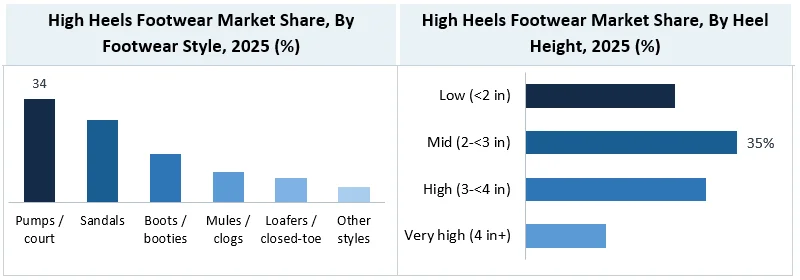
By footwear style, pumps and court shoes held about 34% of value, sandals 27%, boots and booties 16%, mules and clogs 10%, loafers and other closed-toe styles XX% and other styles XX%. Sandals follow seasonal and warm-climate demand, boots and booties lift autumn and winter ticket prices, and mules and clogs grow quickest at 6.4% on slip-on convenience and a relaxed silhouette.
By heel height, mid heels of 2 to below 3 inches led with about 34%, high heels of 3 to below 4 inches held 29%, low heels below 2 inches 24% and very high heels of 4 inches and above 13%. The move toward lower pitches is the defining height trend: low heels grow at 6.0% and mid heels at 5.0%, against 3.2% for very high heels.
Segment Analysis: Target Market, Consumer Demographics, Niche Markets and Segment Attractiveness
1. Product and heel segmentation: Stiletto (29%), block (26%), wedge (18%), cone (8%) and spool (5%) heels define product segmentation, and block heels are the most attractive heel segment, with growth at 5.6%.
2. Consumer demographics and customer profiling: Women are about 93% of buyers, men 4% and children and adolescents 3%. The core target market is the occasion-driven, comfort-seeking professional woman who owns several pairs and wears two or three regularly.
3. Behavioral segmentation: Cost per wear, fit, comfort, promotions and certified materials drive purchase decisions, and poor fit rather than poor design is the main reason for online returns.
High Heels Footwear Market Regional Outlook:
North America, Europe, Asia Pacific, Middle East & Africa and South America
The North America High Heels Footwear Market held the largest High Heels Footwear Market share, about 30% of global value in 2025. The United States anchors demand through a deep department-store, specialty and e-commerce base, a strong bridal and event calendar and heavy import reliance: US Census Bureau data recorded USD 26.6 Bn of footwear imports in 2025, with Vietnam (about 36%) ahead of China. Growth is projected at about 3.9% CAGR as premium, comfort and online channels offset a mature volume base. Europe held about XX% of 2025 value, led by Italy, France, Spain, the United Kingdom and Germany, home to luxury houses, craft manufacturing and strong department-store retail; growth is about 3.6% CAGR.
The Asia Pacific High Heels Footwear Market is expected to be the fastest-growing region, with a 5.8% CAGR through 2034, rising from XX% of 2025 value to about 32% by 2034 and overtaking North America. China remains the largest producer and a fast-growing consumer market, India is scaling organised footwear retail and exports; Japan and South Korea add premium fashion demand, and Singapore-based Charles & Keith shows how regional brands go global. The Middle East and Africa, about 8% of 2025 value, grows at about 5.6% as Gulf luxury malls and international fashion retail expand, while South America, about 6%, grows at 4.8% on Brazil’s footwear heritage and rising e-commerce.
|
Region |
2025 share |
2025 (USD Bn) |
2034 (USD Bn) |
CAGR |
Notes |
|
North America |
30.0% |
XX |
XX |
3.9% |
US department stores, specialty |
|
Europe |
XX% |
XX |
XX |
XX% |
Italy, France, UK, Spain and |
|
Asia Pacific |
XX% |
XX |
XX |
XX% |
China, India, Japan and South |
|
Middle East & Africa |
XX% |
XX |
XX |
XX% |
UAE, Saudi Arabia, Turkey and |
|
South America |
XX% |
XX |
XX |
4.8% |
Brazil leads; footwear |
High Heels Footwear Market Forecast 2025–2034: Growth Phases, CAGR and Scenario Drivers
The MMR High Heels Footwear Market forecast for 2025–2034 shows the market growing from USD 31.8 Bn in 2025 to USD 33.3 Bn in 2026 and USD 47.7 Bn by 2034, a CAGR of 4.6% over 2026–2034 that adds about USD 15.9 Bn of annual revenue over the period. Annual revenue added rises from USD 1.46 Bn in 2026 to USD 2.10 Bn in 2034 as the larger base compounds. In 2026–2027, price-led growth, tariff-driven sourcing shifts and comfort launches set the pace. In 2028–2031, block and low-heel designs, vegan materials and online-first brands lift the mix. In 2032–2034, personalised fit, circular models and Asia Pacific scale could add upside beyond the base case. Downside risks include tariff escalation, weaker discretionary spending, casualisation of dress codes and rising material and freight costs.
Leading High Heels Footwear Manufacturers: Competitive Landscape and High Heels Footwear Market Key Players
The High Heels Footwear Market competitive landscape includes several distinct groups rather than a single set of comparable companies. Fashion-footwear groups such as Steve Madden, Caleres, ALDO Group, Nine West and Vince Camuto sell pumps, sandals and boots through wholesale, owned stores and e-commerce. Luxury and designer houses including Christian Louboutin, Jimmy Choo, Manolo Blahnik, Gianvito Rossi, Giuseppe Zanotti, Aquazzura, Prada, Gucci, Saint Laurent, Dior and Chanel compete on craftsmanship, signature silhouettes and heritage. Value and fast-fashion players such as Zara, Mango, Charles & Keith and Pedro, together with Asian and Latin American groups including Belle International, Bata India, Metro Brands, Arezzo&Co, Schutz and Beira Rio, serve mid-range volume, while OEM and ODM manufacturers supply many of them.
High Heels Footwear Market competition is increasingly shaped by brand equity, comfort credentials, sourcing flexibility and digital reach. In May 2025, Steve Madden completed its acquisition of Kurt Geiger at an enterprise value of about USD 381.39 million; the London-based brand had revenue of USD 527.88 million in the twelve months to 1 February 2025, and Steve Madden said it was accelerating a shift of production away from China to manage US tariffs. Partnerships, designer collaborations and portfolio acquisitions are likely to continue as retailers consolidate suppliers and favour brands that deliver on fit, speed and compliance.
Global High Heels Footwear Market Recent Developments, Product Launches and Industry News | 2025–2026
1. 6 May 2025: Steve Madden completed its acquisition of Kurt Geiger from a group led by Cinven at an enterprise value of about USD 381.39 Million, showing strategic appetite for heeled-footwear and accessory brands.
2. 2025: US footwear imports (HS 64) totalled about USD 26.6 Bn, down 2.6% from 2024, with Vietnam (about USD 9.7 Bn) overtaking China as top supplier by value (US Census Bureau), confirming sourcing diversification.
3. May 2026: US BLS reported women’s footwear prices up 6.2% year on year, with overall footwear up 5.2%, signalling price-led value growth and a risk of consumer trade-down.
4. 6 Jul 2026: India’s Commerce and Industry Minister urged the leather and footwear industry to target USD 15 Bn of exports within five to six years; the India–UK trade agreement was due to take effect on 15 July, supporting Asia Pacific production and exports.
5. 10 Nov 2026: the BLS Consumer Price Index release showed footwear prices up 1% in October from September, with women’s footwear up 0.9% (seasonally adjusted), pointing to continued price pressure into the holiday season.
High Heels Footwear Competitive Landscape Analysis: Competitor Benchmarking, Rivalry Intensity and Market Strategies
1. Competitor analysis and High Heels Footwear Market share: The report profiles 96 players, benchmarking company revenue, net sales, high-heels-related revenue, growth rate and profit margin, and groups them by role rather than ranking them as identical producers.
2. Competitive positioning and differentiation: Luxury houses differentiate on craftsmanship and signature silhouettes, fashion groups on comfort and speed, mass-market players on price and trend response, and independent labels on block-heel comfort, vegan materials and made-to-order pairs.
3. Rivalry intensity and competitive forces: Rivalry is shaped by substitute competition from athletic and comfort footwear, tariff-driven cost pressure, price sensitivity and retailers consolidating suppliers.
4. Market player strategies and competitive maneuvers: Leading brands expand premium and luxury collections, develop ergonomic footwear, adopt sustainable materials, grow direct-to-consumer and online channels, localise supply chains and pursue acquisitions and designer collaborations.
Global High Heels Footwear Market Scope: Inquire before buying
|
Global High Heels Footwear Market |
|||
|
Report Coverage |
Details |
||
|
Base Year: |
2025 |
Forecast Period: |
2026-2034 |
|
Historical Data: |
2020 to 2025 |
Market Size in 2025: |
USD 31.8 Billion |
|
Forecast Period 2026 to 2034 |
4.6% |
Market Size in 2034: |
USD 47.7 Billion |
|
High Heels Footwear Market |
By Heel Construction Type |
Stiletto Heels Block Heels Wedge Heels Cone Heels Spool Heels Other Heel Construction Types |
|
|
By Footwear Style |
Pumps and Court Shoes Sandals Boots and Booties Mules and Clogs Loafers and Other Closed-Toe Styles Other Footwear Styles |
||
|
By Heel Height |
Low Heels (Below 2 Inches) Mid Heels (2 Inches to Below 3 Inches) High Heels (3 Inches to Below 4 Inches) Very High Heels (4 Inches and Above) |
||
|
By Upper Material |
Genuine Leather Textile and Fabric Other Upper Materials |
||
|
By Price Range |
Mass-Market Footwear Mid-Range Footwear Premium Footwear |
||
|
By Primary Purchase Occasion |
Professional and Office Wear Casual and Everyday Wear Formal and Evening Events Bridal and Wedding Wear Other Occasions |
||
|
By End Consumer |
Women Men Children and Adolescents |
||
|
By Distribution Channel |
Offline Retail Brand-Owned Stores Multi-Brand and Specialty Footwear Stores Department Stores Other Offline Retail Channels Online Retail Brand-Owned E-Commerce Websites Third-Party E-Commerce Marketplaces |
||
Global High Heels Footwear Market, By Region
North America (United States, Canada, Mexico)
Europe (Germany, United Kingdom, France, Italy, Spain, Netherlands, Switzerland, Sweden, Denmark, Belgium, Austria, Poland, Rest of Europe)
Asia Pacific (China, Japan, India, South Korea, Australia, New Zealand, Singapore, Taiwan, Thailand, Malaysia, Indonesia, Vietnam, Rest of Asia Pacific)
Middle East and Africa (United Arab Emirates, Saudi Arabia, Israel, Turkey, South Africa, Nigeria, Algeria, Morocco, Angola, Kenya, Ghana, Egypt, Rest of Middle East and Africa)
South America (Brazil, Argentina, Chile, Colombia, Rest of South America)
Key players/Competitors profiles covered in the High Heels Footwear Market report from a strategic perspective
North America
1. Steve Madden, Ltd. (United States)
2. Caleres, Inc. (United States)
3. Sam Edelman (United States)
4. Naturalizer (United States)
5. Nine West (United States)
6. Vince Camuto (United States)
7. Marc Fisher Footwear (United States)
8. Jessica Simpson Collection (United States)
9. Schutz (United States/Brazilian Brand)
10. Michael Kors (United States)
11. Tory Burch LLC (United States)
12. Stuart Weitzman (United States)
13. Kate Spade New York (United States)
14. Ralph Lauren Corporation (United States)
15. Coach (United States)
16. Kenneth Cole Productions (United States)
17. ALDO Group (Canada)
18. Call It Spring (Canada)
19. Pajar Canada (Canada)
20. Journee Collection (United States)
Europe
21. Christian Louboutin (France)
22. Jimmy Choo (United Kingdom)
23. Manolo Blahnik (United Kingdom)
24. Gianvito Rossi (Italy)
25. Sergio Rossi (Italy)
26. Giuseppe Zanotti (Italy)
27. Aquazzura (Italy)
28. Casadei (Italy)
29. Amina Muaddi (Italy)
30. Prada S.p.A. (Italy)
31. Gucci (Italy)
32. Saint Laurent (France)
33. Dior (France)
34. Chanel (France)
35. Valentino Garavani (Italy)
36. Salvatore Ferragamo (Italy)
37. Tod’s S.p.A. (Italy)
38. René Caovilla (Italy)
39. Kurt Geiger (United Kingdom)
40. Dune London (United Kingdom)
41. LK Bennett (United Kingdom)
42. Clarks (United Kingdom)
43. Reiss (United Kingdom)
44. Zara (Spain)
45. Mango (Spain)
46. Camper (Spain)
47. Högl (Austria)
48. Gabor Shoes (Germany)
Asia Pacific
49. Belle International (China)
50. Daphne International Holdings (China)
51. ST&SAT (China)
52. Charles & Keith (Singapore)
53. Pedro (Singapore)
54. Pretty Ballerinas Asia-Pacific Retail Operations
55. RANDA Co., Ltd. (Japan)
56. Diana Co., Ltd. (Japan)
57. ABC-MART Fashion Footwear Operations (Japan)
58. Kanematsu Co., Ltd. (Japan)
59. Bata India Limited (India)
60. Metro Brands Limited (India)
61. Mochi Shoes (India)
62. Inc.5 Shoes (India)
63. Catwalk Worldwide Pvt. Ltd. (India)
64. Reliance Brands Footwear Operations (India)
65. Liberty Shoes Limited (India)
66. Campus Activewear Fashion Footwear Operations (India)
67. Khadim India Limited (India)
68. Fashor Footwear Retail Operations (India)
69. Wittner (Australia)
70. Novo Shoes (Australia)
71. Tony Bianco (Australia)
72. Billini (Australia)
Middle East & Africa
73. Level Shoes (United Arab Emirates)
74. Damas Fashion Footwear Retail Operations (United Arab Emirates)
75. Apparel Group (United Arab Emirates)
76. Landmark Group Footwear Operations (United Arab Emirates)
77. Chalhoub Group Luxury Footwear Operations (United Arab Emirates)
78. Aldo Middle East Retail Operations (United Arab Emirates)
79. Shoe Mart (United Arab Emirates)
80. Europa Art Shoes (South Africa)
81. Spitz (South Africa)
82. Tsonga (South Africa)
South America
83. Arezzo&Co (Brazil)
84. Schutz (Brazil)
85. Arezzo (Brazil)
86. Santa Lolla (Brazil)
87. Via Uno (Brazil)
88. Vizzano (Brazil)
89. Beira Rio (Brazil)
90. Dakota Calçados (Brazil)
91. Jorge Bischoff (Brazil)
92. Luiza Barcelos (Brazil)
93. Carmen Steffens (Brazil)
94. Dumond (Brazil)
95. Piccadilly (Brazil)
96. Ramarim (Brazil)
Others
Global High Heels Footwear Market FAQs: Frequently Asked Questions
1. What is the High Heels Footwear Market Size?
Ans. MMR values the global high heels footwear market at USD 31.8 Bn in 2025, USD 33.3 Bn in 2026 and USD 47.7 Bn by 2034, a 4.6% CAGR over 2026–2034. Volume is about 1,085 million pairs in 2025.
2. What Drives High Heels Footwear Market Growth?
Ans. Growth comes from occasion dressing, bridal and event spending, comfort-led product design, premiumisation, social-media fashion cycles, digital retail and rising incomes in Asia Pacific, partly offset by price inflation, tariffs and the casualisation of dress codes.
3. Which region and country is the largest High Heels Footwear Market?
Ans. North America held the largest share in 2025, about 30% of value, led by the United States. Asia Pacific is the fastest-growing region at about 5.8% CAGR and is expected to pass North America by 2034 on demand and production in China, India, Japan and South Korea.
4. Which High Heels Footwear segments are growing fastest?
Ans. Stiletto is the largest heel construction at about 29% of 2025 value, but block heels grow fastest at 5.6%. Pumps and court shoes lead styles at 34%, while mules and clogs grow fastest at 6.4%. Low heels (6.0%), premium footwear (5.9%), casual and everyday wear (5.9%) and brand-owned e-commerce (8.6%) are other fast-growing segments.
5. Who are the leading High Heels Footwear manufacturers?
Ans. Leading names include Steve Madden (with Kurt Geiger), Caleres, ALDO Group, Christian Louboutin, Jimmy Choo, Manolo Blahnik, Gianvito Rossi, Giuseppe Zanotti, Charles & Keith, Arezzo&Co, Schutz and Bata India.
6. How do stiletto, block and wedge heels differ?
Ans. A stiletto has a slim, tapering heel, suits formal and evening wear and gives the least stability. A block heel has a wide square base that spreads body weight and suits daily wear, which is why it is the fastest-growing construction. A wedge runs continuously under the arch, making it a steady choice for warm-weather sandals and longer walks.