
Bridal Wear Market by Product, Price Range, Application, Distribution Channel and Region - Global Market Size Estimation, Industry-Wide Analysis, Competitive Landscape Assessment & Long-Term Forecast to 2032
Overview
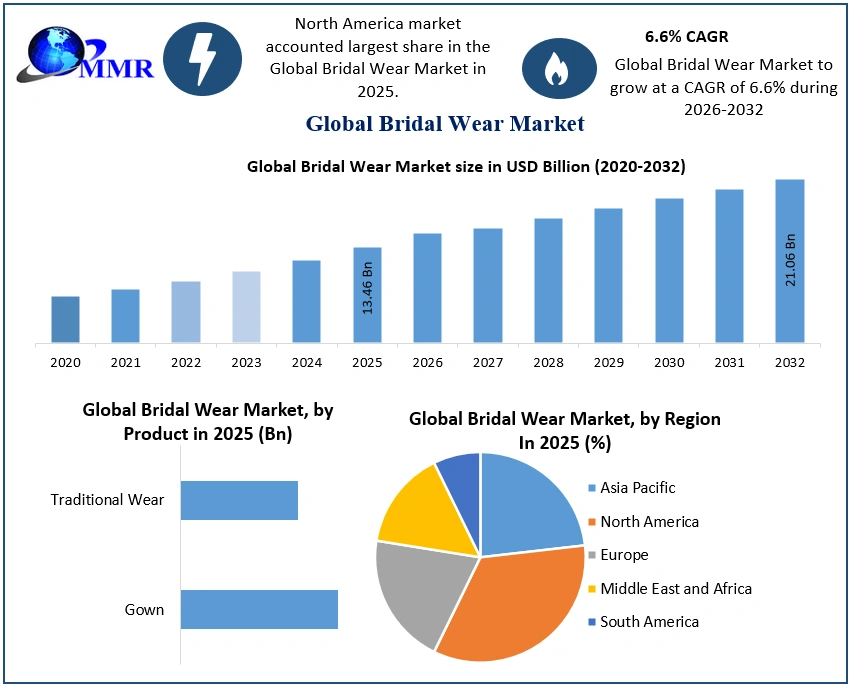
The Bridal Wear Market size was valued at USD 13.46 Billion in 2025 and the total Bridal Wear revenue is expected to grow at a CAGR of 6.6% from 2025 to 2032, reaching nearly USD 21.06 Billion by 2032.
Bridal Wear Market Overview:
The bride's wedding gown, also known as a bridal gown, is the gown women wear during the wedding ceremony. The color, style, and ceremonial significance of the gown might be influenced by the wedding guests' faith and culture. Weddings are frequently religious gatherings. As a result, religion has a huge impact. The "white wedding," which originated in Europe and the United States and has since spread around the world, is profoundly rooted in Christian principles.
 To know about the Research Methodology :- Request Free Sample Report
Bridal Wear Market Dynamics:
Increased urbanization and fashion upgrades, increased disposable income, technological advances, entry of local players, and increased luxury weddings are some of the factors driving the growth of the bridal market.
People are following the latest trends in designer brands worn by celebrities, and companies like Manyawar are investing a lot to develop the same fashion fabrics at low cost, which is driving the demand for bridal wear in the market.
Emerging countries such as China, India, Bangladesh, and Pakistan are rapidly embracing Western culture at their wedding receptions. In different traditions around the world, you need to change multiple dresses on your wedding day. For example, a marriage between casts in India or Chile requires the couple to respect their spouse's tradition by marrying at two ceremonies on the same day. This requires changing the entire wedding ensemble. Such a tradition that requires multiple wedding costumes is expected to increase the demand for products and is expected to drive market growth through the forecast period.
The latest trends and the arrival of technological advances have accelerated market growth. The availability of different styles, sizes, textures, designs, fabrics, and finishes has helped brides meet the needs of magnificent bridal costumes. Mass marketing, improved product lines, and the entry of online retailers have hugely contributed to the demand for the product in the market.
Destination weddings are becoming more popular among millennials. The idea of getting married in a closed circle with the theme of elaborate weddings in front of the family has contributed to the growing popularity of weddings at destinations. Couples and wedding planners usually take enough time to plan a wedding, and the wedding dress is an important part of planning. A wedding dress is expected to show the theme and culture of the place where the wedding is held. These factors are driving the demand for bridal wear in the market.
Textile companies are working with designers to stay on top of the latest trends and improve their product range to attract more customers. The high costs associated with this apparel have limited the purchasing capacity of the middle and lower-middle classes. These factors are restraining the market growth.
Bridal Wear Market Segment Analysis:
By Product, Gowns dominate the market with a 91% share in 2025. Demand is increasing with the advent of different types of textures, fabrics, and styles. Fashion designers focus on decorating gowns with intricate designs to enhance aesthetics. Retailers and fashion designers are focusing on complex craftsmanship designs to decorate clothes to add aesthetic value. In addition, changing fashion trends require manufacturers to update their collections to maintain their position in the market. This is driving the demand for stylish and trendy clothing gowns and also driving the market growth. These factors are driving the growth of the segment in the bridal wear market.
Traditional Wear is expected to grow at a CAGR of 4.5% through the forecast period. From Japanese kimonos to Mongolian dales, wedding dress styles vary according to tradition. In many countries like Indonesia, there are more than 300 ethnic groups with different traditions, and wedding dresses are suitable for these traditions. This diversity of cultural groups around the world is expected to increase the demand for traditional clothing. These factors are expected to drive the market growth through the forecast period.
By Distribution Channel, the Offline segment dominated the market with a 17.88% share in 2025. The presence of different suppliers and the availability of the latest fashion trends in the showroom allow customers to customize their clothes according to their needs. Consumers try out designs and select accordingly or order full customized. These factors are driving the growth of the segment in the market.
The online segment is expected to grow at a CAGR of 5.99% through the forecast period. Increasing popularity, heavy discounts, and 3D virtual trial rooms, etc. These factors are expected to drive the market through the forecast period.
Bridal Wear Market Regional Insights:
North America region dominated the market with a 39% share in 2025. Factors such as the presence of multi-vendors, early adoption of fashion, high disposal revenues, and the emergence of technology to design the latest fabrics are driving the growth of the bridal wear market. The increasing purchasing power of the population has increased spending on weddings. These factors are driving the growth of the market in this region.
Asia Pacific region is expected to grow at a CAGR of 6.5% through the forecast period. Factors such as increased disposable income, high wedding spending, a large fashion-focused young population, cheap bridal wear, and the entry of local players are driving demand for bridal wear. Cultures around the world require multiple dresses on the same occasion. The demographic and cultural diversity of the Asia-Pacific region has great potential for manufacturers to attract different countries and to increase their market presence. The growing population of millennials in countries such as China and India is contributing to the growth of the industry as a whole. These factors are expected to drive the growth of the bridal wear market through the forecast period in this region.
The objective of the report is to present a comprehensive analysis of the Bridal Wear market to the stakeholders in the industry. The past and current status of the industry with the forecasted market size and trends are presented in the report with the analysis of complicated data in simple language. The report covers all the aspects of the industry with a dedicated study of key players that include market leaders, followers, and new entrants.
PORTER, PESTEL analysis with the potential impact of micro-economic factors of the market have been presented in the report. External as well as internal factors that are supposed to affect the business positively or negatively have been analyzed, which will give a clear futuristic view of the industry to the decision-makers.
The report also helps in understanding the Bridal Wear market dynamics, structure by analyzing the market segments and project the Bridal Wear market size. Clear representation of competitive analysis of key players by product, price, financial position, product portfolio, growth strategies, and regional presence in the Bridal Wear market make the report investor’s guide.
Bridal Wear Market Scope: Inquiry Before Buying
| Bridal Wear Market | |||
|---|---|---|---|
| Report Coverage | Details | ||
| Base Year: | 2025 | Forecast Period: | 2026-2032 |
| Historical Data: | 2020 to 2025 | Market Size in 2025: | USD 13.46 Bn. |
| Forecast Period 2026 to 2032 CAGR: | 6.6 % | Market Size in 2032: | USD 21.06 Bn. |
| Segments Covered: | by Product | Gown Traditional Wear |
|
| by Price Range | Premium Medium Economy |
||
| by Application | Wedding Ceremony and Occasions |
||
| by Distribution Channel | Offline Online |
||
Bridal Wear Market, by Region
North America (United States, Canada and Mexico)
Europe (UK, France, Germany, Italy, Spain, Sweden, Austria and Rest of Europe)
Asia Pacific (China, South Korea, Japan, India, Australia, Indonesia, Malaysia, Vietnam, Taiwan, Bangladesh, Pakistan and Rest of APAC)
Middle East and Africa (South Africa, GCC, Egypt, Nigeria and Rest of ME&A)
South America (Brazil, Argentina Rest of South America)
Bridal Wear Market, Key Players
1. Vera Wang
2. Monique Lhuillier
3. Elie Saab
4. Justin Alexander Bridal, Inc.
5. Pronovias Group
6. Berta Bridal
7. Galia Lahav
8. Oscar de la Renta
9. Maggie Sottero Designs, LLC
10. Suzanne Neville Ltd.
11. Jenny Packham
12. Kaviar Gauche
13. Sophie et Voila
14. Kleinfeld Bridal Corp.
15. Viktor&Rolf
16. Allure Bridals
17. Casablanca Bridal
18. Vivienne Westwood
19. Amsale
20. Christina Wu
FAQ:
1] What segments are covered in the Bridal Wear Market report?
Ans. The segments covered in the Bridal Wear Market report are based on Product and Distribution Channel.
2] Which region is expected to hold the highest share in the Bridal Wear Market?
Ans. North America Region is expected to hold the highest share in the Bridal Wear Market.
3] What is the market size of the Bridal Wear Market by 2032?
Ans. The market size of Bridal Wear Market by 2032 is USD 21.06 Bn.
4] Who are the top key players in the Bridal Wear Market?
Ans. Elie Saab, JLM Couture Inc., Justin Alexander Inc., Louis Vuitton, V.E.W. Ltd., Kleinfeld Bridal Corp., Harrods Limited, Moonlight Bridal Design, Inc., Maggie Sottero Designs L.L.C., Pronovias Fashion Group, Rosa Clara, De La Cierva Y Nicolas, CUT S.r.l, Pronuptia de Paris SA., Yumi Katsura International Co., Ltd., Zuhair Murad, Alfred Angelo, Inc., Watters, Madeline Gardner, Sincerity Bridal, Sophia Tolli, Temperley London, Helen Rodrigues, Macy's, Inc., Monique Lhuillier, Naeem Khan, Paloma Blanca, Theia Couture, Vera Wang, David's Bridal Inc., Winnie Couture.
5] What was the Bridal Wear Market Size in 2025?
Ans. The Bridal Wear Market Size was USD 13.46 Bn in 2025.