
Healthcare Information System Market – Industry Structure Evaluation, Demand Drivers Analysis, Regional Growth Analysis and Identification, Competitive Positioning Review & Global Market Size Forecast to 2034
Overview
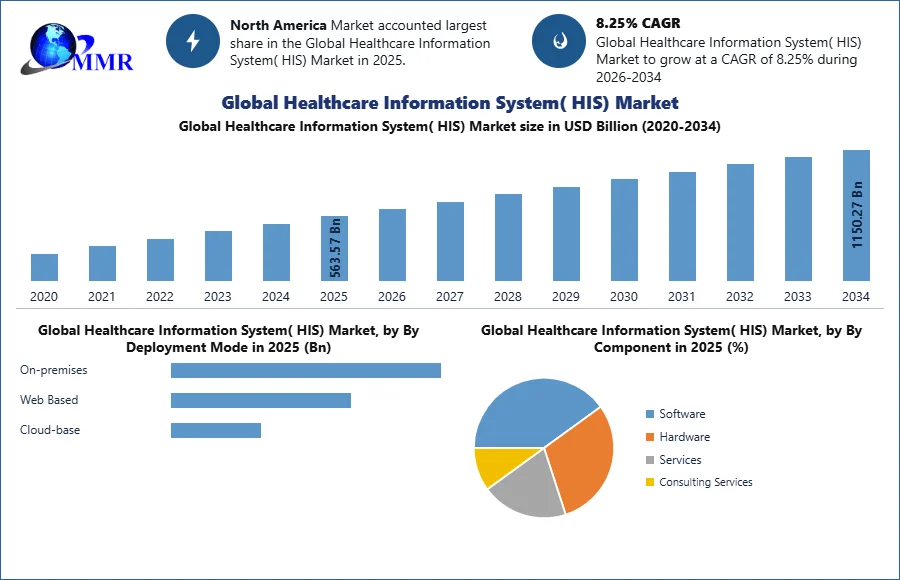
The Healthcare Information System Market size was valued at 563.57 Bn in 2025. The Market is growing at a CAGR of 8.25%, from 2026 to 2034, reaching nearly USD 1150.27 Bn by 2034.
Healthcare Information System Market Overview
Healthcare Information Systems (HIS) are integrated IT solutions designed to manage, analyze, and share patient-specific and healthcare-related data. Core components include Electronic Health Records (EHR), Hospital Information Systems, Pharmacy Information Systems, Laboratory Information Systems, and Clinical Decision Support Systems. EHRs store medical history, diagnoses, medications, treatment plans, and other vital health information, enabling seamless sharing across healthcare providers for accurate, coordinated patient care. For example, over 90% of U.S. physicians use certified EHR technology to streamline hospital workflows and improve patient outcomes. The rise of cloud-based platforms, mobile health applications, and AI-powered clinical decision support systems continues to transform healthcare delivery. Hospitals, clinics, and pharmaceutical organizations are increasingly adopting HIS to improve operational efficiency, patient engagement, and personalized care, creating a globally connected, smarter healthcare ecosystem.
 To know about the Research Methodology :- Request Free Sample Report
North America dominates Healthcare Information System adoption, driven by advanced digital infrastructure, high EHR penetration, and government initiatives such as the ONC Public Health Information and Technology Workforce Program. Epic Systems Corporation and NextGen Healthcare are major market influencers, leveraging generative AI to support clinical decision-making, optimize revenue cycles, enhance patient experiences, and improve clinician workflows. Asia Pacific is emerging as the fastest-growing region, with countries such as China, India, Japan, and South Korea investing heavily in healthcare IT infrastructure this factor significantly drives the Healthcare Information System Market.
Healthcare Information System Market Dynamics
Increasing Adoption of Electronic Health Records (EHRs) to Drive the growth of Healthcare Information System Market
The growing adoption of Electronic Health Records (EHRs) is a major driver boosting the growth of the Healthcare Information System Market. Healthcare providers worldwide are shifting from paper-based systems to digital platforms to enhance efficiency, reduce errors, and improve patient outcomes. EHRs streamline patient data management by integrating medical history, prescriptions, diagnostic results, and treatment plans in a unified digital system. For instance, the U.S. Centers for Medicare & Medicaid Services (CMS) has actively promoted the adoption of EHRs under its Meaningful Use Program, incentivizing hospitals and clinics to digitize healthcare processes. Similarly, in countries such as India, the National Digital Health Mission (NDHM) is boosting EHR implementation to ensure seamless health data accessibility across providers. The demand for EHRs is also rising due to telemedicine growth, as physicians require secure and real-time access to patient records during remote consultations. This transformation improves clinical decision-making and reduces operational costs for hospitals by minimizing duplicate tests and medication errors. With global healthcare spending expected to rise significantly, the adoption of EHRs continue to accelerate, driving strong demand for healthcare information systems. Thus, the digital shift in patient data management is creating a sustainable pathway for market growth, positioning EHRs as the cornerstone of modern healthcare information technology.
Data Security and Privacy Concerns limits the growth of the growth of Healthcare Information System Market
Rapid digitization, data security and privacy concerns remain a critical restraint hampering the growth of the Healthcare Information System Market. With the rising use of EHRs, telehealth, and cloud-based platforms, healthcare organizations face heightened risks of cyberattacks, data breaches, and unauthorized access to sensitive patient information. For example, in 2023, the U.S. healthcare sector reported over 133 million breached health records, according to the Department of Health and Human Services (HHS). These breaches compromise patient confidentiality and lead to significant financial losses, regulatory penalties, and erosion of trust in healthcare systems. Compliance with data protection regulations such as HIPAA (Health Insurance Portability and Accountability Act) in the U.S. and GDPR (General Data Protection Regulation) in Europe adds also pressure on healthcare providers to invest heavily in cybersecurity solutions. Smaller hospitals and clinics often face challenges in allocating sufficient resources for advanced data protection, limiting the adoption of healthcare information systems. Additionally, ransomware attacks targeting hospital databases have disrupted operations, delayed treatments, and put patient safety at risk. For Instance, the WannaCry cyberattack on the UK’s National Health Service (NHS) in 2017, which forced hospitals to cancel appointments and emergency services. These persistent risks highlight that unless robust cybersecurity frameworks and AI-driven threat detection solutions are integrated, data privacy concerns will remain a significant barrier restraining Healthcare Information System Market growth.
Growth in AI-Driven Clinical Decision Support Creates Lucrative Growth Opportunities to the of Healthcare Information System Market
The integration of artificial intelligence (AI) in clinical decision support (CDS) systems presents a lucrative opportunity for the Healthcare Information System Market. AI-driven CDS tools help healthcare providers analyze vast amounts of patient data, identify patterns, and generate actionable insights to enhance diagnosis, treatment planning, and disease prevention. For example, IBM Watson Health has been used to support oncologists in recommending personalized cancer treatments by analyzing clinical research and patient records. Similarly, AI-powered CDS platforms are increasingly applied in radiology to detect anomalies in medical imaging faster and with higher accuracy than traditional methods.
The rising demand for precision medicine, coupled with the global burden of chronic diseases such as diabetes and cardiovascular disorders, is accelerating the need for AI-integrated healthcare information systems. Moreover, AI helps reduce clinician burnout by automating administrative tasks and providing evidence-based recommendations, allowing physicians to focus more on patient care. Real-time predictive analytics enabled by AI also assist in identifying patients at risk of adverse health events, enabling proactive interventions. Governments and healthcare providers are actively investing in AI solutions to improve efficiency and lower healthcare costs. For instance, the European Commission’s AI strategy supports innovations in digital health technologies. Thus, the growing reliance on AI-powered CDS systems is creating immense opportunities for market players to expand their offerings and revolutionize modern healthcare delivery.
Healthcare Information System Market Segment Analysis
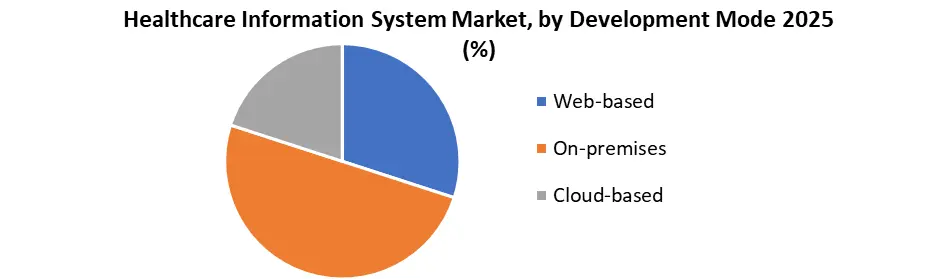
Based Deployment mode, Healthcare Information System Market is segmented into Web-based, On-premises, and Cloud-based. The On-premises segment dominated the Deployment mode segment in year 2025. Due to its strong reliability, control, and data security advantages. Healthcare providers, particularly large hospitals and research institutions, preferred on-premises solutions because they allow complete ownership of IT infrastructure, ensuring sensitive patient health records remain within the organization’s secure environment. With rising concerns over cyberattacks and data breaches in cloud systems, many healthcare institutions chose on-premises deployment to comply with stringent data privacy regulations such as HIPAA in the U.S. and GDPR in Europe. Also, on-premises systems offer greater customization and integration flexibility with legacy hospital systems, which is critical for large-scale organizations handling high patient volumes. Although cloud adoption is increasing due to cost-effectiveness, the upfront investment in on-premises solutions is often justified by long-term stability, robust performance, and minimal downtime. This strong emphasis on security and operational control significantly contributed to the dominance of the on-premises segment in 2025.
Healthcare Information System Market Regional Analysis:
North America Dominated the Healthcare Information System Market in year 2025. Strong digital infrastructure, high EHR adoption rates, and government-backed healthcare IT efforts are expected to boost the North American healthcare information systems industry. With about 90% of doctors using EHR systems, the United States leads the region. Due to its advanced healthcare infrastructure, high adoption of digital health solutions, and strong government initiatives promoting electronic health records (EHRs) and interoperability. The region’s well-established healthcare IT ecosystem, backed by substantial investments from both private and public sectors, created a conducive environment for rapid HIS deployment. Hospitals and clinics increasingly adopted on-premises and cloud-based HIS solutions to enhance operational efficiency, patient care, and regulatory compliance.
According to the Office of the National Coordinator for Health Information Technology (ONC), over 90% of hospitals in the U.S. had adopted certified EHR technology by 2025. This trend encouraged healthcare providers to integrate advanced HIS platforms capable of data analytics, telemedicine support, and AI-driven clinical decision tools. For instance, include Mayo Clinic and Cleveland Clinic, which leveraged HIS platforms to streamline patient management, reduce medical errors, and improve care coordination across multiple facilities. Additionally, government programs like the U.S. Health Information Technology for Economic and Clinical Health (HITECH) Act offered financial incentives for HIS adoption, further boosting market growth. North America’s leadership in HIS adoption stems from its technological readiness, supportive regulatory framework, and the healthcare sector’s focus on improving patient outcomes, operational efficiency, and data-driven decision-making, setting a benchmark for other regions.
Healthcare Information Systems Market Competitive Analysis:
The global Healthcare Information System Market is highly competitive, with leading players leveraging advanced technology, strategic partnerships, and regional customization to strengthen their market presence. Companies operate within a complex regulatory environment, balancing stringent data privacy laws in North America and Europe with cost-sensitive healthcare systems in emerging regions. Players are increasingly focusing on AI-driven analytics, cloud-based platforms, and interoperable solutions to improve clinical efficiency, patient outcomes, and compliance. Key market leaders include Cerner Corporation, Epic Systems, Allscripts, MEDITECH, and McKesson. Cerner excels with integrated EHR solutions and population health management tools, while Epic Systems is known for its scalable, cloud-enabled EHR platforms supporting large hospital networks. Allscripts focuses on predictive analytics and care coordination solutions, and MEDITECH offers cost-effective, customizable HIS solutions for mid-sized hospitals. McKesson drives innovation with pharmacy management integration and supply chain optimization. These companies emphasize R&D, digital transformation, and localized offerings to cater to diverse healthcare settings worldwide.
Healthcare Information System Market Key Trends:
Big Data and Analytics
Healthcare data continues to expand, analytical tools are developing to extract valuable insights from this data. Effective resource allocation, treatment plan personalization, and at-risk patient identification are all possible with predictive analytics.
Use of Artificial Intelligence (AI) and Automation
AI and Automation is presently being used for automating administrative tasks, as well as reviewing patient data for diagnosis, treatment decisions and personalizing care. Generative AI is emerging to assist with taking notes, summarizing visits, and developing discharge instructions, which could help reduce clinician's time writing things down. AI is also being used in cyber-security for prevention and detection of breaches which could save organizations millions of dollars.
Healthcare Information System Market Key development
- March 2026: Oracle Health expanded its AI-powered electronic health record (EHR) capabilities by incorporating advanced clinical documentation and workflow automation tools to improve physician productivity and patient care.
- October 2025: Epic Systems introduced new generative AI features within its EHR platform, which helps in automated clinical note generation, patient messaging assistance, and decision support for healthcare providers.
- September 2025: MEDITECH enhanced its Expanse platform with cloud-based interoperability and AI-driven population health management capabilities, supporting value-based care initiatives.
- June 2025: GE HealthCare strengthened its digital healthcare portfolio by expanding AI-enabled imaging and clinical workflow solutions integrated with hospital information systems.
- February 2025: Philips launched new cloud-enabled healthcare informatics solutions which are designed to improve monitoring of patients , clinical collaboration, and data interoperability across healthcare networks.
- 2024: Microsoft continued to expand its healthcare cloud ecosystem by introducing new AI-powered healthcare data and clinical workflow solutions through Microsoft Cloud for Healthcare, supporting secure data exchange and operational efficiency.
Recent Industry Developments
| Exact Date | Company | Development | Impact |
|---|---|---|---|
| 12 March 2025 | InterSystems | Launched IntelliCare, an AI-powered EHR platform featuring generative AI for clinical workflows and automated ambient listening. | Enhances clinician productivity by reducing manual documentation time and improving data accuracy at the point of care. |
| 28 April 2025 | Google Cloud | Partnered with Seattle Children’s Hospital to deploy Pathway Assistant, an AI agent powered by Gemini models on Vertex AI. | Sets a benchmark for AI-integrated hospital systems that provide real-time clinical decision support for specialized pediatric care. |
| 15 August 2025 | Oracle | Unveiled its next-generation AI-driven Electronic Health Records platform, integrating conversational AI into core EHR workflows. | Strengthens Oracle's competitive position in the cloud-based HIS market by addressing provider burnout through automation. |
| 05 November 2025 | Altera Digital Health | Announced the general availability of Sunrise Thread AI, an ambient scribe assistant that auto-generates structured encounter summaries. | Accelerates the adoption of automated documentation within large-scale hospital networks to optimize revenue cycle management. |
| 14 January 2026 | GE HealthCare | Expanded its Mural Command Center capabilities to include predictive analytics for patient deterioration across multiple facility sites. | Improves patient safety and operational efficiency by centralizing critical data monitoring in large healthcare systems. |
| 10 February 2026 | Cognizant | Launched a suite of Large Language Model (LLM) solutions in collaboration with Google Cloud for healthcare administrative automation. | Reduces administrative overhead for payers and providers, streamlining the claim processing and patient enrollment phases. |
Healthcare Information System Market Scope: Inquire Before Buying
| Global Healthcare Information System( HIS) Market | |||
|---|---|---|---|
| Report Coverage | Details | ||
| Base Year: | 2025 | Forecast Period: | 2026-2034 |
| Historical Data: | 2020 to 2025 | Market Size in 2025: | 563.57 USD Billion |
| Forecast Period 2026-2034 CAGR: | 8.25% | Market Size in 2034: | 1150.27 USD Billion |
| Segments Covered: | By Component | Software Hardware Servers Networking Equipment Storage Devices Services Consulting Services Implementation Services Maintenance and Support Services Managed Services |
|
| By Deployment Mode | Web-based On-premises Cloud-base |
||
| By Application | Hospital Information Systems (HIS) Electronic Health Record Electronic Medical Record Real-time Healthcare Patient Engagement Solution Pharmacy Information Systems (PIS) Medication Dispensing System Packaging & Labeling System Storage & Retrieval System Automated Medication Compounding System Tabletop Tablet Counters Laboratory Information Systems (LIS) Revenue Cycle Management Medical Imaging Information System Radiology Information Systems Monitoring Analysis Software Picture Archiving and Communication Systems |
||
| By End - User | Hospitals Diagnostic Laboratories Ambulatory Surgical Centers Others |
||
Healthcare Information System Market, by Region
North America (United States, Canada, and Mexico)
Europe (UK, France, Germany, Italy, Spain, Sweden, Austria and Rest of Europe)
Asia Pacific (China, South Korea, Japan, India, Australia, Indonesia, Malaysia, Vietnam, Taiwan, Bangladesh, Pakistan and Rest of APAC)
South America (Brazil, Argentina Rest of South America)
Middle East & Africa (South Africa, GCC, Egypt, Nigeria and the Rest of ME&A)
Key Players / Competitors Profiles Covered in Brief in Global Healthcare Information System Market Report in Strategic Perspective:
- Oracle Health
- Koninklijke Philips N.V
- Medical Information Technology, Inc.
- Dedalus
- Siemens Healthineers
- GE Healthcare
- Valantic
- 3M
- Magentus
- Sisoft Healthcare Information Systems
- CompuGroup Medical SE & Co. KGaA
- Epic Systems Corporation
- Veradigm LLC
- Practice Fusion
- DrChrono
- ModMed
- NextGen Healthcare
- Optum
- Altera Digital Health
- eClinicalWorks
- athenahealth
- Napier Healthcare Solutions
- Amwell
- Hewlett Packard Enterprise (HPE)
- Dell Technologies
- NetApp
- McKesson Corporation
- Medidata Solutions Inc.
- AdvancedMD, Inc.
- Carestream Health
- Novarad Corporation
- Aiva, Inc.Health GmbH
- Sword Health
- Ada
- EnlivenHealth
- Orion Health
- Greenway Health, LLC
- CureMD Healthcare
- Agfa-Gevaert Group.
- Experian Information Solutions, Inc
- Life
- Inovalon
- Digital Pharmacist
- Keycentrix, LLC
- Equipo Health Inc.
- WellSky
- ResMed
- Klara Technologies, Inc.
- Solutionreach, Inc.
- Medhost
- Health Catalyst
- Medadvisor Solutions
- Innovaccer, Inc.
- Huma
- AllazoHealth
Others
Table of Contents
- Healthcare Information Systems Market : Executive Summary
- Market Size (2025) & Forecast (2026-2032),
- Market Size (Value USD Mn.) and Market Share (%) - By Segments, Regions and Country
- Healthcare Information Systems Market : Competitive Landscapes
- Company Name
- Headquarters
- Component Provided (Software / Hardware / Services)
- Core Solutions Offered (HIS, EHR, LIS, RIS, PIS)
- Product Portfolio Breadth
- Level of Specialization (Full-suite / Niche)
- Innovation Capability (AI, Analytics, Cloud Integration)
- Deployment Models (Cloud / On-Premise / Hybrid / Web-Based)
- Cloud Adoption Capability (%)
- System Architecture (Legacy vs Cloud-Native)
- Interoperability Standards (FHIR, HL7, APIs)
- Real-Time Data Processing Capability
- System Integration Capabilities
- Compatibility with Legacy Systems
- Multi-Platform Integration (EHR, LIS, PACS, Billing)
- Scalability & Flexibility
- End User
- Market Share (%) 2025
- Revenue 2025 (USD Million)
- Global Reach
- Positioning Based on Product Breadth vs Innovation
- Regional Dominance Mapping (DACH, Nordics, UK)
- Customer Segment Focus (Hospitals vs Clinics)
- Market Structure
- Market Leaders
- Market Followers
- Emerging Players
- Global market share by revenue (%) By Top 10 Players
- Top 10 players vs fragmented market share (%)
- Regional contribution (North America, Europe, APAC)
- Global market share by revenue (%)
- AI-driven clinical decision support capabilities
- Cloud-based HIS platform capabilities
- Interoperability (FHIR, HL7, APIs)
- Real-time healthcare data analytics platforms
- Cybersecurity and compliance technologies
- Hospital Information Systems (HIS) capabilities
- EHR/EMR, LIS, RIS, PACS offerings
- Patient engagement & telehealth solutions
- Revenue cycle management (RCM) systems
- End-to-end digital healthcare platforms
- Cloud vs On-Premise vs Hybrid Strategy
- SaaS Adoption Across Key Players
- Scalability and Flexibility of Solutions
- Multi-Tenant vs Single-Tenant Architecture
- Deployment Preference by Region
- R&D Investment (% of Revenue)
- Positioning Based on Product Breadth vs Innovation
- Regional Dominance Mapping (DACH, Nordics, UK)
- Customer Segment Focus (Hospitals vs Clinics)
- Market Structure
- Market Leaders
- Market Followers
- Emerging Players
- Global market share by revenue (%) By Top 10 Players
- Top 10 players vs fragmented market share (%)
- Regional contribution (North America, Europe, APAC)
- Global market share by revenue (%)
- AI-driven clinical decision support capabilities
- Cloud-based HIS platform capabilities
- Interoperability (FHIR, HL7, APIs)
- Real-time healthcare data analytics platforms
- Cybersecurity and compliance technologies
- Hospital Information Systems (HIS) capabilities
- EHR/EMR, LIS, RIS, PACS offerings
- Patient engagement & telehealth solutions
- Revenue cycle management (RCM) systems
- End-to-end digital healthcare platforms
- Cloud vs On-Premise vs Hybrid Strategy
- SaaS Adoption Across Key Players
- Scalability and Flexibility of Solutions
- Multi-Tenant vs Single-Tenant Architecture
- Deployment Preference by Region
- R&D Investment (% of Revenue)
- Cross-border M&A activities
- Impact of M&A on competition
- Threat from new entrants and disruptive technologies
- Regulatory and compliance risks (HIPAA, GDPR, etc.)
- Cybersecurity threats
- Vendor lock-in and switching barriers
- Market saturation and competitive pressure
- Healthcare Information Systems Market: Dynamics
- Drivers
- Restraints
- Opportunities
- Challenges
- Global Supply Chain and Ecosystem Analysis
- Healthcare Information Systems Market Ecosystem Overview
- OEM and End-User Value Capture
- HIS Software Providers and Their Market Offerings (EHR, LIS, PACS, etc.)
- Role of HIS in Automating Administrative, Clinical, and Financial Processes
- HIS Hardware Providers and Their Contribution (Servers, Storage, Devices)
- System Integrators and Consultants in HIS Implementation
- Key Players in HIS Implementation (Integration to Customization)
- Role of Consultants and System Integrators in HIS Adoption
- Value Added by System Integrators for HIS Solutions
- Ecosystem Challenges and Barriers
- Technology Landscape
- Key technological trends in hospital information systems
- Emerging Technologies in HIS
- Integration with other technologies (e.g., AI, IoT, cloud)
- Use of AI for data-driven insights, predictive healthcare, and patient management
- Impact of Big Data Analytics on patient outcomes, hospital operations, and clinical decision support systems
- Mobile and Remote Access Technologies in HIS
- AI in Healthcare Information Systems
- Impact of Big Data Analytics in HIS
- Data Privacy and Security Innovations in HIS
- Pricing and Revenue Analysis (2025)
- Historic Price Analysis of HIS Software (2020–2025)
- Average Selling Price (ASP) of HIS Solutions
- Price Trends for EHR, LIS, PACS, and Other HIS Solutions
- Impact of Cloud-Based vs On-Premise Solutions on Pricing
- Average Selling Price by Component in 2025
- Pricing Breakdown of HIS Software by Region (USD)
- Average Pricing for EHR Solutions, Clinical Analytics, and More
- Regional Variations in Pricing
- Pricing Analysis of Cloud-Based vs On-Premise HIS Solutions
- Price Comparison Between Cloud and On-Premise HIS
- Cost Analysis of Cloud Solutions for Healthcare Providers
- Regional Pricing Variations in the HIS Market
- Regional Price Comparison (North America, Europe, APAC)
- Impact of Local Regulations and Economic Conditions on Pricing
- Adoption of Tiered Pricing Models by HIS Vendors
- Healthcare IT Infrastructure and Adoption Analysis
- Analysis of Healthcare IT Infrastructure Readiness
- Adoption Rates of Cloud-Based Solutions by End User in 2025
- Adoption Rates of Web-Based Solutions by End-User in 2025
- Integration with Existing Healthcare Systems
- Comparison of Adoption Rates in Developed vs Developing Regions
- Growth of Digital Healthcare Infrastructure in Hospitals
- Hospital Information System (HIS) Adoption in Developing Regions
- Adoption of HIS in Emerging Economies (Asia-Pacific, Latin America, Africa)
- Challenges and Barriers in Developing Regions
- Government Policies and Initiatives for HIS Adoption
- HIS Revenue Growth in Emerging Healthcare Markets
- Healthcare Information Systems Adoption by Country (2025–2032)
- Adoption Rates by Country (Germany, UK, US, France, China, Japan)
- Number of hospitals using HIS by country
- Percentage of healthcare facilities with HIS in developed vs emerging markets
- Rate of adoption for cloud-based HIS by country
- Forecasted adoption growth in Eastern Europe, Africa, and South America
- HIS Adoption Rate by End-User (2025–2032)
- Adoption Rate (%) in Hospitals, Clinics, Diagnostic Labs
- Regional Adoption Rates in North America, Europe, APAC, LATAM, and Africa
- Growth in cloud-based HIS adoption (2025 forecast)
- Breakdown of adoption by small, medium, and large healthcare facilities
- System Configuration and Integration
- Centralized HIS Architecture Integration
- Integration of EHR, LIS, PIS, PACS, and Billing Modules into One Platform
- Use of Interoperability Standards (HL7, FHIR, APIs) for Secure Data Exchange
- Cloud and Hybrid Deployment Models for Scalability
- Real-Time Data Synchronization Across Healthcare Systems
- Technological Integration and Post-Installation Integration
- Post-Implementation Support and Maintenance for Healthcare Information Systems
- Importance of Long-Term Support and Maintenance in HIS Adoption
- Strategies for Ensuring Ongoing HIS Performance and Updates
- Breakdown of Ongoing Costs Associated with System Support
- Technical Support and Troubleshooting Services for Healthcare Providers
- Cybersecurity Monitoring and Data Protection Maintenance
- System Integration Challenges in Healthcare Information Systems
- Key Barriers to Effective HIS Integration Across Healthcare Facilities
- Vendor Lock-In and Switching Costs
- Integration with Legacy Systems and Other Healthcare Solutions
- Real-Time Data Exchange and Interoperability Challenges
- Solutions for Overcoming Integration Barriers
- Demand and Growth of Cloud-Based HIS Solutions by Region in 2025
- Market Comparison: Web-Based, On-Premise, and Cloud-Based HIS Solutions
- Adoption and Growth Outlook for Cloud-Based HIS (2025–2032)
- Enhanced Collaboration and Remote Monitoring Capabilities
- Global Access and Reduced Geographic Barriers
- Cloud Adoption and Scalability in HIS
- Growth in Cloud-Based Healthcare Information Systems
- Cloud Deployment Strategies for Healthcare Providers
- Advantages of Cloud Adoption in HIS Solutions
- Cloud Integration Challenges in Healthcare IT
- Forecast of Cloud HIS Adoption by 2025
- End User and Subscriber Insights
- Hospitals and Health Systems as the Main Subscribers
- Clinics and Ambulatory Centers Increasing Adoption
- Preference for Cloud-Based Subscription HIS Solutions
- Focus on Interoperability, Security, and Workflow Efficiency
- Rising Adoption Among Diagnostic Labs and Specialty Clinics
- Telemedicine and HIS Integration
- Role of HIS in the Expansion of Telemedicine and Virtual Care
- Integration of HIS with Remote Patient Monitoring Solutions
- Key Benefits of HIS and Telemedicine Integration
- Growth of Telemedicine HIS Solutions and Market Forecasts
- Vendor Adoption of Telemedicine Solutions in HIS
- Artificial Intelligence (AI) in Healthcare Information Systems
- Adoption of AI in Clinical Decision Support Systems (CDSS)
- AI for Predictive Healthcare and Patient Management
- Machine Learning Algorithms in EHR Data Analysis
- Role of AI in Workflow Automation within HIS
- Ethical Considerations in AI-Driven Healthcare Systems
- Digital Transformation in Healthcare: Role of HIS
- Impact of Digital Transformation on Healthcare Delivery
- HIS Contribution to the Digitalization of Healthcare Systems
- Integration with Electronic Health Records (EHR) and Health Information Exchange (HIE)
- Role of HIS in Promoting Telemedicine and Remote Care
- Future Prospects of Digital Transformation in HIS
- Analysis of Patient-Centric Healthcare Information Systems
- Transition from Provider-Centric to Patient-Centric HIS
- Role of Patient Portals and Electronic Health Records (EHR)
- Benefits of Patient Engagement Solutions in HIS
- Integration of Telehealth, Mobile Health, and HIS for Patient-Centered Care
- Healthcare Providers’ Focus on Improving Patient Experience through HIS
- Integration of HIS with Clinical Decision Support Systems (CDSS)
- Role of HIS in Enhancing Clinical Decision-Making
- Integration of Clinical Decision Support Systems (CDSS) with HIS
- AI and Predictive Analytics in Decision Support
- Impact on Clinical Outcomes and Patient Safety
- Adoption Trends for CDSS in Healthcare Organizations
- Healthcare Information System in Public vs Private Sectors
- HIS Adoption Trends in Public Healthcare Systems
- Differences in HIS Adoption and Integration in Public and Private Healthcare
- Government Funding and Support for HIS in Public Sector
- Role of HIS in Improving Public Health Systems Efficiency
- Future Outlook for Public Sector HIS Adoption
- Sustainability and Environmental Impact Assessment
- Reduction in Paper-Based Records through Digital Health Records
- Adoption of Cloud-Based HIS Reducing On-Premise IT Energy Consumption
- Use of Energy-Efficient Data Centers and Green IT Infrastructure
- Telehealth and Remote Care Integration Reducing Patient Travel Emissions
- Focus on Sustainable Hospital IT Operations and Smart Infrastructure
- Investment Landscape & Growth Opportunities
- Investment Overview for Healthcare Information Systems (2025)
- Opportunities for Startups in AI-Driven Healthcare Information Systems
- Government Grants and Incentives for HIS Innovation
- Venture Capital Investments in Healthcare IT Startups
- Expansion of AI and Analytics Solutions in Healthcare IT
- Regulatory Landscape
- Global Healthcare Regulations Impacting HIS
- Regional Regulatory Requirements for HIS Solutions
- Compliance with Health Information Standards (HIPAA, GDPR, etc.)
- Electronic Health Record (EHR) Regulations
- Regulatory Compliance in Telemedicine and Remote Healthcare
- Healthcare Data Privacy Regulations (HIPAA, GDPR)
- National Digital Health Policies
- Interoperability and Data Exchange Standards
- Regulatory Compliance for Healthcare Software
- Impact of Government Incentives for HIS Adoption
- Patent Analysis
- Overview of R&D and Innovation in Hospital Information Systems
- Global Patent Filing Trends in Hospital Information Systems (2015–2024)
- R&D Focus Areas Driving Patent Filings
- Overview of R&D Focus Areas Driving Patent Filings
- Risk Assessment and Mitigation Framework
- Cybersecurity and Data Protection Risks
- System Integration and Interoperability Challenges
- High Implementation and Maintenance Costs
- Regulatory Compliance and Data Privacy Risks
- Risk Factors in the Healthcare Information Systems Market
- Market Sensitivity to Healthcare al Information Systems Component
- Global Healthcare Information Systems Market: Market Size and Forecast By Segmentation (By Value in USD Million) (2025-2032)
- Software
- Hardware
- Servers
- Networking Equipment
- Storage Devices
- Services
- Consulting Services
- Implementation Services
- Maintenance and Support Services
- Managed Services
- Cloud-Based
- On-Premise
- Web-Based
- Hospital Information Systems (HIS)
- Electronic Health Record
- Electronic Medical Record
- Real-time Healthcare
- Patient Engagement Solution
- Pharmacy Information Systems (PIS)
- Medication Dispensing System
- Packaging & Labeling System
- Storage & Retrieval System
- Automated Medication Compounding System
- Tabletop Tablet Counters
- Laboratory Information Systems (LIS)
- Revenue Cycle Management
- Medical Imaging Information System
- Radiology Information Systems
- Monitoring Analysis Software
- Picture Archiving and Communication Systems
- Hospitals
- Diagnostic Laboratories
- Ambulatory Surgical Centers
- Others
- North America
- United States
- Mexico
- Canada
- Europe
- United Kingdom
- France
- Germany
- Italy
- Spain
- Sweden
- Russia
- Rest of Europe
- Asia Pacific
- China
- South Korea
- Japan
- India
- Australia
- New Zealand
- Indonesia
- Philippines
- Malaysia
- Vietnam
- Thailand
- Rest of Asia Pacific
- Middle East and Africa
- South Africa
- GCC
- Turkey
- Egypt
- Nigeria
- Rest of ME&A
- South America
- Brazil
- Argentina
- Colombia
- Chile
- Rest Of South America
- Company Profile: Key Players
- IQVIA
-
- Company Overview
- Business Portfolio
- Financial Overview
- SWOT Analysis
- Strategic Analysis
- 1. Deutsche Telekom AG
- 2. InterSystems Corporation
- 3. NEXUS AG.
- 4. GPI Company
- 5. Oracle Health
- 6. Koninklijke Philips N.V
- 7. Medical Information Technology, Inc.
- 8. Dedalus
- 9. Siemens Healthineers
- 10. GE Healthcare
- 11. Valantic
- 12. 3M
- 13. Magentus
- 14. Sisoft Healthcare Information Systems
- 15. CompuGroup Medical SE & Co. KGaA
- 16. Epic Systems Corporation
- 17. Veradigm LLC
- 18. Practice Fusion
- 19. DrChrono
- 20. ModMed
- 21. NextGen Healthcare
- 22. Optum
- 23. Altera Digital Health
- 24. eClinicalWorks
- 25. athenahealth
- 26. Napier Healthcare Solutions
- 27. Amwell
- 28. Hewlett Packard Enterprise (HPE)
- 29. Dell Technologies
- 30. NetApp
- 31. McKesson Corporation
- 32. Medidata Solutions Inc.
- 33. AdvancedMD, Inc.
- 34. Carestream Health
- 35. NovaradCorporation
- 36. Health GmbH
- 37. Sword Health
- 38. Infor.Ada
- 39. EnlivenHealth
- 40. Orion Health
- 41. Greenway Health, LLC
- 42. CureMD Healthcare
- 43. Agfa-Gevaert Group.
- 44. Experian Information Solutions, Inc
- 45. Belong. Life
- 46. Inovalon
- 47. Digital Pharmacist
- 48. Keycentrix, LLC
- 49. Equipo Health Inc.
- 50. WellSky
- Key Findings
- Future Outlook and Opportunity Landscape
- Healthcare Information Systems Market: Research Methodology