
Green Packaging Market by Packaging Type, End user industry and Region – Global Market Size Estimation, Industry-Wide Analysis, Competitive Landscape Assessment & Long-Term Forecast to 2032
Overview
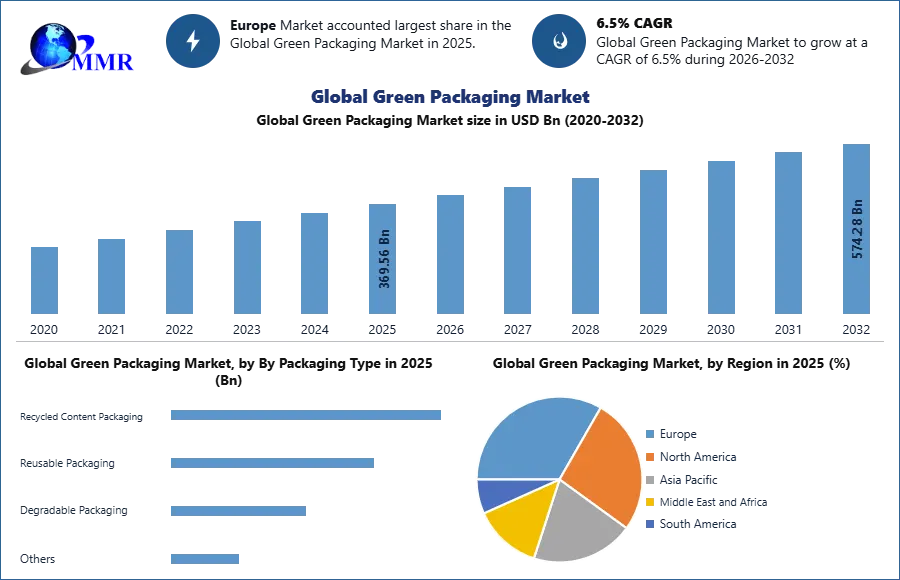
Global Green Packaging Market was valued at USD 369.56 Bn in 2025 and is expected to reach USD 574.28 Bn by 2032, growing at a CAGR of 6.5% during the forecast period.
Global Green Packaging Market Overview
Green packaging is known as eco-friendly packaging, with the use of materials and manufacturing methods that have a reduced impact on the environment compared to traditional packaging. The adoption of green packaging varies across regions, with some areas showing stronger commitments to sustainability than others. Europe and North America, for example, have been early adopters of green packaging practices. Changing consumer preferences in the green packaging market, particularly among younger demographics, are shifting toward environmentally friendly products and packaging, which boosts the Green Packaging Market growth.
With the rise of e-commerce, there is a growing need for sustainable packaging solutions tailored to the unique requirements of online retail. This includes packaging that minimizes waste and optimizes shipping efficiency. Green packaging companies not only contribute to environmental conservation but also position themselves favorably in the eyes of increasingly eco-conscious consumers.
 To know about the Research Methodology :- Request Free Sample Report
Green Packaging Market Dynamics
Growing awareness among consumers to boost the Green Packaging Market growth
Growing awareness among consumers about the environmental impact of packaging materials led to increased demand for sustainable and eco-friendly alternatives. Many Green Packaging companies are integrating environmental sustainability into their corporate social responsibility (CSR) strategies. Adopting green packaging is a way for businesses to demonstrate their commitment to environmental stewardship. Stringent regulations and policies at national and international levels are pushing companies to adopt sustainable packaging practices. These regulations include restrictions on single-use plastics, mandates for recycled content, and requirements for eco-friendly packaging, which significantly boosts the Green Packaging industry.
Green packaging, particularly when designed for efficiency, can lead to cost savings in the long term. For example, lightweight packaging can reduce transportation costs, and the use of recycled materials may lower raw material expenses. Ongoing research and technological advancements have led to the development of new, innovative green packaging materials. This includes biodegradable plastics, compostable materials, and improved recycling processes. Companies are recognizing the need to minimize their environmental footprint, and adopting green packaging is a way to address concerns related to waste generation and pollution. The concept of a circular economy, where materials are reused, recycled, or composted, is influencing packaging strategies and helps to boost the Green Packaging market growth. Green packaging aligns with this approach by promoting a more sustainable use of resources.
Availability of Suitable Alternatives to limit the Green Packaging Market growth
As there are innovative green packaging materials, the range of available options is limited compared to conventional materials, restricting the choices for certain applications. Green packaging materials and technologies are more expensive than traditional alternatives, posing a challenge for businesses, especially smaller ones or those operating on tight budgets. In some regions, the lack of adequate infrastructure for collecting, sorting, and recycling green packaging materials hinder their widespread adoption and limits the Green Packaging Market growth. Insufficient recycling facilities limit the effectiveness of recycling initiatives. Despite growing environmental awareness, some consumers don’t understand the benefits of green packaging or are resistant to change.
Education and communication efforts are crucial to overcoming this barrier. Adopting green packaging require changes throughout the supply chain, from sourcing raw materials to manufacturing processes. Some Green packaging companies find it challenging to navigate this complexity and limits the Green Packaging Market growth. Resistance to change within industries that are accustomed to traditional packaging methods is a significant barrier. Established practices and infrastructure make it challenging for some businesses to transition to green packaging. Some biodegradable materials have limitations in terms of shelf life and performance in certain conditions, which impact their suitability for specific applications.
| Exact Date | Company | Development | Impact |
|---|---|---|---|
| 09 March 2026 | Amcor | Amcor invested in a new production line at its facility in Lugo di Vicenza, Italy, specifically for high-barrier recycle-ready films. | The expansion enables large-scale production of sustainable lidding and pouches, helping global brands comply with the EU Packaging and Packaging Waste Regulation (PPWR). |
| 10 December 2025 | Ball Corporation | Ball Corporation entered a definitive agreement to acquire an 80% majority stake in Benepack, a European manufacturer of aluminum beverage cans. | This strategic acquisition optimizes Ball's manufacturing network in Belgium and Hungary, reinforcing aluminum as a circular and scalable green packaging choice. |
| 18 November 2025 | Mondi | Mondi launched an extended corrugated and solid board portfolio for the food industry following its acquisition of Schumacher Packaging. | The new portfolio provides fiber-based alternatives to plastic, significantly improving shelf visibility and meeting the demand for 100% renewable packaging structures. |
| 05 October 2025 | Huhtamaki | Huhtamaki announced the integration of Zellwin Farms to expand its sustainable molded fiber egg packaging capacity in North America. | This move strengthens the company's position in circular materials, targeting a long-term annual net sales growth of 5-6% through plastic-to-fiber conversion. |
| 22 September 2025 | Notpla | Notpla collaborated with Bidfood Catering Supplies to launch seaweed-coated takeaway boxes across the UK market. | The adoption of this plastic-free, biodegradable coating offers a truly compostable solution for thousands of foodservice customers, reducing reliance on conventional petroleum-based liners. |
| 01 July 2025 | Mars, Incorporated | Mars introduced a new mono-material recyclable pouch for its WHISKAS brand in the U.K. and Germany. | Replacing multi-layer plastic and aluminum components with mono-material designs significantly simplifies the recycling process and supports Mars' goal of 100% recyclable packaging. |
Trends in the Green Packaging Market
1. Minimalist and Sustainable Design: Adoption of minimalist packaging designs that use fewer materials, reducing waste and environmental impact.
2. Plant-Based and Renewable Materials: Increased use of plant-based and renewable materials, such as bamboo, hemp, and mushroom-based packaging.
3. E-commerce-Focused Solutions: Development of packaging solutions tailored for the unique challenges of e-commerce, such as optimizing size, reducing excess materials, and improving recyclability.
4. Smart Packaging for Sustainability: Integration of smart packaging technologies to enhance supply chain efficiency, reduce waste, and provide consumers with information on product sustainability.
Green Packaging Market Segment Analysis
In 2025, the Packaging Type segment shows the highest demand for Recycled Content Packaging and Reusable Packaging. Recycled Content Packaging remains widely adopted as companies aim to reduce environmental impact and comply with sustainability regulations while maintaining cost efficiency. Reusable Packaging is increasingly gaining traction in logistics, retail, and industrial supply chains as organizations implement circular economy practices and reduce single-use packaging waste. Degradable Packaging, including biodegradable and compostable materials, is also expanding as consumers and regulators encourage environmentally responsible alternatives. However, its adoption is sometimes limited by higher production costs and performance challenges compared to conventional materials.
Based on End User Industry, the Food and Beverage segment holds the largest demand in 2025 due to the extensive need for packaging in food safety, product preservation, and transportation. Companies are increasingly adopting sustainable packaging solutions to align with consumer preferences for eco-friendly products and comply with global environmental regulations. Personal Care and Cosmetics also represent a significant segment as brands focus on sustainable branding and recyclable or biodegradable packaging to enhance product appeal. Healthcare and Electronics sectors show steady adoption driven by the need for protective packaging combined with sustainability initiatives. Logistics and Transportation are increasingly utilizing reusable and durable packaging formats to improve supply chain efficiency and reduce waste.
Green Packaging Market Regional Insight
Green Packaging Market Competitive Landscape
Major multinational corporations and established players dominate the green packaging market. Competition exists among companies offering a wide array of green packaging materials and technologies. Companies focus on continuous innovation and invest in research and development to introduce new and improved green packaging solutions. Technological advancements and novel materials are key factors influencing competitiveness. Mergers and acquisitions are observed as companies seek to expand their product portfolios, geographic reach, and capabilities. Green Packaging companies often differentiate themselves based on their commitment to meeting or exceeding sustainability standards. Companies develop marketing strategies that highlight their commitment to sustainability and cater to the growing demand for eco-friendly products. The Green Packaging market is characterized by both global players and regional manufacturers offering localized green packaging solutions.
Green Packaging Market Scope: Inquiry Before Buying
Green Packaging Market, by Region
North America (United States, Canada and Mexico)
Europe (UK, France, Germany, Italy, Spain, Sweden, Austria and Rest of Europe)
Asia Pacific (China, South Korea, Japan, India, Australia, Indonesia, Malaysia, Vietnam, Taiwan, Bangladesh, Pakistan and Rest of APAC)
Middle East and Africa (South Africa, GCC, Egypt, Nigeria and Rest of ME&A)
South America (Brazil, Argentina Rest of South America)
Key Players /Competitor Profiles Covered in the Global Green Packaging Market Report from a Strategic Perspective.
- Amcor plc
- Tetra Pak International S.A.
- Sealed Air Corporation
- Mondi plc
- Smurfit Kappa Group
- DS Smith Plc
- Ball Corporation
- WestRock Company
- Berry Global Inc.
- Sonoco Products Company
- Huhtamäki Oyj
- International Paper Company
- Stora Enso Oyj
- Ardagh Group S.A.
- Crown Holdings Inc.
- Evergreen Packaging Inc.
- Printpack Inc.
- Coveris Holdings S.A.
- Ecolean AB
- Elopak AS
- Winpak Ltd.
- UFlex Ltd.
- Klabin S.A.
- Cascades Inc.
- BASF SE