
Digital Holographic Microscopy Market- Industry Structure Evaluation, Demand Drivers Analysis, Regional Growth Analysis and Identification, Competitive Positioning Review & Global Market Size Forecast to 2032
Overview
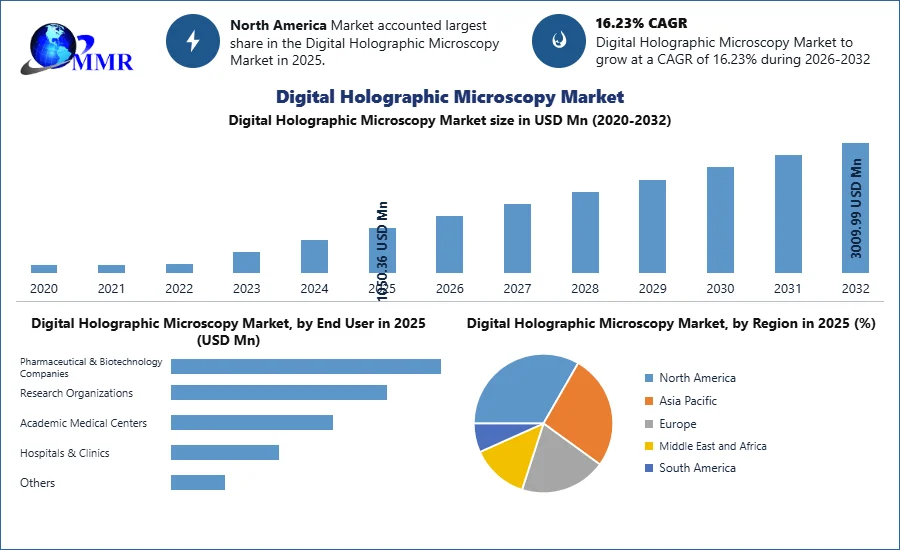
The Digital Holographic Microscopy Market size was valued at USD 1050.36 Million in 2025 and the total Digital Holographic Microscopy Market revenue is expected to grow at a CAGR of 16.23% from 2026 to 2032, reaching nearly USD 3009.99 Million.
Digital Holographic Microscopy (DHM) is an advanced imaging technique that utilizes holography principles to capture and reconstruct three-dimensional images of microscopic objects. Unlike traditional microscopy methods, DHM generates holograms by recording interference patterns of light scattered from an object, allowing for precise measurement of both amplitude and phase information. This non-destructive and label-free imaging capability makes DHM particularly valuable in biomedical research, material science, and industrial applications where high-resolution 3D imaging is critical.
The global Digital Holographic Microscopy Market has experienced significant growth driven by several key factors. Advancements in optical and computational technologies have enhanced the resolution and speed of DHM systems, expanding their applications across various industries. Increasing investments in R&D by academic institutions, pharmaceutical companies, and government agencies have accelerated the adoption of DHM for studying cellular dynamics, disease pathology, and drug discovery. The shift towards personalized medicine and the demand for precise diagnostics have further propelled the Digital Holographic Microscopy Market growth of DHM systems in healthcare settings.
Key players in the Digital Holographic Microscopy Market have been actively involved in strategic developments to maintain their competitive edge. For instance, companies like Phase Holographic Imaging AB have introduced advanced DHM systems capable of real-time imaging and analysis, catering to the evolving needs of researchers and clinicians. These systems integrate AI-driven algorithms for automated analysis and offer user-friendly interfaces, making DHM accessible to a broader audience. Collaborations between technology providers and academic institutions have led to innovations in miniaturized DHM devices suitable for point-of-care diagnostics and field applications.
Recent developments in the Digital Holographic Microscopy Market also include advancements in software solutions for data processing and image reconstruction, aimed at reducing computational complexities and improving workflow efficiency. Regulatory approvals for DHM systems in clinical diagnostics and quality control applications have opened new avenues for Digital Holographic Microscopy Market growth, particularly in regions like North America and Europe.
 To know about the Research Methodology :- Request Free Sample Report
Holographic Microscopy Market Dynamics:
Advancements in Resolution and Imaging Techniques:
Continuous improvements in resolution enhancement techniques, such as oblique illumination and structured illumination, enable Digital Holographic Microscopy Market to achieve higher spatial resolution while maintaining a wide field of view. For instance, innovations in pixel super-resolution and hologram synthesis techniques enhance imaging capabilities. DHM's label-free imaging approach is revolutionizing biomedical research by enabling real-time monitoring of cellular processes like Neutrophil Extracellular Trap (NET) formation. This capability supports advancements in understanding inflammatory diseases and clinical diagnostics. In industrial settings, DHM plays a crucial role in quality control and inspection of micro/nano components. For example, it facilitates precise measurement of surface morphology and defects in semiconductor manufacturing.
Integration of AI algorithms accelerates data analysis and enhances the efficiency of Digital Holographic Microscopy Market. AI enables real-time tracking of microorganism movements and rapid identification of bacterial pathogens, crucial for environmental monitoring and clinical diagnostics. The development of compact DHM systems with integrated waveguide illumination reduces system complexity and enhances portability. This opens new applications in field research and point-of-care diagnostics, where real-time, on-site analysis is critical. Increasing conferences and workshops dedicated to digital holography and 3D imaging indicate growing interest and investment in DHM technologies. These platforms foster collaboration and drive innovation across various disciplines, from photonics to materials science. These drivers collectively propel the digital holographic microscopy market forward, expanding its applications across diverse sectors including healthcare, manufacturing, and research. As technological advancements continue to enhance imaging capabilities and reduce system complexities, DHM is set to play an increasingly pivotal role in advancing scientific discoveries and industrial applications.
Computational Challenges in Digital Holographic Microscopy
Digital Holographic Microscopy Market faces several challenges despite its potential as a powerful 3D imaging technique. The most significant hurdle is the intensive computational requirements for holographic reconstructions. Current algorithms, like fast Fourier-transform, enable rapid reconstruction of individual z-sections of holograms on personal computers. However, the real challenge arises from handling large datasets comprised of thousands of holograms taken over time. Each hologram generates volumetric reconstructions with numerous Z-sections, resulting in massive storage demands. For instance, processing a typical 1-gigabyte holographic movie can lead to terabytes of volumetric data, requiring extended processing times that span several days on standard workstations. The high initial investment and maintenance costs associated with DHM systems pose financial barriers, limiting their widespread adoption across industries. These costs include not only acquiring sophisticated equipment but also ongoing expenses for system calibration and updates.
The complexity of integrating Digital Holographic Microscopy Market with existing microscopy techniques. While DHM offers unique advantages such as label-free imaging and non-invasive measurements, its integration with traditional methods like confocal microscopy requires meticulous calibration and synchronization protocols. This complexity can deter users who seek seamless integration without compromising operational efficiency. Regulatory compliance and standardization issues present additional challenges for DHM adoption. Ensuring compliance with industry regulations and standards in different regions requires substantial effort and resources, impacting Digital Holographic Microscopy Market penetration. The prospects for DHM are promising. Ongoing advancements in computational algorithms are expected to mitigate processing bottlenecks, enhancing the efficiency and speed of holographic reconstructions. Moreover, increasing research and development activities aimed at improving system affordability and usability are likely to broaden DHM's application scope across diverse sectors, including biomedical research, healthcare diagnostics, and industrial quality control.
Digital Holographic Microscopy Market Segment Analysis:
Based on End-User, The Digital Holographic Microscopy Market shows diverse adoption patterns across different end-user segments. Pharmaceutical and biotechnology companies, constituting 24.1% of the Digital Holographic Microscopy Market, utilize DHM for high-resolution imaging of cellular structures and drug interactions, aiding in drug development and quality control processes. Research organizations, comprising 21.4%, heavily leverage DHM for fundamental research in biology, materials science, and nanotechnology, benefiting from its label-free imaging capabilities and precise measurement features. Academic medical centers, accounting for the largest share at 31.0%, integrate DHM into various medical disciplines such as pathology, dermatology, and ophthalmology for diagnostic purposes and advanced research into disease mechanisms. Academic medical centers dominate DHM adoption due to its versatile applications in medical research and diagnostics. Pharmaceutical and biotechnology companies and research organizations contribute significantly to the market's growth by leveraging DHM's advanced imaging capabilities tailored to their specific needs and disciplines.
Digital Holographic Microscopy Market Regional Insights:
North America leads the global Digital Holographic Microscopy Market with a dominant share of 33.5%. This region's leadership is attributed to its advanced healthcare infrastructure, significant investments in research and development (R&D), and early adoption of cutting-edge technologies across industries. In the healthcare sector, DHM is extensively used for biomedical research, cancer diagnostics, and cellular imaging due to its high resolution and non-invasive capabilities. Academic institutions and pharmaceutical companies in the United States and Canada drive much of this demand, aiming to enhance diagnostic accuracy and accelerate drug discovery processes.
Europe follows closely with a substantial Digital Holographic Microscopy Market share of 28.2%. Countries like Germany, France, and the UK are at the forefront of DHM adoption in both academic research and clinical applications. European universities and research organizations leverage DHM for studying cell biology, neuroscience, and materials science. Collaborations between academia and industry players enhance technological advancements in DHM systems, catering to diverse applications from healthcare to industrial quality control.
Asia Pacific emerges as a rapidly growing region in the Digital Holographic Microscopy Market, projected to expand significantly with a share of 24.6%. Countries like Japan, China, and South Korea are investing heavily in healthcare infrastructure and technological innovation. In Asia Pacific, DHM finds applications in clinical diagnostics, where it aids in early disease detection and treatment monitoring. Growing initiatives in biotechnology and life sciences research further propel Digital Holographic Microscopy Market growth, supported by government funding and private investments.
While North America maintains its dominance in the Digital Holographic Microscopy Market, Europe and Asia Pacific are pivotal regions driving substantial growth. The Middle East and Africa are gradually embracing DHM in healthcare, while South America presents emerging opportunities. Each region's adoption is influenced by local healthcare priorities, research capabilities, and investments, shaping the global landscape of digital holographic microscopy.

Digital Holographic Microscope Market Competitive Landscape
The competitive landscape in the digital holographic microscope market includes key players like WiMi Hologram Cloud Inc., Lyncée Tec, and Phase Holographic Imaging AB. WiMi's recent advancements in digital holography, coupled with innovations from other companies, are driving market growth. These developments enhance precision and non-contact measurements, essential for micro/nano component inspection. As companies continuously innovate, integrating advanced algorithms and imaging techniques, the Digital Holographic Microscopy Market is poised for significant expansion. Increased demand for high-resolution 3D imaging in medical, industrial, and research applications will further propel Digital Holographic Microscopy Market growth.
April 21, 2023, WiMi Hologram Cloud Inc. announced the development of the WIMI Digital Holographic Microscope System to address challenges in phase information acquisition, zero-order image, and conjugate image interference in optical technology. The system employs coherent optical imaging theory and digital holography for 3D surface shape detection of micro/nano components. It uses a digital holographic angular spectrum reconstruction algorithm and scanning techniques to create a complete 3D morphology of the object. The system digitizes the entire holographic process, utilizing a charge-coupled device and an angle algorithm to achieve high-precision, non-contact, and non-destructive measurements.
Digital Holographic Microscopy Market Scope: Inquire before buying
| Global Digital Holographic Microscopy Market | |||
|---|---|---|---|
| Report Coverage | Details | ||
| Base Year: | 2025 | Forecast Period: | 2026-2032 |
| Historical Data: | 2018 to 2023 | Market Size in 2025: | US $ 1050.36 Mn. |
| Forecast Period 2026 to 2032 CAGR: | 16.23% | Market Size in 2032: | US $ 3009.99 Mn. |
| Segments Covered: | by Offering | Hardware Software |
|
| by Type | Lаbеl-Frее Іntеrfеrоmеtrіс Тесhnіquе Quаntіtаtіvе Рhаѕе Іmаgе |
||
| by End User | Рhаrmасеutісаl & Віоtесhnоlоgу Соmраnіеѕ Rеѕеаrсh Оrgаnіzаtіоnѕ Асаdеmіс Меdісаl Сеntеrѕ Ноѕріtаlѕ & Сlіnісѕ Others |
||
Digital Holographic Microscopy Market, by Region
North America (United States, Canada and Mexico)
Europe (UK, France, Germany, Italy, Spain, Sweden, Austria, Turkey, Russia and Rest of Europe)
Asia Pacific (China, India, Japan, South Korea, Australia, ASEAN and Rest of APAC)
Middle East and Africa (South Africa, GCC, Egypt, Nigeria and Rest of ME&A)
South America (Brazil, Argentina, Columbia and Rest of South America)
Digital Holographic Microscopy Market, Key Players:
1. Holoxica Limited
2. Hübner Photonics GmbH
3. LYNCEE TEC
4. MetroLaser Inc.
5. Ovizio
6. Phase Holographic Imaging
7. SCHAEFER-TEC
8. TRIMOS
FAQs:
1. What are the growth drivers for the Digital Holographic Microscopy Market?
Ans. Advancements in Resolution and Imaging Techniques are expected to be the major driver for the Market.
2. What is the major challenges for the Market growth?
Ans. Computational Challenges in Digital Holographic Microscopy are expected to be the major challenges in the Market.
3. Which country is expected to lead the global Market during the forecast period?
Ans. North America is expected to lead the Market during the forecast period.
4. What is the projected market size and growth rate of the Digital Holographic Microscopy Market?
Ans. The Digital Holographic Microscopy Market size was valued at USD 1050.36 Million in 2025 and the total Digital Holographic Microscopy Market revenue is expected to grow at a CAGR of 16.23% from 2026 to 2032, reaching nearly USD 3009.99 Million.
5. What segments are covered in the Market report?
Ans. The segments covered in the Market report are by Offering, Type, End-User, and Region.