
Wound Care Market - Industry Structure Evaluation, Demand Drivers Analysis, Regional Growth Analysis and Identification, Competitive Positioning Review & Global Market Size Forecast to 2032
Overview
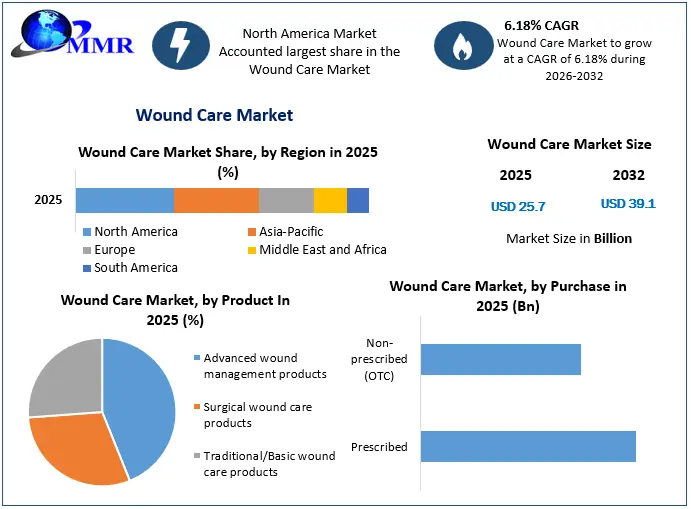
The Wound Care Market size was valued at USD 25.7 Billion in 2025 and the total Wound Care revenue is expected to grow at a CAGR of 6.18% from 2026 to 2032, reaching nearly USD 39.1 Billion.
To know about the Research Methodology :- Request Free Sample Report
Wound Care Market Dynamics:
Rising Prevalence of Chronic Wounds and Aging Population Supporting Market Growth
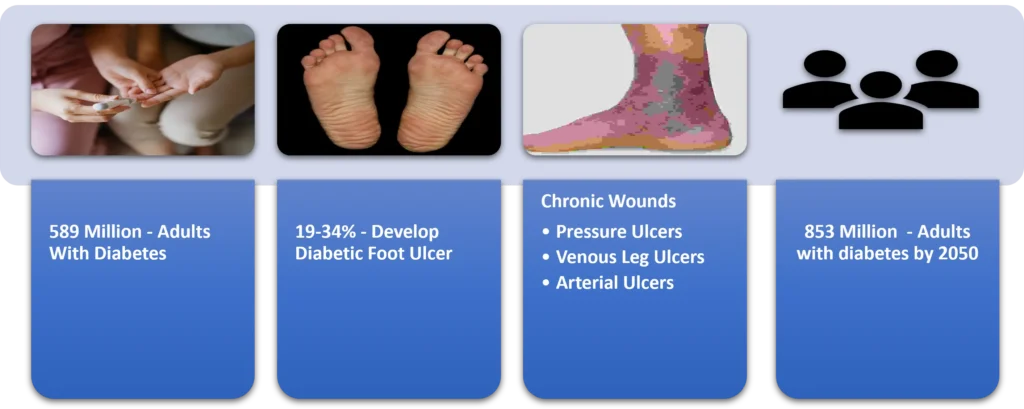
The increase in the cases of diabetes, obesity, peripheral vascular disease, and other chronic conditions caused the significant raise in the number of patients suffering from diabetic foot ulcers, venous leg ulcers, and pressure ulcers. These factors combining with rising geriatric population with lower healing capacity driving a demand for advanced wound care solutions and management across hospitals, specialty wound clinics and home healthcare settings
Increasing Surgical Procedures and Trauma Cases driving Product Adoption
The growing incidence of surgical procedures, burn injuries, road accidents, and sports-related trauma is demanding the need for effective wound care products that minimizes infection risks and improves healing process through tissue repair. Healthcare providers and emergingly adopting advanced wound treatment practices , healthcare care management solutions like negative pressure wound therapy ,advanced surgical procedures continuously expanding the market.
High Cost of Advanced Wound Care Products Limiting Market Penetration
Despite their clinical advantages, advanced wound care therapies, bioengineered skin substitutes, and NPWT devices are expensive to invest in the current scenarios. Limited reimbursement coverage in developing countries and budget constraints among healthcare providers continue to restrict the widespread adoption of premium wound care products, particularly in low- and middle-income regions.
Wound Care Market Trends:
Regenerative Medicine and Bioengineered Skin Substitutes Gaining Momentum -Manufacturers are investing in regenerative wound care technologies, such as collagen dressings, extracellular matrix (ECM) products, bioengineered skin substitutes, stem cell therapies, and growth factor-based treatments.
Digital Wound Assessment and AI-Enabled Remote Monitoring Transforming Wound Management - Healthcare providers are increasingly adopting AI-powered wound imaging, digital measurement tools, telemedicine platforms, and cloud-based wound documentation systems to inspect and monitor wound progression remotely and optimize treatment decisions.
Growing Adoption of Antimicrobial Dressings and Portable NPWT Systems - The increasing focus on infection prevention and outpatient care is driving demand for silver-based, iodine-based, PHMB, and honey-impregnated antimicrobial dressings, alongside portable and single-use negative pressure wound therapy (NPWT) devices.
Wound Care Market Segment Analysis:.
The By Product segment is divided into Advanced wound management products, Surgical wound care products, and Traditional/Basic wound care products.
Advanced wound management products dominate the wound care market due to their effiecient ability to accelerate healing, manage exudate, reduce infection risk, and improve patient outcomes in chronic and complex wounds. This segment includes foam dressings, hydrocolloids, alginates, hydrofiber dressings, antimicrobial dressings, collagen dressings, negative pressure wound therapy (NPWT) systems, and bioengineered skin substitutes. Rising spread of diabetic foot ulcers, pressure ulcers, venous leg ulcers, and other chronic wounds is driving strong adoption of advanced wound care solutions across hospitals, specialty wound clinics, and home healthcare settings.
Surgical wound care products are expected to witness significant growth due to the increasing number of surgical procedures, trauma cases, burn injuries, and orthopedic interventions worldwide. This segment includes surgical dressings, sutures, staples, tissue adhesives, hemostatic agents, and postoperative wound management products used to reduce complications and support faster recovery. Traditional/Basic wound care products such as gauze, cotton, adhesive bandages, and simple dressings continue to maintain steady demand because of their low cost, widespread availability, and use in minor wounds and primary care settings.
The By Type segment comprises Chronic and Acute wounds.
Chronic wounds holds the largest share of the wound care market because they require prolonged treatment, frequent dressing changes, advanced therapies, and ongoing clinical monitoring. Chronic wounds include diabetic foot ulcers, pressure ulcers, venous leg ulcers, arterial ulcers, and other non-healing wounds that are commonly associated with diabetes, obesity, vascular disorders, and aging. The rising global diabetic population and increasing prevalence of mobility-related conditions have substantially expanded the patient pool requiring long-term wound management. Due to this, advanced wound dressings, NPWT devices, regenerative therapies, collagen products, and antimicrobial wound care solutions are extensively used in this segment, making chronic wounds the primary revenue-generating category for manufacturers.
Acute wounds are projected to grow steadily due to rising surgical volumes, trauma injuries, burns, sports injuries, and accident-related wounds. Acute wounds generally heal within shorter timeframe and requires surgical incisions, lacerations, abrasions, burns, and traumatic injuries. Demand in this segment is supported by increasing hospitalization rates, expanding outpatient surgical procedures, and wide use of which prevents infections such as antimicrobial dressings and portable NPWT systems. Though acute wound segment holds largest patient pool, it is going to generate less revenue due patients lower expenditure on acute wounds than chronic wounds
Wound Care Market Recent Developments:
| Date | Recent Development |
| 10 Jun 2025 | Smith+Nephew plc has expanded clinical evidence supporting its PICO™ Single Use Negative Pressure Wound Therapy (sNPWT) system, reinforcing its effectiveness in reducing surgical site complications and accelerating postoperative wound healing. |
| 24 Apr 2025 | Solventum (formerly 3M Health Care) expanded its advanced wound care portfolio with continued innovation in V.A.C.® Therapy and antimicrobial dressing solutions, strengthening its presence in hospital and outpatient wound management. |
| 18 Feb 2025 | Mölnlycke Health Care AB expanded its Mepilex® dressing portfolio with advanced foam dressing solutions designed to improve exudate management and minimize skin damage in chronic wound treatment. |
| 12 Nov 2024 | Convatec Group plc introduced new AQUACEL® Ag+ wound dressing improvement aimed at improving biofilm management and reducing infection risks in chronic and hard-to-heal wounds. |
| 09 Sep 2024 | Coloplast A/S expanded its Biatain® Silicone wound care range with advanced silicone foam dressings developed to improve patient comfort and wound healing outcomes in both acute and chronic wounds. |
Wound Care Market Competitive Landscape:
The global wound care market is highly competitive and characterized by continuous innovation in advanced wound dressings, negative pressure wound therapy (NPWT), regenerative wound care, bioengineered skin substitutes, antimicrobial dressings, and digital wound management technologies. Leading market participants are focusing on expanding their product portfolios through strategic acquisitions, product launches, partnerships, and investments in regenerative medicine, AI-enabled wound assessment, and home healthcare solutions to strengthen their market positions. Companies are prioritizing the development of collagen-based dressings, portable NPWT systems, bioactive wound care products, and infection prevention technologies to address the growing burden of chronic wounds, including diabetic foot ulcers, pressure ulcers, and venous leg ulcers.
Major players such as Smith+Nephew plc, Mölnlycke Health Care AB, 3M Company (Solventum), Convatec Group plc, Coloplast A/S, Integra LifeSciences Holdings Corporation, Organogenesis Holdings Inc., MiMedx Group, Inc., Essity AB (BSN Medical), B. Braun SE, Cardinal Health, Inc., and Medline Industries, LP continue to invest in next-generation wound care technologies, regenerative therapies, and digital wound management platforms. The market is also witnessing increasing collaboration between medical device manufacturers and healthcare providers to enhance clinical outcomes, improve patient monitoring, and expand access to advanced wound care products across hospitals, specialty wound clinics, and home healthcare settings.
Wound Care Market Scope: Inquire before buying
| Global Wound Care Market | |||
|---|---|---|---|
| Report Coverage | Details | ||
| Base Year: | 2025 | Forecast Period: | 2026-2032 |
| Historical Data: | 2020 to 2025 | Market Size in 2025: | USD 25.7 Bn. |
| Forecast Period 2026 to 2032 CAGR: | 6.18% | Market Size in 2032: | USD 39.1 Bn. |
| Segments Covered: | By Product | Advanced wound management products Surgical wound care products Traditional/Basic wound care products |
|
| By Type | Chronic Acute |
||
| By End User | Hospital Long term care Home healthcare |
||
| By Purchase | Prescribed Non-prescribed (OTC) |
||
| By Distribution Channel | Institutional Sales Retail Sales |
||
Wound Care Market by Region:
1. North America (United States, Canada, and Mexico)
2. Europe (UK, France, Germany, Italy, Spain, Sweden, Austria, and the Rest of Europe)
3. Asia Pacific (China, South Korea, Japan, India, Australia, Indonesia, Malaysia, Vietnam, Taiwan, Bangladesh, Pakistan, and the Rest of APAC)
4. Middle East and Africa (South Africa, GCC, Egypt, Nigeria, and the Rest of ME&A)
5. South America (Brazil, Argentina Rest of South America)
Wound Care Market, Key Players:
North America
- 3M Company (Solventum) – United States
- Integra LifeSciences Holdings Corporation – United States
- Organogenesis Holdings Inc. – United States
- Baxter International Inc. – United States
- Johnson & Johnson (Ethicon) – United States
- Medline Industries, LP – United States
- DeRoyal Industries, Inc. – United States
Europe
- Smith+Nephew plc – United Kingdom
- ConvaTec Group Plc – United Kingdom
- Mölnlycke Health Care AB – Sweden
- Coloplast A/S – Denmark
- PAUL HARTMANN AG – Germany
- Essity AB (BSN Medical) – Sweden
- Lohmann & Rauscher GmbH & Co. KG – Germany
Asia Pacific
- Nitto Denko Corporation – Japan
- Gunze Limited – Japan
- Winner Medical Co., Ltd. – China
- Healthium Medtech Limited – India
- Triage Meditech Pvt. Ltd. – India
Others
Frequently Asked Questions:
1. What are the growth drivers for the Wound Care market?
Ans. The Increasing incidences of chronic wounds due to aging populations and lifestyle-related ailments, Advancements in wound care technologies and therapies, Rising surgical procedures, and trauma cases demanding efficient wound management are expected to be the major driver for the Wound Care market.
2. What is the major restraint for the Wound Care market growth?
Ans. Limited reimbursement policies and complexities in the regulatory landscape are expected to be the major restraining factors for the Wound Care market growth.
3. Which region is expected to lead the global Wound Care market during the forecast period?
Ans. North America is expected to lead the global Wound Care market during the forecast period.
4. What is the projected market size and growth rate of the Wound Care Market?
Ans. TheWound Care Market size was valued at USD 25.7 Billion in 2025 and the total Wound Care revenue is expected to grow at a CAGR of 6.18% from 2026 to 2032, reaching nearly USD 39.1 Billion.
5. What segments are covered in the Wound Care Market report?
Ans. The segments covered in the Wound Care market report are Product, Type, Purchase, Distribution Channel, End User, and Region.