
Global Healthcare Analytics Market by Type, by Component, by Delivery Mode, by Applications, by End-Use, by Region and Forecast 2034
Overview
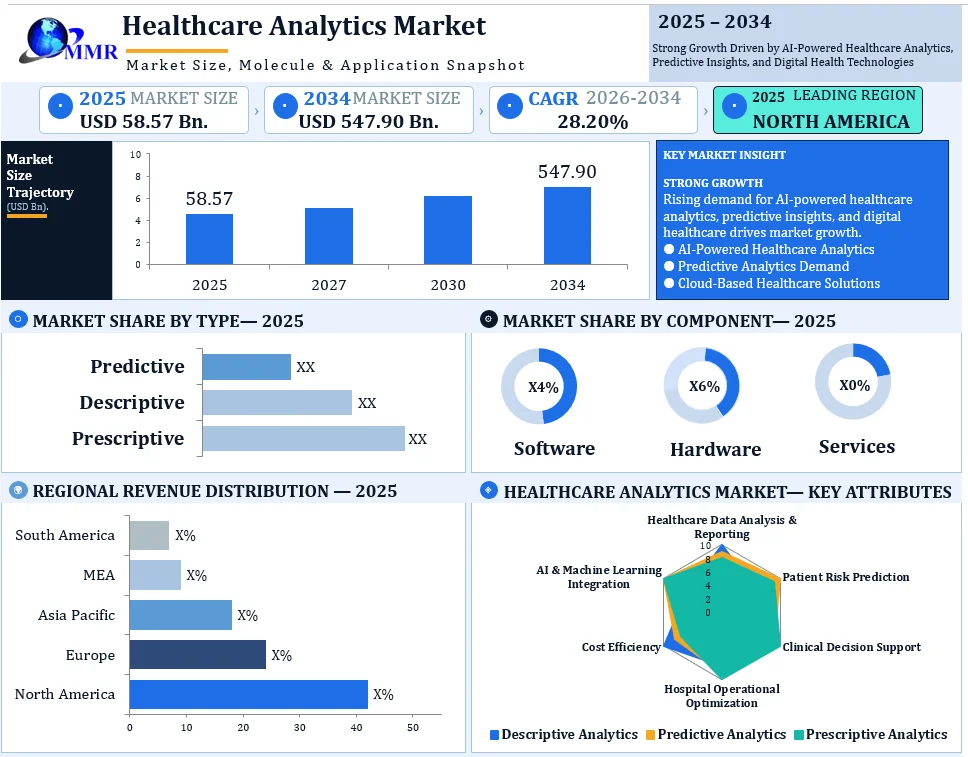
The Global Healthcare Analytics Market was valued at USD 58.57 Billion in 2025 and is projected to reach USD 547.90 Billion by 2034, growing at a CAGR of 28.20% during the forecast period 2026–2034.
| Parameter | Value |
| Market Size (2025) | USD 58.57 Billion |
| Market Size (2034) | USD 547.90 Billion |
| CAGR | 28.20% |
| Historical Period | 2020 to 2025 |
| Forecast Period | 2026 to 2034 |
Global Healthcare Analytics Market Overview
The Healthcare Analytics Market covers advanced healthcare data analytics technologies, software platforms, and services that analyze clinical, financial, and operational data to support evidence-based decision-making across healthcare organizations. Healthcare analytics uses descriptive analytics, predictive analytics, prescriptive analytics, artificial intelligence (AI), machine learning, and healthcare big data analytics to identify patient health patterns, optimize hospital operations, and improve healthcare service delivery. The Global Healthcare Analytics Market plays an important role in reducing healthcare costs, improving patient outcomes, supporting clinical decision-making, and strengthening population health management. Hospitals, pharmaceutical companies, and health insurance providers utilize healthcare analytics software, electronic health record (EHR) analytics, clinical data intelligence, and healthcare business intelligence solutions to improve treatment planning, resource utilization, and financial performance. Increasing demand for value-based healthcare, digital health technologies, and efficient medical data management strengthens Healthcare Analytics Market growth.
The Healthcare Analytics Industry is transforming through increasing adoption of AI-powered healthcare analytics, cloud-based healthcare analytics platforms, predictive patient risk modeling, real-time clinical analytics, and advanced healthcare data integration technologies. Healthcare providers increasingly use analytics platforms to support disease prediction, hospital readmission analysis, patient monitoring, and clinical workflow optimization, while healthcare payers adopt insurance claims analytics, revenue cycle management analytics, fraud detection, and healthcare financial analytics. Major buyers include hospitals, healthcare networks, insurance companies, pharmaceutical manufacturers, biotechnology companies, and research organizations. Expanding investments in generative AI healthcare analytics, population health management, interoperability solutions, remote patient monitoring analytics, and healthcare data security create opportunities for technology vendors and healthcare analytics service providers. Growing demand for cloud deployment, automated healthcare reporting, and intelligent medical decision-support systems supports Healthcare Data Analytics Market expansion and digital healthcare transformation.
North America leads the Global Healthcare Analytics Market in MMR's regional assessment, supported by advanced healthcare IT infrastructure, electronic health record adoption, healthcare technology investment, and established analytics software providers. The United States and Canada represent important markets for predictive healthcare analytics, clinical decision support, and AI-powered hospital analytics, while Asia Pacific presents opportunities across China, India, Japan, and South Korea through expanding healthcare digitization and hospital modernization. Leading Healthcare Analytics Market key players include IBM, Oracle Corporation, Microsoft Corporation, SAS Institute, Health Catalyst, IQVIA, Cognizant, and Mede Analytics. For example, Health Catalyst provides healthcare data analytics platforms for clinical and operational performance improvement, while SAS Institute offers advanced analytics and AI solutions for healthcare decision-making. Maximize Market Research (MMR) evaluates Healthcare Analytics Market size, share, growth drivers, technology segmentation, deployment models, regional demand, and competitive positioning. Its published research places the market at USD 58.57 Billion in 2025 and projects USD 547.90 Billion by 2034, representing a 28.2% CAGR during 2026–2034. The analysis identifies descriptive analytics, healthcare analytics software, financial applications, and healthcare providers as leading segments in its 2025 assessment, highlighting opportunities in predictive analytics, healthcare operational efficiency, data-driven patient care, and advanced healthcare analytics technologies.
Global Healthcare Analytics Market Highlights
Global Healthcare Analytics Market Size, Growth and Share Analysis
To know about the Research Methodology :- Request Free Sample Report
Global Healthcare Analytics Market Dynamics
Drivers: Increasing Healthcare Data Volumes, Chronic Disease Burden and Demand for Data-Driven Patient Care Accelerate Healthcare Analytics Market Growth
The Global Healthcare Analytics Market is driven by growing electronic health record (EHR) adoption, increasing chronic disease management requirements, and rising demand for cost-effective healthcare services. Hospitals and healthcare providers utilize clinical data analytics, predictive healthcare analytics, and healthcare business intelligence software to monitor patient outcomes, reduce hospital readmissions, and improve resource allocation. For example, healthcare analytics dashboards track 30-day hospital readmission rates, average patient length of stay in days, and treatment costs per patient in USD to support clinical and financial decisions. Increasing healthcare digitalization, value-based reimbursement, and population health management strengthen Healthcare Analytics Market demand and healthcare data analytics industry growth.
Restraints: High Implementation Costs, Patient Data Privacy Regulations and Limited Healthcare IT Budgets Restrict Market Expansion
The Healthcare Analytics Market faces restraints from expensive analytics software implementation, cloud infrastructure investments, cybersecurity requirements, and strict patient information protection regulations. Healthcare organizations must protect sensitive electronic medical records, insurance claims data, laboratory results, and patient billing information while complying with healthcare data privacy requirements such as HIPAA and GDPR. Advanced healthcare analytics platforms involve software licensing fees, data storage costs, system integration expenses, and ongoing technical maintenance, increasing financial pressure on smaller hospitals and clinics. Limited IT budgets, complex procurement processes, and concerns regarding unauthorized medical data access restrict Healthcare Analytics Software Market adoption and healthcare technology investment.
Opportunities: Expansion of Cloud-Based Healthcare Analytics, Digital Health Platforms and Emerging Healthcare Markets Creates New Revenue Potential
The Global Healthcare Analytics Market presents significant opportunities through expanding adoption of cloud-based healthcare analytics, healthcare analytics software-as-a-service (SaaS), remote patient monitoring, and population health management platforms. Healthcare technology providers develop scalable analytics solutions for hospitals, insurance companies, and pharmaceutical organizations seeking flexible data processing and lower infrastructure management requirements. For example, remote patient monitoring analytics platforms process 24/7 connected-device data, including heart rate in beats per minute (bpm), blood pressure in mmHg, and blood glucose in mg/dL where supported. Growing healthcare modernization across India, China, Brazil, and the GCC creates opportunities for Healthcare Data Analytics Market expansion, cloud analytics services, and digital healthcare investments.
Challenges: Healthcare Data Interoperability, Data Quality and AI Model Reliability Increase Analytics Implementation Complexity
The Healthcare Analytics Industry faces challenges involving fragmented hospital information systems, inconsistent medical records, incomplete datasets, and complex healthcare data integration. Healthcare organizations must combine electronic health records, laboratory information systems, medical imaging data, pharmacy records, and insurance claims into reliable analytics platforms. Standards such as HL7 FHIR R4 and ICD-10 support healthcare information exchange and clinical data classification, but differences in implementation create technical difficulties. Healthcare analytics providers also address algorithmic bias, inaccurate predictions, model validation, and data governance requirements. Maintaining healthcare data interoperability, clinical analytics accuracy, secure data integration, and reliable AI decision-support systems remain essential for successful deployment.
Trends: Generative AI, Real-Time Predictive Analytics and Intelligent Healthcare Automation Transform the Market
The Global Healthcare Analytics Market is witnessing increasing adoption of generative AI in healthcare analytics, machine learning algorithms, natural language processing (NLP), real-time hospital dashboards, and automated healthcare reporting. Healthcare software developers introduce advanced analytics platforms that summarize clinical documents, identify operational patterns, and support predictive patient risk assessment. For example, AI-powered analytics applications evaluate 30-day and 90-day patient outcome indicators, while hospital business intelligence dashboards monitor bed occupancy percentages, patient admission trends, and financial performance. Growing interest in FHIR-enabled healthcare analytics, explainable AI, healthcare data Lakehouse platforms, and intelligent clinical decision support shapes Healthcare Analytics Market trends and technology innovation through 2034.
Global Healthcare Analytics Market Segment Analysis
Global Healthcare Analytics Market, by Delivery Mode
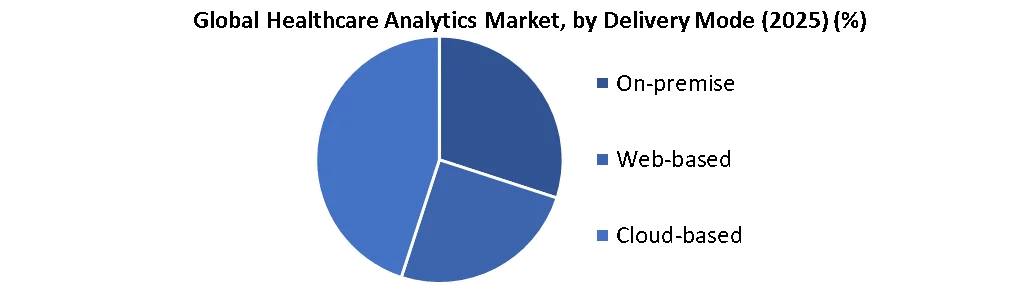
The Healthcare Analytics Market is segmented by delivery mode into On-premise, Web-based, and Cloud-based Healthcare Analytics. On-premise Healthcare Analytics provides healthcare organizations with direct control over patient data, healthcare IT infrastructure, clinical analytics software, and sensitive medical information, supporting data security and regulatory compliance. Web-based Healthcare Analytics enables hospitals, healthcare providers, and insurance companies to access healthcare data analytics dashboards, clinical reporting tools, and healthcare business intelligence solutions through web browsers. Cloud-based Healthcare Analytics supports scalable data storage, real-time healthcare analytics, AI-powered predictive analytics, machine learning, electronic health record (EHR) integration, and population health management. Increasing adoption of Healthcare Analytics SaaS Platforms, Cloud Healthcare Data Management, Predictive Healthcare Analytics, Hospital Analytics Software, and Digital Healthcare Solutions strengthens Healthcare Analytics Market growth, technological innovation, and market opportunities through 2034.
Global Healthcare Analytics Market, by End User
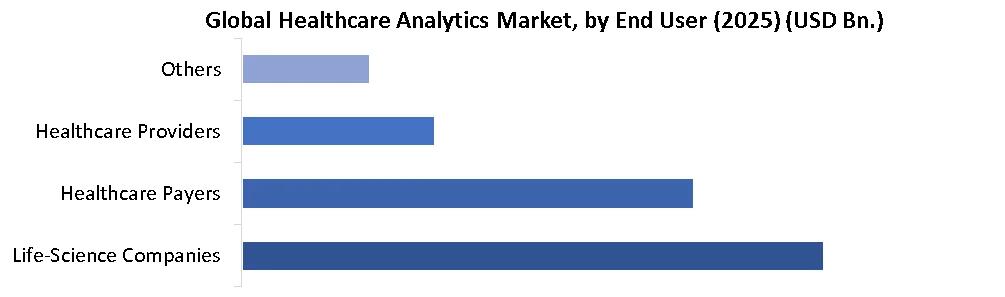
The Global Healthcare Analytics Market is segmented by end-use into Healthcare Payers, Healthcare Providers, and Others. Healthcare Payers, including health insurance companies and government healthcare programs, utilize healthcare claims analytics, insurance fraud detection, risk assessment, cost optimization, and predictive healthcare analytics to improve financial performance and reimbursement management. Healthcare Providers, including hospitals, clinics, and healthcare networks, adopt clinical data analytics, electronic health record (EHR) analytics, AI-powered healthcare analytics, patient outcome prediction, and hospital operational analytics to improve treatment decisions, patient care, and healthcare efficiency. The Others segment, including pharmaceutical companies, biotechnology firms, and healthcare research organizations, focuses on clinical trial analytics, real-world evidence, pharmaceutical data analytics, and population health research. Increasing adoption of Healthcare Big Data Analytics, Cloud-Based Healthcare Analytics, Value-Based Care Analytics, and Healthcare Business Intelligence Solutions supports Healthcare Analytics Market growth and industry opportunities through 2034.
Global Healthcare Analytics Market Regional Insights
North America: North America leads the Global Healthcare Analytics Market, supported by advanced healthcare IT infrastructure, strong electronic health record (EHR) adoption, and increasing investment in digital healthcare technologies. The United States and Canada drive demand for AI-powered healthcare analytics, predictive analytics, clinical data analytics, and healthcare business intelligence solutions.
Europe: The Europe Healthcare Analytics Market benefits from healthcare digitalization, strict data protection requirements, and increasing adoption of advanced medical analytics platforms. Germany, the UK, France, and Italy support demand for cloud-based healthcare analytics, hospital data management, population health analytics, and healthcare interoperability solutions.
Asia Pacific: The Asia Pacific Healthcare Analytics Market presents significant growth opportunities through expanding healthcare infrastructure, hospital modernization, and increasing adoption of digital health technologies. China, India, Japan, and South Korea strengthen demand for healthcare big data analytics, AI-driven clinical analytics, predictive healthcare software, and cloud-based healthcare solutions.
Middle East & Africa: The Middle East & Africa Healthcare Analytics Market expands through healthcare modernization initiatives, digital hospital investments, and increasing demand for efficient patient data management. Saudi Arabia, the UAE, and South Africa support adoption of healthcare analytics software, hospital operational analytics, electronic medical record analytics, and AI-powered healthcare technologies.
South America: The South America Healthcare Analytics Market experiences growing demand for healthcare digital transformation, medical data management, and cost-effective hospital operations. Brazil, Argentina, and Colombia create opportunities for healthcare predictive analytics, revenue cycle management analytics, healthcare business intelligence, and cloud-based clinical analytics platforms.
Global Healthcare Analytics Market Recent Developments
| Published Date | Recent Developments |
|---|---|
| 20 October 2026 | Microsoft announces a five-year strategic partnership with SickKids Hospital in Canada to advance AI-powered healthcare analytics, Microsoft Azure cloud infrastructure, predictive clinical analytics, and precision healthcare technologies. |
| 13 October 2026 | IQVIA expands its strategic partnership with Veeva Systems to strengthen clinical trial data analytics, healthcare data management, pharmaceutical research efficiency, and data-driven clinical decision-making. |
| 1 October 2026 | SAS Institute partners with North Carolina State University to advance artificial intelligence research, healthcare big data analytics, predictive healthcare modeling, and AI-driven medical research innovation. |
| 23 September 2026 | Oracle Corporation introduces enhanced AI capabilities in Oracle Life Sciences Data Intelligence, supporting real-world healthcare data analytics, predictive analytics, clinical research intelligence, and natural-language data analysis. |
| 20 August 2026 | Innovaccer announces a partnership with Impact Primary Care Network to expand population health management analytics, AI-enabled care management, patient risk prediction, and cloud-based healthcare analytics solutions. |
Global Healthcare Analytics Market Competitive Landscape
The Global Healthcare Analytics Market competitive landscape reflects increasing competition among healthcare technology companies, healthcare data analytics software providers, artificial intelligence developers, and digital health solution providers. Leading Healthcare Analytics Market key players, including Microsoft Corporation, Oracle Corporation, IBM, SAS Institute, IQVIA, Health Catalyst, Cognizant, Innovaccer, and Mede Analytics, focus on AI-powered healthcare analytics, predictive analytics, cloud-based healthcare software, healthcare big data management, and strategic partnerships. Microsoft provides Azure-based healthcare data and AI solutions, while Oracle offers healthcare data intelligence and clinical analytics technologies. SAS Institute delivers advanced analytics and machine learning solutions, while Health Catalyst provides healthcare data platforms for clinical and operational performance improvement. Increasing demand for electronic health record (EHR) analytics, population health management, revenue cycle analytics, healthcare business intelligence, and real-time patient data analytics strengthens market competition. Healthcare technology companies prioritize generative AI, data interoperability, cybersecurity, predictive patient risk modeling, and hospital workflow optimization to expand their global presence. Maximize Market Research's competitive analysis examines company market positioning, product portfolios, technological innovations, regional presence, mergers and acquisitions, strategic collaborations, and emerging Healthcare Analytics Market growth opportunities through 2034.
Healthcare Analytics Market Scope: Inquiry Before Buying
| Healthcare Analytics Market | |||
|---|---|---|---|
| Report Coverage | Details | ||
| Base Year: | 2025 | Forecast Period: | 2026-2034 |
| Historical Data: | 2020 to 2025 | Market Size in 2025: | 58.57 USD Billion |
| Forecast Period 2026-2034 CAGR: | 28.2% | Market Size in 2034: | 547.9 USD Billion |
| Segments Covered: | by Type | Prescriptive Descriptive Predictive |
|
| by Component | Software Hardware Services |
||
| by Delivery Mode | On-premise Web-based Cloud-based |
||
| by Applications | Clinical Financial Operational and Administrative |
||
| by End-Use | Healthcare Payers Healthcare Providers Life-Science Companies Others |
||
Global Healthcare Analytics Market, by Region
Asia Pacific: China, India, Japan, South Korea, Australia, Singapore, Indonesia, Malaysia, Thailand, Vietnam, Taiwan, Philippines, Bangladesh, Pakistan, and Rest of Asia Pacific.
Europe: United Kingdom, Germany, France, Italy, Spain, Sweden, Austria, Switzerland, Netherlands, Turkey, Russia, and Rest of Europe.
North America: United States, Canada, Mexico, and Rest of North America.
Middle East & Africa: Saudi Arabia, United Arab Emirates, Qatar, Kuwait, Bahrain, Oman, South Africa, Egypt, Nigeria, and Rest of Middle East & Africa.
South America: Brazil, Argentina, Colombia, Chile, Peru, and Rest of South America.
Global Healthcare Analytics Market Key Players
1. Microsoft Corporation – United States
2. Oracle Corporation – United States
3. IBM Corporation – United States
4. SAS Institute Inc. – United States
5. IQVIA Holdings Inc. – United States
6. Optum, Inc. – United States
7. McKesson Corporation – United States
8. Health Catalyst, Inc. – United States
9. MedeAnalytics, Inc. – United States
10. Inovalon Holdings, Inc. – United States
11. Veradigm LLC – United States
12. Arcadia Solutions, LLC – United States
13. Innovaccer Inc. – United States
14. Cotiviti, Inc. – United States
15. CitiusTech – United States
16. EXL Service Holdings, Inc. – United States
17. Wipro Limited – India
18. Cognizant Technology Solutions Corporation – United States
19. Infosys Limited – India
20. GE HealthCare Technologies Inc. – United States
21. Koninklijke Philips N.V. – Netherlands
22. Siemens Healthineers AG – Germany
23. Epic Systems Corporation – United States
24. athenahealth, Inc. – United States
25. Komodo Health, Inc. – United States
26. Merative – United States
27. Datavant – United States
28. HealthVerity, Inc. – United States
29. Clarify Health Solutions, Inc. – United States
30. Cedar Gate Technologies – United States
31. HealthEdge Software, Inc. – United States
32. Lightbeam Health Solutions – United States
33. Milliman, Inc. (MedInsight) – United States
34. Gainwell Technologies LLC – United States
35. Elsevier – Netherlands
36. Verisk Analytics, Inc. – United States
37. Amazon Web Services, Inc. – United States
38. Google Cloud – United States
39. InterSystems Corporation – United States
40. NextGen Healthcare, Inc. – United States
41. Edifecs, Inc. – United States
42. Vizient, Inc. – United States
43. Persivia, Inc. – United States
44. SpectraMedix – United States
45. Azara Healthcare – United States
46. Flatiron Health, Inc. – United States
47. Medidata Solutions – United States
48. Tempus AI, Inc. – United States
49. Truveta, Inc. – United States
50. Atropos Health – United States
Frequently Asked Questions:
1. What is the Global Healthcare Analytics Market size in 2025?
The Global Healthcare Analytics Market is valued at USD 58.57 Billion in 2025, supported by growing demand for AI-powered healthcare analytics, clinical data analytics, predictive healthcare software, and digital health solutions.
2. What is the Healthcare Analytics Market CAGR and forecast for 2034?
The Healthcare Analytics Market is projected to reach USD 547.90 Billion by 2034, growing at a CAGR of 28.20% during 2026–2034, driven by healthcare digital transformation, cloud-based analytics, and artificial intelligence adoption.
3. What are the major drivers of Healthcare Analytics Market growth?
Increasing electronic health record (EHR) adoption, rising healthcare data volumes, chronic disease management, and demand for predictive healthcare analytics, population health management, and AI-driven clinical decision support drive global market growth.
4. What are the major types and applications of Healthcare Analytics?
The Healthcare Analytics Market includes Descriptive Analytics, Predictive Analytics, and Prescriptive Analytics. Major applications include Clinical Analytics, Financial Analytics, and Operational & Administrative Analytics, supporting healthcare cost optimization and patient care improvement.
5. What are the key delivery modes and end users in the Healthcare Analytics Market?
Major delivery modes include On-premise, Web-based, and Cloud-based Healthcare Analytics. Key end users include Healthcare Providers, Healthcare Payers, and Others, with growing adoption of healthcare business intelligence, hospital analytics software, and insurance claims analytics.
6. Which region dominates the Global Healthcare Analytics Market?
North America leads the Healthcare Analytics Market, supported by advanced healthcare IT infrastructure, EHR adoption, and AI-powered healthcare technologies. Asia Pacific presents significant growth opportunities across China, India, Japan, and South Korea.
7. Who are the leading Healthcare Analytics Market companies, and what are the emerging trends?
Leading Healthcare Analytics Market key players include Microsoft, Oracle, IBM, SAS Institute, IQVIA, Health Catalyst, Innovaccer, and Mede Analytics. Major market trends include generative AI in healthcare, predictive analytics, cloud-based healthcare platforms, real-time clinical analytics, and healthcare data interoperability.