
Web Content Management Market - Industry Structure Evaluation, Demand Drivers Analysis, Growth Analysis and Identification, Competitive Positioning Review & Market Size Forecast to 2034
Overview
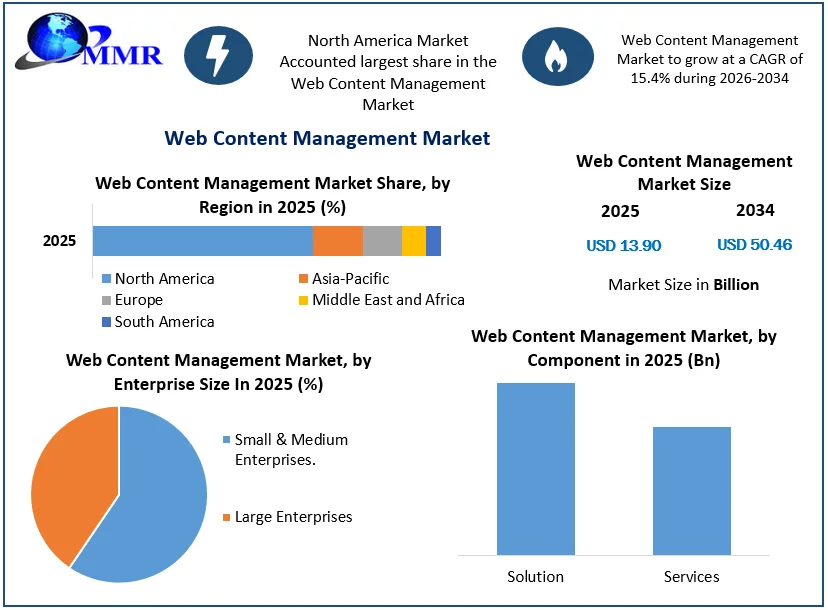
Web Content Management Market size was valued at US$ 13.90 Billion in 2025 and the total Web Content Management revenue is expected to grow at 15.4% through 2026 to 2034, reaching nearly US$ 50.46 Billion.
Web Content Management Market Overview:
A web content management system is a software-based content management system designed exclusively for web content. It offers website writing, collaboration, and administration tools to assist users with minimum understanding of web programming languages or markup languages in creating and managing website content.
Web Content Management Market Growth and Share Analysis
To know about the Research Methodology :- Request Free Sample Report
Because of the increasing popularity of digital media, there has been a paradigm change in global advertising content investment. As a result, they are pivoting toward influencer marketing, which allows them to target potential consumers. The global Web Content Management Market is predicted to grow over the forecast period (2026-2034). This might be attributed mostly to increased internet usage and the proliferation of smartphones. An increase in the need for online and data-driven digital approaches to successfully satisfy customer objectives is also likely to boost market demand throughout the forecast period (2026-2034).
The need to manage huge volumes of data properly and efficiently has led to the development of several web content solutions, which are also expected to have a favorable impact on market growth in the future years. Web Content Management may share material across several sites and is an excellent marketing tool for several businesses. As a consequence of technology advancements and the introduction of cloud-based web content solutions, businesses may boost their productivity and customer relations. These solutions improve productivity while also providing rapid access to digital content, which is expected to boost market growth.
Web Content Management Market Dynamics:
The current main driver of the global web content management market is consumers’ shift toward video-based content across the OTT platforms. The growth in worldwide media consumption is one of the primary market drivers of the Web Content Management Market. Digital formats are rapidly being used for global media consumption. Consumers may now access media material of their choosing, whether it be information, entertainment, or social activity, at any time and from any location, due to an increase in the number of digital media-capable devices and an increase in internet connection speed.
A significant restraint in the web content management market is the interoperability problem related to data integration. The data itself is the central aspect of interoperability. If a platform can't simply interchange data to and from another system, it's not fully interoperable. This implies that it is frequently insufficient merely to communicate with other systems; the program must also use common standards for the information itself. Developing web content management is critical for keeping digitally adaptive as technology and client expectations evolve. Implementing a highly integrated and seamless web content management system, on the other hand, is sometimes an expensive task.
One of the main challenges in the web content management market is a language barrier and content localization. It is not sufficient to translate material into the local tongue. It must be adapted to certain places. For a high degree of interactivity, the local audience should be able to connect with the exhibited material. Nowadays, almost every website employs a tracking or analytics service. Within the geographic data area, these tools offer users valuable statistics and demonstrate where their visitors primarily originate from. The technologies also assist businesses in determining which languages their customers use to access their websites. The data acquired from websites can suggest which additional languages websites should support to best satisfy the requirements and expectations of their visitors. Localization is the process of adapting a website to other cultural backgrounds and languages, making it easier for visitors to browse material and locate what they are searching for.
Web Content Management Market Segment Analysis:
By Component: This market segment is further sub-segmented into two parts: solution and services. The potential of the integrated Web Content Management solution to be supplied as a component of a suite or platform is linked to the rise of the integrated solution category. It is integrated with another solution to provide multiple benefits to end customers. Editing software, personalization, digital assets, document management, and record recovery are all examples of such benefits. Customers may benefit from a variety of data protection options from a single solution by doing so.
By Deployment Type: The web content management market is classified into cloud and on-premises. The cloud deployment sector is expected to grow at a CAGR of xx% over the projected period (2025-2034). It is owing to the low time and capital requirements, as well as the ease of deployment.
By Enterprise Size: The market is sub-segmented into Large Enterprises and Small & Medium Enterprises. The Large Enterprises market held the highest share in the global web content management market by enterprise size in 2025. The small & medium enterprises market is expected to witness a CAGR of 16.28 % during (2026 - 2034).
By Application: This segment is sub-segmented into Website Management, Social Media Management, Document Management, Content Scheduling, Workflow Management, and Others. Over the projected period (2025-2034), the social media management segment is expected to grow at a rapid CAGR of xx%. It is because of factors such as the increasing need for companies to boost their online presence on numerous social media platforms by creating, posting, and reviewing user posts.
By End-User: The sub-segments are Media & Entertainment, Retail & E-Commerce, Travel & Hospitality, Healthcare, Telecom & IT, Government & Public Sector, and Others. Over the projection period (2025-2034), the healthcare sector would increase at a rapid rate. The growing demand for real-time patient record-keeping and increased patient care across numerous channels is driving the use of Web Content Management systems and services. Furthermore, the desire for better patient experiences and better & quality care for tailored therapies in real-time will promote the expansion of Web Content Management systems throughout the healthcare industrial industry.
Web Content Management Market Regional Insights:
During the projection period (2025-2034), the North American web content management market expected to grow at a CAGR of 12.7%. The North American region is made up of numerous industrialized countries with high rates of technological advancements. The growing population of tech-savvy clients in countries like Canada and the United States will support the expansion of the Web Content Management industry in this area. Furthermore, businesses in this region are rapidly embracing cutting-edge technology to improve their digital presence and attract a large client base.
During the forecast period (2026-2034), the Asia Pacific web content management market expected to grow at a CAGR of 16.5%. The Asia Pacific cloud web content management market by country in 2025 was dominated by China. During the forecast period (2026-2034), the Japanese market would grow at a CAGR of 16.8 %. Furthermore, the Indian market is expected to grow at an 18.7% CAGR during the forecast period (2026 - 2034).
During the projection period (2025-2034), the European web content management market expected to grow at a 13.7% CAGR. The European web content document management market by country in 2025 was dominated by Germany. The UK market is growing at a 14.2% CAGR throughout the forecast period (2026 - 2034). Furthermore, the France market is expected to grow at a CAGR of 14.8% during the forecast period (2026 - 2034).
The objective of the report is to present a comprehensive analysis of the global Web Content Management market to the stakeholders in the industry. The past and current status of the industry with the forecasted market size and trends are presented in the report with the analysis of complicated data in simple language. The report covers all the aspects of the industry with a dedicated study of key players that include market leaders, followers, and new entrants.
PORTER, PESTEL analysis with the potential impact of micro-economic factors of the market have been presented in the report. External as well as internal factors that are supposed to affect the business positively or negatively have been analyzed, which will give a clear futuristic view of the industry to the decision-makers.
The report also helps in understanding the global Web Content Management market dynamics, structure by analyzing the market segments and projecting the global Web Content Management market size. Clear representation of competitive analysis of key players by product, price, financial position, product portfolio, growth strategies, and regional presence in the global Web Content Management market make the report investor’s guide.
Web Content Management Market Recent Development
| Date | Company | Development | Impact |
|---|---|---|---|
| 31 March 2025 | Contentful | Contentful launched its next-generation composable platform featuring native AI-driven personalization tools alongside a new strategic partnership with Shopify. | The integration connects content and commerce systems directly within the workspace to enable faster campaign launches and higher e-commerce conversion rates. |
| 21 May 2025 | Optimizely | Optimizely announced a strategic technology partnership with commercetools to combine its AI-powered DXP and CMS capabilities with composable commerce architecture. | The solution eliminates IT bottlenecks for B2C retailers by allowing marketers to update storefronts and deploy real-time personalized content without development delays. |
| 12 June 2025 | Automattic | Automattic acquired Clay, an AI-powered relationship management platform, to integrate intelligent network data across its web publishing and messaging ecosystems. | The acquisition enhances personalized web experiences and communication capabilities for creators and agencies operating on WordPress platforms. |
| 10 September 2025 | Optimizely | Optimizely debuted advanced AI agent orchestration capabilities within Optimizely Opal, introducing specialized visual workflow agents for web content platforms. | This feature dramatically lowers operational costs and accelerates the content supply chain by automating complex marketing, compliance, and SEO operations. |
| 04 November 2025 | Sitecore | Sitecore unveiled SitecoreAI, a next-generation SaaS digital experience platform built on XM Cloud featuring an Agentic Studio with 20 pre-built AI agents. | The platform unifies content, data, and personalization to deliver a 371% return on investment and a 50% increase in digital conversions for enterprise clients. |
Web Content Management Market Scope: Inquire before buying
| Web Content Management Market | |||
|---|---|---|---|
| Report Coverage | Details | ||
| Base Year: | 2025 | Forecast Period: | 2026-2034 |
| Historical Data: | 2020 to 2025 | Market Size in 2025: | US $ 13.90 Billion. |
| Forecast Period 2026 to 2034 CAGR: | 15.4 % | Market Size in 2034: | US $ 50.46 Billion. |
| Segments Covered: | by Component | Solution Services |
|
| by Deployment Type | On-premise Cloud |
||
| by Enterprise Size | Small & Medium Enterprises. Large Enterprises |
||
| by Application | Website Management Social Media Management Document Management Content Scheduling Workflow Management Others. |
||
| by End-User | Media & Entertainment Retail & E-Commerce Travel & Hospitality Healthcare Telecom & IT Government & Public Sector Others |
||
Web Content Management Market, by Region
North America (United States, Canada and Mexico)
Europe (UK, France, Germany, Italy, Spain, Sweden, Austria and Rest of Europe)
Asia Pacific (China, South Korea, Japan, India, Australia, Indonesia, Malaysia, Vietnam, Taiwan, Bangladesh, Pakistan and Rest of APAC)
Middle East and Africa (South Africa, GCC, Egypt, Nigeria and Rest of ME&A)
South America (Brazil, Argentina Rest of South America)
Web Content Management Market Key Players
1. HubSpot, Inc.
2. Upland Software Inc
3. Kentico Software LLC.
4. EpiServer
5. Hyland Software Inc.
6. E-Spirit AG
7. Crownpeak Technology Inc.
8. Oracle Corporation
9. Acquia Inc.
10.Adobe Inc.
11.Microsoft Corporation
12.OpenText Corporation
13.IBM Corporation
14.HCL Technologies Ltd.
15.Sitecore, Inc.
16.Progress Software Corporation
Frequently Asked Questions:
1. Which is the potential market for web content management in terms of the region?
Ans. The growing population of tech-savvy clients in countries like Canada and the United States will support the expansion of the Web Content Management industry in this area.
2. What are the opportunities for new market entrants?
Ans. Because of the increasing popularity of digital media, there has been a paradigm change in global advertising content investment. As a result, they are pivoting toward influencer marketing, which allows them to target potential consumers.
3. What is expected to drive the growth of the market in the next seven years?
Ans. The need to manage huge volumes of data properly and efficiently has led to the development of several web content solutions, which are also expected to have a favorable impact on market growth in the future years.
4. What is the projected market size & growth rate of the Web Content Management Market?
Ans. Web Content Management Market size was valued at US$ 13.90 Billion in 2025 and the total Web Content Management revenue is expected to grow at 15.4% through 2026 to 2034, reaching nearly US$ 50.46 Billion.
5. What segments are covered in the Web Content Management Market report?
Ans. The segments covered in the market are Component, Deployment Type, Enterprise Size, Application, End-User and, Region.