
Water Based Pigments Market – Global Market Size, Strategic Growth Drivers, Risk Assessment Framework, Regulatory Landscape Review, Competitive Intensity Mapping & Long-Term Industry Outlook to 2034
Overview
The Global Water-Based Pigments Market is valued at USD 3.85 billion in 2025 and is projected to grow at a CAGR of 6.2% from 2026 to 2034, reaching USD 6.62 billion by 2034.
Global Water Based Pigments Market Overview
The global water-based pigments market comprises pigments and colour formulations that use water as the primary dispersion or carrier medium instead of conventional solvent-based systems. These pigments provide colour, opacity, brightness, and surface coverage across various industrial and commercial applications. Water-based pigments include organic pigments, inorganic pigments, pigment dispersions, and colour concentrates that support the formulation of water-based paints, coatings, printing inks, textiles, plastics, paper, and construction materials. The market plays an important role in the transition towards environmentally responsible colour solutions by reducing volatile organic compound (VOC) emissions and supporting safer manufacturing processes. Growing demand for eco-friendly pigments, sustainable colourants, water-based pigment dispersions, high-performance colour formulations, and low-VOC pigment technologies strengthens market expansion.
The market benefits from increasing demand across the paints and coatings, packaging, automotive, construction, textile, and printing industries. Manufacturers focus on developing advanced pigment formulations that deliver colour consistency, dispersion stability, weather resistance, chemical resistance, and long-term durability. Rising environmental awareness and stringent emission regulations encourage industries to shift from solvent-based formulations towards water-based alternatives. Technological advancements in pigment dispersion, surface treatment, and formulation chemistry further improve product performance and application compatibility. Additionally, expanding infrastructure development, automotive production, flexible packaging, and industrial manufacturing support demand for water-based organic pigments, inorganic pigments, specialty pigment dispersions, and sustainable colour technologies across global markets.
Water Based Pigments Market Size, Growth & Share Analysis 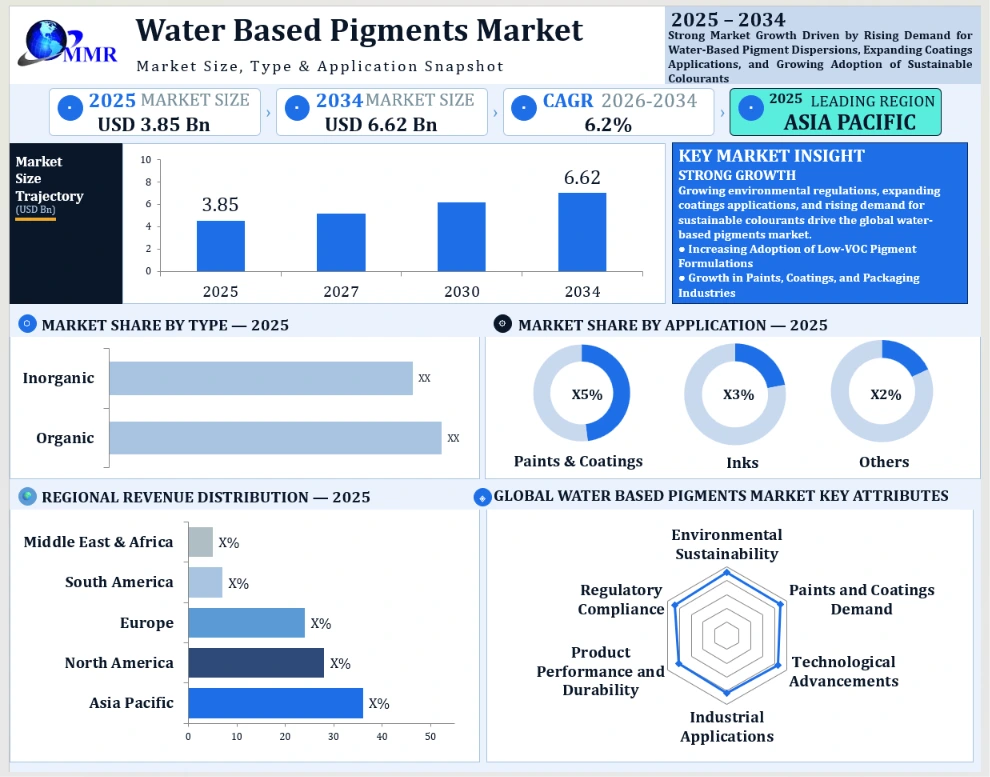
To know about the Research Methodology :- Request Free Sample Report
Global Water Based Pigments Market – Key Highlights
- The global water-based pigments market is valued at USD 3.85 billion in 2025 and is projected to reach USD 6.62 billion by 2034, registering a CAGR of 6.2%.
- Asia-Pacific dominates the market, driven by rapid industrialization, infrastructure development, and expanding paints, coatings, packaging, and textile industries.
- The paints and coatings segment represents a major demand area due to increasing adoption of low-VOC formulations in construction, automotive, and industrial applications.
- Growing environmental regulations and demand for sustainable colour solutions accelerate the shift from solvent-based pigments to water-based alternatives.
- Leading companies focus on advanced pigment dispersion technologies, sustainable formulations, portfolio expansion, and application-specific product development to strengthen their competitive positions.
Global Water Based Pigments Market – Market Dynamics
Global Water Based Pigments Market Drivers
Rising Demand for Environmentally Friendly Colour Solutions
Increasing environmental awareness and stricter regulations on volatile organic compound (VOC) emissions encourage manufacturers to adopt water-based pigment formulations instead of conventional solvent-based alternatives. Water-based pigment systems support low-emission manufacturing, reduce dependence on organic solvents, and improve workplace safety. Water-based gravure inks demonstrate the potential to reduce VOC emissions by up to 70% compared with traditional oil-based gravure inks, strengthening demand for low-VOC pigments, eco-friendly colourants, and sustainable pigment dispersions.
Expansion of Paints and Coatings Applications
Growing construction activities, infrastructure development, residential renovation, and automotive production increase demand for water-based pigments in architectural and industrial coatings. Manufacturers increasingly use aqueous pigment dispersions to achieve colour consistency, opacity, weather resistance, and surface durability. Paints and coatings account for 75.3% of the water-based pigments market's end-use segment in 2025, highlighting the importance of decorative and industrial coating applications.
Growth in Sustainable Printing and Packaging
Increasing demand for flexible packaging, paperboard printing, labels, and commercial printing supports the adoption of water-based pigment inks. Packaging manufacturers focus on low-emission printing technologies and recyclable packaging solutions to meet sustainability requirements. Improvements in pigment dispersion stability, colour strength, drying performance, and print quality expand the use of water-based printing inks, digital pigment inks, and sustainable packaging colourants.
Global Water Based Pigments Market Restraints
Higher Formulation and Processing Requirements
Water-based pigment systems require specialized dispersing agents, stabilizers, wetting agents, and formulation controls to maintain uniform particle distribution and prevent sedimentation. Manufacturers also manage drying speed, substrate compatibility, microbial stability, and water sensitivity. These technical requirements increase formulation complexity and create additional processing costs, particularly in applications requiring high colour strength and consistent performance.
Limitations in Performance Across Certain Applications
Water-based pigments face performance limitations in applications that require high moisture resistance, rapid drying, strong adhesion, and exposure to harsh environmental conditions. Their compatibility with certain substrates and industrial processes requires additional formulation adjustments. These limitations create challenges in replacing solvent-based pigment systems across specialized automotive, industrial, and protective coating applications.
Global Water Based Pigments Market Opportunities
Development of Advanced Water-Based Pigment Dispersions
Technological advancements in particle-size control, surface modification, polymer compatibility, and dispersion stabilization create opportunities for high-performance water-based pigment products. Manufacturers focus on improving colour strength, storage stability, weather resistance, and compatibility with different aqueous resin systems. These developments support demand for high-performance organic pigments, inorganic pigment dispersions, specialty colour concentrates, and advanced waterborne formulations.
Growing Adoption in Automotive and Industrial Coatings
Automotive manufacturers increasingly incorporate waterborne coating technologies to reduce solvent emissions and meet environmental requirements. Demand for durable finishes, consistent colour appearance, and improved coating performance creates opportunities for specialty water-based pigments. Expansion in electric vehicle manufacturing, automotive refinishing, industrial equipment, and metal coating applications further supports product innovation.
Global Water Based Pigments Market Challenges
Raw Material Price Volatility
Fluctuations in the prices of titanium dioxide, specialty organic pigments, dispersing agents, resins, and other chemical feedstocks create cost pressures for pigment manufacturers. Dependence on petrochemical-derived inputs and specialized raw materials affects production economics, pricing strategies, and profit margins. Manufacturers focus on sourcing diversification, formulation optimization, and supply-chain integration to manage these challenges.
Maintaining Product Stability and Consistent Quality
Achieving uniform dispersion, colour reproducibility, storage stability, and compatibility across different applications remains a major technical challenge. Water-based pigment formulations require careful control of particle size, pH, viscosity, and additive concentration. Variations in these parameters affect product performance during storage and application, making quality control and formulation development essential for manufacturers.
Global Water Based Pigments Market Segment analysis:
By the end-users’ segment, paints and coating area is expected to show persistent growth during the estimated year. The application of the paints and coating is broadly driven by the decorative sector as it provides good spreadability, rapid drying, trendy color requirement, other beneficial characteristics includes reduced dust, improved flowability, and reduced product loss. On the other hand, as the construction is growing so there will be demand for corrosion-free coating and painting for the end process. Water-based pigments have been fulfilling this need for long and expected to contribute to the market growth in the long run. Additionally, advancement in the automotive sector is mainly driven by the demand of eco-friendly product for the targeted material and will boost the market demand in the coming years.
Global Water Based Pigments Market Regional Analysis:
Asia-Pacific dominates the global water-based pigments market, supported by rapid industrialization, expanding manufacturing activities, infrastructure development, and increasing demand for environmentally friendly colour solutions. China, India, Japan, and South Korea drive regional consumption through their established paints and coatings, packaging, textile, printing inks, and plastics industries. The region accounts for 45.8% of the global market in 2025, with a market value of USD 5.2 billion. Growing adoption of water-based pigment dispersions, organic pigments, low-VOC colourants, and sustainable coating formulations strengthens regional demand. Expanding construction activities, automotive manufacturing, and flexible packaging production further support market growth.
North America represents a significant market for water-based pigments, driven by environmental regulations, established chemical manufacturing infrastructure, and increasing demand for low-emission coating and printing technologies. The United States leads regional consumption through architectural coatings, automotive refinishing, industrial coatings, packaging, and commercial printing applications. Manufacturers increasingly adopt waterborne pigment formulations, high-performance pigment dispersions, eco-friendly colourants, and low-VOC technologies to meet environmental requirements. Growing investments in sustainable packaging, infrastructure renovation, and advanced manufacturing further support regional market development.
Europe maintains a strong position in the water-based pigments market, supported by stringent environmental standards, sustainable manufacturing practices, and demand for high-quality colour formulations. Germany, France, Italy, and the United Kingdom drive regional consumption through automotive coatings, industrial finishes, construction materials, printing inks, and textile applications. Regulatory frameworks such as REACH and increasing emphasis on low-emission production encourage the adoption of water-based organic pigments, specialty pigment dispersions, sustainable colourants, and environmentally compatible formulations. Innovation in pigment chemistry and advanced dispersion technologies further strengthens regional competitiveness.
South America experiences increasing demand for water-based pigments due to expanding construction activities, packaging production, automotive manufacturing, and textile processing. Brazil and Argentina represent important regional markets, supported by demand for decorative paints, industrial coatings, printing inks, and plastic colourants. Growing awareness of environmental compliance and the adoption of water-based coatings, low-VOC pigment systems, and sustainable pigment dispersions support market development. Infrastructure investments and improvements in domestic manufacturing capabilities further create opportunities for regional suppliers.
Middle East and Africa represents an emerging market for water-based pigments, supported by infrastructure expansion, urban development, construction projects, and increasing industrial manufacturing. Saudi Arabia, the United Arab Emirates, and South Africa contribute to regional demand through architectural coatings, protective finishes, packaging, plastics, and industrial applications. Growing investments in commercial infrastructure and sustainable construction encourage the adoption of water-based pigment concentrates, durable colour formulations, low-VOC coatings, and environmentally friendly pigments. Improvements in regional distribution networks and manufacturing capabilities further support market penetration.
Global Water Based Pigments Market – Competitive Landscape
The global water-based pigments market exhibits a competitive structure comprising multinational specialty chemical manufacturers, pigment producers, pigment dispersion specialists, and integrated colour-solution suppliers. Competition centres on product quality, colour consistency, dispersion stability, formulation compatibility, environmental compliance, and manufacturing capabilities. Leading companies strengthen their market positions through product innovation, portfolio expansion, strategic acquisitions, and investments in sustainable pigment technologies. Key participants focus on developing water-based pigment dispersions, low-VOC colourants, high-performance organic and inorganic pigments, and customized colour formulations for paints and coatings, printing inks, plastics, textiles, and packaging applications.
Key Competitive Strategies
- Product Innovation: Manufacturers develop advanced aqueous pigment dispersions with improved colour strength, particle stability, compatibility, and durability.
- Sustainable Formulations: Companies focus on low-VOC technologies, environmentally compatible raw materials, and waterborne colour solutions.
- Portfolio Expansion: Suppliers expand organic, inorganic, specialty, and effect pigment offerings to address diverse industrial requirements.
- Strategic Acquisitions: Companies strengthen production capabilities, expand geographic reach, and integrate complementary pigment technologies.
- Application-Specific Solutions: Manufacturers develop customized formulations for automotive coatings, packaging inks, industrial finishes, and digital printing.
Competitive Insights
- Dispersion Technology Creates Product Differentiation
A major competitive advantage comes from the ability to maintain uniform pigment particle distribution in water-based formulations. Manufacturers with advanced dispersant chemistry and particle-stabilization technologies improve colour strength, storage stability, and compatibility with different aqueous resin systems. This capability creates differentiation beyond basic pigment production.
- Integration of Pigment Manufacturing and Dispersion Solutions
Companies increasingly compete through integrated offerings that combine pigment production, surface treatment, dispersion development, and technical formulation support. This approach helps customers reduce formulation complexity and achieve consistent performance across coatings, inks, and plastics applications.
- Acquisition-Led Expansion Reshapes Competition
The completion of Sudarshan Chemical Industries' acquisition of Heubach in March 2025 strengthens its global pigment portfolio and manufacturing footprint. The expanded capabilities support competition across organic pigments, inorganic pigments, and liquid dispersions.
- Digital Printing Creates a Specialized Competitive Segment
Water-based pigment dispersions for digital printing require controlled particle sizes, stable formulations, and reliable adhesion to different substrates. DIC Corporation's development of water-based dispersions for non-absorbent surfaces, including food packaging and wallpaper, illustrates how application-specific innovation creates new competitive opportunities.
Global Water Based Pigments Market Recent Developments:
| Date | Company | Development | Impact |
|---|---|---|---|
| 12 January 2026 | BASF SE | BASF launched a new line of low-VOC, water-based pigment preparations tailored for exterior architectural coatings and industrial tinting systems. | The formulation delivers enhanced color strength and weather resistance while ensuring strict compliance with European environmental safety standards. |
| 18 February 2026 | Clariant | Clariant introduced its advanced Hostatint water-based pigment dispersions optimized for sustainable packaging printing inks and digital applications. | The innovation significantly improves color consistency and dispersion stability, reducing hazardous chemical usage in commercial packaging production. |
| 10 March 2026 | DIC Corporation | DIC Corporation expanded its production capacity for eco-friendly aqueous pigment dispersions at its main manufacturing facility in the Asia-Pacific region. | The strategic expansion addresses soaring regional demand for sustainable water-based colorants used in automotive and industrial wood coatings. |
| 22 April 2026 | Sun Chemical | Sun Chemical rolled out a new portfolio of APEO-free water-based pigment preparations specifically engineered for high-performance paper and textile printing. | The product line accelerates the shift toward greener textile processing and non-toxic packaging solutions across global supply chains. |
| 15 May 2026 | Heubach Group | Heubach announced a strategic collaboration with regional resin producers to co-develop high-performance organic water-based pigments for metal protective coatings. | The partnership successfully shortens product cure times and increases corrosion protection capabilities for industrial maintenance applications. |
Global Water Based Pigments Market Scope: Inquire before buying
| Global Water Based Pigments Market | |||
|---|---|---|---|
| Report Coverage | Details | ||
| Base Year: | 2025 | Forecast Period: | 2026-2034 |
| Historical Data: | 2020 to 2025 | Market Size in 2025: | US $ 3.85 Bn. |
| Forecast Period 2026 to 2034 CAGR: | 6.2% | Market Size in 2034: | US $ 6.62 Bn. |
| Segments Covered: | by Type | Organic Inorganic |
|
| by End-users | Paints and Coatings Plastics Inks Others |
||
Global Water Based Pigments Market, by Region
North America (United States, Canada and Mexico)
Europe (UK, France, Germany, Italy, Spain, Sweden, Austria and Rest of Europe)
Asia Pacific (China, South Korea, Japan, India, Australia, Indonesia, Malaysia, Vietnam, Taiwan, Bangladesh, Pakistan and Rest of APAC)
Middle East and Africa (South Africa, GCC, Egypt, Nigeria and Rest of ME&A)
South America (Brazil, Argentina Rest of South America)
Global Water Based Pigments Market Key Players
- Chromatech Incorporated
- Spectra Colorants
- Alex Color Company
- Achitex Group
- DVM Pigments & Additives
- Clariant AG
- BASF SE
- Yipin Pigments, Inc.
- Indo Tex
- Skychem
- Heubach GmbH
- Penn Color, Inc.
- Pidilite Industries Limited
- The Sherwin-Williams Company
- Northwest Dispersions
- Proquimac
- Kao Corporation
- LANXESS AG
- Sudarshan Chemical Industries Limited
- DIC Corporation
- Sun Chemical
- Cabot Corporation
- Vibrantz Technologies
- DyStar Group
- Huntsman Corporation
- Kronos Worldwide, Inc.
- The Chemours Company
- Tronox Holdings plc
- Venator Materials PLC
- Cathay Industries
- Orion S.A.
- Toyo Ink Group (artience Co., Ltd.)
- Eckart GmbH
- Silberline Manufacturing Company, Inc.
- Carl Schlenk AG
- Geotech International B.V.
- Lomon Billions Group
- Zhejiang Longsheng Group Co., Ltd.
- Trust Chem Co., Ltd.
- The Shepherd Color Company
- Sensient Technologies Corporation
- Archroma
- Atul Limited
- Dow Inc.
- Evonik Industries AG
- Solvay SA
- Fujifilm Corporation
- Agfa-Gevaert Group
- Flint Group
- Follmann GmbH & Co. KG
Frequently Asked Questions:
1.Which region has the largest share in Global Water Based Pigments Market?
Ans: Asia Pacific region held the highest share in 2025.
2.What is the growth rate of Global Water Based Pigments Market?
Ans: The Global Water Based Pigments Market is growing at a CAGR of 6.2% during forecasting period 2026-2034.
3.What is scope of the Global Water Based Pigments Market report?
Ans: Global Water Based Pigments Market report helps with the PESTEL, PORTER, COVID-19 Impact analysis, Recommendations for Investors & Leaders, and market estimation of the forecast period.
4.Who are the key players in Global Water Based Pigments Market?
Ans: The important key players in the Global Market are – Chromatech Incorporated,Spectra Colorants,Alex Color Company,Achitex Group,DVM Pigments,Clariant,BASF,Yipin USA,Indo Tex,Skychem,Heubach GmbH,Penn Color.
5.What is the study period of this Market?
Ans: The Global Water Based Pigments Market is studied from 2020 to 2034.