Ultrafiltered Milk Market - Industry Structure Evaluation, Demand Drivers Analysis, Regional Growth Analysis and Identification, Competitive Positioning Review & Global Market Size Forecast to 2032

4.6%
CAGR (2026-2032)
8.74 USD Bn.
Market Size
322
Report Pages
160
Market Tables

Overview

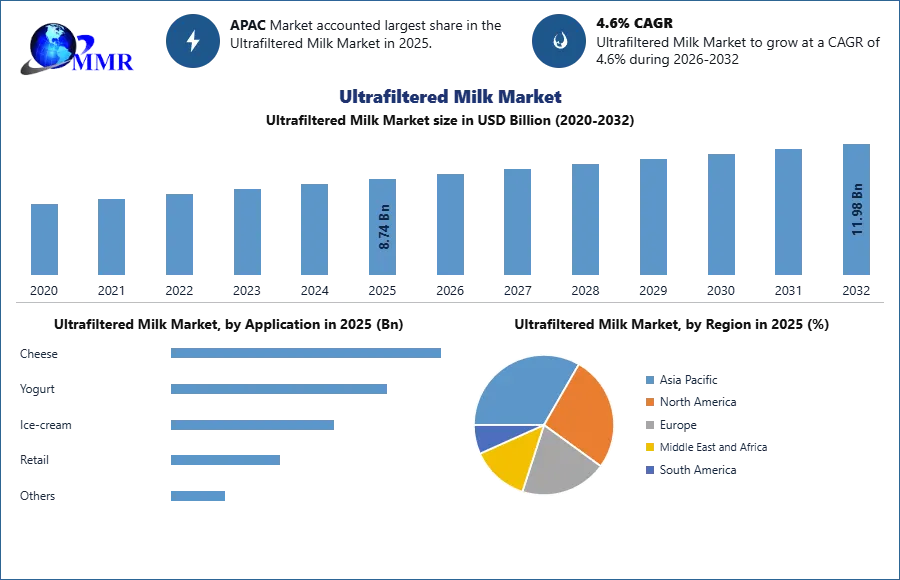
Ultrafiltered Milk Market size was valued at USD 8.74 Billion in 2025 and the total Ultrafiltered Milk revenue is expected to grow at a CAGR of 4.6% from 2026 to 2032, reaching nearly USD 11.99 Billion.

Ultrafiltration processing is one of the usually used membrane filtration techniques in the food & beverage industry, which permits retention and permeation of specific components through the semi-permeable membrane based on their molecular weight sizes. In the dairy industry, this technology permits the retention of high molecular weight, suspended solids, like milk proteins and elimination of water and low molecular weight components, like lactose and soluble minerals from the milk using a semi-permeable membrane. Milk products, and dairy constituents containing high protein and lower lactose content can be thus produced by ultrafiltration technology.
Ultrafiltered Milk Market

To know about the Research Methodology :- Request Free Sample Report

The growth in the status of ultra-filtered milk comes as the traditional milk industry understands progressing competition from the many substitutes that now lead the market. Organic Valley releases the first organic ultrafiltered milk presented nationally. According to the forecaster, the milk has above 50% protein and 50% less sugar than regular milk.

Users demand for processed cheese food, a varied range of nutritional products, clean label products, increasing supply chain channels, and frequent launch of novel products are some of the foremost factors fuelling the growth of the global premiumization milk market. Similarly, the demand for a natural and concentrated form of milk in cheese making with flexible labeling limitations, innovation across the value-added dairy industry, product premiumization, and launch of the product with new packaging, and growing R&D activities are expected to raise the ultrafiltered milk market in the current future.

The U.S. manufacturers could do something beneficial with their stock of ultrafiltered milk, and Canadians with a requirement for milk protein, for example, cheese producers, could purchase the product at a cut-price. The problem with this system was two-fold. Primarily, increased butter consumption was a global phenomenon, thus Canadian dairy manufacturers also had a large stock of non-fat solids, like ultrafiltered milk. Different Canadian cheese producers, Americans were not permitted to use ultrafiltered milk in their production before 2025, so Canadian producers with an excess of ultrafiltered milk had nowhere to sell this by product except to Canadian cheese producers. Though, global prices were lower than the prices set in Canada, so Canadian cheese producers were better off purchasing ultrafiltered milk from the U.S. and other countries.

Recent Industry Developments (2025–2026)

Exact Date Company Development Impact
20 February 2026 Arla Foods Arla announced the completion of a UHT Centre of Excellence in Lockerbie, Scotland, to boost long-life and value-added milk production. The facility strengthens supply chain efficiency for high-protein, ultra-filtered dairy products across European retail channels.
21 January 2026 Fairlife Fairlife was officially named the Most Trusted High Protein Milk brand in the U.S. for 2026 following massive consumer expansion. Solidifies the company's dominant market share in the ultrafiltered segment, reaching over 30 million American households.
16 October 2025 Saputo Dairy Australia The company announced a $0.15 per kgMS step-up in milk prices for the 2025-26 season to secure exclusive high-quality supply. Ensures a stable raw material flow for the production of specialized dairy ingredients and ultrafiltered fluid milk.
08 August 2025 Chobani Chobani expanded its ultrafiltered milk-based portfolio, contributing to its ascent in the Top 100 Dairy companies for 2025. Increases competitive pressure on traditional dairy players by integrating ultrafiltered technology into snacks and yogurt bases.
15 June 2025 Organic Valley Organic Valley completed the national rollout of its first organic ultrafiltered milk with 50% more protein and 50% less sugar. Addresses the premium organic segment of the market, catering to health-conscious consumers seeking clean-label concentrated nutrients.
14 May 2025 Arla Foods Arla's Board of Representatives approved a strategic merger with DMK Group to consolidate European dairy processing capabilities. The merger creates a regional powerhouse with enhanced R&D capacity for specialized membrane filtration technologies.


The objective of the report is to present a comprehensive analysis of the Global Ultrafiltered Milk Market including all the stakeholders of the industry. The past and current status of the industry with forecasted market size and trends are presented in the report with the analysis of complicated data in simple language. The report covers all the aspects of the industry with a dedicated study of key players that includes market leaders, followers, and new entrants.

PORTER, SWOT, PESTEL analysis with the potential impact of micro-economic factors of the market have been presented in the report. External as well as internal factors that are supposed to affect the business positively or negatively have been analyzed, which will give a clear futuristic view of the industry to the decision-makers.

The report also helps in understanding Global Ultrafiltered Milk Market dynamics, structure by analyzing the market segments and project the Global Ultrafiltered Milk Market size. Clear representation of competitive analysis of key players by type, price, financial position, product portfolio, growth strategies, and regional presence in the Global Market make the report investor’s guide.

 Ultrafiltered Milk Market: Inquire before buying

Ultrafiltered Milk Market
Report Coverage Details
Base Year: 2025 Forecast Period: 2026-2032
Historical Data: 2020 to 2025 Market Size in 2025: 4.2 USD Billion
Forecast Period 2026-2032 CAGR: 6.7% Market Size in 2032: 6.61 USD Billion
Segments Covered: By Product Type Whole Ultrafiltered Milk
Reduced-fat Ultrafiltered Milk
Non-fat Ultrafiltered Milk
Flavored Ultrafiltered Milk
By Packaging Bottles
Cartons
Pouches
By Nutritional Content High Protein
Low Lactose
Fortified
Organic
By Application Cheese
Yogurt
Ice-cream
Others
By Distribution Channel Convenience Stores
Food Service
    HoReCa
    Institutional
Online Retail
Supermarket Hypermarket
By End User Foodservice
Manufacturing
Residential
Healthcare

Ultrafiltered Milk Market, by Region :

North America (United States, Canada and Mexico)
Europe (UK, France, Germany, Italy, Spain, Sweden, Austria, Holland, Turkey, Russia and Rest of Europe)
Asia Pacific (China, India, Japan, South Korea, New Zealand, Australia, ASEAN and Rest of APAC)
Middle East and Africa (South Africa, GCC, Egypt, Nigeria and Rest of ME&A)
South America (Brazil, Argentina, Columbia and Rest of South America)

Key Players / Competitors Profiles Covered in Brief in Global Ultrafiltered Milk Market Report in Strategic Perspective:

  1. The Coca-Cola Company
  2. HP Hood LLC
  3. Idaho Milk Products, Inc.
  4. Fonterra Co-operative Group
  5. Kerry Group
  6. Tatura Milk Industries Ltd.
  7. Darigold Ingredients Company
  8. Erie Foods International, Inc.
  9. Enka Sut Company
  10. Grassland Dairy Products
  11. Agropur Dairy Cooperative
  12. Saputo Inc.
  13. Organic Valley
  14. Chobani
  15. Arla Foods
  16. The a2 Milk Company
  17. Kansas Dairy Ingredients
  18. Yili Group
  19. Mengniu Dairy
  20. Maple Hill Creamery
  21. Graham's Family Dairy
  22. Interfood Holding BV
  23. Fairlife
  24. Lactalis Group
  25. Glanbia plc

Frequently Asked Questions

1] What is the projected Ultrafiltered Milk Market size and growth rate?
Ans. The global Ultrafiltered Milk Market size was $8.74 billion in 2025, projected to reach $11.99 billion by 2032, reflecting a steady 4.6% Industry Growth CAGR.

2] Which region leads the Ultrafiltered Milk Market share analysis?
Ans. North America dominates Ultrafiltered Milk Market share analysis due to Fairlife’s massive expansion, high consumer demand for protein-rich dairy, and established large-scale membrane filtration infrastructure.

3] Which regions lead in Ultrafiltered Milk Market trade and exports?
Ans. North America remains the top exporter, while the Asia-Pacific region emerges as the leading importer, driving Ultrafiltered Milk Market Trends 2026 through rising nutritional demand.

4] What are the primary Ultrafiltered Milk Trends 2026 for health-conscious consumers?
Ans. Recent Ultrafiltered Milk Trends 2026 highlight a shift toward organic, clean-label products offering 50% more protein and 50% less sugar than traditional fluid milk options.

5] How does membrane filtration technology impact Ultrafiltered Milk Industry Growth Drivers? Ans. Advanced membrane filtration acts as key Ultrafiltered Milk Industry Growth Drivers by allowing brands like Chobani to create concentrated, high-protein bases for premium dairy products.

6] How is the supply chain evolving for Ultrafiltered Milk manufacturers?
Ans. To optimize the Ultrafiltered Milk supply chain, leaders like Arla Foods are investing in regional Centers of Excellence to improve production efficiency for value-added dairy.

7] How do regulatory changes influence the Ultrafiltered Milk Market Outlook?
Ans. The Ultrafiltered Milk Market Outlook is shaped by updated FDA labeling guidelines, allowing UF milk use in cheese production, which significantly expands industrial B2B demand.

Table of Contents

1. Ultrafiltered Milk Market: Executive Summary 1.1. Executive Summary 1.2. Market Size (2025) & Forecast (2025-2032), 1.3. Market Size (Value in USD, Volume in Liters) and Market Share (%) – By Segments, Regions, and Country 2. Competitive Landscape 2.1. MMR Competition Matrix 2.2. Competitive Positioning Of Global Key Players 2.3. Key Players Benchmarking 2.3.1 Company Name 2.3.2 Headquarter 2.3.3 Business Portfolio 2.3.4 Pricing index 2.3.5 Manufacturing Capability 2.3.6 Certification and Qualification 2.3.7 Application and Innovation Capability 2.3.8 Commercial & Market Reach 2.3.9 Revenue (2025) 2.3.10 Market Share (%)2025 2.3.11 Growth Rate(%) 2.3.12 R&D Investment 2.3.13 Geographical Presence 2.4. Market Structure 2.4.1 Market Leaders 2.4.2 Market Followers 2.4.3 Emerging Players 2.5. Mergers and Acquisitions Details 3. Market Dynamics 3.1. Market Trends 3.2. Ultrafiltered Milk Market Dynamics 3.2.1 Drivers 3.2.2 Restraints 3.2.3 Opportunities 3.2.4 Challenges 3.3. PORTER’s Five Forces Analysis 3.4. PESTLE Analysis 4. Ultrafiltration Technology Analysis 4.1 Overview of Ultrafiltration Technology in Dairy Processing 4.2 Membrane Filtration Processes and Technical Specifications 4.3 Ceramic vs Polymeric Membrane Technologies – Performance Benchmark 4.4 Concentration Ratios and Protein Standardization Methods 4.5 Innovation in Filtration Equipment and Process Efficiency 4.6 Energy Consumption Metrics and Sustainability Improvements 4.7 Comparison with Alternative Concentration Methods 4.7.1 Evaporation 4.7.2 Reverse Osmosis 4.7.3 Microfiltration 5. Manufacturing & Processing Analysis 5.1 Production Capacity by Region and Key Manufacturers 5.2 Ultrafiltration Equipment Suppliers and Technology Providers 5.3 Quality Control, Consistency, and Standardization Practices 5.4 Co-manufacturing and Contract Processing Trends 5.5 Capital Expenditure (CAPEX) and Operating Cost Structure 5.6 Automation, Digitalization, and Smart Dairy Processing Adoption 6. Raw Material & Input Analysis 6.1 Raw Milk Quality Specifications for Ultrafiltration 6.2 Seasonal Availability and Sourcing Patterns 6.3 Permeate Management and By-product Utilization Strategies 6.4 Energy and Water Consumption Benchmarks 6.5 Packaging Material Requirements and Cost Implications 6.6 Membrane Replacement Cycles, Costs, and Maintenance Schedules 7. Supply Chain Analysis 7.1 Raw Milk Procurement and Supplier Qualification 7.2 Processing Facility Location Strategy and Capacity Utilization 7.3 Cold Chain Logistics and Temperature-Controlled Distribution 7.4 Shelf-life Optimization Across the Supply Chain 7.5 Retailer Partnerships and Channel Integration 7.6 Direct-to-Consumer (D2C) and Subscription Models 7.7 Supply Chain Vulnerabilities, Risks, and Mitigation Strategies 8. Pricing Analysis (2025) 8.1 Price Comparison: Ultrafiltrated Milk vs Conventional Milk 8.2 Price Differentiation by Protein Content and Processing Intensity 8.3 Regional Pricing Dynamics and Market Disparities 8.4 Cost–Price Relationship and Margin Structure 8.5 Impact of Raw Milk Price Volatility on UF Milk Pricing 8.6 Premium Pricing Models for High-Protein and Functional Variants 8.7 B2B vs B2C Pricing Structures and Contract Models 9. Regulatory & Standards Framework 9.1 FDA Regulations and GRAS Status (United States) 9.2 EU Dairy Regulations and Ultrafiltrated Milk Labeling Norms 9.3 Standards of Identity for Ultrafiltrated Milk 9.4 Protein Content, Nutritional, and Functional Claims Regulations 9.5 Organic, Clean Label, and Non-GMO Certifications 9.6 Food Safety Compliance (HACCP, GMP, FSMA) 9.7 International Trade Regulations, Import–Export Barriers, and Tariffs 10. Distribution Channel Analysis 10.1 Distribution Channel Overview and Market Share by Channel Type 10.2 Multi-channel and Omnichannel Distribution Strategies 10.3 Channel-wise Profitability and Margin Analysis 10.4 Geographic Reach, Coverage, and Penetration 10.5 Distributor, Wholesaler, and Retail Partner Landscape 11. Application Analysis: Ultrafiltrated Milk in Coffee & Beverage Systems 11.1 Role of Ultrafiltrated Milk in Hot & Cold Coffee Applications 11.2 Foam Formation, Microfoam Stability, and Latte Art Performance 11.3 Heat Stability Under Espresso Machine and Steam Wand Conditions 11.4 Protein–Fat Ratio Optimization for Specialty Coffee 11.5 Taste Neutrality, Mouthfeel, and Sensory Performance 11.6 Lactose Reduction Benefits for Coffee Beverage Menus 11.7 Comparison vs Conventional Milk, Barista Milk, and Plant-Based Creamers 12. Consumer Behavior & Demand Trends 12.1 Target Demographics and Consumer Segmentation 12.2 Key Purchase Drivers 12.2.1 Protein enrichment 12.2.2 Lactose reduction 12.2.3 Taste and texture 12.3 Brand Loyalty, Switching Behavior, and Private Label Impact 12.4 Health, Wellness, and Functional Nutrition Trends 12.5 Lactose Intolerance Prevalence and Consumption Impact 12.6 Sustainability Awareness and Ethical Purchasing Preferences 12.7 Price Sensitivity and Willingness-to-Pay Analysis 13. Foodservice & Coffee Channel Demand Analysis 13.1 Demand from Specialty Coffee Chains and Cafés 13.2 Adoption in Quick Service Restaurants (QSRs) and Bakery Cafés 13.3 Usage in Central Kitchens and Commissary Coffee Systems 13.4 Contract Supply Models with Coffee Chains 13.5 Volume Consumption Patterns in Foodservice vs Retail 13.6 Equipment Compatibility (espresso machines, automatic brewers) 14. Marketing & Branding Strategies 14.1 Brand Positioning Approaches 14.1.1 Premium 14.1.2 Functional Nutrition 14.1.3 Health-focused 14.2 Digital Marketing, E-commerce, and Social Media Strategies 14.3 Influencer Marketing and Nutrition Expert Endorsements 14.4 In-store Promotions, Sampling, and Retail Activation 14.5 Nutrition Education, Label Transparency, and Awareness Campaigns 14.6 Packaging Innovation and Sustainability Messaging 15. Sustainability & Environmental Impact Analysis 15.1 Water Usage Comparison: Ultrafiltration vs Conventional Processing 15.2 Energy Efficiency, Emissions, and Carbon Footprint Metrics 15.3 Permeate Utilization, Waste Reduction, and By-product Monetization 15.4 Sustainable and Recyclable Packaging Initiatives 15.5 Circular Economy Models in Dairy Processing 15.6 Environmental Certifications and Compliance Standards 16. Co-branding & Menu Strategy for Coffee Brands 16.1 Nutritional Labeling as a Menu Differentiator 16.2 High-Protein & Lactose-Reduced Coffee Beverages 16.3 Consumer Willingness to Pay in Specialty Coffee 16.4 Sustainability Messaging for Coffee + Dairy Pairing 16.5 Barista Education and In-store Communication 17. Ultrafiltered Milk Market: Global Market Size and Forecast by Segmentation (by Value in USD Billion and Volume In Liters) (2025-2032) 17.1. Ultrafiltered Milk Market Size and Forecast, By Product Type (2025-2032) 17.1.1 Whole Ultrafiltered Milk 17.1.2 Reduced-fat Ultrafiltered Milk 17.1.3 Non-fat Ultrafiltered Milk 17.1.4 Flavored Ultrafiltered Milk 17.2. Ultrafiltered Milk Market Size and Forecast, By Packaging (2025-2032) 17.2.1 Bottles 17.2.2 Cartons 17.2.3 Pouches 17.3. Ultrafiltered Milk Market Size and Forecast, By Nutritional Content (2025-2032) 17.3.1 High Protein 17.3.2 Low Lactose 17.3.3 Fortified 17.3.4 Organic 17.4. Ultrafiltered Milk Market Size and Forecast, By Application (2025-2032) 17.4.1 Cheese 17.4.2 Yogurt 17.4.3 Ice-cream 17.4.4 Others 17.5. Ultrafiltered Milk Market Size and Forecast, By Distribution Channel (2025-2032) 17.5.1 Convenience Stores 17.5.2 Food Service 17.5.3 HoReCa 17.5.4 Institutional 17.5.5 Online Retail 17.5.6 Supermarket Hypermarket 17.6. Ultrafiltered Milk Market Size and Forecast, By End User (2025-2032) 17.6.1 Foodservice 17.6.2 Manufacturing 17.6.3 Residential 17.6.4 Healthcare 17.7. Ultrafiltered Milk Market Size and Forecast, by Region (2025-2032) 17.7.1 North America 17.7.2 Europe 17.7.3 Asia Pacific 17.7.4 Middle East and Africa 17.7.5 South America 18. North America Ultrafiltered Milk Market Size and Forecast by Segmentation (by Value in USD Billion and Volume In Liters) (2025-2032) 18.1. North America Market Size and Forecast, By Product Type 18.2. North America Market Size and Forecast, By Packaging 18.3. North America Market Size and Forecast, By Nutritional Content 18.4. North America Market Size and Forecast, By Application 18.5. North America Market Size and Forecast, By Distribution Channel 18.6. North America Market Size and Forecast, By End User 18.7. North America Market Size and Forecast, By Country 18.7.1 United States 18.7.2 United States Market Size and Forecast, By Product Type 18.7.3 United States Market Size and Forecast, By Packaging 18.7.4 United States Market Size and Forecast, By Nutritional Content 18.7.5 United States Market Size and Forecast, By Application 18.7.6 United States Market Size and Forecast, By Distribution Channel 18.7.7 United States Market Size and Forecast, By End User 18.7.8 Canada 18.7.9 Mexico 19. Europe Ultrafiltered Milk Market Size and Forecast by Segmentation (by Value in USD Billion and Volume In Liters) (2025-2032) 19.1. Europe Market Size and Forecast, By Product Type 19.2. Europe Market Size and Forecast, By Packaging 19.3 Europe Market Size and Forecast, By Nutritional Content 19.4. Europe Market Size and Forecast, By Application 19.5 Europe Market Size and Forecast, By Distribution Channel 19.6 Europe Market Size and Forecast, By End User 19.7. Europe Market Size and Forecast, By Country 19.7.1 United Kingdom 19.7.2 France 19.7.3 Germany 19.7.4 Italy 19.7.5 Spain 19.7.6 Sweden 19.7.7 Russia 19.7.8 Rest of Europe 20. Asia Pacific Ultrafiltered Milk Market Size and Forecast by Segmentation (by Value in USD Billion and Volume In Liters) (2025-2032) 20.1. Asia Pacific Market Size and Forecast, By Product Type 20.2. Asia Pacific Market Size and Forecast, By Packaging 20.3. Asia Pacific Market Size and Forecast, By Nutritional Content 20.4. Asia Pacific Market Size and Forecast, By Application 20.5. Asia Pacific Market Size and Forecast, By Distribution Channel 20.6. Asia Pacific Market Size and Forecast, By End User 20.7. Asia Pacific Market Size and Forecast, By Country 20.7.1 China 20.7.2 South Korea 20.7.3 Japan 20.7.4 India 20.7.5 Australia 20.7.6 Indonesia Philippines 20.7.7 Malaysia 20.7.8 Vietnam 20.7.9 Thailand 20.7.10 Rest of Asia Pacific 21. Middle East and Africa Ultrafiltered Milk Market Size and Forecast by Segmentation (by Value in USD Billion and Volume In Liters) (2025-2032) 21.1. Middle East and Africa Market Size and Forecast, By Product Type 21.2. Middle East and Africa Market Size and Forecast, By Packaging 21.3. Middle East and Africa Market Size and Forecast, By Nutritional Content 21.4. Middle East and Africa Market Size and Forecast, By Application 21.5. Middle East and Africa Market Size and Forecast, By Distribution Channel 21.6. Middle East and Africa Market Size and Forecast, By End User 21.7. Middle East and Africa Market Size and Forecast, By Country 21.7.1 South Africa 21.7.2 GCC 21.7.3 Egypt 21.7.4 Nigeria 21.7.5 Rest of MEA 22. South America Ultrafiltered Milk Market Size and Forecast by Segmentation (by Value in USD Billion and Volume In Liters) (2025-2032) 22.1. South America Market Size and Forecast, By Product Type 22.2. South America Market Size and Forecast, By Packaging 22.3. South America Market Size and Forecast, By Nutritional Content 22.4. South America Market Size and Forecast, By Application 22.5. South America Market Size and Forecast, By Distribution Channel 22.6. South America Market Size and Forecast, By End User 22.7. South America Market Size and Forecast, By Country 22.7.1 Brazil 22.7.2 Argentina 22.7.3 Colombia 22.7.4 Chile 22.7.5 Rest of South America 23. Company Profile: Key Players 23.1. Fairlife (The Coca-Cola Company) 23.1.1 Company Overview 23.1.2 Business Portfolio 23.1.3 Financial Overview 23.1.4 SWOT Analysis 23.1.5 Strategic Analysis 23.1.6 Recent Developments 23.2 Saputo Inc 23.3 Organic Valley 23.4 Idaho Milk Products, Inc. 23.5 Fonterra Co-operative Group 23.6 Kerry Group 23.7 Darigold Ingredients 23.8 Grassland Dairy Products 23.9 Slate Milk 23.10 Neilson TruTaste (Joyya) 23.10.1 Others 24. Key Findings 25. Analyst Recommendations 26. Research Methodology

Custom Market Research Services

We Will Customise The Research For You, In Case The Report Listed Above Does Not Meet With Your Requirements