
Train Seat Market Size by Train Type, Seat Type, Railcar Type, Region – Segment-Level Market Assessment, Growth Opportunity Analysis, Competitive Mapping & Forecast to 2034
Overview
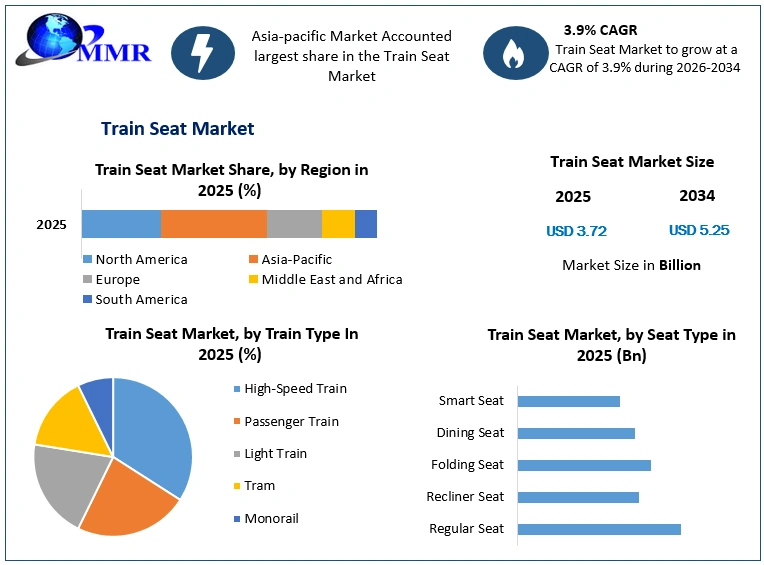
The Train Seat Market size was valued at USD 3.72 Billion in 2025 and the total Train Seat Market revenue is expected to grow at a CAGR of 3.9% from 2026 to 2034, reaching nearly USD 5.25 Billion in 2034.
Train Seat Market Overview
A train seat is a single seating unit located within a train carriage or compartment where passengers sit during their journey. Train seats are an essential part of passenger comfort and safety, providing a designated place for travelers to sit during their trip. These seats are equipped with features such as armrests, tray tables, and adjustable reclining positions.
Train Seat Market Growth and Share Analysis
To know about the Research Methodology :- Request Free Sample Report
The Train Seat Market is growing rapidly thanks to the increasing population and its growing demand for faster, safer, and more comfortable transportation. The Governments are investing heavily in railway infrastructure and development. Urban quality promotion through high-speed railways has been analyzed from a dynamic network view, highlighting the importance of high-speed train networks in urban growth.
1. China's train seat market is expected to grow significantly owing to the extension of the Medium and Long-Term Railway Plan (MLTRP) until 2034, which includes the development of 100,000 kilometers of the national route and 12,000 kilometers of High-Speed Rail network.
Some of the major key players that are actively working in the Train Seat market include Grammer AG, Seat Inc., Saira Seats, Harita Seating System Ltd., Ultimate Transportation Equipment Systems, Kiel Group, Sege Seats, Fisa Srl, Juyi Seating, Camira Fabrics, McConnell seatings.
Europe is the fastest-growing region with a significant market share in 2025. The region is expected to grow at a CAGR of 3.8% during the forecast period and maintain its dominance by 2034. In Europe focusing on developing sustainable and eco-friendly seat materials as well as prioritizing passenger comfort with train seats, means a rise in demand for recliner seats with different features that enhance the growth of the Train Seat Market. The European Union Funds initiatives like the shift to Rail that promote railway transport development.
Train Seat Market Dynamics:
Rising urbanization and population growth are straining transportation infrastructure, driving the demand for high-speed trains.
The high-speed trains are expected to grow rapidly in development given their capacity to travel significantly longer distances in a short duration of time. With an increasing population in cities public transport is essential, the train offers a huge capacity option compared to the car. High-speed trains are a more eco-friendly mode of transport compared to cars and airplanes, as they are electric or use low-emission fuels, contributing to reduced greenhouse gas emissions and cleaner air in cities. We reduce air pollution, lower carbon emissions, and build more sustainable cities. High-speed trains play a vital role in mitigating greenhouse gas emissions, enhancing air quality, and providing environmentally-friendly commuting alternatives for increasing populations facing traffic congestion and pollution issues. High-speed rail networks globally are committed to sustainability by decreasing carbon emissions, advocating for energy efficiency, and providing eco-friendly alternatives to traditional transportation methods. So, high-speed trains are a significant step towards achieving a greener future by contributing efficient and environmentally friendly travel options that benefit both the economy and the environment.
Restraints of the Train Seat Market:
High Infrastructure and capital costs in high-speed trains and monorail projects
The train seat Market faces challenges given to the significant infrastructure and high price investment is important to develop sustainable infrastructure train seat are very costly, they reduced budget allocated for train seat procurement, impacting the volume of seats ordered and affecting suppliers' revenues, which decrease the growth of train seat market. The train industry's growth is controlled by such high investment expenses in low-population-density countries like Argentina, Canada, and Brazil. Thus, it is expected that the global train seat materials market experience slow growth in the near future owing to its large capital expenditure and the limited development of the railway industry in evolving economies. The high-speed train and monorail projects are implementing a delay procedure because of significant investments is required. These delays procedure directly impacts the demand for train seats, as manufacturers experience fluctuation in orders and material production. The manufacturing facilities for train seats act as a barrier to entry for new key players in the Train seat market. Established manufacturers with existing production capabilities have a competitive advantage, limiting the market share available to newcomers.
Train Seat Market Segment Analysis:
Based on Seat Type, the Regular Seat segment holds the largest market share of about 51.03% in the Train Seat Market in 2025. According to the MMR analysis, the segment is expected to grow at a CAGR of 3.9% during the forecast period and maintain its dominance till 2034. The regular Seat segment dominates thanks to its cost –cost-effectiveness, space-saver, and versatility, size is ideal for local and regional trains. The short-distance route prioritizes affordability and capacity in regular seats. Many transportation industries used regular seats. The industries prioritise regular seats, and maximum capacity to accommodate as many passengers as compared to premium seats.
Based on Train Type, the High-speed train Segment holds the largest market share in the Train Seat Market in 2025 and is expected to maintain its dominance till 2034. High-speed trains provide comfort, efficiency, safety, and low-cost eco-sustainability for transportation. High-speed trains serve as hassle-free modes of transport for commuters. It offers flexibility with traveler plans so demand for high-speed trains increasing rapidly consequently demand for the train seat market is developing.
Train Seat Market of Regional Analysis
Asia-Pacific dominates the Train Seat Market with the largest market share accounting for 42.03% in 2025, the region is expected to grow during the forecast period and maintain its dominance by 2034. Asia–Pacific region is the largest market because the Asia-Pacific region has a high population, transportation become very crucial, and high traffic density occurs in countries such as China and India. So High-speed trains and metro trains are growing rapidly. India is making heavy investments to upgrade the train transportation system, increase intercity trade, and upcoming metro projects. The government's Make in India initiative laid special emphasis on promoting development activities within the country. They are investing heavily in developing and upgrading their train infrastructure, recognizing the economic and social benefits of robust rail networks. It has created a strong demand for new train seats is expected to drive the train seat market.
Train travel remains a popular choice for many in Asia due to its affordability, especially for long-distance journeys. The cost-effectiveness of train tickets compared to airfares attracts budget-conscious travellers looking for economical transportation options. The train offers a comfortable travel experience with the ability to move freely during traveling. Increasing productivity in fast-developing urban areas and growing train infrastructure in cities so, in the region, many people are attracted to the option of train travel as a more economical and accessible mode of transportation.
North America is growing in the Train Seat Market holds a market share of xx% and is significantly growing during its forecast period. Governments in North America are investing in growing and improving present train networks and creating a demand for new train seats, which growing the Train seat Market. In the United States, the Department of Transportation started to create a project on a high-speed passenger rail network that connects a large population center between 100 and 600 miles.
Competitive Landscape for Train Seat Market:
The competitive landscape of the Train Seat Market is constantly evolving, with new players emerging and established players adapting their strategies. A key component of their strategy is their constant commitment to research and development (R&D) to maintain a leading position in technological development. Building Partnerships and collaboration with established players, research institutions, and investors to leverage expertise and resources.
1. In November 2020, China’s National Development and Reform Committee (NDRC) revealed a plan to invest around USD 12.6 billion in high-speed rail projects to connect various cities of the nation.
2. Manufacturers are also complying with the stringent pollution norms set by governments. They are integrating eco-friendly options in seating design. Camira Fabrics makes fabrics from recycled plastic collected from the oceans.
3. Chile on Rails is a highly ambitious government undertaken by the Chilean government with an investment of USD 5 billion to turn around the railway infrastructure and network in the country. The project is planned to start in 2020 and aims at increasing the annual passenger numbers from 50 million to 150 million and doubling the cargo volume by 2034. The plan includes 27 security and infrastructure projects and 1000 km of railway lines.
Train Seat Market Recent Industry Developments
| Date | Company | Development | Impact |
|---|---|---|---|
| 25 June 2025 | Austrian Federal Railways (ÖBB) & Stadler | Austrian Federal Railways (ÖBB) and Stadler unveiled the KISS double-deck passenger train in Vienna, featuring 486 integrated high-comfort seats per trainset. | The deployment delivers a 20% increase in seating capacity on long-distance routes while establishing new standards for barrier-free ergonomic passenger seating. |
| 01 September 2025 | CRRC Changchun & China Railway Harbin Group | CRRC Changchun and China Railway Harbin Group officially launched the YINLV tourist train outfitted with 528 senior-friendly ergonomic sleeper berths. | The commercial rollout drives segment expansion in customized luxury and age-friendly railway seating solutions across Asian regional corridors. |
| 01 October 2025 | Etihad Rail & Keolis | Etihad Rail established a joint venture with Keolis to roll out national passenger rail operations equipped with modern high-density and premium seating cabins. | The partnership opens a significant regional market for advanced OEM train seat suppliers across the Middle East. |
| 22 October 2025 | Eurostar & Alstom Group | Eurostar signed a €2 billion agreement with Alstom for 50 Avelia Horizon double-decker "Celestia" trains featuring 540 eco-designed seats per train. | The agreement expands fleet capacity by 20% while incorporating lightweight, 97% recyclable seating materials to improve train energy efficiency. |
| 19 November 2025 | Nederlandse Spoorwegen (NS) & Stadler | Nederlandse Spoorwegen executed a €400 million contract with Stadler to acquire 36 FLIRT Flex commuter trains equipped with high-capacity ergonomic passenger seating. | The order secures a total passenger volume of 8,000 seats across the Dutch commuter network to support growing suburban passenger traffic. |
Train Seat Market Scope: Inquire before buying
| Train Seat Market | |||
|---|---|---|---|
| Report Coverage | Details | ||
| Base Year: | 2025 | Forecast Period: | 2026-2034 |
| Historical Data: | 2020 to 2025 | Market Size in 2025: | US $ 3.72 Bn. |
| Forecast Period 2026 to 2034 CAGR: | 3.9% | Market Size in 2034: | US $ 5.25 Bn. |
| Segments Covered: | by Train Type | High-Speed Train Passenger Train Light Train Tram Monorail |
|
| by Seat Type | Regular Seat Recliner Seat Folding Seat Dining Seat Smart Seat |
||
| by Railcar Type | Overland Subway Long Distance Others |
||
Train Seat Market, by Region
North America (United States, Canada and Mexico)
Europe (UK, France, Germany, Italy, Spain, Sweden, Austria and Rest of Europe)
Asia Pacific (China, South Korea, Japan, India, Australia, Indonesia, Malaysia, Vietnam, Taiwan, Bangladesh, Pakistan and Rest of APAC)
Middle East and Africa (South Africa, GCC, Egypt, Nigeria and Rest of ME&A)
South America (razil, Argentina Rest of South America)
Train Seat Market Key Players:
North America:
1. Seats Incorporated
2. Kustom Seating Unlimited Inc.
3. Fenix Group(U.S.)
4. Franz Kiel GmbH (Germany)
5. Freedman Seating Co. (Chicago)
6. USSC Group (U.S.)
7. Kustom Seating Unlimited (US)
Europe:
1. Transcal Ltd. (U.K.)
2. Knorr-Bremse Rail Vehicle Systems
3. Camira Fabrics (U.K.)
4. Grammer AG
5. FISA Srl (Italy)
6. Saira Seats (France)
7. Lazzerini Srl (Italy)
8. Ultimate Transportation Equipment’s GmbH (Europe)
9. Rescroft Ltd (England)
Asia-Pacific Region:
1. McConnell Seat Australia Pty Ltd. ( Australia)
2. Shanghai TanDa Railway Vehicle Seat System Co., Ltd. (China)
3. GINYO Transport (China)
4. Delta Furniture
5. KTK Group (China)
6. Juyi Seating (China)
7. Harita Seating System Ltd.
8. Sege Seats
9. Schalke LocomotivesGmbH (South Korea)
Frequently Asked Questions:
1] What is the growth rate of the Train Seat Market?
Ans. The Train Seat Market is expected to grow at a CAGR of 3.9% during the forecast period of 2026 to 2034.
2] Which region is expected to hold the highest score in the Train Seat Market?
Ans. Asia-Pacific region is expected to hold the highest share of the Train Seat Market.
3] What is the market size of the Train Seat Market?
Ans. The Train Seat Market size was valued at USD 3.72 Billion in 2025 reaching nearly USD 5.25 Billion in 2034.
4] What is the forecast period for the Train Seat Market?
Ans. The forecast period for the Train Seat Market is 2026-2034.
5] What segments are covered in the Train Seat Market report?
Ans. The segments covered in the Train Seat Market report are based on Train Type, Seat Type, and Railcar Type.