
Tissue Diagnostic Market Size – Industry Structure Evaluation, Demand Drivers Analysis, Regional Growth Analysis and Identification, Competitive Positioning Review & Global Market Size Forecast to 2032
Overview
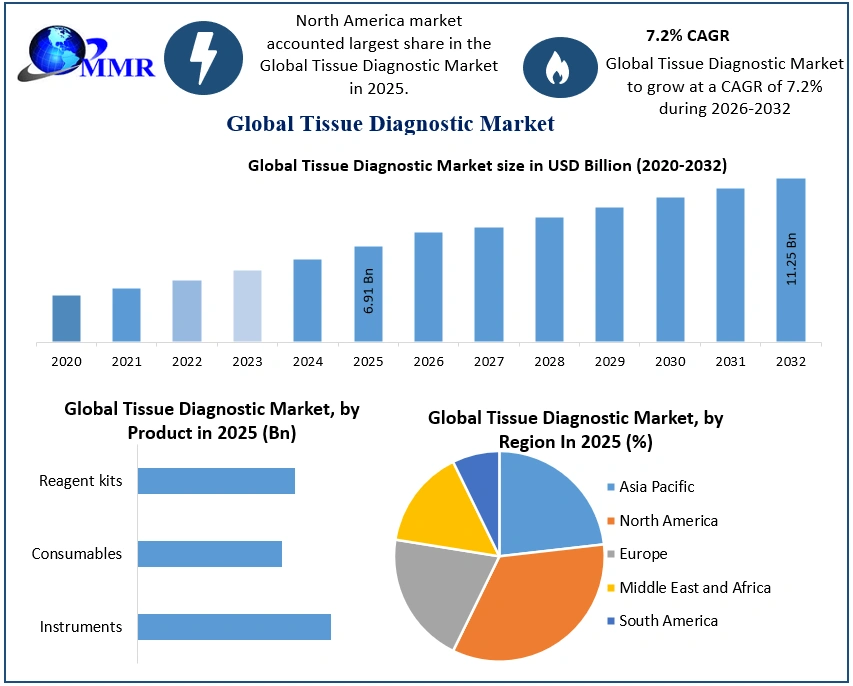
The Tissue Diagnostic Market size was valued at USD 6.91 Billion in 2025 and the total Tissue Diagnostic revenue is expected to grow at a CAGR of 7.2% from 2026 to 2032, reaching nearly USD 11.25 Billion by 2032.
Tissue diagnostics is a technique to diagnose and classify diseases based on tissue from organs and tumors, such as determining whether a patient has cancer, its type (such as kidney or prostate cancer), and its features (such as Stage II, grade, or subtype of lung cancer). Tissue diagnostics play an important role in improving the treatment and health outcomes of cancer patients. The world is working together to fight against the rising incidence of cancer cases. As treatments improve rapidly, there is a greater need for tissue diagnostic testing, which driving demand for the tissue diagnostic market.
To know about the Research Methodology :- Request Free Sample Report
1.According to MMR, Globally, more than 14 million individuals are diagnosed with cancer each year, and by 2032, that figure is expected to increase to more than 21 million. Major Key players are introducing new cancer diagnosis products. For instance, Roche introduced its innovative Benchmarks ULTRA PLUS system for cancer diagnostics in June 2022, Pathologists can deliver high-quality, time-sensitive results to doctors and patients due to the Benchmarks ULTRA PLUS tissue staining system's improved workflow, testing efficiency, and environmentally sustainable features.
The tissue diagnostics market has been driven by advanced infrastructure for cancer diagnosis, government initiatives for cancer research, and the adoption of digital pathology and automation in tissue diagnostics Methods. Some of the key players operating in the infection control market are Agilent Technologies, Danaher Corporation, F. Hoffmann-La Roche Ltd, BIOMÉRIEUX, Abbott Laboratories, Merck KGaA, General Electric Company (GE Healthcare), BioGenex, Cell Signaling Technology, Inc.
Asia-Pacific is the fastest-growing region with a market share of over xx% in 2025. The region is expected to grow at a CAGR of 7.9 % during the forecast period and maintain its dominance by 2032. In the Asia-Pacific region, increasing awareness about early disease detection and regular screenings leads to higher demand for tissue diagnostics methods. Governments have taken initiatives to improve healthcare infrastructure and access to advanced medicines are expected to boost the growth of the tissue diagnostics market in the region.
Tissue Diagnostic Market Dynamics:
Rising Chronic Disease Incidences Boost Tissue Diagnostic Market
Improved healthcare and living standards have increased life expectancy, but an aging population is more lying to chronic diseases like cancer, requiring tissue diagnostics for accurate diagnosis and treatment. With the increasing incidences of chronic diseases such as Cancer, cardiovascular diseases, diabetes, and neurological disorders for early detection, diagnosis, and treatment planning of a variety of chronic diseases, tissue diagnostics is mandatory. So, the demand for accurate diagnostic techniques, including the tissue diagnostics market. Advancements in technology have greatly improved the accuracy, efficiency, and accessibility of tissue diagnostics. Innovations such as digital pathology, molecular diagnostics, and immunohistochemistry have enhanced the speed and precision of tissue analysis, enabling earlier detection and personalized treatment strategies. The Immunohistochemistry technique is Tissue diagnostics plays a vital role in advancing personalized medicine. They help healthcare professionals identify specific biomarkers within the tissue, enabling them to customize treatments based on a patient's unique disease characteristics. This approach has been revolutionary in cancer treatment, leading to the development of targeted therapies with improved efficacy and fewer side effects than traditional treatments.

High cost of advanced technologies & Reimbursement limitations
The tissue diagnostic market is facing a major obstacle due to the high costs associated with advanced technologies. This financial barrier is limiting market growth and accessibility to state-of-the-art diagnostic tools and techniques. However advancements in digital pathology, next-generation sequencing, and AI-based software propelling market growth, pricing is still a major barrier to the widespread use of these cutting-edge technologies. Healthcare systems face challenges as a consequence of the cost of expensive tissue diagnostic solutions, especially in countries that are developing where financial restraints prevent the widespread adoption of these advanced technologies.
Reimbursement policies play an important part in determining which products enter the market and affect investment decisions in product development. In the tissue diagnostic market, reimbursement limitations in certain regions impact the availability and adoption of diagnostic tests. Some regions only reimburse for specific patient subgroups with enhanced clinical benefits, affecting the commercial considerations for pharmaceutical and diagnostic supporters. The reimbursement practices for companion diagnostics, which are FDA-approved or cleared tests, are more straightforward than those for paired diagnostics outside the United States where the financier differs significantly. The clinical utility of tests is critical including benefits, risks, and real-life evidence capture post-approval.
Tissue Diagnostic Market Segment Analysis:
Based on Disease, the Breast Cancer segment hold the largest market share of about 49.56% in the Tissue Diagnostic Market in 2025. According to the MMR analysis, the segment is expected to grow at a CAGR of 7.3% during the forecast period and maintain its dominance till 2032. The breast cancer market is dominated by factors like changes in lifestyles, age factors, as well as an increase in breast cancer activities. Breast cancer is a significant healthcare concern and the tissue diagnostic market plays a key role in its detection, diagnosis, and planning for a line of cancer treatment. Advanced techniques such as immunohistochemistry and in situ hybridization, are being increasingly used to analyze breast tissue samples, allowing specific characterization of tumours.

Based on End Users, the Hospital segment hold the largest market share of about 44.56% in the Tissue Diagnostic Market in 2025 and is expected to maintain its dominance till 2032. In Hospital visit patients, an increase in internal diagnostic procedures within hospitals, and initial diagnosis of cancer by clinical tests are conducted in the presence of reimbursement in well-developed Hospitals. Hospitals are increasingly adopting tissue-based diagnostic testing techniques over conventional methods due to their ability to reduce timelines and improve disease diagnostics through agreement models.
The Contract Research Organizations (CROs) segment is expected to see lucrative growth during the forecast period. CROs provide research support, and clinical trial services, and manage trials, and functions of companies that face budget restraints.

Tissue Diagnostic Market Regional Analysis
North America dominates the Tissue Diagnostic Market with the largest market share accounting for 47.3 % in 2025, the region is expected to grow during the forecast period and maintain its dominance by 2032. North America dominates the market with a strong presence of leading companies like Abbott Laboratories, Thermo Fisher Scientific., and Danaher Corporation. North America regularly spends more per person on healthcare than other regions. This means that there exists greater funds available for purchasing tissue diagnostic tools and services. The increasing healthcare expenditure and high–quality infrastructure for hospitals and clinical laboratories boost the tissue diagnostic market.
Europe, the fastest-growing region in the Tissue Diagnostic Market hold a market share of 22.8% and is significantly growing during its forecast period. In Europe increasing awareness about cancer and chronic diseases, hence growing demands for diagnostic care centres. Automation in laboratory workflow integration by using advanced technologies and processes, which optimize the use of personnel and equipment, improves safety by reducing contact with biohazards and reducing errors giving accurate results.
Competitive Landscape for Tissue Diagnostic Market:
The competitive landscape of the Tissue Diagnostic market is constantly evolving, with new players emerging and established players adapting their strategies. A key component of their strategy is their constant commitment to research and development (R&D) to maintain a leading position in technological development.
In February 2023, F. Hoffmann-La Roche Ltd launched its IDH1 R132H (MRQ-67) Rabbit Monoclonal Antibody and the ATRX Rabbit Polyclonal Antibody for use in the Benchmark series of instruments for the detection of brain cancer.
In 2022, Leica Biosystems acquired Cell IDx, a leader in multiplexed tissue profiling, to advance its multiplexing menu and offer ready-to-use pre-kitted formulations. This acquisition aimed to expand Leica Biosystems' capabilities in translational research and provide researchers with tools to accelerate scientific exploration into translational outcomes.
In 2022, F. Hoffmann-La Roche Ltd (Switzerland) invested USD 16.79 million in R&D activities focusing on product development and launches to maintain its market position
In 2022, Danaher Corporation (US) with its subsidiary Leica Biosystems, invested USD 1.742 billion in research and development in 2021, demonstrating its commitment to innovation and expanding its diagnostic business
In October 2022,F. Hoffman-La Roche Ltd received FDA approval for its PATHWAY anti-HER2/neu (4B5) Rabbit Monoclonal Primary Antibody use as a companion diagnostic test to identify metastatic breast cancer patients with low HER2 expression.
In 2021, to increase the availability of precision medication for lung cancer, QIAGEN released its first FDA-approved tissue companion diagnostic to detect the KRAS G12C mutation in NSCLC tumors. The Rotor-Gene Q MDx instrument, a part of the modular QIAsymphony family of automation solutions, is used with the real-time qualitative PCR kit.
Tissue Diagnostic Industry Ecosystem
Tissue Diagnostic Market Scope: Inquire before buying
| Tissue Diagnostic Market | |||
|---|---|---|---|
| Report Coverage | Details | ||
| Base Year: | 2025 | Forecast Period: | 2026-2032 |
| Historical Data: | 2020 to 2025 | Market Size in 2025: | USD 6.91 Bn. |
| Forecast Period 2026 to 2032 CAGR: | 7.2% | Market Size in 2032: | USD 11.25 Bn. |
| Segments Covered: | by Product | Instruments Consumables Reagent kits |
|
| by Disease | Breast Cancer Gastric Cancer Prostate Cancer Lymphoma Lung Cancer Others |
||
| by Technology | In-situ Hybridization Immunohistochemistry Digital Pathology Special staining Others |
||
| by End-User | Hospital & Clinics Diagnostic centres Contract Research Organizations Research Laboratories Others |
||
Tissue Diagnostic Market, by Region
North America (United States, Canada and Mexico)
Europe (UK, France, Germany, Italy, Spain, Sweden, Austria and Rest of Europe)
Asia Pacific (China, South Korea, Japan, India, Australia, Indonesia, Malaysia, Vietnam, Taiwan, Bangladesh, Pakistan and Rest of APAC)
Middle East and Africa (South Africa, GCC, Egypt, Nigeria and Rest of ME&A)
South America (Brazil, Argentina Rest of South America)
Tissue Diagnostic Market, Key Players:
North America:
1. Abbott Laboratories (USA)
2. Agilent Technologies (California)
3. Danaher Corporation (Washington)
4. Thermo Fisher Scientific Inc. (USA)
5. HOLOGIC, INC. (U.S.)
6. Ventana Medical Systems (USA)
7. BIO SB Inc. (California)
8. PerkinElmer Inc. (Massachusetts)
9. Sakura Finetek USA, Inc. (USA)
10. Cell Signaling Technology, Inc. (U.S.)
11. Becton, Dickinson, and Company ( New Jersey)
12. PHC Holdings Corporation (Japan)
Europe:
1. F. Hoffmann-La Roche Ltd. (Switzerland)
2. Milestone Srl (Italy)
3. Merck KGaA (Germany)
4. QIAGEN N.V. (Netherlands)
5. Sysmex Corporation (Europe)
Asia-Pacific Market:
1. Siemens Healthineers Asia Pacific
2. Roche Diagnostics Asia Pacific Pte Ltd.
3. Sakura Finetek Japan Co., Ltd. (Japan)
South America:
4. Ventana Medical Systems, Inc., (Tucson)
5. BioGenex Laboratories (Brazil)
Frequently Asked Questions:
1] What segments are covered in the Tissue Diagnostic Market report?
Ans. The segments covered in the Tissue Diagnostic Market report are based on Product, Disease, Technology, and End Users.
2] Which region is expected to hold the highest share in the Tissue Diagnostic Market?
Ans. The North America region is expected to hold the highest share of the Tissue Diagnostic Market.
3] What is the market size of the Tissue Diagnostic Market?
Ans. The Tissue Diagnostic Market size was valued at USD 6.91 Billion in 2025 and the total Tissue Diagnostic revenue is expected to grow at a CAGR of 7.2% from 2026 to 2032, reaching nearly USD 11.25 Billion by 2032.
4] What is the forecast period for the Tissue Diagnostic Market?
Ans. The forecast period for the Tissue Diagnostic Market is 2026-2032.
5] What is the growth rate of the Tissue Diagnostic Market?
Ans. The Tissue Diagnostic market is expected to grow at a CAGR of 7.2% during the forecast period of 2026 to 2032.