
Global Tin Chemicals Market Size by Type, by Application, by End-User, by Region and Forecast 2034
Overview
The Global Tin Chemicals Market was valued at USD 1.69 Billion in 2025 and is projected to reach USD 2.86 Billion by 2034, growing at a CAGR of 6.04% during the forecast period 2026–2034.
| Parameter | Value |
|---|---|
| Market Size (2025) |
USD 1.69 Billion |
| Market Size (2034) |
USD 2.86 Billion |
| CAGR | 6.04% |
| Historical Period |
2020 to 2025 |
| Forecast Period |
2026 to 2034 |
Global Tin Chemicals Market Overview
The Tin Chemicals Market focuses on inorganic and organic tin compounds used in electroplating, PVC stabilization, catalysts, glass coatings, and advanced electronics. Tin chemicals, including stannous chloride, stannic chloride, tin oxide, and organotin compounds, provide corrosion resistance, thermal stability, chemical reactivity, and surface protection. Growing demand for industrial chemicals, metal finishing, specialty coatings, and electronic components supports Tin Chemicals Market growth and manufacturing applications worldwide.
The Tin Chemicals Market trends highlight increasing demand for high-purity tin compounds, sustainable chemical processing, advanced electroplating, and electronic materials. Major buyers include chemical manufacturers, electronics companies, automotive suppliers, glass producers, and metal finishing industries. Emerging opportunities in semiconductor manufacturing, energy-efficient glass coatings, and specialty catalysts support Tin Chemicals Market expansion. Asia Pacific represents a leading market region, supported by industrial production in China, Japan, South Korea, and India. Key industry participants include Yunnan Tin Company, Mitsubishi Materials Corporation, and Keeling & Walker, which operate across tin materials, specialty chemicals, and industrial applications.
Maximize Market Research (MMR)'s Global Tin Chemicals Market analysis examines market size, share, growth drivers, product segmentation, regional demand, competitive landscape, and investment opportunities through 2034. The research focuses on tin-based chemical innovation, industrial electroplating, PVC stabilizers, specialty catalysts, and high-performance electronic materials. MMR's market outlook highlights opportunities for chemical producers, technology suppliers, and investors while evaluating raw material price volatility, environmental regulations, manufacturing efficiency, and changing industrial demand.
Global Tin Chemicals Market Key Highlights
Global Tin Chemicals Market Size, Growth and Share Analysis
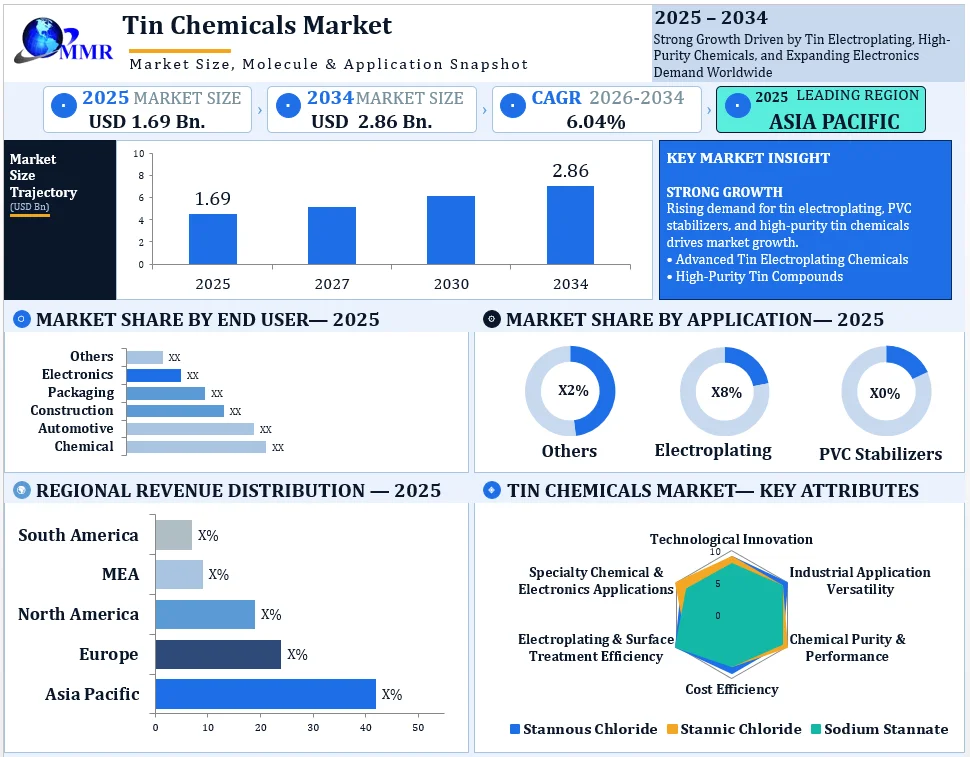
To know about the Research Methodology :- Request Free Sample Report
Global Tin Chemicals Market Dynamics:
Rising Demand for Tin-Based Chemicals in Electroplating, PVC Stabilizers and Industrial Manufacturing
The Global Tin Chemicals Market growth is driven by increasing demand for electroplating chemicals, PVC heat stabilizers, specialty catalysts, glass coatings, and advanced electronic materials. Tin chemicals, including stannous chloride (SnCl₂), stannic chloride (SnCl₄), tin oxide (SnO₂), and organotin compounds, play an important role in metal surface treatment, corrosion resistance, polymer processing, and chemical manufacturing. Industrial-grade tin compounds with purity levels of 99%–99.9% support specialized manufacturing requirements, depending on product specifications. The electronics industry uses tin-based electroplating solutions for connectors, circuit components, and solderable surfaces, while PVC manufacturers use selected organotin stabilizers to improve thermal stability during processing. Increasing demand for automotive electronics, industrial machinery, high-performance plastics, and precision metal finishing strengthens the Tin Chemicals Market demand, industrial applications, and long-term growth outlook.
Fluctuating Tin Metal Prices, High Manufacturing Costs and Supply Chain Dependence
The Tin Chemicals Market faces significant restraints from volatile refined tin prices, limited raw material availability, energy-intensive chemical processing, and increasing production expenses. Tin metal represents a critical raw material for manufacturing stannous chloride, stannic chloride, tin oxide, and other inorganic tin chemicals, making chemical production costs sensitive to changes in global tin supply and metal pricing. Manufacturing high-purity tin compounds with specifications of 99.9% or above requires additional purification, controlled chemical reactions, specialized processing equipment, and strict quality testing. Dependence on concentrated tin mining and refining operations also creates procurement and supply chain risks for chemical manufacturers. Transportation costs, energy prices, and inventory management requirements further influence production economics. These factors affect Tin Chemicals Market pricing, manufacturer profitability, production capacity utilization, and cost competitiveness, particularly among small and medium-sized specialty chemical producers.
Expanding Semiconductor Applications, Solar Technologies and Energy-Efficient Glass Coatings
The Global Tin Chemicals Market opportunities expand through growing applications in semiconductor manufacturing, transparent conductive coatings, photovoltaic technologies, advanced sensors, and energy-efficient architectural glass. Tin dioxide (SnO₂) serves as an important material in gas sensors, functional coatings, and selected electronic applications, while fluorine-doped tin oxide (FTO) supports transparent conductive glass used in solar cells, electronic devices, and specialized optical systems. High-purity tin chemical grades of 99.99% and above create opportunities in electronic materials and research applications that require controlled impurity levels. Increasing development of smart building materials, advanced electronic components, renewable energy systems, and functional glass products supports demand for specialized tin-based compounds. Manufacturers also explore product differentiation through high-purity formulations, customized chemical grades, and application-specific materials. These developments strengthen Tin Chemicals Market investment opportunities, specialty chemical innovation, advanced materials commercialization, and emerging industrial applications through 2034.
Environmental Regulations, Organotin Toxicity and Development of Safer Chemical Formulations
The Tin Chemicals Market challenges center on environmental compliance, chemical toxicity management, wastewater treatment, and maintaining product performance under increasingly demanding regulatory requirements. Certain organotin compounds face restrictions because of their potential environmental persistence and toxicological effects, creating challenges for manufacturers serving PVC processing, industrial catalysts, and specialty chemical applications. Tin chemical producers require effective handling systems, controlled manufacturing operations, impurity monitoring, and appropriate treatment of chemical waste streams. Developing lower-toxicity tin-based stabilizers, environmentally responsible processing technologies, and safer specialty chemical formulations requires additional technical research and product qualification. Manufacturers also face challenges in maintaining consistent chemical purity, thermal performance, storage stability, and compatibility with industrial processing systems. Balancing regulatory compliance, product reliability, manufacturing efficiency, and customer requirements remains a major factor influencing Global Tin Chemicals Market competitiveness, sustainable manufacturing strategies, and long-term commercial development.
Global Tin Chemicals Market Trends
| Key Market Trends | Technology and Product Insights |
Market Impact and Growth Opportunities |
|---|---|---|
| High-Purity Tin Chemicals Innovation |
Advanced stannous chloride, stannic chloride, and tin compounds offer selected purity grades of 99.9%–99.99% for specialized applications. |
Rising demand for high-purity tin chemicals and advanced electronic materials supports market growth. |
| Advanced Tin Electroplating Technologies |
Tin-based electroplating chemicals improve corrosion resistance, solderability, and surface performance in electronic components. |
Growing adoption of tin electroplating chemicals and metal finishing solutions strengthens industrial demand. |
| Tin-Based PVC Stabilizer Development |
Organotin stabilizers improve thermal stability and processing efficiency in selected rigid PVC applications. |
Demand for PVC heat stabilizers and specialty polymer additives supports market opportunities, subject to regulatory requirements. |
| Tin Oxide and Smart Glass Applications |
Tin dioxide (SnO₂) and fluorine-doped tin oxide (FTO) support conductive coatings, gas sensors, and photovoltaic materials. |
Expansion of energy-efficient glass, solar technologies, and advanced electronics creates new growth opportunities. |
| Sustainable Tin Chemical Manufacturing |
Tin recovery, recycling, wastewater treatment, and lower-toxicity formulations improve resource efficiency and environmental performance. |
Increasing focus on sustainable tin chemicals and responsible industrial manufacturing supports long-term competitiveness. |
Global Tin Chemicals Market Segment Analysis:
Global Tin Chemicals Market Segment, by Type
The Tin Chemicals Market by Type includes Sodium Stannate, Stannous Chloride, Stannic Chloride, Stannous Oxalate, Stannic Sulphate, and Others, supporting industrial chemical processing, electroplating, specialty coatings, and advanced manufacturing applications. Sodium Stannate supports alkaline tin plating, glass manufacturing, and metal surface treatment, while Stannous Chloride plays an important role in electroplating, chemical reduction, and catalyst production. Stannic Chloride serves as a chemical intermediate and catalyst in polymer manufacturing and specialty chemical synthesis. Stannous Oxalate supports specialty chemical formulations and tin compound synthesis, while Stannic Sulphate finds applications in selected chemical processing and metal finishing operations. The Others segment includes tin oxides, organotin compounds, and specialized tin-based chemicals. Increasing demand for high-purity tin chemicals, industrial electroplating solutions, tin-based catalysts, specialty chemical intermediates, and advanced electronic materials supports Tin Chemicals Market growth, product innovation, and industrial applications through 2034.
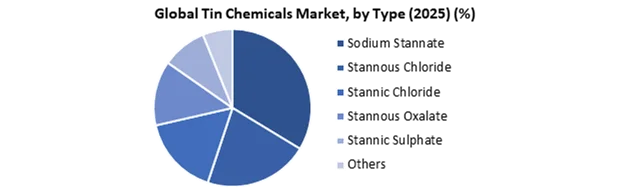
Global Tin Chemicals Market Segment, by End-Use Industry
The Tin Chemicals Market by End-Use Industry includes Chemical, Automotive, Construction, Packaging, Electronics, and Others, reflecting growing demand for tin-based compounds across industrial manufacturing applications. The Chemical segment uses stannous chloride, stannic chloride, and organotin compounds in specialty catalysts, chemical synthesis, and polymer processing, while the Automotive segment utilizes tin electroplating chemicals for corrosion-resistant components, electrical connectors, and electronic systems. The Construction segment benefits from tin-based PVC stabilizers, architectural glass coatings, and specialty building materials, whereas the Packaging segment uses tin chemicals in metal surface treatment and tinplate processing. The Electronics segment generates demand for high-purity tin compounds, semiconductor materials, printed circuit boards, and electronic component plating. The Others segment includes textiles, ceramics, glass manufacturing, and specialty industrial applications. Increasing adoption of high-purity tin chemicals, advanced electroplating technologies, specialty chemical intermediates, and tin-based industrial materials supports Global Tin Chemicals Market growth, end-use industry demand, and emerging business opportunities through 2034.
Global Tin Chemicals Market Regional Insights:
| Region | Regional Market Insights and Growth Opportunities |
|---|---|
| North America |
The North America Tin Chemicals Market benefits from advanced electronics manufacturing, automotive production, and specialty chemical innovation. Rising demand for high-purity tin compounds, tin electroplating chemicals, industrial catalysts, and metal finishing solutions supports regional market growth. |
| Europe | The Europe Tin Chemicals Market focuses on sustainable chemical manufacturing, automotive electronics, and specialty polymer applications. Growing demand for tin-based PVC stabilizers, stannous chloride, tin oxide coatings, and industrial chemical intermediates strengthens regional market opportunities. |
| Asia Pacific |
Asia Pacific represents a leading region in the Global Tin Chemicals Market, supported by extensive electronics production, tin refining, and chemical manufacturing. Increasing demand for tin electroplating solutions, high-purity tin chemicals, PVC stabilizers, and semiconductor materials drives regional market expansion. |
| Middle East & Africa |
The Middle East & Africa Tin Chemicals Market presents emerging opportunities through industrial diversification, construction, and petrochemical manufacturing. Rising demand for tin-based catalysts, PVC processing chemicals, corrosion-resistant coatings, and specialty tin compounds supports regional market development. |
| South America |
The South America Tin Chemicals Market benefits from tin mining, metal processing, automotive manufacturing, and specialty chemical production. Growing applications of stannous chloride, tin plating chemicals, industrial catalysts, and advanced surface treatment solutions create regional growth opportunities through 2034. |
Global Tin Chemicals Market Recent Developments
| Date | Recent Developments |
|---|---|
| October 2026 | Seligdar PJSC reports a 20% increase in tin concentrate production to 3,121 tonnes during the first nine months of 2026, supported by manufacturing modernization and technological upgrades. The expansion strengthens the upstream supply chain for tin chemicals and specialty tin compounds. |
| June 2026 | Yunnan Tin Company signs an acquisition agreement for Chifeng Dajingzi Tin Industry, valued at approximately USD 26.20 million. The acquisition supports tin smelting capacity consolidation and supply chain integration for high-purity tin chemicals and industrial tin-based materials. |
| June 2026 | Sofab Inks develops advanced tin oxide (SnO₂) nanoparticle inks containing particles as small as 5 nanometers’ for perovskite solar cells. The product innovation supports tin chemicals market opportunities in photovoltaic materials, advanced coatings, and specialty catalysts. |
| March 2026 | Malaysia Smelting Corporation (MSC) begins construction of a new rotary furnace at its Rahman Hydraulic Tin mine in Malaysia, with an investment of approximately USD 2.5 million and planned processing capacity of 10 tonnes per day. The project strengthens refined tin supply for downstream chemical manufacturing. |
| 12 January 2026 | Malaysia Smelting Corporation and Yunnan Tin Company hold strategic discussions on resource development, smelting technology, digitalization, and potential industrial collaboration. The engagement supports opportunities for tin processing, specialty tin chemicals, and global supply chain development, although no binding joint venture is announced. |
Global Tin Chemicals Market Competitive Landscape
The Tin Chemicals Market competitive landscape reflects increasing competition among specialty chemical manufacturers, tin refiners, industrial chemical suppliers, and advanced material producers. Leading Tin Chemicals Market key players, including Yunnan Tin Company, Malaysia Smelting Corporation, Mitsubishi Materials Corporation, Keeling & Walker, Mason Corporation, Gulbrandsen Technologies, and TIB Chemicals, focus on high-purity tin compounds, product innovation, manufacturing efficiency, and strategic partnerships. Yunnan Tin Company operates across tin mining, refining, and downstream tin products, while Keeling & Walker specializes in tin oxide materials for ceramic, glass, and industrial applications. Mitsubishi Materials Corporation participates in advanced metal processing and specialty materials, supporting the broader tin chemical supply chain. Increasing demand for stannous chloride, stannic chloride, sodium stannate, tin oxide, organotin compounds, and electroplating chemicals strengthens market competition across electronics, automotive, construction, packaging, and chemical manufacturing industries. Maximize Market Research's Tin Chemicals Market competitive analysis examines company market positioning, product portfolios, manufacturing capabilities, technological advancements, regional presence, mergers and acquisitions, strategic collaborations, and emerging Global Tin Chemicals Market growth opportunities through 2034.
Global Tin Chemicals Market Scope: Inquire before buying
| Tin Chemicals Market | |||
|---|---|---|---|
| Report Coverage | Details | ||
| Base Year: | 2025 | Forecast Period: | 2026-2034 |
| Historical Data: | 2020 to 2025 | Market Size in 2025: | USD 1.69 Billion |
| Forecast Period 2026 to 2034 CAGR: | 6.04% | Market Size in 2034: | USD 2.86 Billion |
| Segments Covered: | by Type | Sodium Stannate Stannous Chloride Stannic Chloride Stannous Oxalate Stannic Sulphate Others |
|
| by Application | Electroplating PVC Stabilizers Chemical Intermediates Others |
||
| by End-Use | Chemical Automotive Construction Packaging Electronics Others |
||
Global Tin Chemicals Market, by Region
North America (United States, Canada and Mexico)
Europe (UK, France, Germany, Italy, Spain, Sweden, Austria and Rest of Europe)
Asia Pacific (China, South Korea, Japan, India, Australia, Indonesia, Malaysia, Vietnam, Taiwan, Bangladesh, Pakistan and Rest of APAC)
Middle East and Africa (South Africa, GCC, Egypt, Nigeria and Rest of ME&A)
South America (Brazil, Argentina Rest of South America)
Global Tin Chemicals Market Key Players:
1. Yunnan Tin Company Limited
2. TIB Chemicals AG
3. Keeling & Walker Limited
4. William Blythe Limited
5. Mason Corporation
6. PT Timah Industri
7. Westman Chemicals Pvt. Ltd.
8. Lorad Chemical Corporation
9. Gulbrandsen Technologies
10. Showa Kako Corporation
11. BNT Chemicals GmbH
12. PMC Group
13. Galata Chemicals
14. Baerlocher GmbH
15. Songwon Industrial Co., Ltd.
16. Reagens S.p.A.
17. Valtris Specialty Chemicals
18. Nitto Kasei Co., Ltd.
19. Vikas Ecotech Limited
20. Novista Group
21. Hubei Benxing Chemical Co., Ltd.
22. Guangdong Rainbow Chemical Group Co., Ltd.
23. Daejung Chemicals & Metals Co., Ltd.
24. GFS Chemicals, Inc.
25. Strem Chemicals
26. Thermo Fisher Scientific Inc.
27. Merck KGaA
28. American Elements
29. Alfa Chemistry
30. Haihang Industry Co., Ltd.
31. S V Plastochem Private Limited
32. Shreenivas Chemicals
33. Suzhou Binshun Chemical Co., Ltd.
34. Wuhan Kemi-Works Chemical Co., Ltd.
35. Shandong Ruifeng Chemical Co., Ltd.
36. Jiangsu Yoke Technology Co., Ltd.
37. Pau Tai Industrial Corporation
38. Arkema S.A.
39. Dow Inc.
40. DuPont
41. Element Solutions Inc.
42. MKS Instruments, Inc.
43. Uyemura & Co., Ltd.
44. JCU Corporation
45. Mitsubishi Materials Corporation
46. Mitsubishi Chemical Group Corporation
47. Malaysia Smelting Corporation Berhad
48. Minsur S.A.
49. SNAM S.p.A.
50. China Tin Group Co., Ltd.
Frequently Asked Questions:
1. What is the Global Tin Chemicals Market size, CAGR, and growth forecast from 2025 to 2034?
The Global Tin Chemicals Market was valued at USD 1.69 Billion in 2025 and is projected to reach USD 2.86 Billion by 2034, growing at a CAGR of 6.04% during the forecast period 2026–2034.
2. What are the major growth drivers of the Tin Chemicals Market?
Key Tin Chemicals Market growth drivers include increasing demand for tin electroplating chemicals, PVC heat stabilizers, industrial catalysts, and high-purity tin compounds.
3. Which products and applications are important in the Tin Chemicals Market?
Major products include Sodium Stannate, Stannous Chloride, Stannic Chloride, Stannous Oxalate, and Stannic Sulphate. Key applications include electroplating, PVC stabilizers, and chemical intermediates.
4. Which region leads the Global Tin Chemicals Market?
Asia Pacific represents a leading Tin Chemicals Market region, supported by tin refining, electronics manufacturing, and specialty chemical production in China, India, Japan, and South Korea.
5. Who are the leading companies in the Global Tin Chemicals Market?
Major Tin Chemicals Market key players include Yunnan Tin Company, TIB Chemicals, Keeling & Walker, William Blythe, Mason Corporation, and PT Timah Industri.