
Thin Wall Packaging Market - Industry Structure Evaluation, Demand Drivers Analysis, Regional Growth Analysis and Identification, Competitive Positioning Review & Global Market Size Forecast to 2034
Overview
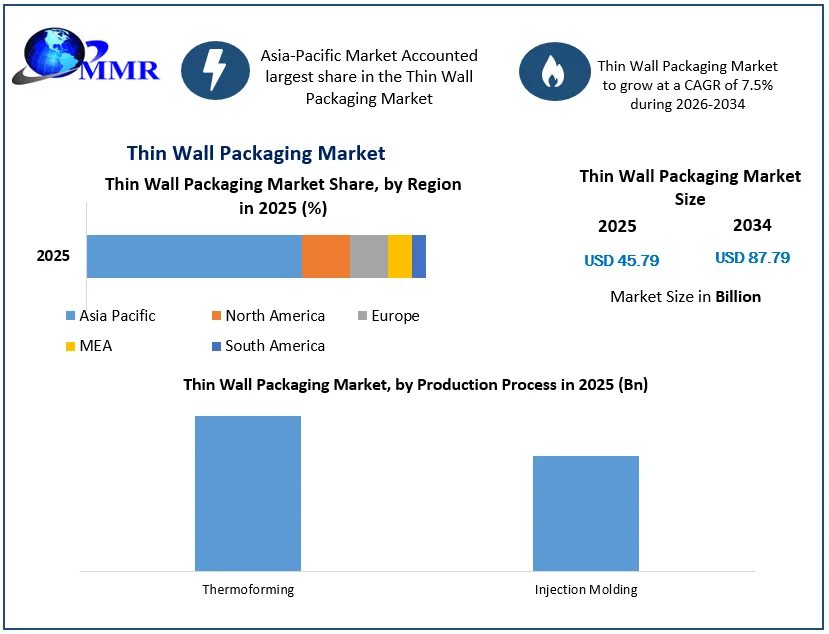
The Thin Wall Packaging Market was valued at USD 45.79 Bn in 2025 and is expected to reach USD 87.79 Bn by 2034, at a CAGR of 7.5% during the forecast period.
Thin Wall Packaging Market Overview:
Thin-wall packaging is a lightweight, rigid plastic container with minimal wall thickness used primarily for food and consumer goods packaging.
The report covered the market scope, various materials such as polypropylene, polyethylene, and polystyrene, and included formats like cups, tubs, trays, and jars. It thoroughly examines availability trends, highlighting increased production capabilities across Asia-Pacific and Europe due to advances in injection molding technology. The demand and supply dynamics are evaluated, revealing strong demand growth driven by convenience foods, sustainability pressures, and cost-effectiveness, while the supply chain remains robust with diversified regional manufacturing hubs. The report identifies Asia-Pacific as the dominant regional market, owing to high consumption rates and expanding urban populations. Major key players profiled include Berry Global, RPC Group, Paccor, and Greiner Packaging. The report details end-user contributions, particularly from the food & beverage sector, which accounts for the largest market share due to the need for quick-service, disposable packaging.
Thin Wall Packaging Market Growth and Share Analysis
To know about the Research Methodology :- Request Free Sample Report
Thin Wall Packaging Market Dynamics
Increasing Prevalence of Chronic Diseases to Drive Thin-Wall Packaging Market Growth
The increasing prevalence of chronic diseases, including cancer and cardiovascular disorders, is driving demand for highly sensitive and targeted diagnostic and therapeutic tools. Nanotechnology enhances the performance and miniaturization of devices, enabling early disease detection, drug delivery precision, and real-time monitoring. Furthermore, rising investments in healthcare innovation and government funding for nanotech research significantly support market expansion.
development costs and complex regulatory approvals to create the Thin Wall Packaging Market Restraints
High development costs and complex regulatory approvals are associated with nanotech-enabled medical devices. Moreover, safety concerns regarding the long-term effects of nanoparticles in the human body can delay product approvals and adoption. A lack of standardized testing and validation protocols further complicates commercialization efforts, especially for newer entrants in the market.
Emerging Markets and Technological Innovations to Create Thin Wall Packaging Market Opportunities
Major opportunities for the nanotechnology medical devices market, especially in emerging economies like India, China, and Brazil, where healthcare infrastructure is rapidly modernizing. Additionally, there is vast potential in the development of implantable nanodevices, smart drug delivery systems, and biosensors for personalized medicine. Collaborations between tech startups and healthcare giants are opening avenues for breakthrough innovations, creating a fertile environment for technological advancements and market penetration.
Barriers to Integration and Adoption of Nanotechnology in the Thin Wall Packaging Market
Key challenges identified in the report include the integration of nanotechnology into existing healthcare systems and scaling up production without compromising quality or safety. Intellectual property issues, limited technical expertise in developing nations, and interoperability with conventional medical devices are ongoing obstacles. Public awareness and acceptance of nanotechnology in medicine remain limited, posing an educational and ethical challenge to widespread adoption.
Thin Wall Packaging Market Segment Analysis
Based on Material type, the Thin Wall Packaging Market is segmented into Polypropylene (PP), Polyethylene (PE), High-Density Polyethylene (HDPE), Low-Density Polyethylene (LDPE), Polyethylene Terephthalate (PET), Polystyrene (PS), Polyvinyl Chloride (PVC), and Others. Among these, the Polypropylene (PP) segment dominated the market in 2025. Polypropylene (PP) leads the thin wall packaging market due to its superior balance of performance and cost-efficiency. It offers excellent impact resistance, high clarity, lightweight properties, and is ideal for injection molding, making it widely used in food containers, trays, and tubs. Its high melting point supports microwave applications, and its recyclability aligns with sustainability trends, further strengthening its dominance in both rigid and semi-rigid thin-wall packaging solutions.
Based on product type, the Thin Wall Packaging Market is segmented into Tubs, Cups, Jars, Trays, Clamshells, Lids, and Pots. Among these, the Cups Segment dominated the market in 2025, due to their extensive usage in the food and beverage industry, especially for packaging dairy products, ready-to-eat meals, and beverages.
Cups are preferred for their lightweight nature, easy stackability, cost-effectiveness, and compatibility with automation in filling and sealing processes. Their widespread application in both institutional and household use, along with the growing trend of on-the-go consumption and increased demand for single-serve packaging, reinforces their dominant position. Furthermore, innovations in material use and design to enhance sustainability and shelf appeal have further boosted the market share of cups in thin-wall packaging.
Regional Analysis of Thin-Wall Packaging Market
In 2025, the Asia-Pacific (APAC) region dominated the Thin-Wall Packaging Market. Countries like China, India, and Indonesia are driving this growth due to rapid urbanization, expanding middle-class populations, and rising consumption of packaged food and beverages. China's packaged food market, which is one of the largest globally, significantly boosts the demand for thin-wall containers like tubs, cups, and trays.
The dominance of APAC is further supported by the availability of low-cost raw materials and labor, strong manufacturing capabilities, and increasing investments in modern retail infrastructure. Additionally, growing environmental awareness is pushing demand for lightweight and recyclable packaging solutions, where thin-wall packaging plays a key role. These factors collectively made APAC the leading region in this market in 2025.
Competitive Landscape of the Thin Wall Packaging Market
The Asia-Pacific thin wall packaging market is witnessing significant growth. Countries like China, India, Japan, South Korea, and Southeast Asian nations are driving this surge, largely fuelled by the rapid expansion of the food and beverage, ready-to-eat meals, dairy, and e-commerce sectors. China remains a dominant force in the region, with companies like Taizhou Fuling Plastics leading in the production of disposable and thin-wall containers for both domestic consumption and export. Similarly, India has seen the rise of local manufacturers like the Hi-Tech Group, which caters to the increasing demand from the retail and food delivery segments. Global giants such as Amcor Plc, with its Asia-Pacific base in Australia, and Berry Global are strategically expanding operations in the region through local manufacturing plants and partnerships, especially in markets like China, India, and Southeast Asia, to benefit from low production costs and high-volume demand. Companies like ALPLA Group, Silgan Holdings, and Mitsubishi Chemical Group are also strengthening their presence with investments in recyclable and bio-based thin wall packaging to meet both environmental regulations and evolving consumer expectations. The region’s focus on sustainability is becoming more prominent, with governments encouraging the use of recyclable and lightweight packaging materials, particularly in Japan and South Korea, where regulatory pressures and environmental awareness are high. Asia-Pacific is not only a major consumer base but also a crucial manufacturing hub due to its scale, cost advantages, and increasing focus on sustainable innovation, making it a pivotal region in the global competitive landscape of the thin wall packaging market in 2025.
Recent Developments in the Thin Wall Packaging Market
| Date | Company | Development | Impact |
|---|---|---|---|
| 26 February 2025 | Amcor plc | Shareholders overwhelmingly approved the combination with Berry Global Group to merge their global healthcare, food service, and rigid thin wall packaging portfolios. | The merger scales production footprint and targets USD 650 million in annual synergies along with USD 180 million in incremental R&D investments. |
| 01 April 2025 | Mondi Group | Completed the acquisition of Western European packaging assets from Schumacher Packaging to expand its sustainable rigid and corrugated converting operations. | The strategic acquisition enhances production capacity and broadens high-performance packaging solutions across Western European consumer markets. |
| 19 May 2025 | Greiner Packaging | Partnered with Orthomol to launch a fully automated production line for thin wall supplement vials utilizing 100% food-grade rPET. | The automated line incorporates 18 real-time inspection cameras and a laminar flow system to optimize material efficiency while significantly reducing carbon emissions. |
| 01 September 2025 | Berry Global Inc. | Introduced an advanced thin-wall plastic container technology engineered specifically for food service and consumer applications. | The proprietary design reduces raw material usage by 20% without sacrificing structural rigidity, lowering production costs and freight weight. |
| 09 April 2026 | Faerch A/S | Partnered with fresh-meat producer Norfersk to scale commercial production of thin-wall trays containing 70% CIRPET+ recycled content. | The partnership establishes a closed-loop tray-to-tray recycling system for food packaging across Nordic retail markets. |
Key Trends in the market
Sustainable Materials: Growing use of recyclable and bio-based plastics like PLA and PP due to environmental regulations and consumer demand.
Light weighting: Increased focus on thinner, stronger packaging to reduce material use, costs, and carbon footprint.
Thin Wall Packaging Market Report Scope: Inquire before buying
| Thin Wall Packaging Market | |||
|---|---|---|---|
| Report Coverage | Details | ||
| Base Year: | 2025 | Forecast Period: | 2026-2034 |
| Historical Data: | 2020 to 2025 | Market Size in 2025: | USD 45.79 Bn. |
| Forecast Period 2026 to 2034 CAGR: | 7.5% | Market Size in 2034: | USD 87.79 Bn. |
| Segments Covered: | by Material Type | Polypropylene (PP) Polyethylene (PE), High-Density Polyethylene (HDPE) Low-Density Polyethylene (LDPE), Polyethylene Terephthalate (PET), Polystyrene (PS), Polyvinyl Chloride (PVC) Others |
|
| by Product Type | Tubs Cups Jars Trays Clamshells Lids Pots |
||
| by Production Process | Thermoforming Injection Molding |
||
Thin Wall Packaging Market by Region
North America (United States, Canada, and Mexico)
Europe (UK, France, Germany, Italy, Spain, Sweden, Austria, and the Rest of Europe)
Asia Pacific (China, South Korea, Japan, India, Australia, Indonesia, Philippines, Malaysia, Vietnam, Thailand, ASEAN, and the Rest of APAC)
Middle East & Africa (South Africa, GCC, Nigeria, Rest of ME&A)
South America (Brazil, Argentina, Rest of South America)
Thin Wall Packaging Market Key Players
The Global Thin Wall Packaging industry is a collection of lightweight and thinner plastic or polymer packaging solutions, which have a thickness of less than 0.5 to 3 millimeters, for food, drinks, cosmetics, and medical products to reduce waste and shipping expenses. The significant product types are polypropylene (PP) resins, injection molding process, and food/beverages.
| Company Name | Headquarters | Core Competencies |
| Amcor plc | Zürich, Switzerland | Thin-wall plastic packaging, rigid packaging, food packaging |
| Berry Global Group, Inc. | Evansville, Indiana, USA | Thin-wall injection-molded containers, food packaging, rigid plastics |
| Sonoco Products Company | Hartsville, South Carolina, USA | Consumer packaging, rigid plastic packaging, thin-wall containers |
| Greiner Packaging International GmbH | Kremsmünster, Austria | Thin-wall injection molding, dairy packaging, food containers |
| PACCOR GmbH | Düsseldorf, Germany | Thin-wall food packaging, cups, trays, containers |
| Silgan Holdings Inc. | Stamford, Connecticut, USA | Rigid plastic packaging, food containers, closures |
| Alpha Packaging | St. Louis, Missouri, USA | Plastic packaging, bottles, rigid packaging solutions |
| Pactiv Evergreen Inc. | Lake Forest, Illinois, USA | Thin-wall food containers, foodservice packaging |
| Mold-Tek Packaging Limited | Hyderabad, Telangana, India | Thin-wall injection-molded containers, food and paint packaging |
| Groupe Guillin | Ornans, France | Food trays, thermoformed and thin-wall packaging |
| ILIP S.r.l. | Bologna, Italy | Thin-wall food containers, thermoformed packaging |
| Sabert Corporation | Sayreville, New Jersey, USA | Thin-wall food containers, trays, and packaging solutions |
| Huhtamaki Oyj | Espoo, Finland | Foodservice packaging, thin-wall containers, sustainable packaging |
| Faerch A/S | Holstebro, Denmark | Thin-wall CPET food trays, recyclable food packaging |
| ALPLA Group | Hard, Austria | Rigid plastic packaging, thin-wall containers, injection molding |
| Plastipak Holdings, Inc. | Plymouth, Michigan, USA | PET and rigid plastic packaging, thin-wall containers |
| IPL Global | Dublin, Ireland | Thin-wall injection-molded packaging, food and industrial containers |
| Berry Superfos | Taastrup, Denmark | Thin-wall injection-molded containers, dairy and food packaging |
| RPC Bebo Plastik GmbH | Bremervörde, Germany | Thin-wall injection-molded food packaging, cups and tubs |
Frequently Asked Questions:
1. Which region has the largest share in the Thin wall packaging Market?
Ans: The Asia Pacific region held the highest share in 2025.
2. What is the growth rate of the thin-wall packaging Market?
Ans: The Global Market is expected to grow at a CAGR of 7.5% during the forecast period 2026-2034.
3. Who are the key players in the Thin wall packaging Market?
Ans: Amcor plc, Mold, SGC, and Berry Global Group are the key players in the market.
4. What is the study period of this market?
Ans: The Thin wall packaging market is studied from 2020 to 2034.
5. Which Segment is the most dominant in the Thin wall packaging Market based on application
Ans: In the Market segment by application, the most dominant segment is Food & Beverages