
Global Textura Tray Market Size by Tray Dimension, Material, End-use, Region and Forecast 2034
Overview
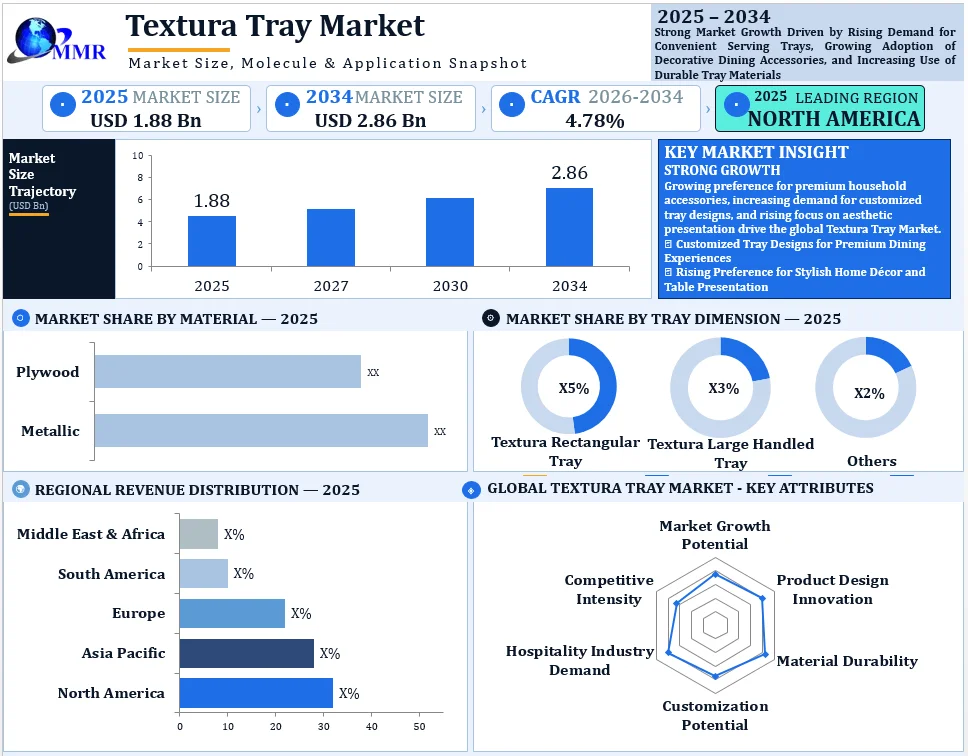
The Global Textura Tray Market is valued at USD 1.88 billion in 2025 and is projected to grow at a CAGR of 4.78% from 2026 to 2034, approaching to USD 2.86 billion by 2034.
Global Textura Tray Market Overview
The market encompasses plywood trays, metallic trays, decorative serving trays, and functional meal-carrying trays used across residential, commercial, and hospitality settings. Market growth is supported by rising demand for durable serving trays, premium dining accessories, decorative household products, and convenient food-serving solutions. Increasing applications across hotels, restaurants, catering services, banquet halls, and food-service establishments strengthen demand for versatile tray designs. Consumer preference for aesthetically appealing home décor, modern dining accessories, lightweight materials, easy-to-carry structures, and easy-to-clean surfaces further supports product adoption. Manufacturers focus on material quality, surface finishing, product durability, ergonomic handles, moisture resistance, customizable designs, and premium finishes to address evolving consumer requirements. Expanding hospitality infrastructure, growth in food-service activities, changing lifestyles, and increasing interest in stylish household accessories create additional opportunities for market development. Product innovation, attractive textures, functional designs, and improvements in manufacturing processes remain important factors shaping the competitive landscape of the Global Textura Tray Market
Global Textura Tray Market: Key Highlights
• Market Size and Growth: The Global Textura Tray Market is valued at USD 1.88 billion in 2025 and is projected to reach USD 2.86 billion by 2034, registering a CAGR of 4.78% during 2025–2034.
• Growing Demand for Convenient Serving Solutions: Changing lifestyles, increasing demand for ready-to-serve food, and preferences for easy-to-carry trays support market growth across residential, commercial, and hospitality applications.
• Material Innovation and Product Durability: Metallic, plywood, and other tray materials support diverse requirements for structural strength, durability, surface finishing, moisture resistance, and convenient handling.
• Hospitality and Dining Industry Expansion: Growing demand from hotels, restaurants, catering services, banquet halls, and food-service establishments strengthens the adoption of decorative serving trays, functional meal-carrying trays, and customized dining accessories.
• Product Differentiation and Competitive Strategies: Manufacturers focus on texture innovation, premium finishes, customizable designs, manufacturing efficiency, competitive pricing, and distribution expansion to strengthen their positions in the Global Textura Tray Market.
Global Textura Tray Market Growth and Share Analysis
To know about the Research Methodology :- Request Free Sample Report
Textura Tray Market Dynamics:
Global Textura Tray Market Drivers
Rising Demand for Convenient Food Serving and Carrying Solutions
Changing lifestyles in developed and developing economies support demand for convenient food-serving solutions and durable carrying alternatives. Growing preferences for ready-to-serve food, easy-to-carry products, and practical dining accessories strengthen the adoption of Textura trays across households, restaurants, hotels, and catering establishments. Increasing demand for functional serving trays that combine convenience, durability, and attractive designs further supports market growth.
Expansion of the Hospitality Sector and Premium Dining Accessories
The expanding hospitality sector contributes to the demand for Textura trays across hotels, restaurants, banquet halls, and catering services. Increasing emphasis on presentation, customer experience, and organized food serving encourages the adoption of decorative and functional tray designs. Demand for plywood and metallic trays also benefits from their use in household dining, hospitality interiors, and premium serving applications.
Global Textura Tray Market Restraints
Material Costs and Product Maintenance Requirements
Fluctuations in plywood, metal, finishing materials, and manufacturing costs create challenges for Textura tray manufacturers. Premium surface finishing and customized designs can increase production expenses and retail prices. Maintenance requirements, susceptibility to moisture or surface damage in certain materials, and competition from lower-cost serving alternatives can also influence purchasing decisions.
Environmental Regulations and Material Selection Challenges
Stringent rules and regulations concerning material safety, waste generation, and sustainable manufacturing influence material selection and production processes. Manufacturers face challenges in balancing product durability, food-contact suitability, affordability, and environmental considerations. Requirements for strong trays that protect food during handling and transportation can also increase material and design complexity.
Global Textura Tray Market Opportunities
Innovation and Technological Advancement in Tray Design
Innovation and technological advancement in tray design and materials create opportunities for product differentiation. Manufacturers can introduce lightweight structures, improved surface finishing, ergonomic handles, moisture-resistant coatings, and customizable textures to meet changing consumer preferences. These developments support the use of Textura trays across residential dining, commercial food service, and hospitality applications.
Growing Demand for Customization and Decorative Household Products
Increasing interest in home décor, premium dining accessories, and personalized serving products creates opportunities for specialized Textura tray designs. Manufacturers can target hotels, restaurants, catering businesses, and residential consumers through customized sizes, metallic finishes, decorative textures, and premium plywood designs. Expanding hospitality infrastructure and demand for visually appealing serving accessories further support market opportunities.
Global Textura Tray Market Challenges
Maintaining Product Quality and Food Protection
Manufacturers must ensure that Textura trays provide adequate strength, durability, and reliable performance during serving, handling, and transportation. Maintaining surface quality, structural stability, ease of cleaning, and resistance to regular wear remains important across household and hospitality applications. Meeting these requirements while controlling production costs presents an ongoing challenge.
Balancing Affordability, Durability, and Design Innovation
The need to provide attractive, durable, and cost-effective products creates challenges for manufacturers. Premium materials, customized designs, and advanced finishing processes can increase production costs, while consumers continue to seek affordable serving alternatives. Balancing aesthetics, functionality, material quality, and competitive pricing remains essential for sustained growth in the Global Textura Tray Market.
Global Textura Tray Market Segment Analysis:
The report groups the Global Textura Tray Market in different segments By Tray dimension, Material Type, End-Use, and region to forecast the revenues and analyse the market share of each segment over the forecast period.
Based on material type, the Global Textura Tray Market is segmented into Metallic, Plywood and Plastic. The Metallic segment was dominant in 2025 and is expected to command a market share of xx% by 2034. Metallic trays are reusable and can be reused after proper wash, which acts as a cost-efficient option for the user. Plywood trays are the recyclable option of the tray without any harm to the environment. Plastics trays are also used as it is chemical-resistant, inexpensive, and lightweight. The specific properties of the packaging are determined by the nature of the particular polymers used. Polyolefin is a combination of polyethene (PE) and polypropylene (PP) are the highly used plastics in trays.
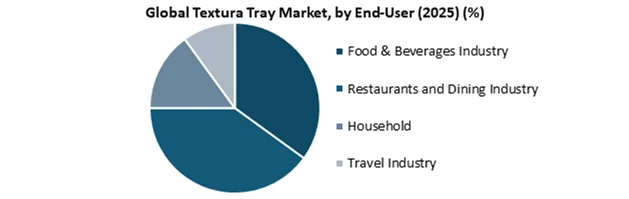
Based on end-user, the Global Textura Tray Market is segmented into Food & Beverages Industry, Restaurants and dining Industry, Household and Travel Industry. The Restaurants and dining industry segment were dominant in 2025 and is expected to command a market share of xx% by 2034.
Based on tray dimension, the Global Textura Tray Market is segmented into Textura Rectangular tray, Textura Large Handled tray, Textura Round Tray, Textura Oval tray and Comatec Textura Tray. Depending on the use of the tray and the convenience the choice of the Textura tray dimension is done.
Global Textura Tray Market Regional Insights:
North America holds a leading position in the Global Textura Tray Market, supported by changing lifestyles, demand for consumer-ready-to-eat meals, and the expansion of the restaurant and dining industry. The United States and Canada contribute to regional demand through busy consumer lifestyles, increasing online food delivery, and growing preferences for convenient food-serving solutions. The presence of established hospitality businesses, restaurants, catering services, and food-service establishments supports the use of durable and easy-to-carry trays. Demand for multi-cavity ready-meal trays, convenient packaging formats, and functional serving products further strengthens market development across the region.
Asia Pacific experiences growing demand for Textura trays, driven by urbanization, changing eating habits, expanding hospitality infrastructure, and rising food-service activities. China, India, Japan, and South Korea contribute through restaurant expansion, online food delivery, household dining, and commercial catering services. Increasing demand for ready-to-serve food, convenient carrying alternatives, and decorative household accessories supports product adoption. Growing investments in hotels, restaurants, and food-service establishments also encourage demand for functional, durable, and customizable tray designs.
Europe represents an important market for Textura trays, supported by established restaurant and dining industries, hospitality services, and consumer interest in premium household products. Germany, France, Italy, and the United Kingdom contribute through hotels, restaurants, catering businesses, and residential dining applications. Changing lifestyles and demand for consumer-ready meals encourage the adoption of convenient serving solutions. Increasing preferences for attractive designs, durable materials, easy-to-carry structures, and customized dining accessories further support regional market development.
South America offers growth opportunities in the Textura Tray Market through expanding restaurant networks, increasing urbanization, and developing hospitality and food-service industries. Brazil and Argentina support demand through restaurants, hotels, catering services, and household dining applications. Changing eating habits and increasing interest in convenient food-serving products encourage the use of practical and decorative trays. Growing online food delivery activities and demand for cost-effective, durable serving alternatives also contribute to regional market development.
The Middle East and Africa market benefits from expanding hospitality infrastructure, tourism, restaurant development, and commercial dining activities. GCC countries and South Africa contribute through hotels, restaurants, catering establishments, and household dining applications. Increasing investments in hospitality facilities and demand for premium dining experiences support the adoption of decorative and functional Textura trays. Preferences for durable materials, convenient serving solutions, attractive finishes, and customizable products create additional opportunities across the region.
Global Textura Tray Market Competitive Landscape
The Global Textura Tray Market features competition among manufacturers and suppliers of decorative serving trays, plywood trays, metallic trays, and functional dining accessories. Market participants focus on product differentiation, material quality, surface finishing, durability, customization, and design innovation to strengthen their competitive positions. Demand from households, hotels, restaurants, catering services, and commercial dining establishments encourages manufacturers to expand their product portfolios and develop solutions that combine functionality with visual appeal.
Key Competitive Strategies
1. Product Differentiation Through Texture and Design
Manufacturers emphasize distinctive textures, premium finishes, decorative patterns, and contemporary designs to differentiate their products. Customizable colors, shapes, sizes, and surface treatments help address demand across residential dining, hospitality, and premium serving applications.
2. Material Innovation and Product Durability
Companies focus on plywood, metal, and other suitable materials to improve structural strength, handling convenience, and product lifespan. Moisture resistance, scratch resistance, easy cleaning, and durable surface finishing remain important product attributes, particularly for frequently used hospitality trays.
3. Customization for Hospitality and Commercial Buyers
Hotels, restaurants, catering companies, and banquet facilities create demand for customized serving trays that align with specific service requirements and interior designs. Manufacturers can strengthen business relationships through bulk-order capabilities, customized dimensions, coordinated finishes, and products designed for repeated commercial use.
4. Premiumization and Household Décor Applications
Manufacturers increasingly position serving trays as both functional dining accessories and decorative household products. Premium finishes, textured surfaces, metallic accents, and coordinated décor collections support product differentiation and address consumer preferences for stylish home accessories.
5. Distribution Expansion and Digital Sales
Companies strengthen market access through partnerships with hospitality suppliers, home décor retailers, wholesalers, and online marketplaces. Digital product catalogs, product customization options, and direct-to-consumer channels improve product visibility and help manufacturers reach both commercial buyers and residential customers.
6. Cost Optimization and Manufacturing Efficiency
Efficient material utilization, standardized production processes, and scalable manufacturing help companies maintain competitive pricing while preserving product quality. Manufacturers balance customization requirements with production costs to serve different customer segments, from budget-conscious households to premium hospitality establishments.
Factors That Strengthen Competitive Positioning
| Competitive Factor | Strategic Importance |
|---|---|
| Material Quality | Supports durability, structural strength, and product reliability |
| Texture and Surface Finish | Differentiates products through visual appeal and tactile characteristics |
| Customization Capabilities | Addresses specific residential and hospitality requirements |
| Product Durability | Supports repeated use in restaurants, hotels, and catering services |
| Pricing Competitiveness | Helps manufacturers serve different customer segments |
| Distribution Network | Expands access to retail, wholesale, and commercial buyers |
| Design Innovation | Supports premium positioning and product differentiation |
| Manufacturing Efficiency | Improves production consistency and cost management |
Market Positioning and Competitive Differentiation
The competitive landscape is shaped by the ability to combine distinctive textures, durable materials, attractive designs, customization, and cost-effective manufacturing. Manufacturers that address both the functional requirements of commercial food serving and the decorative preferences of residential consumers can differentiate their product portfolios. Opportunities also emerge from customized hospitality solutions, premium dining accessories, coordinated home décor collections, and expanded online distribution.
Competitive outlook: Product differentiation, material innovation, customization, and effective distribution remain key strategies for strengthening competitive positioning in the Global Textura Tray Market. A company-level ranking requires verified information on market shares, revenues, product portfolios, and geographic presence; without these data, a defensible ranking of individual manufacturers is not established.
The objective of the report is to present a comprehensive analysis of the Global Textura Tray Market to the stakeholders in the industry. The past and current status of the industry with forecasted market size and trends are presented in the report with the analysis of complicated data in simple language.
The report covers all the aspects of the industry with a dedicated study of key players that include market leaders, followers, and new entrants. PORTER, SVOR, PESTEL analysis with the potential impact of micro-economic factors of the market have been presented in the report. External as well as internal factors that are supposed to affect the business positively or negatively have been analyzed, which will give a clear futuristic view of the industry to the decision-makers.
The report also helps in understanding the Global Textura Tray Market dynamics, structure by analyzing the market segments and projects the Global Textura Tray Market size. Clear representation of competitive analysis of key players by product, price, financial position, product portfolio, growth strategies, and regional presence in the Global Textura Tray Market make the report investor’s guide.
Global Textura Tray Market: Recent Developments
| Date | Company | Development | Impact |
|---|---|---|---|
| 24 February 2026 | Yangi AB | Launches a production-ready dry-formed fiber tray for meat, fish, deli, and ready-meal applications using its Cellera technology. |
Supports sustainable tray innovation, customized designs, and efficient manufacturing. |
| 13 April 2026 | Roootz | Expands its Roma hotel tea tray range with artificial leather finishes alongside existing wood veneer options. |
Improves product variety, durability, and design flexibility for hospitality customers. |
| 2026 | Roltex | Introduces its Craft Tray in a 2026 catering collection, featuring layered FSC-certified paper, customizable sizes, finishes, and printing options. |
Strengthens customization options for catering and commercial serving applications. |
| 2026 | Mehar Tableware Pvt. Ltd. | Showcases its Pormela Rusty Collection trays under the DINEWELL brand at Ambiente 2026, featuring lightweight melamine construction, textured finishes, and multiple sizes. |
Expands decorative serving tray choices for household dining and hospitality settings. |
Textura Tray Market Scope: Inquire before buying
| Textura Tray Market | |||
|---|---|---|---|
| Report Coverage | Details | ||
| Base Year: | 2025 | Forecast Period: | 2026-2034 |
| Historical Data: | 2020 to 2025 | Market Size in 2025: | USD 1.88 Bn. |
| Forecast Period 2026 to 2034 CAGR: | 4.78% | Market Size in 2034: | USD 2.86 Bn. |
| Segments Covered: | by Tray Dimension | Textura Rectangular tray Textura Large Handled tray Textura Round Tray Textura Oval tray Comatec Textura Tray |
|
| by Material | Metallic Plywood |
||
| by End-user | Food & Beverages Industry Restaurants and dining Industry Household Travel Industry |
||
Textura Tray Market, by Region
North America (United States, Canada and Mexico)
Europe (UK, France, Germany, Italy, Spain, Sweden, Austria and Rest of Europe)
Asia Pacific (China, South Korea, Japan, India, Australia, Indonesia, Malaysia, Vietnam, Taiwan, Bangladesh, Pakistan and Rest of APAC)
Middle East and Africa (South Africa, GCC, Egypt, Nigeria and Rest of ME&A)
South America (Brazil, Argentina Rest of South America)
Textura Tray Market, Key Players are:
1. Sonoco Products Company
2. Pactiv Evergreen
3. Cambro Manufacturing
4. Quinn Packaging
5. Genpak
6. Sealed Air Corporation
7. MCP Performance Plastics
8. Silver Plastics GmbH & Co. KG
9. Huhtamäki Oyj
10. Amcor plc
11. Faerch Group
12. DS Smith
13. Omniform Group
14. Versatile Packaging
15. Raptis Pax
16. Evesham Specialist Packaging
17. Holfeld Plastics
18. Tacca Industries
19. INFIA Srl
20. Peter Grice Packaging
21. Marinucci Australia
22. Ampulla Ltd.
23. Groupe Guillin
24. NGP Plastic SA
25. Berry Global
26. Sabert Corporation
27. Novolex
28. Coveris
29. Winpak Ltd.
30. Placon Corporation
31. Anchor Packaging
32. Graphic Packaging International
33. Mondi Group
34. Dart Container Corporation
35. CKF Inc.
36. ProAmpac
37. Stora Enso
38. International Paper
39. Cascades Inc.
40. Reynolds Consumer Products
41. Duni Group
42. EasyPak LLC
43. WinCup
44. BioPak
45. Greendale Packaging
Global Textura Tray Market: Frequently Asked Questions
1. What is the market size of the Global Textura Tray Market in 2025?
Ans. The Global Textura Tray Market is valued at USD 1.88 billion in 2025, reflecting demand for serving trays, decorative dining accessories, and functional meal-carrying products.
2. What is the projected CAGR of the Global Textura Tray Market during 2026–2034?
Ans. The market is projected to grow at a CAGR of 4.78% from 2026 to 2034, supported by changing lifestyles, hospitality sector expansion, and increasing demand for convenient serving solutions.
3. What is the projected market size of the Global Textura Tray Market by 2034?
Ans. The market is projected to reach USD 2.86 billion by 2034, driven by demand for durable trays, premium dining accessories, decorative household products, and customized hospitality solutions.
4. Which material segments are covered in the Global Textura Tray Market?
Ans. The market covers metallic and plywood trays, with the broader product landscape also including plastic trays. Material selection depends on durability, structural strength, weight, surface finishing, maintenance requirements, and intended application.
5. Which factors drive the Global Textura Tray Market?
Ans. Key growth drivers include changing lifestyles, demand for ready-to-serve food, increasing online food delivery, expansion of the restaurant and dining industry, hospitality infrastructure development, and rising preferences for decorative serving trays and customizable dining accessories.