
Global Sugar Free Confectionery Market By Product, By Ingredients, By Packaging Type, By Consumer Demographics, By Application, By Distribution Channel, by Region and Forecast 2034
Overview
Global Sugar Free Confectionery Market Overview
The Global Sugar Free Confectionery Market covers the manufacture, distribution, and retail sale of confectionery products formulated without added sugar, including sugar free chocolate, hard candies, gummies and jellies, chewing gum, mints, and other sweet confections. These products replace sucrose and glucose syrup with sugar alcohols such as xylitol, erythritol, maltitol, sorbitol, and isomalt, natural sweeteners such as stevia, monk fruit, and allulose, and high-intensity sweeteners such as sucralose and aspartame. The market is influenced by the rising prevalence of diabetes and obesity, growing consumer preference for reduced sugar diets, sugar reduction policies, clean-label product innovation, and the expansion of modern retail and e-commerce distribution networks.
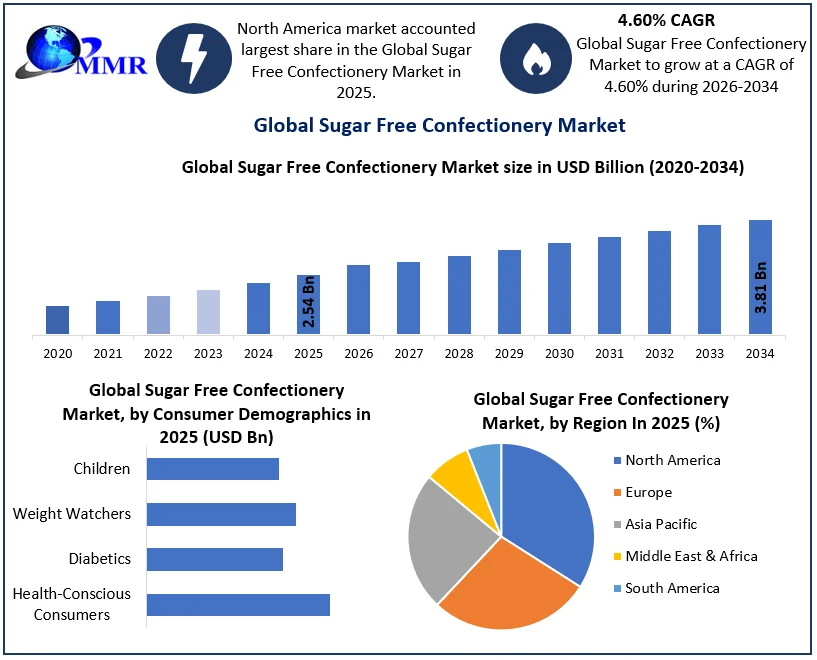
The Global Sugar Free Confectionery Market size was valued at USD 2.54 Billion in 2025 and the total market revenue is expected to grow at a CAGR of 4.60% from 2025 to 2034, reaching USD 3.81 Billion by 2034. In terms of sales volume, the market is estimated at XX Metric Tons in 2025 and is projected to reach XX Metric Tons by 2034. Sugar free hard candies, gummies, and chewing gum remain the most widely consumed product formats, while sugar free chocolate is gaining traction among health-conscious, diabetic, and keto-oriented consumers seeking indulgence without added sugar. Formulation remains technically demanding, as sugar contributes sweetness, bulk, texture, humectancy, and shelf stability, which must be replicated through carefully engineered sweetener blends, bulking agents, fibres, and flavour systems. Manufacturers are therefore investing in sweetener blending, taste-masking, and texture-optimization technologies to reduce aftertaste, cooling effects, and digestive tolerance concerns associated with certain polyols.
The MMR report on the Global Sugar Free Confectionery Market provides a structured assessment of the industry, covering key manufacturers, ingredient suppliers, product categories, packaging formats, distribution channels and retail participants. The report evaluates market size and growth trends, examines demand across major product segments, and assesses regional market performance and competitive positioning. It also includes company profiling and competitive benchmarking to help readers understand the strategies, product portfolios and market presence of leading participants. By bringing these insights together, the report supports businesses in identifying growth opportunities, evaluating competitive dynamics, understanding changing consumer preferences and making informed decisions related to market entry, product development, expansion and investment.
Global Sugar Free Confectionery Market Growth and Share Analysis
To know about the Research Methodology :- Request Free Sample Report
|
Parameter |
Value |
|
Market Size (2025) |
USD 2.54 Billion |
|
Market Size (2034) |
USD 3.81 Billion |
|
CAGR |
4.60% |
|
Historical Period |
2020 to 2025 |
|
Forecast Period |
2026 to 2034 |
Global Sugar Free Confectionery Market Key Highlights
• Strong Market Growth: The Global Sugar Free Confectionery Market was valued at USD 2.54 Billion in 2025 and is projected to reach USD 3.81 Billion by 2034, growing at a CAGR of 4.60% during the forecast period.
• Rising Diabetes and Metabolic Health Awareness: Growing prevalence of diabetes, obesity, and pre-diabetic conditions is increasing demand for diabetic-friendly, low-sugar, and sugar free confectionery alternatives worldwide.
• Sugar Reduction Policies Support Reformulation: Public health guidelines, front-of-pack labelling regimes, and sugar taxation initiatives are encouraging manufacturers to reformulate and expand sugar free product portfolios.
• Sweet & Candy Confectionery Leads the Product Landscape: Sugar free hard candies, gummies, mints, and chewing gum continue to account for the largest product share owing to affordability, wide availability, and established consumer acceptance.
• Sugar Alcohols Dominate Ingredient Usage: Xylitol, erythritol, maltitol, sorbitol, and isomalt remain the preferred bulk sweeteners for sugar free confectionery because of their bulk, texture, and heat-stability properties.
• Natural Sweeteners Gaining Momentum: Stevia, monk fruit, and allulose-based formulations are growing faster than conventional sweeteners, supported by clean-label positioning and demand for plant-based ingredients.
• North America Leads While Asia Pacific Grows Fastest: North America holds the largest regional share, whereas Asia Pacific is projected to record the fastest growth, supported by rising incomes, urbanization, and increasing diabetes prevalence.
• Online & D2C Channels Expanding Rapidly: E-commerce platforms, subscription services, and manufacturer-operated storefronts are improving access to niche sugar free, keto, and diabetic-friendly confectionery brands.
• Clean-Label and Functional Innovation: Premium launches featuring fibre enrichment, dental-health claims, vitamins, probiotics, and novel flavours are strengthening brand differentiation and consumer loyalty.
Global Sugar Free Confectionery Market Dynamics:
Rising Prevalence of Diabetes and Growing Health Consciousness to Drive Global Sugar Free Confectionery Market
Consumers worldwide are reassessing their daily sugar intake as awareness regarding diabetes, obesity, dental health, and cardiometabolic disorders increases. Sugar free confectionery enables consumers to continue enjoying sweet products while limiting added sugar consumption, making it a relevant category for diabetic consumers, weight-conscious shoppers, fitness-oriented buyers, and parents seeking lower-sugar options for children.
According to the International Diabetes Federation (IDF) Diabetes Atlas, 11th Edition, 589 Billion adults aged 20 to 79 years were living with diabetes in 2024, and this number is projected to reach 853 Billion by 2050. The growing diabetic and pre-diabetic population, particularly across China, India, the United States, and other fast-urbanizing economies, is creating a sustained consumer base for sugar free chocolates, candies, gummies, and chewing gum.
Government Sugar Reduction Policies and Nutrition Labelling to Create Market Opportunities
Public health authorities across major economies are promoting sugar reduction through dietary guidelines, reformulation targets, front-of-pack labelling, and taxation of high-sugar products. The World Health Organization (WHO) recommends limiting free sugars to less than 10% of total energy intake, with a further reduction to below 5% suggested for additional health benefits. Such guidance is encouraging manufacturers to reduce sugar content across confectionery portfolios and introduce dedicated sugar free alternatives.
Warning-label regimes in Latin American countries such as Chile and Mexico, together with regulatory claim definitions for sugar free products in the United States, the European Union, and other regions, are influencing product formulation, packaging communication, and marketing strategies. Companies that can combine regulatory compliance with appealing taste profiles are expected to benefit from evolving policy environments.
Technological Advancements in Sweetener Systems and Product Formulation
Replacing sugar in confectionery is technically complex because sugar provides sweetness, volume, texture, moisture control, and shelf stability. Manufacturers are addressing these challenges through advanced sweetener blends combining sugar alcohols with stevia, monk fruit, sucralose, or allulose, along with soluble fibres, bulking agents, flavour modulators, and taste-masking systems.
Developments in stevia extraction and purification, including higher-purity steviol glycosides, are improving sweetness quality and reducing bitter aftertaste. Likewise, erythritol-based formulations, allulose, and fibre-based bulking systems are enabling better mouthfeel in chocolate, gummies, and soft chews. Improved depositing, cooling, and coating technologies are also helping manufacturers maintain product consistency in sugar free production lines.
Taste Perception, Ingredient Costs, and Regulatory Scrutiny of Sweeteners as Market Challenges
Despite strong demand, the market faces several constraints. Consumers may perceive certain sugar free products as inferior in taste or texture compared with conventional confectionery, while sugar alcohol-based products can cause digestive discomfort when consumed in excess and are required to carry laxative-effect advisories in several markets, including the European Union. Premium sweeteners such as stevia, monk fruit, and allulose also increase formulation costs relative to sucrose.
Regulatory and scientific scrutiny of sweeteners is another important consideration. In 2023, the WHO issued a guideline advising against the use of non-sugar sweeteners for weight control, which has increased consumer interest in ingredient transparency and encouraged some brands to emphasize natural or minimally processed sweetener systems. In addition, volatility in cocoa and dairy ingredient prices continues to affect chocolate-based sugar free products. Manufacturers that invest in formulation excellence, transparent labelling, and diversified ingredient sourcing are better positioned to manage these challenges.
Global Sugar Free Confectionery Market Segment Analysis
The Global Sugar Free Confectionery Market is segmented into product, ingredients, packaging type, consumer demographics, application, and distribution channel. Each segment represents different formulation requirements, consumption occasions, consumer needs, and commercial demand patterns.
By Product
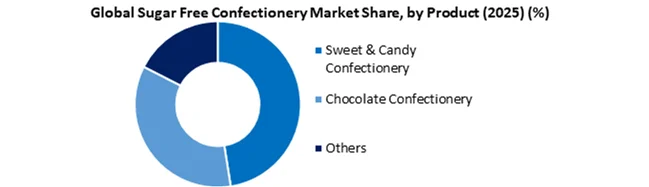
Based on product, the global market is segmented into sweet & candy confectionery, chocolate confectionery, and others.
The sweet & candy confectionery segment is expected to hold a significant share of the global market owing to the wide consumption of sugar free hard candies, gummies, jellies, mints, lozenges, and chewing gum across all age groups. These products benefit from affordability, long shelf life, portability, and strong impulse-purchase behaviour at supermarkets, convenience stores, and pharmacies. Dental-care positioning of xylitol-based gum and mints, along with fruit-flavoured sugar free gummies, continues to support product demand.
The chocolate confectionery segment is witnessing increasing demand as consumers seek indulgent products with reduced sugar content. Sugar free chocolate bars, chocolate-coated nuts, bite-sized pieces, and baking chocolate formulated with erythritol, maltitol, stevia, or allulose are expanding rapidly across premium and health-focused retail channels. Cocoa availability, price fluctuations, and sweetener-related texture challenges remain important considerations for manufacturers.
The others segment includes caramels, toffees, marshmallows, jellies, protein-based confections, functional soft chews, and emerging sugar free confectionery innovations, which are gaining importance through novel formats and functional positioning.
By Ingredients
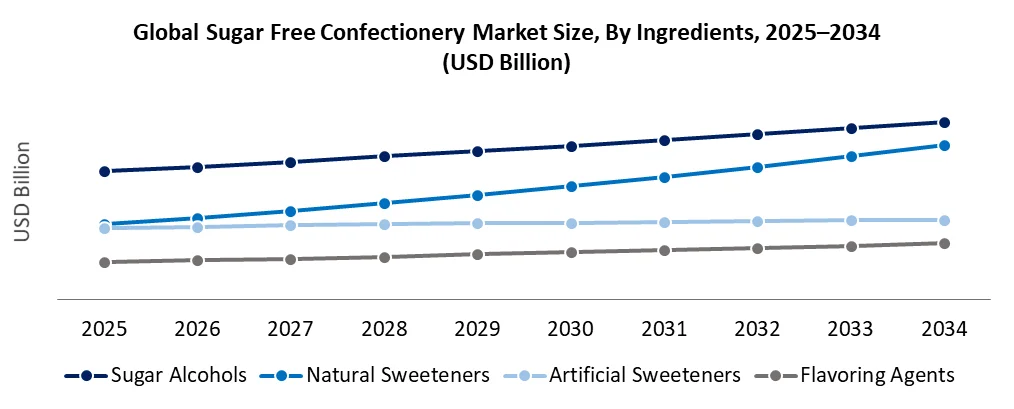
Based on ingredients, the market is segmented into natural sweeteners, artificial sweeteners, sugar alcohols, and flavoring agents.
Sugar alcohols are expected to account for the largest share of ingredient usage, supported by their bulking capability, sugar-like mouthfeel, low glycaemic response, and wide application in hard candies, chewing gum, and chocolate. Xylitol, erythritol, maltitol, sorbitol, and isomalt are extensively used in sugar free confectionery manufacturing, although digestive tolerance and cooling sensation require careful formulation.
Natural sweeteners, including stevia, monk fruit, and allulose, are expected to record the fastest growth within the ingredient landscape owing to clean-label demand and consumer preference for plant-derived ingredients. Artificial sweeteners such as sucralose, aspartame, and acesulfame potassium continue to provide high sweetness intensity at low usage levels, particularly in mass-market chewing gum and candy, while flavoring agents play a critical role in masking aftertaste and enhancing taste perception.
By Distribution Channel
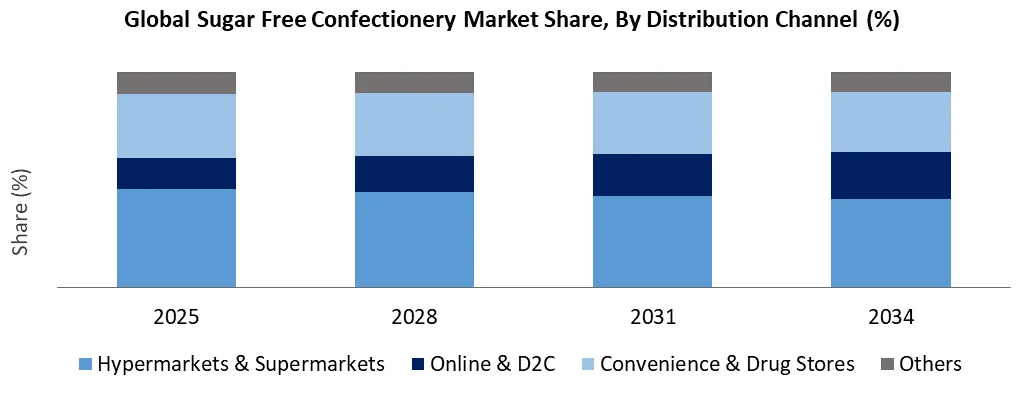
Based on distribution channel, the market is segmented into hypermarkets & supermarkets, online & D2C, convenience & drug stores, and others.
Hypermarkets and supermarkets are expected to remain the leading distribution channel owing to broad product assortments, promotional visibility, and large customer footfall. Convenience and drug stores play an important role in impulse purchases, diabetic-focused products, and dental-care gum and mints.
The online and D2C channel is projected to be the fastest-growing channel as shoppers increasingly buy niche, keto, and diabetic-friendly confectionery through e-commerce marketplaces, subscription services, and brand-owned websites. Digital marketing, influencer engagement, and customer reviews are further supporting online product discovery.
By Consumer Demographics
Based on consumer demographics, the market is segmented into health-conscious consumers, diabetics, weight watchers, and children. Health-conscious consumers represent the broadest demand base, while diabetic consumers form a core, high-loyalty segment seeking trusted sugar free products. Weight-conscious shoppers and parents seeking lower-sugar treats for children are expanding demand for portion-controlled and better-for-you confectionery.
Global Sugar Free Confectionery Market Regional Insights:
The Global Sugar Free Confectionery Market is segmented into North America, Europe, Asia Pacific, Middle East & Africa, and South America. North America is expected to account for the largest market share of 34% in 2025, driven by high consumer awareness of diabetes and sugar reduction, strong presence of established confectionery manufacturers and specialist sugar free brands, and widespread availability across retail and online channels. The United States leads regional demand through its health-conscious consumer base and innovation in keto and diabetic-friendly products, while Canada and Mexico contribute through expanding better-for-you product ranges and evolving nutrition labelling frameworks.
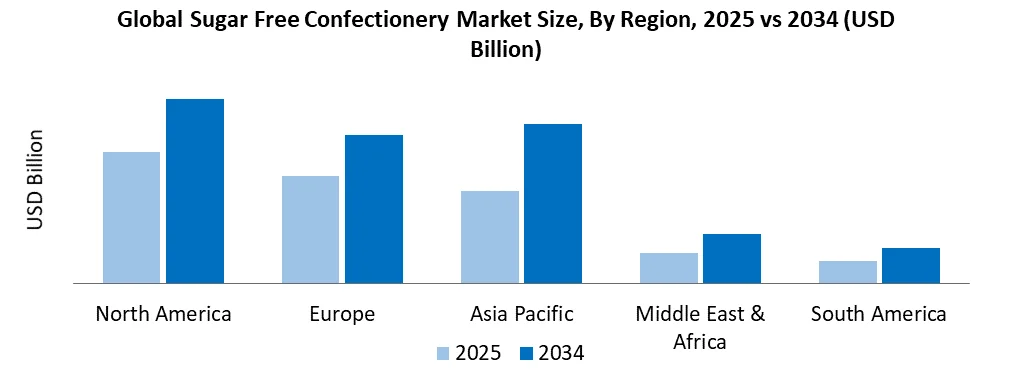
Europe represents a mature and innovation-driven market, supported by strong sugar free chewing gum, mint, and chocolate traditions, stringent food-safety regulation, and widespread adoption of polyol-based confectionery. Germany, the United Kingdom, France, Italy, Spain, the Netherlands, and the Nordic countries are important contributors, with manufacturers emphasizing clean-label sweeteners, reduced-sugar reformulation, and sustainable packaging.
Asia Pacific is projected to be the fastest-growing region, with a CAGR of 6.2% during 2025 to 2034, as rising disposable incomes, urbanization, expanding modern retail, and the rapid increase in diabetes prevalence across China, India, and Southeast Asia support demand for sugar free confectionery. Japan and South Korea contribute through functional gum, candy, and wellness-oriented product innovation, while e-commerce penetration is widening access across emerging economies.
The Middle East & Africa is gaining importance through rising health awareness, growing urban populations, and expansion of supermarkets and pharmacy retail in Saudi Arabia, the UAE, Turkey, South Africa, and Egypt. South America is witnessing steady growth supported by nutrition-labelling regulations and product reformulation across Brazil, Argentina, Chile, and Colombia, where manufacturers are expanding sugar free portfolios to address changing consumer expectations.
Formulation-to-Label Readiness as a Competitive Differentiator
The Global Sugar Free Confectionery Market is increasingly creating opportunities for manufacturers that can combine sugar reduction with taste consistency, product stability and transparent ingredient labelling. An emerging area of innovation is the development of formulation-to-label solutions, where manufacturers select sweeteners, bulking agents, fibres and flavour systems not only to achieve the desired sweetness but also to maintain texture, mouthfeel and shelf life while meeting changing consumer expectations. This approach can help companies differentiate their products through cleaner ingredient positioning, reduced-sugar claims and improved product experiences. Manufacturers that integrate formulation innovation with regulatory compliance and consumer-focused product development may strengthen their competitive positioning and expand their presence across sugar-free candies, chocolates, chewing gums and other confectionery categories.
Global Sugar Free Confectionery Market Recent Developments:
|
Date |
Recent Developments |
|
18-Feb-26 |
Nestlé UK & Ireland expanded |
|
05-Mar-26 |
Samyang Specialty introduced its |
|
08-Apr-26 |
ITC's Sunfeast Farmlite launched a |
|
18-May-26 |
Zydus Wellness highlighted the |
|
18-Jun-26 |
Planet A Foods introduced ChoViva |
|
25-Jun-26 |
BENEO introduced its Sweets Box, a |
Global Sugar Free Confectionery Market Scope: Inquire before buying
| Sugar Free Confectionery Market | |||
|---|---|---|---|
| Report Coverage | Details | ||
| Base Year: | 2025 | Forecast Period: | 2026-2034 |
| Historical Data: | 2020 to 2025 | Market Size in 2025: | 2.54 USD Billion |
| Forecast Period 2026-2034 CAGR: | 4.6% | Market Size in 2034: | 3.81 USD Billion |
| Segments Covered: | by Product | Sweet & Candy Confectionery Chocolate Confectionery Others |
|
| by Ingredients | Natural Sweeteners Artificial Sweeteners Sugar Alcohols Flavoring Agents |
||
| by Packaging Type | Bags Boxes Pouches Bulk Packaging |
||
| by Consumer Demographics | Health-Conscious Consumers Diabetics Weight Watchers Children |
||
| by Application | Sugar-Free Chocolate Sugar-Free Gummies Sugar-Free Hard Candies Sugar-Free Chewing Gum |
||
| by Distribution Channel | Hypermarkets & Supermarkets Online & D2C Convenience & Drug Stores Others |
||
Sugar Free Confectionery Market, by Region
North America (United States, Canada and Mexico)
Europe (Germany, Italy, UK, France, Netherlands, Norway, Denmark, Sweden, Finland, Spain, Poland, Switzerland, Russia and Rest of Europe)
Asia Pacific (China, Japan, South Korea, India, Australia, Singapore, Indonesia, Malaysia, Thailand, Vietnam, Taiwan, Philippines and Rest of Asia Pacific)
Middle East and Africa (Saudi Arabia, UAE, Turkey, South Africa, Qatar, Egypt, Oman and Rest of Middle East & Africa)
South America (Brazil, Argentina, Chile, Colombia and Rest of South America)
Sugar Free Confectionery Key Players:
1. The Hershey Company
2. Mars, Incorporated
3. Mondelez International
4. Nestlé S.A.
5. Ferrero Group
6. Perfetti Van Melle
7. HARIBO GmbH & Co. KG
8. Lindt & Sprüngli AG
9. Meiji Holdings Co., Ltd.
10. Lotte Corporation
11. Yıldız Holding
12. Grupo Arcor
13. August Storck KG
14. Cloetta AB
15. Ricola AG
16. Katjes Fassin GmbH & Co. KG
17. Ferrara Candy Company
18. Tootsie Roll Industries
19. Lily's Sweets
20. ChocZero Inc.
21. SmartSweets Inc.
22. Asher's Chocolate Co.
23. Dr. John's Healthy Sweets
24. Diabetic Candy.com
25. ROY Chocolatier
26. Sugarless Confectionery
27. Xlear, Inc.
28. Sula GmbH
29. The Sugarless Company
30. Sugar Free Co.
31. Zolli Candy
32. Project 7
33. Behave Candy
34. Joyride Sweets
35. Tom & Jenny's
36. YummyEarth, Inc.
37. Nuts To You
38. Russell Stover Chocolates
39. See's Candies
40. Ghirardelli Chocolate Company
41. Abdallah Candies Inc.
42. Albanese Confectionery Group
43. Atkinson Candy Company
44. Dr. C. Soldan GmbH
45. Vivil A. Müller GmbH & Co. KG
46. Hitschler International
47. Jelly Belly Candy Company
48. Swizzels Matlow Limited
49. Spangler Candy Company
50. Stauffer's
51. Candy People AB
52. Verve Confectionery
53. Kinnerton Confectionery
54. Concord Confections
55. Global Brands Ltd.
56. Corvus Jan
57. Manner GmbH
58. Ludwig Schokolade GmbH & Co. KG
59. Nova Chocolate
60. The Topps Company
Others
Frequently Asked Questions:
1. What is the Global Sugar Free Confectionery Market size?
Ans: The Global Sugar Free Confectionery Market was valued at USD 2.54 Billion in 2025 and is projected to reach USD 3.81 Billion by 2034, growing at a CAGR of 4.60% during 2026 to 2034.
2. Which product segments are covered in the sugar free confectionery market?
Ans: The market is segmented by product into sweet & candy confectionery, chocolate confectionery, and others, and by application into sugar-free chocolate, sugar-free gummies, sugar-free hard candies, and sugar-free chewing gum.
3. Which region is expected to dominate the Global Sugar Free Confectionery Market?
Ans: North America is expected to dominate the global market in 2025, while Asia Pacific is projected to be the fastest-growing region during the forecast period.
4. What are the key growth drivers of the sugar free confectionery industry?
Ans: Key drivers include the rising prevalence of diabetes and obesity, growing consumer preference for reduced sugar diets, sugar reduction policies and nutrition labelling, clean-label sweetener innovation, and the expansion of online and D2C distribution.
5. Who are the major key players in the Global Sugar Free Confectionery Market?
Ans: Major companies include The Hershey Company, Mars, Incorporated, Mondelez International, Nestlé S.A., Ferrero Group, Perfetti Van Melle, HARIBO, Lindt & Sprüngli, Lily's Sweets, ChocZero, SmartSweets, Ricola, Cloetta, Lotte Corporation, Meiji Holdings, and others.
6. What is the forecast period for the Global Sugar Free Confectionery Market?
Ans: The report considers 2020–2025 as the historical period and 2026–2034 as the forecast period, with 2025 as the base year.