
Global Solar Simulator Market Size By Solar Simulator Type, By Light Source, By Performance Classification, By Application, By End User, by Region and Forecast 2034
Overview
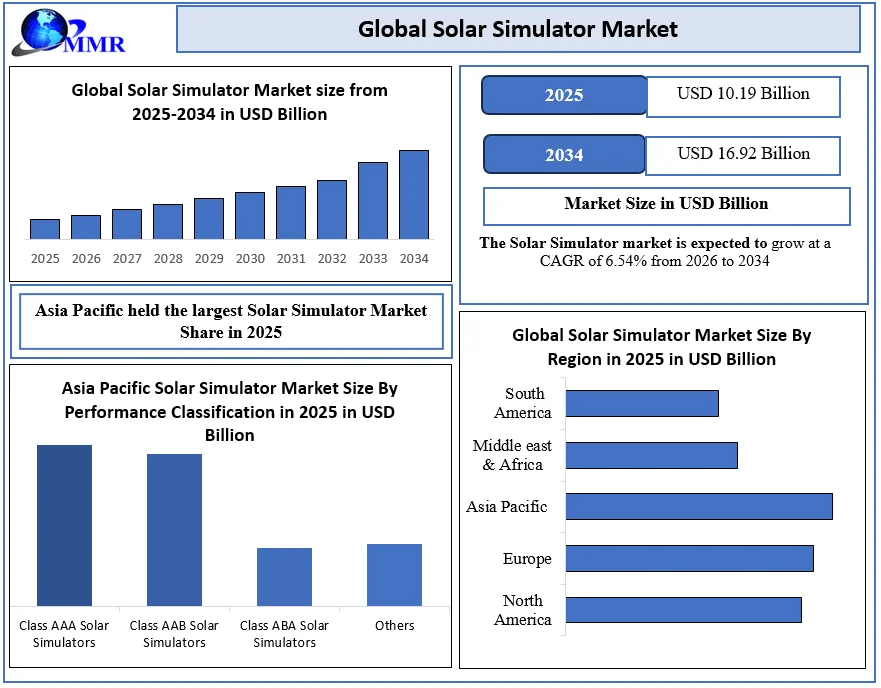
Global Solar Simulator Market size was valued at USD 10.19 Billion in 2025, and the total revenue is expected to grow at a CAGR of 6.54% from 2026 to 2034, reaching USD 16.92 Billion.
Global Solar Simulator Market Overview:
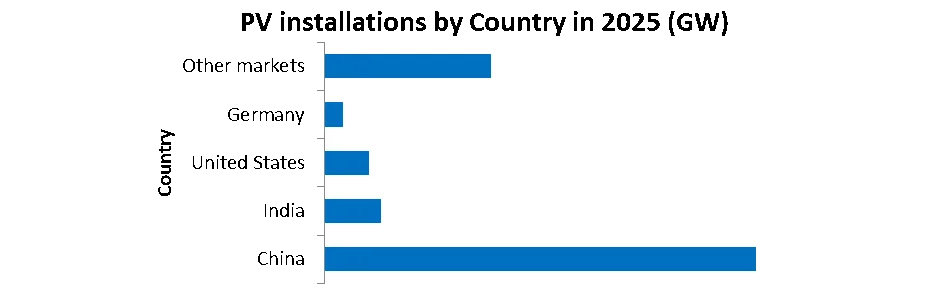
The artificial sunlight systems for controlled testing of photovoltaic (PV) cells, modules, solar materials, coatings, and other light-sensitive products. These systems support electrical performance measurements, quality assurance, calibration, and product development. The global cumulative PV capacity reached 2.96 TW at the end of 2025, following nearly 690 GW of new installations during the year. China installed about 415 GW, India 54 GW, and the United States 43 GW. This expansion creates a substantial downstream need for reliable module qualification and manufacturing-line testing, which boosts Solar Simulators Market growth. Solar simulators are evaluated for spectral match, irradiance uniformity, and temporal stability under IEC 60904-9:2020. Demand spans laboratory instruments and production-scale systems, with customers increasingly emphasizing reproducible results, integration with current-voltage measurement, and compatibility with emerging cell architectures.
Global Solar Simulator Market Key Highlight
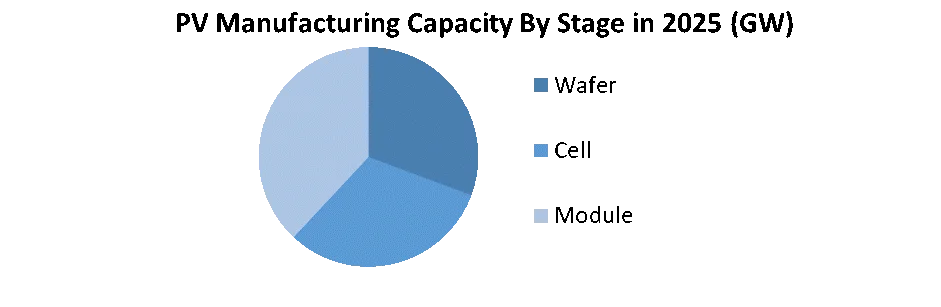
• Global photovoltaic module manufacturing capacity reached nearly 1,500 GW in 2025, supporting demand for automated solar simulators, production-line quality testing, and advanced module characterization systems.
• Global solar cell manufacturing capacity reached approximately 1,212 GW in 2025, creating opportunities for high-precision solar simulators used in photovoltaic efficiency testing and performance validation.
• China accounted for nearly 87% of global solar cell manufacturing capacity in 2025, strengthening demand for flash solar simulators, automated testing systems, and calibration equipment.
• N-type photovoltaic technology represented approximately 82% of crystalline-silicon wafers used for cell manufacturing in 2025, encouraging adoption of advanced solar simulation and characterization technologies.
• India's approved solar module manufacturing capacity reached approximately 144 GW annually by December 2025, supporting investments in photovoltaic testing infrastructure, laboratory equipment, and production quality assurance.
Global Solar Simulator Market Growth and Share Analysis
To know about the Research Methodology :- Request Free Sample Report
Trend: Programmable LED and Hybrid Illumination
A prominent technology Solar Simulator Market trend is the shift toward programmable LED and hybrid light engines that provide more flexible spectral control than conventional single-lamp systems. These designs can support wavelength tuning, repeatable irradiance settings, and automated test recipes for different photovoltaic technologies. IEC 60904-9:2020 specifies four individual performance classes—A+, A, B, and C—across spectral match, spatial non-uniformity, and temporal instability. Class A+ spectral matching uses an allowable relative range of 0.875–1.125 against the reference spectrum in the extended evaluation range. Suppliers increasingly compete on measurement reproducibility, software integration, calibration support, and throughput. Xenon-based systems remain relevant, particularly where established test procedures and broad-spectrum illumination are prioritised.
Global Solar Simulator Market Dynamics:
Expanding PV Manufacturing and Quality Assurance to drive Solar Simulator Market
Expanding photovoltaic deployment is a major demand driver for solar simulator equipment. Nearly, 690 GW of new global PV installations in 2025, bringing cumulative capacity to 2.96 TW. China alone added about 415 GW, highlighting the scale of the industry’s production and testing ecosystem. Solar simulators are used to characterise current-voltage performance, verify module output, and support production quality control, boosting Solar Simulator Market growth. As manufacturers improve cell efficiency and develop tandem architectures, more demanding spectral and repeatability requirements encourage upgrades to testing equipment.
High Capital and Calibration Requirements to Hamper Solar Simulator Market Growth
The market faces adoption barriers from the capital cost and technical complexity of precision illumination equipment. Production-line solar simulators may require substantial test-area coverage, optical alignment, electrical integration, environmental control, and specialized calibration. Under IEC 60904-9:2020, class A spatial non-uniformity is limited to 2%, while class A+ is limited to 1%, underscoring the precision required for premium systems. Lamps, filters, optics, detectors, and reference devices can change characteristics over time, necessitating periodic verification and maintenance. Smaller laboratories and manufacturers may postpone equipment replacement when budgets are constrained, which hampers Solar Simulator Market growth. Customers also face compatibility challenges when adapting existing instruments to new module dimensions, contact schemes, and photovoltaic architectures.
Global Solar Simulator Market Segment Analysis
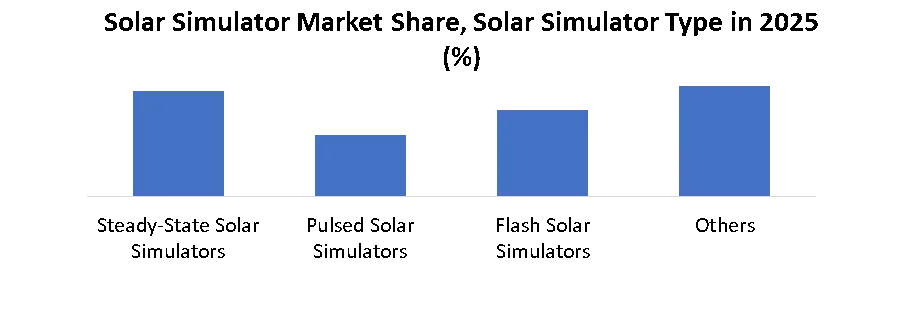
Based on Solar Simulator Type, The Pulsed and flash solar simulators held the largest Solar Simulator Market in 2025. The high-throughput photovoltaic module testing because they can capture electrical characteristics during controlled illumination events without prolonged thermal loading. Flash simulators are a subtype of pulsed simulators; therefore, separate pulsed and flash categories overlap unless pulsed is explicitly defined as non-flash pulsed systems. Steady-state simulators are important for laboratory characterization, spectral studies, and tests requiring continuous illumination. The steady-state, single-pulse, and multi-pulse systems are recognized operating modes, with performance assessed across three characteristics: spectral match, irradiance uniformity, and temporal instability.
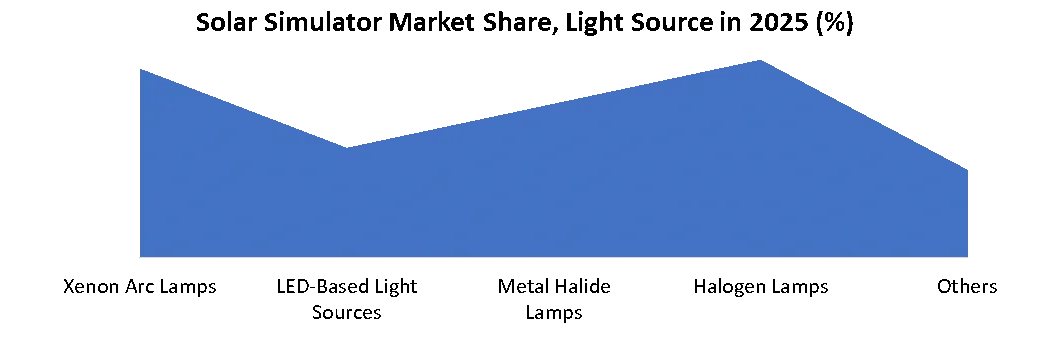
Based on Light Source, Xenon dominated the Solar Simulator Market in 2025. The lamps are an established light source for solar simulation because they can deliver intense broadband illumination suited to photovoltaic performance testing. LED-based light sources are an important technology growth area owing to programmable spectral channels, rapid control, and potential maintenance advantages in suitable applications. Metal halide and halogen lamps continue to serve selected illumination and materials-testing requirements, although their performance and economics depend on system design. Hybrid systems combine two or more source technologies and should be tracked separately to avoid double counting.
Global Solar Simulator Market Regional Insights
Asia Pacific held the largest Solar Simulator Market share in 2025. The leading demand and manufacturing hub for solar simulator systems, supported by the concentration of photovoltaic manufacturing and associated research activity. China installed approximately 415 GW of PV capacity in 2025, equivalent to around 60% of worldwide additions, while India installed about 54 GW. China’s large cell and module manufacturing base supports extensive factory-level flash testing, calibration, and laboratory characterisation. Japan, South Korea, Taiwan, and India contribute equipment manufacturing, advanced materials research, and PV technology development. Regional customers require systems spanning compact research instruments to large-area module testers. The concentration of photovoltaic manufacturing capacity provides another important advantage for Asia Pacific.
Global production capacity reached nearly 1,189 GW for wafers, 1,212 GW for cells, and 1,450–1,500 GW for modules. This industrial concentration creates a substantial addressable customer base for solar simulator suppliers, particularly those providing large-area flash testing systems, automated module characterization platforms, and integrated production-line testing solutions. However, manufacturing capacity should not be interpreted as actual equipment purchases because production utilisation, replacement cycles, and technology upgrades determine simulator procurement.
Global Solar Simulator Market Competitive Landscape
The competitive landscape combines specialist Solar Simulation Manufacturers, optical-instrument providers, and photovoltaic production-testing system suppliers. Representative participants include Newport (MKS Instruments), Abet Technologies, Solar Light Company, WAVELABS, Eternalsun, PASAN, H.A.L.M. Elektronik, G2V Optics, Sciencetech, Wacom Electric, SAN-EI Electric, and Enlitech. Competitors differentiate through illuminated test area, light-source architecture, spectral tuning, current-voltage measurement integration, automation, service, and compliance documentation. IEC 60904-9:2020 evaluates three technical dimensions spectral match, spatial non-uniformity, and temporal instability—providing a consistent basis for performance comparisons.
Global Solar Simulator Market Recent Developments
MKS Instruments (Newport Corporation)
• 27 May 2025 – MKS Instruments announced the launch of its Newport Solaris Series Class A+AA Solar Simulators, developed for high-precision photovoltaic testing and advanced solar cell research. The new systems incorporate xenon arc lamp technology to reproduce sunlight across ultraviolet, visible, and infrared wavelengths. The series includes five models, offering illumination areas up to 12 × 12 inches and spectral coverage extending from 300 to 1,200 nm. Certified according to IEC 60904-9:2020, the simulators support testing of conventional silicon, perovskite, and organic photovoltaic technologies. The development strengthens MKS Instruments' position in laboratory-grade solar simulation and photovoltaic characterization equipment.
Abet Technologies, Inc.
As of November 2026 – Abet Technologies continues to offer a diversified portfolio of solar simulation systems for photovoltaic research, laboratory testing, and materials characterization. Its product range includes solar simulators rated from 150 W to 3,000 W, with illuminated testing areas ranging from 50 × 50 mm to 350 × 350 mm. The portfolio includes SunLite, Sun 2000, Sun 3000 Class AAA, and high-output solar simulation systems. Equipment configurations support horizontal, vertical, and downward illumination. Integrated power supplies, shutter controls, spectral filters, and cooling systems support repeatable testing. However, no separately dated 2025–2026 solar simulator product launch was verified.
Global Solar Simulator Market Scope: Inquiry Before Buying
| Global Solar Simulator Market | |||
|---|---|---|---|
| Report Coverage | Details | ||
| Base Year: | 2025 | Forecast Period: | 2026-2034 |
| Historical Data: | 2020 to 2025 | Market Size in 2025: | 10.19 USD Billion |
| Forecast Period 2026-2034 CAGR: | 6.54% | Market Size in 2034: | 16.92 USD Billion |
| Segments Covered: | by Solar Simulator Type | Steady-State Solar Simulators Pulsed Solar Simulators Flash Solar Simulators Others |
|
| by Light Source | Xenon Arc Lamps LED-Based Light Sources Metal Halide Lamps Halogen Lamps Others |
||
| by Performance Classification | Class AAA Solar Simulators Class AAB Solar Simulators Class ABA Solar Simulators Others |
||
| by Application | Photovoltaic Cell Testing Photovoltaic Module Testing Solar Materials and Component Testing Photochemical and Photocatalytic Testing Environmental and Durability Testing Others |
||
| by End User | Solar Cell and Module Manufacturers Research Institutes and Universities Independent Testing and Certification Laboratories Aerospace and Defense Organizations Industrial Product and Material Manufacturers Others |
||
Global Solar Simulator Market Key Players are :
North America
1. MKS Instruments
2. Abet Technologies, Inc.
3. Solar Light Company, LLC
4. Spectrolab, Inc.
5. Sciencetech Inc.
6. G2V Optics Inc.
7. Optical Associates, Inc. (OAI)
8. Atonometrics, Inc.
9. PV Measurements, Inc.
10. Photo Emission Tech., Inc.
11. Angstrom Designs, Inc.
12. Atlas Material Testing Technology LLC
13. Halo Industries, Inc.
14. Intepro Systems
Europe
15. Eternalsun Spire
16. WAVELABS Solar Metrology Systems GmbH
17. H.A.L.M. Elektronik GmbH
18. Endeas Oy
19. Avalon ST
20. PASAN SA
21. Meyer Burger Technology AG
22. MBJ Solutions GmbH
23. Ecoprogetti Srl
24. Ossila Ltd.
25. Bentham Instruments Ltd.
26. InfinityPV ApS
27. Lumartix SA
28. Ingenieurbüro Mencke & Tegtmeyer GmbH
29. KUKA Systems GmbH
30. TS-Space Systems Ltd.
Asia Pacific
31. Gsolar Power Co., Ltd.
32. Wacom Electric Co., Ltd.
33. Iwasaki Electric Co., Ltd.
34. Asahi Spectra Co., Ltd.
35. Nisshinbo Mechatronics Inc.
36. EKO Instruments Co., Ltd.
37. SAN-EI Electric Co., Ltd.
38. Yamashita Denso Corporation
39. ADTEC Engineering Co., Ltd.
40. Peccell Technologies, Inc.
41. Enlitech Co., Ltd.
42. Zolix Instruments Co., Ltd.
43. Beijing Perfectlight Technology Co., Ltd.
44. EVERFINE Corporation
45. Crowntech Photonics Co., Ltd.
46. Holmarc Opto-Mechatronics Ltd.
47. KEISOKU GIKEN Co., Ltd.
48. Micronics Japan Co., Ltd.
49. Qingdao Solar Scientific Instrument High-tech Co., Ltd.
50. Shenzhen Purui Material Technology Co., Ltd.
Frequently Asked Questions:
1] What segments are covered in the Solar Simulator Market report?
Ans. The segments covered in the Solar Simulator Market report are based on Dimension, Light Source, and Application.
2] Which region is expected to hold the highest share in the Solar Simulator Market?
Ans. The Asia Pacific region is expected to hold the highest share in the Solar Simulator Market.
3] What is the market size volume of the Solar Simulator Market by 2034?
Ans. The market size of the market by 2034 is expected to reach at USD 16.92 Bn.
4] What is the forecast period for the Solar Simulator Market?
Ans. The forecast period for the Solar Simulator Market is 2026-2034.
5] What was the market size volume of the Solar Simulator Market in 2025?
Ans. The market size of the Solar Simulator Market in 2025 was valued at USD 10.19 Bn.