1. SECTION A – GLOBAL SOLAR GLASS MARKET INTRODUCTION & DYNAMICS
1.1. Executive Market Landscape & Industry Overview
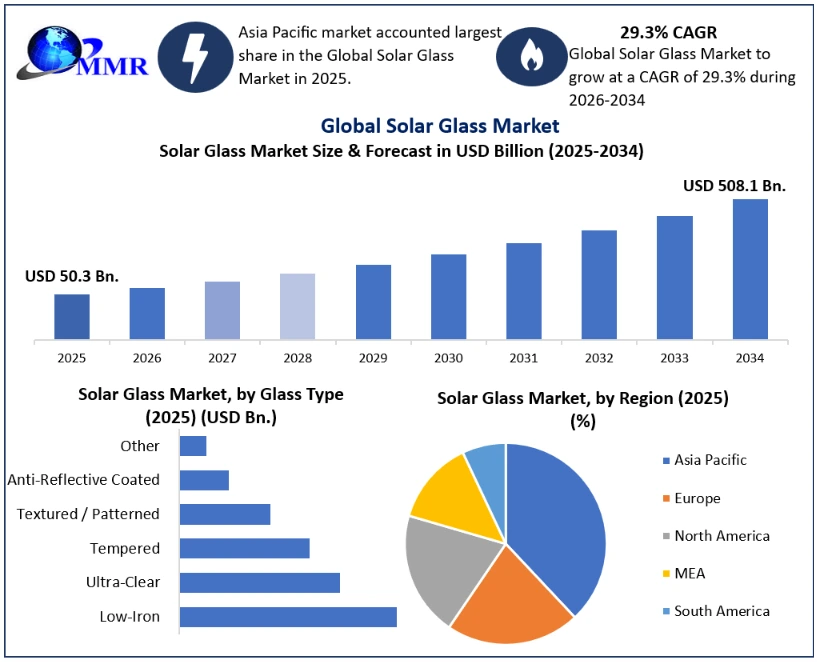
1.1.1. Global Solar Glass Market Size (Value in USD Bn) (Volume in Tonnes) and cumulative deployment capacity trends (GW).
1.1.2. Historical market growth momentum driven by utility-scale photovoltaic (PV) installations and decentralized rooftop solar adoption.
1.1.3. Forecast revenue projections with key growth drivers like government renewable energy targets and net-zero mandates.
1.1.4. Macroeconomic indicators (polysilicon price volatility, trade tariffs, energy security policies) impacting long-term industry expansion.
1.1.5. Long-term market outlook highlighting future investment opportunities across emerging solar hubs.
1.1.6. Compound Annual Growth Rate (CAGR) analysis of the global solar glass market from 2025 to 2034.
1.2. Market Dynamics & Framework Analysis
1.2.1. Market Trends
1.2.2. Market Dynamics
1.2.2.1. Market Drivers
1.2.2.2. Market Restraints
1.2.2.3. Opportunities
1.2.2.4. Challenges
1.2.3. PORTER’s Five Forces Analysis
1.2.4. PESTLE Analysis
1.3. Cost Structure, Value Chain & Pricing Dynamics
1.3.1. Comprehensive breakdown of solar glass manufacturing cost structures (silica sand, soda ash, energy/fuel inputs, and furnace depreciation).
1.3.2. Profit margin distribution across raw material suppliers, glass processors, module assemblers, and distribution channels.
1.3.3. Pricing models and contract mechanisms (long-term supply agreements vs. spot-market pricing).
1.3.4. Energy cost trends (natural gas and electricity price fluctuations) influencing overall production expenses.
1.3.5. Yield optimization and scrap reduction strategies among solar glass plant operators.
1.4. Supply Chain and Raw Material Dynamics
1.4.1. High-purity low-iron silica sand availability, quartz reserves, and soda ash sourcing stability.
1.4.2. Procurement strategies for critical production inputs (refractory materials, metallic oxides for coloring/coatings, and diamond grinding wheels).
1.4.3. Mitigation of supply chain bottlenecks affecting specialized rolling and float glass production lines.
1.4.4. Strategic supplier partnerships enhancing raw material consistency and optical clarity performance.
1.4.5. Geographic dependency on primary mineral deposits and high-purity quartz processing hubs.
1.5. End-User Demand and Application Sector Trends
1.5.1. Utility-scale solar power plant developers driving high-volume procurement of standard and textured solar glass.
1.5.2. Commercial and industrial (C&I) rooftop system deployment trends requiring lightweight or thin glass solutions.
1.5.3. Residential solar adoption patterns favoring aesthetic, dark-tinted, or patterned photovoltaic modules.
1.5.4. Integration of solar glass within agricultural greenhouses (Agrivoltaics) and transport infrastructure.
1.5.5. Specialized demand segments for off-grid portable solar applications and military-grade solar units.
1.6. Solar Glass Technology and Coating Innovation Trends
1.6.1. Anti-reflective coating (ARC) formulations improving light transmittance and energy yield.
1.6.2. Self-cleaning and hydrophobic nano-coating technologies minimizing dust and soiled-loss reduction.
1.6.3. Development of ultra-thin solar glass variants (e.g., 1.6mm to 2.0mm) designed to reduce module weight for dual-glass configurations.
1.6.4. Heat-strengthened and tempered safety glass engineering for enhanced mechanical load resistance (wind and snow loads).
1.6.5. Colored, patterned, and aesthetically customized architectural solar glass innovations for BIPV facades.
1.7. Manufacturing Ecosystem & Plant Capacity Utilization Market Trends
1.7.1. Global furnace capacity utilization rates across major manufacturing hubs in China, Southeast Asia, India, and Europe.
1.7.2. Cold-repair cycles, furnace life extension technologies, and continuous-melt operational efficiency.
1.7.3. Quality assurance, defect detection systems (bubble and inclusion analysis), and adherence to international standards (IEC 61215, IEC 61730).
1.7.4. Automation and robotics integration in cutting, edge-grinding, and tempering lines.
1.7.5. Energy-efficient furnace technologies (oxy-fuel combustion and electric melting hybrid furnaces) reducing carbon intensity.
1.8. Logistics, Packaging, and Handling Infrastructure
1.8.1. Specialized transport rack design and vertical packaging techniques preventing transit-induced scratches or breakage.
1.8.2. Containerized export logistics, maritime shipping optimization, and inland freight risk mitigation.
1.8.3. Warehousing requirements for fragile, high-surface-area glass sheets under controlled humidity and temperature.
1.8.4. Automated loading and unloading systems at module assembly manufacturing plants.
1.8.5. Reverse logistics and recycling frameworks for damaged or end-of-life solar glass panels.
1.9. Digital Infrastructure and Smart Plant Operations
1.9.1. Industrial IoT (IIoT) sensors monitoring float glass thickness, annealing lehr temperatures, and flatness in real time.
1.9.2. Artificial Intelligence (AI) optical inspection systems for automated surface defect and bubble detection.
1.9.3. Enterprise Resource Planning (ERP) tools synchronizing raw material batch mixing with continuous furnace output.
1.9.4. Cybersecurity frameworks protecting operational technology (OT) in automated glass fabrication plants.
1.9.5. Data analytics platforms optimizing predictive maintenance for heavy melting furnaces and cutting machinery.
1.10. Operational Applications and Performance Benchmarking
1.10.1. High-transmittance solar glass optimization for maximizing photon absorption across standard crystalline silicon cells.
1.10.2. Bifacial module performance analysis leveraging transparent and dual-glass rear encapsulations.
1.10.3. Durability testing metrics against potential-induced degradation (PID) and salt-mist/ammonia corrosion.
1.10.4. Mechanical durability under severe hail impact and dynamic wind-load testing conditions.
1.10.5. Thermal shock resistance and ultraviolet (UV) degradation resistance over long operational lifespans.
1.11. Installed Base & Existing Production Capacity Analysis
1.11.1. Global installed base of solar glass manufacturing lines by region, country, and facility scale.
1.11.2. Capacity segmentation by glass thickness (e.g., <2mm, 2mm–3.2mm, >3.2mm) and application type.
1.11.3. Analysis of existing production lines by light transmittance ratings, coating types, and furnace daily melting capacity.
1.11.4. Facility age profile and identification of older plants approaching furnace relining or technological upgrades.
1.11.5. Regional manufacturing footprint distribution across Asia-Pacific, North America, Europe, and emerging markets.
1.12. Environmental Compliance and Sustainability Standards
1.12.1. Furnace emission control technologies targeting sulfur oxides (SO_x), nitrogen oxides (NO_x), and particulate matter reduction.
1.12.2. Waste glass (cullet) recycling integration within primary batch mixtures to lower raw material extraction footprints.
1.12.3. Compliance with hazardous substance regulations (RoHS and REACH directives) regarding coating chemicals.
1.12.4. Life-cycle assessment (LCA) tracking carbon payback periods for solar glass production.
1.12.5. Government incentives and green manufacturing subsidies accelerating low-emission facility investments.
1.13. Import-Export Trade & Regional Logistics Analysis (2025)
1.13.1. Global trade flow of raw solar glass sheets and finished cut-to-size panels across international borders.
1.13.2. Impact of anti-dumping duties, countervailing measures, and trade protectionism on regional supply chains.
1.13.3. Geopolitical trade restrictions affecting cross-border technology transfers and manufacturing equipment access.
1.13.4. Export control regulations governing advanced coating and processing machinery shipments.
1.13.5. Regional trade pacts facilitating preferential tariffs for clean energy component supply chains.
1.14. Long-Term Supply Contracts and Merchant Market Dynamics
1.14.1. Prevalence of long-term take-or-pay supply agreements between solar glass makers and Tier-1 module manufacturers.
1.14.2. Impact of spot-market price volatility on uncommitted manufacturing capacity revenues.
1.14.3. Risk-sharing mechanisms addressing sudden raw material or energy price shocks during contract periods.
1.14.4. Volume commitment thresholds and quality penalty structures in commercial supply contracts.
1.14.5. Financial backing, credit-rating assessments, and counterparty stability evaluations shaping vendor selection.
1.15. Emerging Technologies and Future Innovation Trends (2025)
1.15.1. Transparent luminescent solar concentrators (TLSCs) integrating power generation into standard building windows.
1.15.2. Perovskite-silicon tandem cell-compatible specialized ultra-transparent front and back glass.
1.15.3. Quantum dot-embedded solar glass technology for enhanced spectrum utilization.
1.15.4. Advanced self-healing anti-soiling coatings reducing long-term operations and maintenance (O&M) washing requirements.
1.15.5. Solid-state melting and waste-heat recovery innovations for ultra-low-carbon glass production.
1.15.6. .
1.16. Commercial Models, Joint Ventures & Investment Trends (2025)
1.16.1. Equity joint ventures between energy developers, module manufacturers, and glass fabrication specialists.
1.16.2. Private equity and green bond financing supporting multi-million-dollar mega-factory expansions.
1.16.3. Long-term partnership models ensuring guaranteed volume off-take in exchange for preferential pricing.
1.16.4. Public-private partnerships supporting regional domestic solar manufacturing self-sufficiency initiatives.
1.16.5. Cross-industry collaborations between chemical companies and glass fabricators for next-generation coatings.
1.17. Operational Performance and Plant Reliability Analysis (2025)
1.17.1. Furnace uptime, thermal efficiency, and continuous operation metrics over multi-year production cycles.
1.17.2. Maintenance execution strategies to prevent catastrophic refractory brick failure in melting tanks.
1.17.3. Yield optimization techniques tracking first-pass quality rates through cutting and tempering stages.
1.17.4. Optical performance consistency over prolonged exposure to high-intensity solar irradiance.
1.17.5. Asset integrity management supporting long-term facility valuation and output stability.
1.18. Regulatory Framework and Compliance Analysis (2025)
1.18.1. International safety and performance standards governing photovoltaic glass (e.g., ISO, IEC, ASTM standards).
1.18.2. Environmental permitting procedures and air quality regulations for heavy industrial glass melting furnaces.
1.18.3. Building codes and structural load safety regulations affecting the deployment of BIPV and large-format glass.
1.18.4. National local content requirements influencing facility location decisions and regional market entry.
1.18.5. Grid integration and safety codes impacting specialized photovoltaic module deployment frameworks.
1.19. Long-Term Supply Contracts and Merchant Market Dynamics
1.19.1. Tracking active, idled, and newly commissioned solar glass melting lines across global manufacturing clusters.
1.19.2. Float glass line conversion trends (architectural glass lines shifting to solar-grade low-iron glass manufacturing).
1.19.3. Regional manufacturing capacity scalability matching accelerating global PV module installation demands.
1.19.4. Multi-plant coordination improving logistical response times for regional module assembly customers.
1.19.5. Expansion strategies targeting localized manufacturing to bypass trade barriers and logistics costs.
1.20. Customer Requirements and Manufacturer Ecosystem
1.20.1. Evolution of independent solar glass suppliers versus vertically integrated module manufacturers (e.g., integrated glass-to-module lines).
1.20.2. Research collaborations between glass producers and academic institutions targeting higher solar spectrum transmission.
1.20.3. Co-development frameworks between glass fabricators and encapsulant/backsheet suppliers.
1.20.4. Government-backed industrial consortia increasing investments in domestic solar material supply chains.
1.20.5. Strategic alignment between downstream PV power plant operators and upstream glass material innovators.
1.21. Sustainability and Net-Zero Decarbonization Strategies
1.21.1. Transition from fossil-fuel-fired furnaces to hydrogen-fueled or electric-boosted glass melting technologies.
1.21.2. Integration of plant-level solar photovoltaic microgrids and waste-heat recovery systems for auxiliary manufacturing energy.
1.21.3. ESG compliance tracking, carbon footprint transparency, and Scope 1, 2, and 3 emissions reporting.
1.21.4. Circular economy initiatives promoting closed-loop cullet collection from module manufacturing waste.
1.21.5. End-of-life recycling infrastructure development for decommissioned photovoltaic glass panels.
1.22. Strategic Risk Assessment
1.22.1. Catastrophic furnace breakdown risks and extended operational downtime during cold repairs.
1.22.2. Raw material price spikes (soda ash, ultra-pure silica) eroding manufacturing profit margins.
1.22.3. Regulatory shifts modifying carbon tax liabilities or energy pricing structures for energy-intensive industries.
1.22.4. Overcapacity risks resulting from aggressive greenfield capacity expansions across competing regions.
1.22.5. Geopolitical trade friction impacting access to vital mineral inputs and overseas export markets.
1.23. Solar Glass Demand Intensity & PV Application Consumption Analysis
1.23.1. Solar glass requirement per MW of PV capacity across single-glass, dual-glass, bifacial, thin-glass, and specialized module configurations.
1.23.2. Solar glass consumption by PV application, including utility-scale, C&I rooftop, residential, agrivoltaics, floating PV, BIPV, and solar greenhouses.
1.23.3. Glass thickness, module dimensions, weight, and glass-to-module ratio influencing glass consumption per MW.
1.23.4. Solar glass requirements across PERC, TOPCon, HJT, back-contact, and emerging perovskite-silicon tandem modules.
1.23.5. Regional solar deployment additions and corresponding incremental solar glass consumption.
1.23.6. Relationship between PV module manufacturing capacity, module production volumes, and upstream solar glass requirements.
1.23.7. Domestic versus imported solar glass consumption across major PV manufacturing regions and emerging solar deployment markets.
1.24. Global Solar Glass Market: Segmentation and Forecast, By Value in USD Million and Volume in Million Tonnes (2025–2034)
1.24.1. By Glass Type
1.24.1.1. Low-Iron Solar Glass
1.24.1.2. Ultra-Clear Solar Glass
1.24.1.3. Tempered Solar Glass
1.24.1.4. Textured / Patterned Solar Glass
1.24.1.5. Anti-Reflective Coated Solar Glass
1.24.1.6. Other Solar Glass Types
1.24.2. By Solar Technology
1.24.2.1. Crystalline Silicon
1.24.2.2. Thin-Film
1.24.2.3. Perovskite
1.24.3. By Thickness
1.24.3.1. Below 2 mm
1.24.3.2. 2–3.2 mm
1.24.3.3. 3.3–4 mm
1.24.3.4. Above 4 mm
1.24.4. By Coating Type
1.24.4.1. Anti-Reflective Coated Glass
1.24.4.2. Anti-Soiling Coated Glass
1.24.4.3. Self-Cleaning Glass
1.24.4.4. Uncoated Solar Glass
1.24.5. By Module Glass Configuration
1.24.5.1. Single-Glass Module
1.24.5.2. Dual-Glass Module
1.24.5.3. Bifacial Module Glass
1.24.5.4. Building-Integrated Photovoltaic (BIPV) Glass
1.24.6. By Application
1.24.6.1. Ground-Mounted Solar
1.24.6.2. Utility-Scale Solar Plants
1.24.6.3. Commercial Solar Farms
1.24.6.4. Distributed Solar
1.24.6.5. Residential Solar
1.24.6.6. Commercial & Industrial Rooftop Solar
1.24.6.7. Integrated Solar Applications
1.24.6.7.1. Building-Integrated Photovoltaics (BIPV)
1.24.6.7.2. Solar Façades
1.24.6.7.3. Solar Windows
1.24.6.7.4. Solar Roof Systems
1.24.6.8. Agricultural Solar
1.24.6.8.1. Agrivoltaics
1.24.7. Global Solar Glass Market Size and Forecast, By Region & Country
1.24.7.1. North America
1.24.7.1.1. United States
1.24.7.1.2. Canada
1.24.7.1.3. Mexico
1.24.7.2. Europe
1.24.7.2.1. United Kingdom
1.24.7.2.2. France
1.24.7.2.3. Germany
1.24.7.2.4. Italy
1.24.7.2.5. Spain
1.24.7.2.6. Sweden
1.24.7.2.7. Russia
1.24.7.2.8. Rest of Europe
1.24.7.3. Asia Pacific
1.24.7.3.1. China
1.24.7.3.2. South Korea
1.24.7.3.3. India
1.24.7.3.4. Japan
1.24.7.3.5. Australia
1.24.7.3.6. Indonesia
1.24.7.3.7. Philippines
1.24.7.3.8. Malaysia
1.24.7.3.9. Vietnam
1.24.7.3.10. Thailand
1.24.7.3.11. Rest of Asia Pacific
1.24.7.4. Middle East & Africa
1.24.7.4.1. South Africa
1.24.7.4.2. Saudi Arabia
1.24.7.4.3. United Arab Emirates
1.24.7.4.4. Qatar
1.24.7.4.5. Kuwait
1.24.7.4.6. Bahrain
1.24.7.4.7. Oman
1.24.7.4.8. Egypt
1.24.7.4.9. Nigeria
1.24.7.4.10. Rest of Middle East & Africa
1.24.7.5. South America
1.24.7.5.1. Brazil
1.24.7.5.2. Argentina
1.24.7.5.3. Chile
1.24.7.5.4. Colombia
1.24.7.5.5. Rest of South America
2. SECTION B – COMPETITIVE INTELLIGENCE & INDUSTRIAL ECOSYSTEM
2.1. Solar Glass Market Competitive Landscape
2.1.1. Solar Glass Market Competitive Matrix
2.1.2. Key Player Benchmarking
2.1.3. Company Name
2.1.4. Headquarters
2.1.5. Business Portfolio
2.1.6. Production Capacity
2.1.7. Glass Thickness Range
2.1.8. Transmittance Rate
2.1.9. Customer Base
2.1.10. Distribution Network
2.1.11. Revenue
2.1.12. Market Share
2.1.13. R&D Investment (%)
2.1.14. Profit Margin (%)
2.1.15. Y-O-Y (%)
2.1.16. Geographic Presence
2.1.17. Market Structure
2.1.18. Market Leaders
2.1.19. Market Followers
2.1.20. Emerging Players
2.1.21. Mergers & Acquisitions Details
2.1.22. Recent Key Developments
2.2. Company Profiles: Key Players
2.2.1. Overview
2.2.2. Business Portfolio
2.2.3. Financial Overview
2.2.4. SWOT Analysis
2.2.5. Strategic Analysis
2.2.6. Recent Developments
2.3. Industry Structure Analysis & Market Concentration
2.3.1. Market concentration levels (oligopolistic nature of top-tier solar glass manufacturers controlling global output).
2.3.2. Entry barriers for new participants (massive capital expenditure for melting furnaces, strict environmental permitting, and tight client qualification cycles).
2.3.3. Technology leadership and optical performance capabilities as competitive differentiators.
2.3.4. Competitive positioning strategies among leading high-clarity glass manufacturers.
2.3.5. Market share distribution across established industry participants.
2.4. Strategic Initiatives and Expansion Strategy Analysis
2.4.1. Mergers, acquisitions, and joint ventures strengthening global manufacturing footprints.
2.4.2. Capacity reservation agreements and long-term supply alliances with leading module assemblers.
2.4.3. Geographical market expansion into emerging solar manufacturing zones outside primary hubs.
2.4.4. Diversification strategies across specialized low-iron and ultra-thin glass product portfolios.
2.4.5. Investments in production innovation enhancing optical clarity and durability advantages.
2.5. Product and Facility Design Benchmarking
2.5.1. Standardization of large-format glass designs (e.g., 182mm and 210mm wafer compatible sizes) to match modern module layouts.
2.5.2. Melting furnace efficiency benchmarking across competing manufacturers.
2.5.3. Innovation benchmarking based on light transmittance percentage, tensile strength, and weight reduction.
2.5.4. Technology development supporting future high-efficiency cell technology integration.
2.5.5. Comparative analysis of solar glass product portfolios across tier-1 vendors.
2.6. Financial Performance and Profitability Benchmarking
2.6.1. Revenue growth trends, EBITDA margins, and capacity utilization economics across major glass producers.
2.6.2. Capital expenditure (CapEx) and operational expenditure (OpEx) optimization strategies for energy-intensive melting operations.
2.6.3. Operational efficiency metrics supporting long-term revenue growth performance.
2.6.4. Financial stability, debt management, and liquidity assessments of primary market players.
2.6.5. Research investment trends supporting next-generation coating and ultra-thin development activities.
2.7. Branding, Client Relations & Partnership Benchmarking
2.7.1. Corporate reputation in product quality, optical consistency, and on-time delivery execution.
2.7.2. Customer engagement models and long-term alliance agreements with top-tier photovoltaic module makers.
2.7.3. Digital marketing and technical branding presence in the global renewable energy supply chain.
2.7.4. International collaboration supporting sustainable glass manufacturing initiatives.
2.7.5. Brand positioning across commercial and utility-scale solar project developers.
2.8. Supply Chain and Sourcing Benchmarking
2.8.1. Subcontractor and raw material management strategies across global processing plants.
2.8.2. Supply chain risk mitigation for critical inputs like high-purity silica and soda ash.
2.8.3. Logistics and heavy-transport optimization for fragile glass shipments.
2.8.4. Vertical integration strategies supporting cost reduction and supply reliability.
2.8.5. Global sourcing practices strengthening supply chain resilience across manufacturing hubs.
2.9. Innovation Leadership and R&D Investment Benchmarking
2.9.1. Research and development investments directed toward anti-soiling, high-transmittance, and ultra-thin technologies.
2.9.2. Emerging technology adoption supporting future photovoltaic efficiency milestones.
2.9.3. Advanced product development strengthening competitive market positioning.
2.9.4. Collaboration with academic institutions, testing laboratories, and standard-setting bodies.
2.9.5. Innovation pipelines focusing on low-carbon electrical melting furnaces and eco-friendly coatings.
2.10. Solar Glass Market, Key Players
2.10.1. North America
2.10.1.1. Guardian Glass
2.10.1.2. First Solar, Inc.
2.10.1.3. Vitro S.A.B. de C.V.
2.10.1.4. Cardinal Glass Industries
2.10.1.5. PPG Industries, Inc.
2.10.1.6. Viracon, Inc.
2.10.2. Europe
2.10.2.1. Saint-Gobain S.A.
2.10.2.2. NSG Group
2.10.2.3. Şişecam
2.10.2.4. Interfloat Corporation
2.10.2.5. SCHOTT AG
2.10.2.6. Euroglas GmbH
2.10.2.7. Hecker Glastechnik GmbH & Co. KG
2.10.2.8. Onyx Solar Group LLC
2.10.3. Asia-Pacific
2.10.3.1. Xinyi Solar Holdings Limited
2.10.3.2. Flat Glass Group Co., Ltd.
2.10.3.3. CSG Holding Co., Ltd.
2.10.3.4. AGC Inc.
2.10.3.5. IRICO Group New Energy Co., Ltd.
2.10.3.6. Jinjing Group Co., Ltd.
2.10.3.7. Borosil Renewables Limited
2.10.3.8. Taiwan Glass Industry Corporation
2.10.3.9. Nippon Electric Glass Co., Ltd.
2.10.3.10. Changzhou Almaden Co., Ltd.
2.10.3.11. Henan Ancai Hi-Tech Co., Ltd.
2.10.3.12. Kibing Group
2.10.3.13. Hainan Development Holdings Nanhai Co., Ltd.
2.10.3.14. Jiangsu Xiuqiang Glasswork Co., Ltd.
2.10.3.15. China Glass Holdings Limited
2.10.3.16. Luoyang Glass Company Limited
2.10.4. South America
2.10.4.1. Cebrace
2.10.4.2. Vitro S.A.B. de C.V.
2.10.4.3. Tecnoglass Inc.
2.10.5. Middle East & Africa
2.10.5.1. Şişecam
2.10.5.2. Guardian Glass
2.10.5.3. Saint-Gobain
2.10.5.4. AGC Inc.
2.10.5.5. Others
3. SECTION C – STRATEGIC OUTLOOK
3.1. Key Findings
3.2. Strategic Moves & Industry Outlook
3.3. Research Methodology