Smart Meters Market – Global Market Size, Strategic Growth Drivers, Risk Assessment Framework, Regulatory Landscape Review, Competitive Intensity Mapping & Long-Term Industry Outlook to 2032

8.3%
CAGR (2026-2032)
27.72 USD Bn.
Forecast Market Size
327
Report Pages
153
Market Tables

Overview

The Smart Meters Market size was valued at USD 27.72 Billion in 2025 and the total Smart Meter revenue is expected to grow at a CAGR of 8.6 % from 2026 to 2032, reaching nearly USD 49.38 Billion by 2032.

Smart Meters Market Overview:

The Smart Meters Market is of paramount importance in the modern energy landscape, facilitating efficient energy management and promoting sustainability. Smart meters offer both qualitative and quantitative benefits, enabling consumers to monitor their energy usage in real-time and make informed decisions to reduce consumption and lower utility bills. Moreover, for utility providers, smart meters enhance operational efficiency by automating meter readings, detecting energy theft or tampering, and improving outage management. These devices Contributes its role in achieving research objectives related to energy conservation, grid optimization, and environmental impact reduction.

Smart meters find applications across various sectors, including residential, commercial, and industrial. In the residential sector, smart meters empower homeowners to monitor and manage their energy usage, optimize appliance usage, and reduce utility bills. In commercial and industrial settings, smart meters enable businesses to track energy consumption in real-time, identify inefficiencies, and implement energy-saving measures to improve operational efficiency and reduce costs.
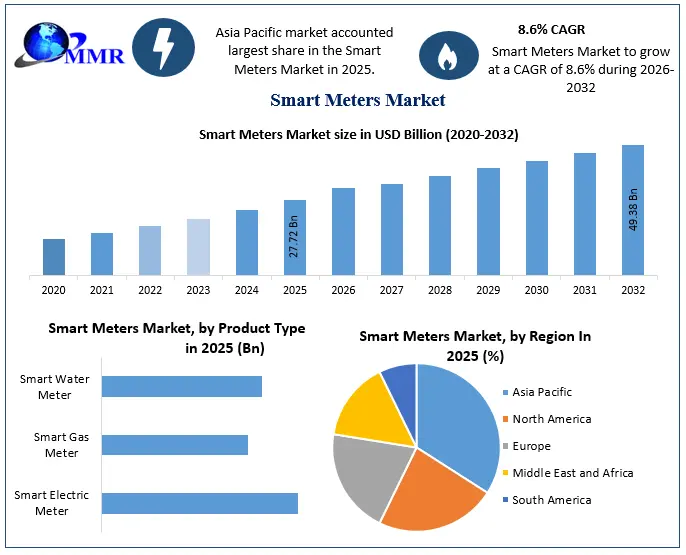
Smart Meters Market GrowthTo know about the Research Methodology :- Request Free Sample Report

Smart Meters Market Dynamics:

Increasing smart grid deployment and government initiatives for energy efficiency are driving market growth

The increasing deployment of smart grids and government initiatives promoting energy efficiency are driving the growth of the global Smart Meters Market. Utilities across developed and emerging economies are replacing conventional meters with smart electricity, gas, and water meters to improve energy management, reduce transmission and distribution losses, and enable real-time consumption monitoring. Supportive government mandates, favorable regulatory policies, and investments in smart city infrastructure are further accelerating the adoption of smart metering solutions. Additionally, growing consumer awareness regarding energy conservation and demand-side management is contributing significantly to market expansion.

High initial deployment costs and cybersecurity concerns are restraining market growth

High initial deployment costs and cybersecurity concerns are restraining the growth of the global Smart Meters Market. The installation of advanced metering infrastructure (AMI), communication networks, and data management systems requires substantial capital investment, particularly for large-scale utility projects. Furthermore, increasing concerns regarding data privacy, cyberattacks, and unauthorized access to consumer energy usage information pose challenges for utilities and technology providers. Integration complexities with legacy grid infrastructure and varying regulatory standards across countries also hinder market growth.

Growing investments in IoT-enabled smart metering and AI-powered energy management are creating market opportunities

The growing investments in IoT-enabled smart metering and AI-powered energy management are creating significant opportunities for the global Smart Meters Market. Utilities are increasingly integrating smart meters with Internet of Things (IoT) platforms, artificial intelligence (AI), cloud computing, and advanced analytics to enable predictive maintenance, demand forecasting, and real-time grid optimization. The rapid expansion of renewable energy integration, electric vehicle (EV) charging infrastructure, and distributed energy resources is further increasing the demand for intelligent metering solutions. Additionally, the development of next-generation communication technologies such as NB-IoT, LTE-M, and 5G is expected to enhance smart meter connectivity and create long-term growth opportunities for market participants.

Smart Meters Market Trends:

  • Growing adoption of Advanced Metering Infrastructure (AMI) and IoT-enabled smart metering is a key trend in the Smart Meters Market-The growing adoption of Advanced Metering Infrastructure (AMI) and IoT-enabled smart metering is a key trend shaping the Smart Meters Market. Utilities are increasingly deploying AMI solutions to enable two-way communication, real-time energy consumption monitoring, remote meter reading, outage detection, and automated billing. The integration of IoT sensors, cloud-based platforms, and advanced analytics is improving grid visibility, operational efficiency, and customer engagement. Additionally, rising investments in smart grid modernization and digital utility infrastructure are accelerating the adoption of connected smart metering solutions across residential, commercial, and industrial sectors.
  • Increasing integration of AI, edge computing, and renewable energy management is transforming the Smart Meters Market-The increasing integration of artificial intelligence (AI), edge computing, and renewable energy management is transforming the Smart Meters Market. Utilities are leveraging AI-powered analytics to improve load forecasting, demand response, predictive maintenance, and energy optimization while enhancing grid reliability. Smart meters are also playing a critical role in integrating distributed energy resources, rooftop solar systems, battery energy storage systems, and electric vehicle (EV) charging infrastructure into modern power grids. Furthermore, advancements in 5G, NB-IoT, LTE-M, and secure communication technologies are enabling faster data transmission, improved interoperability, and more efficient energy management, supporting the continued expansion of the global Smart Meters Market.

Segment Analysis – Global Smart Meters Market

By Product Type,

The Smart Electric Meter segment dominated the global Smart Meters Market in 2025 and is expected to maintain its leading position throughout the forecast period. The segment's dominance is driven by large-scale smart electricity meter rollouts, increasing investments in smart grid infrastructure, and government mandates for advanced metering deployment. Smart electric meters enable real-time energy monitoring, remote meter reading, demand response, outage detection, and accurate billing, making them an integral component of modern power distribution networks. The growing integration of renewable energy sources, electric vehicle (EV) charging infrastructure, and distributed energy resources is further accelerating the adoption of smart electric meters across residential, commercial, and industrial sectors.

The Smart Gas Meter segment is expected to witness substantial growth during the forecast period, driven by the increasing focus on improving gas distribution efficiency, reducing operational losses, and enhancing consumer billing accuracy. Utilities are increasingly deploying smart gas meters to enable remote monitoring, leak detection, consumption analytics, and predictive maintenance. Government initiatives promoting digital utility infrastructure, coupled with rising investments in advanced metering infrastructure (AMI) for natural gas networks, are expected to support the expansion of this segment.

The Smart Water Meter segment is anticipated to register significant growth during the forecast period, supported by increasing concerns over water conservation, leakage management, and sustainable water resource utilization. Smart water meters provide real-time consumption data, remote monitoring capabilities, and early leak detection, helping utilities reduce non-revenue water losses and optimize distribution networks. Rising urbanization, smart city initiatives, and investments in intelligent water management systems are expected to further drive the adoption of smart water meters worldwide.

By Technology,

The Advanced Metering Infrastructure (AMI) segment dominated the global Smart Meters Market in 2025 and is expected to maintain its leading position throughout the forecast period. The segment's growth is driven by the increasing deployment of two-way communication networks that enable real-time data collection, remote meter reading, outage management, demand response, and dynamic pricing. Utilities are increasingly investing in AMI solutions to improve grid reliability, enhance operational efficiency, and support smart grid modernization initiatives. Furthermore, the integration of AMI with IoT, artificial intelligence (AI), and cloud-based analytics is enabling utilities to optimize energy management and improve customer engagement, thereby accelerating market growth.
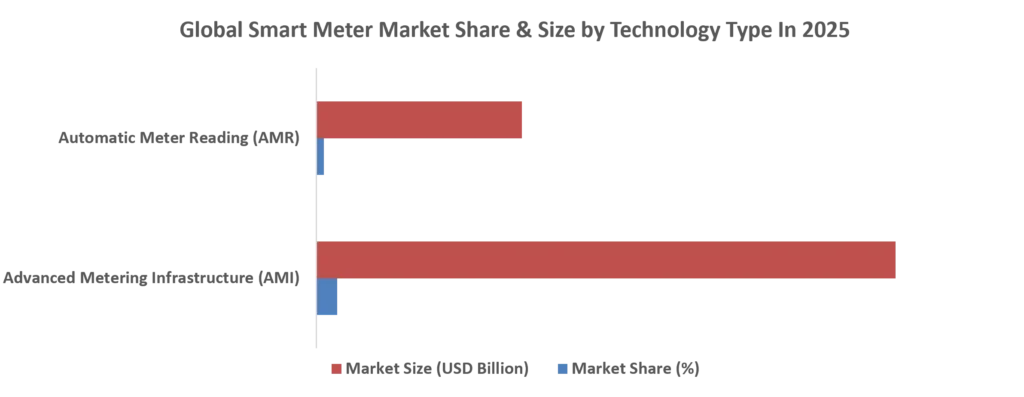
Global Smart Meter Market Size & Share In 2025

The Automatic Meter Reading (AMR) segment is expected to witness steady growth during the forecast period, driven by its cost-effectiveness and ease of deployment, particularly in regions transitioning from conventional metering systems. AMR technology enables one-way communication for automated meter data collection, reducing manual meter reading costs and improving billing accuracy. The technology continues to be widely adopted by utilities seeking operational efficiency with lower infrastructure investments. However, as utilities increasingly prioritize real-time monitoring and bidirectional communication capabilities, many AMR deployments are gradually being upgraded to AMI-based systems, supporting the evolution of advanced digital utility networks.
Regional Analysis – Global Smart Meters Market

Asia-Pacific Dominated the Global Smart Meters Market

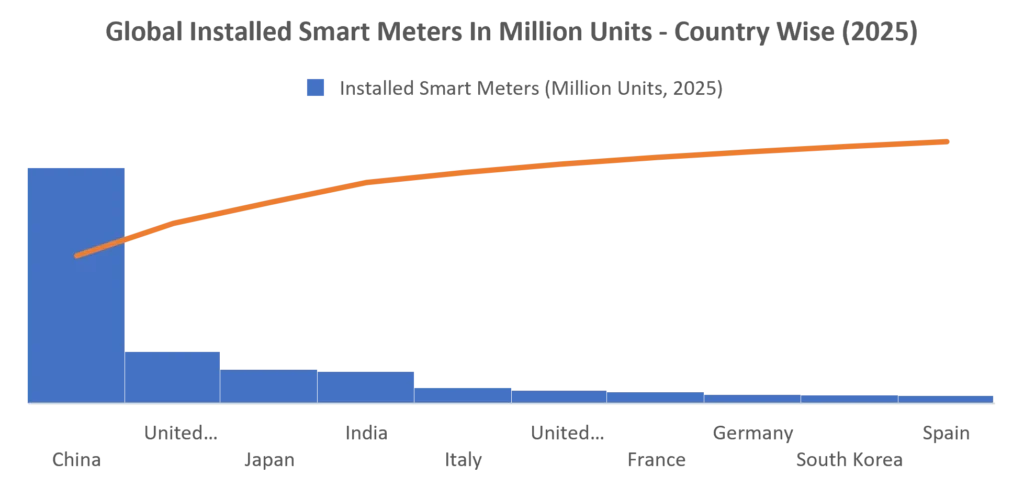
Asia-Pacific dominated the global Smart Meters Market in 2025 and is expected to maintain its leading position throughout the forecast period. The region's dominance is driven by large-scale smart meter deployment programs, rapid urbanization, increasing electricity demand, and significant investments in smart grid infrastructure. Countries such as China, India, Japan, and South Korea are implementing nationwide smart metering initiatives to modernize power distribution networks, improve energy efficiency, and reduce transmission and distribution losses. Government policies promoting digital utilities, renewable energy integration, and smart city development, along with the presence of leading smart meter manufacturers, are further strengthening the region's market position.

Europe Holds a Significant Share of the Smart Meters Market

Europe accounted for a substantial share of the global Smart Meters Market, driven by stringent energy efficiency regulations, ambitious carbon reduction targets, and mandatory smart meter rollout programs across several countries. Nations including the United Kingdom, Germany, France, Italy, and Spain are investing heavily in advanced metering infrastructure (AMI) to enhance grid reliability, improve energy management, and support the integration of renewable energy sources. The region is also witnessing increasing adoption of smart gas and water meters, supported by favorable regulatory frameworks and digital transformation initiatives within the utility sector.

North America is Expected to Register Strong Growth in the Smart Meters Market

North America is expected to witness strong growth during the forecast period, supported by ongoing investments in smart grid modernization, advanced metering infrastructure, and intelligent energy management systems. The United States and Canada are focusing on upgrading aging utility infrastructure while expanding the deployment of smart electric, gas, and water meters to improve operational efficiency and customer engagement. Increasing adoption of distributed energy resources, electric vehicle (EV) charging infrastructure, IoT-enabled grid technologies, and AI-driven analytics is further driving demand for advanced smart metering solutions across the region.

Latin America and the Middle East & Africa are Emerging Markets

Latin America and the Middle East & Africa are expected to experience steady growth in the Smart Meters Market during the forecast period. Countries such as Brazil, Mexico, Saudi Arabia, the UAE, and South Africa are investing in smart grid infrastructure, digital utility transformation, and smart city projects to improve energy efficiency and reduce utility losses. Rising electricity demand, increasing government support for infrastructure modernization, and growing deployment of renewable energy projects are creating new opportunities for smart meter manufacturers. Furthermore, expanding investments in water conservation and intelligent gas distribution networks are expected to support long-term market growth across these regions.

Global Installed Smart meters in 2025 - Country Wise

Recent Developments In Global Smart Meter Market

Month & Date Recent Development Strategic Impact
May 2026 Landis+Gyr Group AG launched an advanced grid-edge intelligence platform integrated with next-generation smart meters to enhance grid visibility and distributed energy resource management. Strengthened the company's smart grid portfolio and improved utilities' ability to optimize grid operations.
March 2026 Itron, Inc. expanded its collaboration with utility providers to deploy AI-enabled Advanced Metering Infrastructure (AMI) solutions for real-time energy management and grid optimization. Enhanced the company's presence in digital utility infrastructure and accelerated AMI adoption.
January 2026 Kamstrup A/S introduced next-generation smart water meters featuring IoT connectivity and advanced leak detection capabilities for municipal utilities. Expanded its smart water solutions portfolio and strengthened its position in intelligent water management.
October 2025 Schneider Electric SE enhanced its EcoStruxure™ Grid platform by integrating advanced metering analytics and cloud-based energy management capabilities. Improved digital grid management, enabling utilities to optimize energy distribution and operational efficiency.
August 2025 Honeywell International Inc. expanded its smart utility solutions portfolio with advanced gas metering technologies designed to improve network monitoring, safety, and operational efficiency. Strengthened the company's smart gas metering capabilities and supported utilities in modernizing gas distribution infrastructure.

Competitive Landscape – Global Smart Meters Market

The global Smart Meters Market is highly competitive, with leading companies focusing on product innovation, advanced metering infrastructure (AMI) deployment, strategic partnerships, digital grid modernization, and geographic expansion to strengthen their market positions. Market participants are increasingly investing in Internet of Things (IoT)-enabled smart meters, artificial intelligence (AI)-powered energy analytics, cloud-based meter data management systems, and secure communication technologies to improve grid reliability, operational efficiency, and customer engagement. Companies are also expanding manufacturing capabilities, collaborating with utility providers, and securing large-scale smart meter deployment contracts to capitalize on the growing demand for smart energy management solutions.

Major industry participants such as Landis+Gyr Group AG, Itron, Inc., Sensus USA Inc., Honeywell International Inc., Siemens AG, Schneider Electric SE, Kamstrup A/S, Aclara Technologies LLC, Diehl Metering GmbH, and Holley Technology Ltd. are strengthening their competitive positions through continuous investments in smart metering technologies, utility digitization, AI-enabled analytics, and cybersecurity solutions. Companies are also focusing on developing interoperable AMI platforms, expanding smart water and gas metering portfolios, and supporting utilities in achieving energy efficiency, carbon reduction, and smart city objectives.

Global Smart Meters Market Scope: Inquire before buying

Smart Meters Market
Report Coverage Details
Base Year: 2025 Forecast Period: 2026-2032
Historical Data: 2020 to 2025 Market Size in 2025: US $ 27.72 Bn.
Forecast Period 2026 to 2032 CAGR: 8.6% Market Size in 2032: US $ 49.38 Bn.
Segments Covered: By Product Type Smart Electric Meter
Smart Gas Meter
Smart Water Meter
By Technology Advanced Metering Infrastructure (AMI)
Automatic Meter Reading (AMR)
By End-Use Residential
Commercial
Industrial

 Global Smart Meters Market, by Region

Asia Pacific (China, South Korea, Japan, India, Australia, Indonesia, Malaysia, Vietnam, Taiwan, Bangladesh, Pakistan and Rest of APAC)
Europe (UK, France, Germany, Italy, Spain, Sweden, Austria and Rest of Europe)
North America (United States, Canada and Mexico)
Middle East and Africa (South Africa, GCC, Egypt, Nigeria and Rest of ME&A)
South America (Brazil, Argentina Rest of South America)

Smart Meters Market Key Players:

North America:
1. Aclara Technologies LLC - USA
2. Itron Inc. - USA
3. Sensus USA Inc. - USA
4. Neptune Technology Group Inc. - USA
5. Badger Meter – USA
6. General Electric Ltd - USA

Europe:
1. Elster Group SE - Germany
2. Kamstrup A/S - Denmark
3. Diehl Stiftung & Co. KG - Germany
4. IGL Genesis Technologies - Germany
5. Pietro Fiorentini - Italy
6. Sagemcom SAS - France
7. Apator S.A - Poland
8. Honeywell International 
9. EDMI - UK

Asia-Pacific:
1. Jiangsu Linyang Energy Co. Ltd - China
2. Ningbo Sanxing Electric Co. Ltd - China
3. Hexing Electric Company Ltd - China
4. Holley Metering Limited - China
5. Shenzhen Hemei Group Co. Ltd – China
6. Wasion Group Holdings - China

FAQs:
1. What are the growth drivers for the Smart Meters market?
Ans. Increasing mobile device management activities driving the Smart Meters Market

2. What are the major restraining factors for the Smart Meters Market growth?
Ans. Reduction in Investments for Infrastructure Development and Low Investment Returns is a restraining factor of Smart Meters Market

3. Which region is expected to lead the Smart Meters Market during the forecast period?
Ans. Asia Pacific is expected to lead the Smart Meters Market during the forecast period

4. What is the projected market size and growth rate of the Smart Meters Market?
Ans. The Smart Meters Market size was valued at USD 27.72 Billion in 2025 and the total Smart Meter revenue is expected to grow at a CAGR of 8.6 % from 2026 to 2032, reaching nearly USD 49.38 Billion by 2032.

5. What segments are covered in the Smart Meters Market report?
Ans. The segments covered in the Smart Meters Market report are Product Type, Technology, End Use, and Region.

Table of Contents

1. Smart Meters Market Introduction 1.1. Study Assumption and Market Definition 1.2. Scope of the Study 1.3. Executive Summary 2. Global Smart Meters Market: Competitive Landscape 2.1. MMR Competition Matrix 2.2. Competitive Landscape 2.3. Key Players Benchmarking 2.3.1. Company Name 2.3.2. Business Segment 2.3.3. End-user Segment 2.3.4. Revenue (2025) 2.3.5. Company Locations 2.4. Leading Smart Meters Market Companies, by market capitalization 2.5. Market Structure 2.5.1. Market Leaders 2.5.2. Market Followers 2.5.3. Emerging Players 2.6. Mergers and Acquisitions Details 3. Smart Meters Market: Dynamics 3.1. Smart Meters Market Trends by Region 3.1.1. North America Smart Meters Market Trends 3.1.2. Europe Smart Meters Market Trends 3.1.3. Asia Pacific Smart Meters Market Trends 3.1.4. Middle East and Africa Smart Meters Market Trends 3.1.5. South America Smart Meters Market Trends 3.2. Smart Meters Market Dynamics by Region 3.2.1. North America 3.2.1.1. North America Smart Meters Market Drivers 3.2.1.2. North America Smart Meters Market Restraints 3.2.1.3. North America Smart Meters Market Opportunities 3.2.1.4. North America Smart Meters Market Challenges 3.2.2. Europe 3.2.2.1. Europe Smart Meters Market Drivers 3.2.2.2. Europe Smart Meters Market Restraints 3.2.2.3. Europe Smart Meters Market Opportunities 3.2.2.4. Europe Smart Meters Market Challenges 3.2.3. Asia Pacific 3.2.3.1. Asia Pacific Smart Meters Market Drivers 3.2.3.2. Asia Pacific Smart Meters Market Restraints 3.2.3.3. Asia Pacific Smart Meters Market Opportunities 3.2.3.4. Asia Pacific Smart Meters Market Challenges 3.2.4. Middle East and Africa 3.2.4.1. Middle East and Africa Smart Meters Market Drivers 3.2.4.2. Middle East and Africa Smart Meters Market Restraints 3.2.4.3. Middle East and Africa Smart Meters Market Opportunities 3.2.4.4. Middle East and Africa Smart Meters Market Challenges 3.2.5. South America 3.2.5.1. South America Smart Meters Market Drivers 3.2.5.2. South America Smart Meters Market Restraints 3.2.5.3. South America Smart Meters Market Opportunities 3.2.5.4. South America Smart Meters Market Challenges 3.3. PORTER's Five Forces Analysis 3.4. PESTLE Analysis 3.5. Technology Roadmap 3.6. Regulatory Landscape by Region 3.6.1. North America 3.6.2. Europe 3.6.3. Asia Pacific 3.6.4. Middle East and Africa 3.6.5. South America 3.7. Key Opinion Leader Analysis For Smart Meters Industry 3.8. Analysis of Government Schemes and Initiatives For Smart Meters Industry 3.9. Smart Meters Market Trade Analysis 3.10. The Global Pandemic Impact on Smart Meters Market 4. Smart Meters Market: Global Market Size and Forecast by Segmentation (in USD Billion) 2025-2032 4.1. Smart Meters Market Size and Forecast, by Product Type (2025-2032) 4.1.1. Smart Electric Meter 4.1.2. Smart Gas Meter 4.1.3. Smart Water Meter 4.2. Smart Meters Market Size and Forecast, by Technology (2025-2032) 4.2.1. Advanced Metering Infrastructure (AMI) 4.2.2. Automatic Meter Reading (AMR) 4.3. Smart Meters Market Size and Forecast, by End-Use (2025-2032) 4.3.1. Residential 4.3.2. Commercial 4.3.3. Industrial 4.4. Smart Meters Market Size and Forecast, by Region (2025-2032) 4.4.1. North America 4.4.2. Europe 4.4.3. Asia Pacific 4.4.4. Middle East and Africa 4.4.5. South America 5. North America Smart Meters Market Size and Forecast by Segmentation (in USD Billion) 2025-2032 5.1. North America Smart Meters Market Size and Forecast, by Product Type (2025-2032) 5.1.1. Smart Electric Meter 5.1.2. Smart Gas Meter 5.1.3. Smart Water Meter 5.2. North America Smart Meters Market Size and Forecast, by Technology (2025-2032) 5.2.1. Advanced Metering Infrastructure (AMI) 5.2.2. Automatic Meter Reading (AMR) 5.3. North America Smart Meters Market Size and Forecast, by End-Use (2025-2032) 5.3.1. Residential 5.3.2. Commercial 5.3.3. Industrial 5.4. North America Smart Meters Market Size and Forecast, by Country (2025-2032) 5.4.1. United States 5.4.1.1. United States Smart Meters Market Size and Forecast, by Product Type (2025-2032) 5.4.1.1.1. Smart Electric Meter 5.4.1.1.2. Smart Gas Meter 5.4.1.1.3. Smart Water Meter 5.4.1.2. United States Smart Meters Market Size and Forecast, by Technology (2025-2032) 5.4.1.2.1. Advanced Metering Infrastructure (AMI) 5.4.1.2.2. Automatic Meter Reading (AMR) 5.4.1.3. United States Smart Meters Market Size and Forecast, by End-Use (2025-2032) 5.4.1.3.1. Residential 5.4.1.3.2. Commercial 5.4.1.3.3. Industrial 5.4.2. Canada 5.4.2.1. Canada Smart Meters Market Size and Forecast, by Product Type (2025-2032) 5.4.2.1.1. Smart Electric Meter 5.4.2.1.2. Smart Gas Meter 5.4.2.1.3. Smart Water Meter 5.4.2.2. Canada Smart Meters Market Size and Forecast, by Technology (2025-2032) 5.4.2.2.1. Advanced Metering Infrastructure (AMI) 5.4.2.2.2. Automatic Meter Reading (AMR) 5.4.2.3. Canada Smart Meters Market Size and Forecast, by End-Use (2025-2032) 5.4.2.3.1. Residential 5.4.2.3.2. Commercial 5.4.2.3.3. Industrial 5.4.3. Mexico 5.4.3.1. Mexico Smart Meters Market Size and Forecast, by Product Type (2025-2032) 5.4.3.1.1. Smart Electric Meter 5.4.3.1.2. Smart Gas Meter 5.4.3.1.3. Smart Water Meter 5.4.3.2. Mexico Smart Meters Market Size and Forecast, by Technology (2025-2032) 5.4.3.2.1. Advanced Metering Infrastructure (AMI) 5.4.3.2.2. Automatic Meter Reading (AMR) 5.4.3.3. Mexico Smart Meters Market Size and Forecast, by End-Use (2025-2032) 5.4.3.3.1. Residential 5.4.3.3.2. Commercial 5.4.3.3.3. Industrial 6. Europe Smart Meters Market Size and Forecast by Segmentation (in USD Billion) 2025-2032 6.1. Europe Smart Meters Market Size and Forecast, by Product Type (2025-2032) 6.2. Europe Smart Meters Market Size and Forecast, by Technology (2025-2032) 6.3. Europe Smart Meters Market Size and Forecast, by End-Use (2025-2032) 6.4. Europe Smart Meters Market Size and Forecast, by Country (2025-2032) 6.4.1. United Kingdom 6.4.1.1. United Kingdom Smart Meters Market Size and Forecast, by Product Type (2025-2032) 6.4.1.2. United Kingdom Smart Meters Market Size and Forecast, by Technology (2025-2032) 6.4.1.3. United Kingdom Smart Meters Market Size and Forecast, by End-Use (2025-2032) 6.4.2. France 6.4.2.1. France Smart Meters Market Size and Forecast, by Product Type (2025-2032) 6.4.2.2. France Smart Meters Market Size and Forecast, by Technology (2025-2032) 6.4.2.3. France Smart Meters Market Size and Forecast, by End-Use (2025-2032) 6.4.3. Germany 6.4.3.1. Germany Smart Meters Market Size and Forecast, by Product Type (2025-2032) 6.4.3.2. Germany Smart Meters Market Size and Forecast, by Technology (2025-2032) 6.4.3.3. Germany Smart Meters Market Size and Forecast, by End-Use (2025-2032) 6.4.4. Italy 6.4.4.1. Italy Smart Meters Market Size and Forecast, by Product Type (2025-2032) 6.4.4.2. Italy Smart Meters Market Size and Forecast, by Technology (2025-2032) 6.4.4.3. Italy Smart Meters Market Size and Forecast, by End-Use (2025-2032) 6.4.5. Spain 6.4.5.1. Spain Smart Meters Market Size and Forecast, by Product Type (2025-2032) 6.4.5.2. Spain Smart Meters Market Size and Forecast, by Technology (2025-2032) 6.4.5.3. Spain Smart Meters Market Size and Forecast, by End-Use (2025-2032) 6.4.6. Sweden 6.4.6.1. Sweden Smart Meters Market Size and Forecast, by Product Type (2025-2032) 6.4.6.2. Sweden Smart Meters Market Size and Forecast, by Technology (2025-2032) 6.4.6.3. Sweden Smart Meters Market Size and Forecast, by End-Use (2025-2032) 6.4.7. Austria 6.4.7.1. Austria Smart Meters Market Size and Forecast, by Product Type (2025-2032) 6.4.7.2. Austria Smart Meters Market Size and Forecast, by Technology (2025-2032) 6.4.7.3. Austria Smart Meters Market Size and Forecast, by End-Use (2025-2032) 6.4.8. Rest of Europe 6.4.8.1. Rest of Europe Smart Meters Market Size and Forecast, by Product Type (2025-2032) 6.4.8.2. Rest of Europe Smart Meters Market Size and Forecast, by Technology (2025-2032) 6.4.8.3. Rest of Europe Smart Meters Market Size and Forecast, by End-Use (2025-2032) 7. Asia Pacific Smart Meters Market Size and Forecast by Segmentation (in USD Billion) 2025-2032 7.1. Asia Pacific Smart Meters Market Size and Forecast, by Product Type (2025-2032) 7.2. Asia Pacific Smart Meters Market Size and Forecast, by Technology (2025-2032) 7.3. Asia Pacific Smart Meters Market Size and Forecast, by End-Use (2025-2032) 7.4. Asia Pacific Smart Meters Market Size and Forecast, by Country (2025-2032) 7.4.1. China 7.4.1.1. China Smart Meters Market Size and Forecast, by Product Type (2025-2032) 7.4.1.2. China Smart Meters Market Size and Forecast, by Technology (2025-2032) 7.4.1.3. China Smart Meters Market Size and Forecast, by End-Use (2025-2032) 7.4.2. S Korea 7.4.2.1. S Korea Smart Meters Market Size and Forecast, by Product Type (2025-2032) 7.4.2.2. S Korea Smart Meters Market Size and Forecast, by Technology (2025-2032) 7.4.2.3. S Korea Smart Meters Market Size and Forecast, by End-Use (2025-2032) 7.4.3. Japan 7.4.3.1. Japan Smart Meters Market Size and Forecast, by Product Type (2025-2032) 7.4.3.2. Japan Smart Meters Market Size and Forecast, by Technology (2025-2032) 7.4.3.3. Japan Smart Meters Market Size and Forecast, by End-Use (2025-2032) 7.4.4. India 7.4.4.1. India Smart Meters Market Size and Forecast, by Product Type (2025-2032) 7.4.4.2. India Smart Meters Market Size and Forecast, by Technology (2025-2032) 7.4.4.3. India Smart Meters Market Size and Forecast, by End-Use (2025-2032) 7.4.5. Australia 7.4.5.1. Australia Smart Meters Market Size and Forecast, by Product Type (2025-2032) 7.4.5.2. Australia Smart Meters Market Size and Forecast, by Technology (2025-2032) 7.4.5.3. Australia Smart Meters Market Size and Forecast, by End-Use (2025-2032) 7.4.6. Indonesia 7.4.6.1. Indonesia Smart Meters Market Size and Forecast, by Product Type (2025-2032) 7.4.6.2. Indonesia Smart Meters Market Size and Forecast, by Technology (2025-2032) 7.4.6.3. Indonesia Smart Meters Market Size and Forecast, by End-Use (2025-2032) 7.4.7. Malaysia 7.4.7.1. Malaysia Smart Meters Market Size and Forecast, by Product Type (2025-2032) 7.4.7.2. Malaysia Smart Meters Market Size and Forecast, by Technology (2025-2032) 7.4.7.3. Malaysia Smart Meters Market Size and Forecast, by End-Use (2025-2032) 7.4.8. Vietnam 7.4.8.1. Vietnam Smart Meters Market Size and Forecast, by Product Type (2025-2032) 7.4.8.2. Vietnam Smart Meters Market Size and Forecast, by Technology (2025-2032) 7.4.8.3. Vietnam Smart Meters Market Size and Forecast, by End-Use (2025-2032) 7.4.9. Taiwan 7.4.9.1. Taiwan Smart Meters Market Size and Forecast, by Product Type (2025-2032) 7.4.9.2. Taiwan Smart Meters Market Size and Forecast, by Technology (2025-2032) 7.4.9.3. Taiwan Smart Meters Market Size and Forecast, by End-Use (2025-2032) 7.4.10. Rest of Asia Pacific 7.4.10.1. Rest of Asia Pacific Smart Meters Market Size and Forecast, by Product Type (2025-2032) 7.4.10.2. Rest of Asia Pacific Smart Meters Market Size and Forecast, by Technology (2025-2032) 7.4.10.3. Rest of Asia Pacific Smart Meters Market Size and Forecast, by End-Use (2025-2032) 8. Middle East and Africa Smart Meters Market Size and Forecast by Segmentation (in USD Billion) 2025-2032 8.1. Middle East and Africa Smart Meters Market Size and Forecast, by Product Type (2025-2032) 8.2. Middle East and Africa Smart Meters Market Size and Forecast, by Technology (2025-2032) 8.3. Middle East and Africa Smart Meters Market Size and Forecast, by End-Use (2025-2032) 8.4. Middle East and Africa Smart Meters Market Size and Forecast, by Country (2025-2032) 8.4.1. South Africa 8.4.1.1. South Africa Smart Meters Market Size and Forecast, by Product Type (2025-2032) 8.4.1.2. South Africa Smart Meters Market Size and Forecast, by Technology (2025-2032) 8.4.1.3. South Africa Smart Meters Market Size and Forecast, by End-Use (2025-2032) 8.4.2. GCC 8.4.2.1. GCC Smart Meters Market Size and Forecast, by Product Type (2025-2032) 8.4.2.2. GCC Smart Meters Market Size and Forecast, by Technology (2025-2032) 8.4.2.3. GCC Smart Meters Market Size and Forecast, by End-Use (2025-2032) 8.4.3. Nigeria 8.4.3.1. Nigeria Smart Meters Market Size and Forecast, by Product Type (2025-2032) 8.4.3.2. Nigeria Smart Meters Market Size and Forecast, by Technology (2025-2032) 8.4.3.3. Nigeria Smart Meters Market Size and Forecast, by End-Use (2025-2032) 8.4.4. Rest of ME&A 8.4.4.1. Rest of ME&A Smart Meters Market Size and Forecast, by Product Type (2025-2032) 8.4.4.2. Rest of ME&A Smart Meters Market Size and Forecast, by Technology (2025-2032) 8.4.4.3. Rest of ME&A Smart Meters Market Size and Forecast, by End-Use (2025-2032) 9. South America Smart Meters Market Size and Forecast by Segmentation (in USD Billion) 2025-2032 9.1. South America Smart Meters Market Size and Forecast, by Product Type (2025-2032) 9.2. South America Smart Meters Market Size and Forecast, by Technology (2025-2032) 9.3. South America Smart Meters Market Size and Forecast, by End-Use (2025-2032) 9.4. South America Smart Meters Market Size and Forecast, by Country (2025-2032) 9.4.1. Brazil 9.4.1.1. Brazil Smart Meters Market Size and Forecast, by Product Type (2025-2032) 9.4.1.2. Brazil Smart Meters Market Size and Forecast, by Technology (2025-2032) 9.4.1.3. Brazil Smart Meters Market Size and Forecast, by End-Use (2025-2032) 9.4.2. Argentina 9.4.2.1. Argentina Smart Meters Market Size and Forecast, by Product Type (2025-2032) 9.4.2.2. Argentina Smart Meters Market Size and Forecast, by Technology (2025-2032) 9.4.2.3. Argentina Smart Meters Market Size and Forecast, by End-Use (2025-2032) 9.4.3. Rest Of South America 9.4.3.1. Rest Of South America Smart Meters Market Size and Forecast, by Product Type (2025-2032) 9.4.3.2. Rest Of South America Smart Meters Market Size and Forecast, by Technology (2025-2032) 9.4.3.3. Rest Of South America Smart Meters Market Size and Forecast, by End-Use (2025-2032) 10. Company Profile: Key Players 10.1. Aclara Technologies LLC - USA 10.1.1. Company Overview 10.1.2. Business Portfolio 10.1.3. Financial Overview 10.1.4. SWOT Analysis 10.1.5. Strategic Analysis 10.1.6. Scale of Operation (small, medium, and large) 10.1.7. Details on Partnership 10.1.8. Regulatory Accreditations and Certifications Received by Them 10.1.9. Awards Received by the Firm 10.1.10. Recent Developments 10.2. Itron Inc. - USA 10.3. Sensus USA Inc. - USA 10.4. Neptune Technology Group Inc. - USA 10.5. Badger Meter – USA 10.6. General Electric Ltd - USA 10.7. Elster Group SE - Germany 10.8. Kamstrup A/S - Denmark 10.9. Diehl Stiftung & Co. KG - Germany 10.10. IGL Genesis Technologies - Germany 10.11. Pietro Fiorentini - Italy 10.12. Sagemcom SAS - France 10.13. Apator S.A - Poland 10.14. Honeywell International - USA 10.15. EDMI - UK 10.16. Jiangsu Linyang Energy Co. Ltd - China 10.17. Ningbo Sanxing Electric Co. Ltd - China 10.18. Hexing Electric Company Ltd - China 10.19. Holley Metering Limited - China 10.20. Shenzhen Hemei Group Co. Ltd – China 10.21. Wasion Group Holdings - China 11. Key Findings 12. Industry Recommendations 13. Smart Meters Market: Research Methodology 14. Terms and Glossary

Custom Market Research Services

We Will Customise The Research For You, In Case The Report Listed Above Does Not Meet With Your Requirements