
Sintered Steel Market – Industry Structure Evaluation, Demand Drivers Analysis, Regional Growth Analysis and Identification, Competitive Positioning Review & Global Market Size Forecast to 2032
Overview
Global Sintered Steel Market was valued at USD 29.93 Bn in 2025 and is expected to reach USD 41.28 Bn by 2032, growing at a CAGR of 4.7% during the forecast period.
Sintered Steel Market Overview:
The growing emphasis on producing low-cost metal parts with decreased waste and increased accuracy is expected to fuel market growth, particularly in the automotive industry. Steel is a popular alloy in industrial applications for making parts with properties like high strength and corrosion resistance. In comparison to other techniques like casting, stamping, and cutting, sintering has a number of advantages. Along with the freedom of sophisticated design, sintered steel part production minimises machining costs and waste, which is estimated to raise market growth.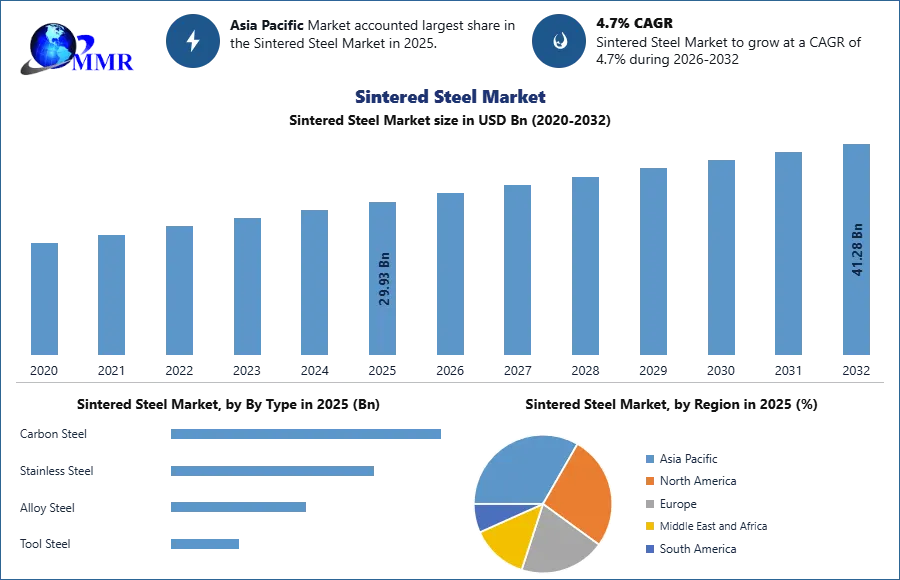 To know about the Research Methodology :- Request Free Sample Report
Sintered Steel Market Dynamics:
The automotive industry is the main end user of sintered steel because people are paying more and more attention to strict regulations and concerns about high manufacturing costs, increased waste in the manufacturing process and carbon footprint. Specifications such as Bharat Stage VI (BS-VI) are expected to bring profitable opportunities for sintered components throughout the forecast period. The BS-VI specification focuses on reducing harmful emissions and requires manufacturers to add sensors before and after the catalytic converter in order to take into account productivity advantages. Sintering is an ideal process for mass production of such parts. Compared with traditional processes, the sintering process involves fewer manufacturing steps, thereby reducing energy use and a low carbon footprint. In addition, the sintered steel mesh components are light in weight and provide better yields at low costs. Such benefits, combined with the growing car component sector, are likely to drive demand for sintered steel in the future years.
Despite increasing product demand, the growth of the sintered steel market is expected to be affected by certain unfavourable factors of sintering technology, such as difficulty in producing large parts and lack of high strength of sintered parts compared with cast iron or forged parts. In addition, the machinery and equipment required for manufacturing are very expensive, limiting mass production. In addition to technical constraints, with the rapid development of technology in the future, raw material steel can also be replaced by elements such as aluminium.
| Exact Date | Company | Development | Impact |
|---|---|---|---|
| 14 January 2026 | Schunk Group | Schunk Group introduced advanced CFC (Carbon Fiber-Reinforced Carbon) materials as a replacement for massive steel components in high-temperature sintering furnaces. | This development addresses the thermal limits of traditional steel, significantly reducing energy losses and preventing the mechanical sagging of support structures during the sintering process. |
| 30 November 2025 | Ramsarup Industries (Shyam Metalics) | The company commissioned a modern linear sinter plant and a high-efficiency blast furnace as part of a ₹369 crore investment. | The facility utilizes zero-process-water-discharge technology, reducing water and power consumption by 20% while converting iron ore fines into high-quality feedstock for steel production. |
| 13 October 2025 | Sumitomo Electric Industries | Sumitomo Electric released its 2025 strategy focused on soft magnetic composites (SMC) made from sintered iron powder for axial gap motors. | By leveraging powder metallurgy, the company is enabling the downsizing of EV drive units, directly supporting the automotive industry's transition to more compact and efficient electric powertrains. |
| 07 October 2025 | GKN Powder Metallurgy | GKN showcased its new range of sintered electrification solutions, including battery-grade iron phosphate and high-surface-area (HSA) materials at The Battery Show 2025. | The expansion into battery precursor materials represents a strategic diversification, applying sintering expertise to enhance the efficiency and morphology of LFP battery applications. |
| 19 June 2025 | GKN Powder Metallurgy | GKN announced the official launch of its Metallic Membrane cartridge filters, manufactured using specialized sintered metal powder technologies. | This product targets fine filtration in chemical and pharmaceutical sectors, offering superior sustainability and cleaning efficiency compared to traditional polymer-based filter systems. |
| 30 April 2025 | Schunk Group | Schunk Group expanded its Metal Injection Molding (MIM) capabilities to produce series-ready, complex sintered steel components for the aerospace and medical sectors. | The advancement allows for the economical production of small, intricate parts with high dimensional precision, reducing the need for secondary machining and lowering overall manufacturing costs. |
Sintered Steel Market Segment Analysis:
In 2025, the Carbon Steel segment holds the highest demand in the sintered steel market due to its cost-effectiveness, high strength, and widespread use in automotive and industrial components. Carbon steel sintered parts are extensively utilized in engines, transmissions, and structural components where durability and wear resistance are essential. Stainless Steel is also witnessing growing demand because of its corrosion resistance and suitability for applications in harsh environments, particularly in electrical and industrial sectors. Meanwhile, Alloy Steel provides enhanced mechanical properties such as improved hardness and fatigue resistance, making it suitable for high-performance applications. Tool Steel, although used in specialized applications requiring extreme hardness and precision, represents a comparatively smaller share of the market.
Based on Process, Conventional Manufacturing dominates the sintered steel market in 2025 due to its established production techniques, cost efficiency, and large-scale manufacturing capabilities. This process is widely adopted in the automotive and industrial sectors for producing durable and complex metal components. Metal Injection Molding (MIM) is experiencing rapid growth because it enables the production of highly precise and intricate parts with excellent mechanical properties, making it suitable for small and complex components. Additionally, Additive Manufacturing is gradually gaining traction as industries explore advanced manufacturing technologies for customized designs, reduced material waste, and rapid prototyping. However, its adoption remains limited compared to traditional processes due to higher costs and technological barriers.
In 2025, the Transportation segment represents the largest end-user of sintered steel components, primarily driven by the automotive industry's demand for high-strength, lightweight, and cost-efficient parts. Sintered steel is widely used in engines, transmissions, and drivetrain components to enhance performance and durability. The Industrial sector also contributes significantly to market demand as sintered steel components are commonly utilized in machinery, tools, and equipment requiring high wear resistance. The Electrical segment is gradually expanding as the use of sintered steel in electrical motors and magnetic components increases. Meanwhile, the Others category, including sectors such as consumer goods and construction, maintains moderate demand.
| Sintered Steel Market | |||
|---|---|---|---|
| Report Coverage | Details | ||
| Base Year: | 2025 | Forecast Period: | 2026-2032 |
| Historical Data: | 2020 to 2025 | Market Size in 2025: | 29.93 USD Bn |
| Forecast Period 2026-2032 CAGR: | 4.7% | Market Size in 2032: | 41.28 USD Bn |
| Segments Covered: | By Type | Carbon Steel Stainless Steel Alloy Steel Tool Steel |
|
| by Process | Metal Injection Molding (MIM) Conventional Manufacturing Additive Manufacturing |
||
| By End-User | Transportation Industrial Electrical Others |
||
| By Application | Engines Transmissions Body Chassis Drivetrain Electrical Others |
||
Sintered Steel Market Regional Insights:
PORTER, PESTEL analysis with the potential impact of micro-economic factors of the market has been presented in the report. External as well as internal factors that are supposed to affect the business positively or negatively have been analyzed, which will give a clear futuristic view of the industry to the decision-makers.
The report also helps in understanding the Sintered Steel market dynamics, structure by analyzing the market segments and projects the Sintered Steel market size. Clear representation of competitive analysis of key players by product, price, financial position, product portfolio, growth strategies, and regional presence in the Sintered Steel market make the report investor’s guide.
Sintered Steel Market Scope: Inquire before buying
Sintered Steel Market, by Region
North America (United States, Canada and Mexico)
Europe (UK, France, Germany, Italy, Spain, Sweden, Austria and Rest of Europe)
Asia Pacific (China, South Korea, Japan, India, Australia, Indonesia, Malaysia, Vietnam, Taiwan, Bangladesh, Pakistan and Rest of APAC)
Middle East and Africa (South Africa, GCC, Egypt, Nigeria and Rest)
South America (Brazil, Argetina and Rest of South America)
Sintered Steel Market, Key Players
1. Acerinox S.A.
2. AMES Sintering Metallic
3. Aperam
4. ArcelorMittal
5. ASCO Sintering
6. GKN PLC
7. Hitachi Chemical
8. JSCMS
9. Mirach Metallurgy Co
10. Nippon Steel
11. Outokumpu
12. POSCO
13. RTI Industries
14. Samvardhana Motherson
15. Sandmeyer Steel
16. Sandvik AB
17. Schmolz
18. Schunk Sinter Metals
19. Sintercom India
20. Sumitomo Electric
21. Synalloy Corporation
22. The Miba Group
23. thyssenkrupp Stainless
24. Viraj Profiles Limited