
Silicon Carbide Fiber Market - Industry Structure Evaluation, Demand Drivers Analysis, Regional Growth Analysis and Identification, Competitive Positioning / Landscape Review & Global Market Size Forecast to 2032
Overview
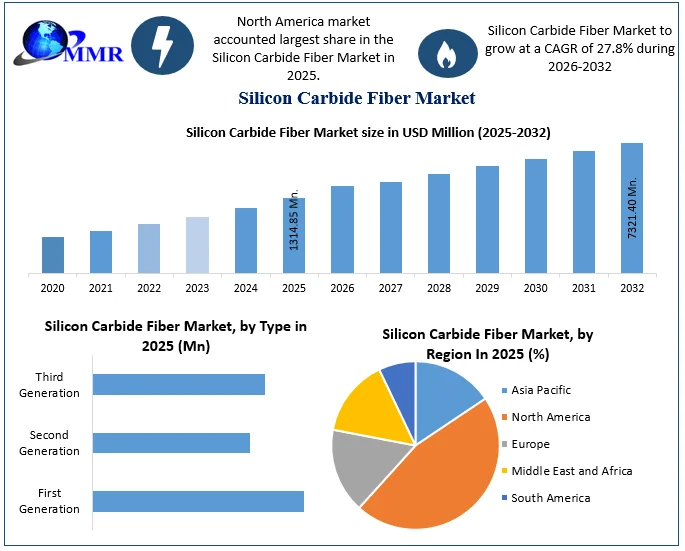
The Silicon Carbide Fiber Market size was valued at USD 1314.85 Million in 2025 and the total Silicon Carbide Fiber revenue is expected to grow at a CAGR of 27.8% from 2026 to 2032, reaching nearly USD 7321.40 Million.
Silicon Carbide Fiber Market Introduction:
SiC (silicon carbide) fibres are made up of of silicon carbide molecules and have great tensile strength, stiffness, chemical, resistance, and low thermal expansion. SiC fibres are commonly manufactured using the Yajima technique, chemical vapour deposition (CVD), and laser driven chemical vapour deposition (LCVD). Several studies and advances are being conducted in order to expand the range of applications for these fibres. Silicon carbide fibres, for example, are reinforced with SiC composite matrix in high-temperature structural applications like gas turbine engines. Under the effect of a wide temperature range, these fibres can survive structural and environmental conditions (up to 2700-degree Fahrenheit). They are also preferred over other materials like metallic superalloys, monolithic ceramics, carbon fibre composites, and oxide ceramic composites because of their capacity to be tailored for specific stress levels and a wide working temperature range.
To know about the Research Methodology:- Request Free Sample Report
Silicon Carbide Fiber Market Dynamics:
Over the forecast period, the market is expected to be driven by the increasing use of lightweight silicon carbide (SiC) fibres for component manufacture in the aerospace industry. The market is also likely to be driven by rising demand for the product in nuclear power plants for channel boxes and fuel cladding.
When compared to other high-performance fibres on the market, silicon carbide fibres have a better strength-to-weight ratio. Over the forecast period, the higher performance of SiC fibres at extreme temperature conditions is expected to enhance market growth. Additionally, these fibres have exceptional chemical resistance, a high modulus, and a low thermal expansion.
High volume usage in the defence industry is predicted to promote the silicon carbide fibres business in the United States. Over the estimated period, the SiC market is likely to be driven by rising product use in the production of energy and power components. Because of the huge production volume, the products are expected to be readily available, resulting in greater consumption.
Silicon carbide fibres are marketed at exorbitant prices, and the product has a restricted market presence because the United States and Japan control the majority of commercial production. Manufacturers around the world, particularly in the Middle East and Africa, are installing and expanding capacity to satisfy rising demand and strengthen their position in the worldwide SiC fibres market.
The development of improved silicon carbide fibres that may be employed in high-temperature structural applications is being aided by technological improvements supplied by globally recognised research centres. The product's operating properties are predicted to improve as a result of the development of innovative designs and processing technologies. However, potential competitors, such as academic institutions and other entities with greater financial resources, are projected to pose a challenge to these players as they work to develop more effective and cost-efficient goods.
COVID-19 Impact on Silicon Carbide Fiber Market:
The COVID-19 epidemic has wreaked havoc on numerous industries' demand & supply chains. More than a hundred countries have closed their international borders to non-essential trade and transportation. Due to the potential of infection among the workforce, manufacturing companies are likewise functioning at half capacity during this epidemic. Moreover, demand for silicon carbide (SiC) fibres has declined because of the liquidity crunch and financial crisis. Also, the lockdowns have been enforced in nations where the aerospace and defence sectors contribute a significant portion of the economy's growth, such as the United States, China, India, France, Germany, and others, resulting in lower demand for SiC fibres.
Silicon Carbide Fiber Market Segment Analysis:
Based On Form Segment: The Silicon Carbide Fiber market is further segmented into Continuous, Woven, and Others. In terms of revenue, the continuous silicon carbide fibres segment dominated the global market in 2025 and it is expected to grow at a CAGR of 35.9% during the forecast period (2026-2032). These fibres operate well in high-radiation environments, attracting a lot of interest from the nuclear power generation business. The majority of ceramic matrix composites with continuous filament reinforcement are lightweight and durable. The product is widely used in the aerospace and defence industries to manufacture massive essential components. Fiber tows are also simple to work with and can be utilized to create complex-shaped composites.
To make non-oxidative silicon carbide fibres, a variety of processing approaches have been explored. The advancement of these procedures is predicted to manage the product's microstructural development as well as a wide range of attributes such as modulus, tensile strength, density, and dielectric constant. In 2025, the woven silicon carbide fibres category accounted for 34.6 percent of the global market's revenue, and it is expected to grow significantly thanks to increasing demand from high-temperature applications. Demand for SiC fibres is likely to rise in the next years as more advanced silicon carbide-based composites are used in hypersonic applications.
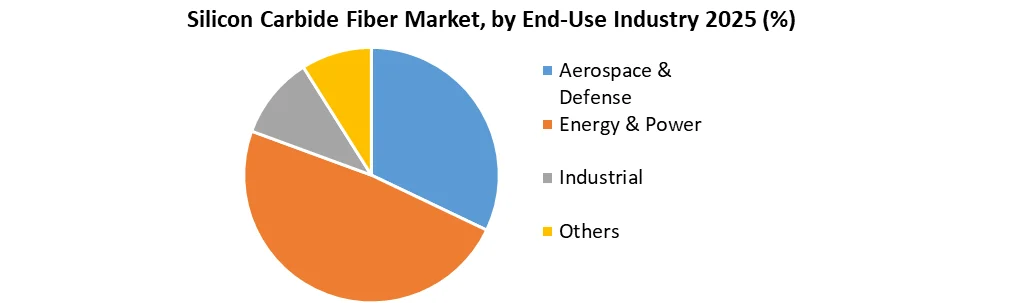
On the basis of End-use Industry: The Silicon Carbide Fiber market is further segmented into Aerospace & Defense, Energy & Power, Industrial, and Others. The aerospace and defence segment contributed the most revenue in 2025, and it is expected to grow at a CAGR of 34.6 percent during the forecast period. This is mainly due to the lightweight, heat resistant, durable, chemically stable, shock resistant, and creep resistant qualities of silicon carbide fibres. These properties make them appropriate for a broad range of aerospace and defence applications, including engine component insulation and turbine nanotubes. During the forecast period, the energy & power category is expected to increase at a CAGR of 18.5 percent
Silicon Carbide Fiber Market Regional Insights:
Because of the continuous expansion of the aerospace sector, the North American market was valued at USD 208.1 million in 2025 and is expected to increase significantly over the forecast period. Thanks to increased shipments of general aviation aircraft, civil space systems, and commercial aircraft, the aerospace and military industries in the United States experienced exponential expansion in industrial output. The region's aerospace and military industry is expected to grow rapidly as manufacturing production rises in response to strong domestic and worldwide demand for commercial aircraft. Rising defence spending in the region, as well as increased NASA funding, are likely to drive demand for silicon carbide fibres.
On account of rising application industries such as aerospace & defence and energy & power, the Asia Pacific size is expected to grow at a CAGR of 33.5 percent in terms of value from 2026 to 2032. Manufacturers in China are increasing their efforts to include silicon carbide into their goods, which is expected to boost market growth in the region.
The demand for the product in the production of gas turbines is expected to be high throughout the ME&A. Thanks to rising use of renewable energy, the power industry in the region plans to build roughly 500 new coal power plants by 2032. Over the forecast period, the development of the region's nuclear power generation capacity is expected to boost demand for silicon carbide fibres.
The objective of the report is to present a comprehensive analysis of the global Silicon Carbide Fiber market to the stakeholders in the industry. The past and current status of the industry with the forecasted market size and trends are presented in the report with the analysis of complicated data in simple language. The report covers all the aspects of the industry with a dedicated study of key players that include market leaders, followers, and new entrants.
PORTER, PESTEL analysis with the potential impact of micro-economic factors of the market has been presented in the report. External as well as internal factors that are supposed to affect the business positively or negatively have been analyzed, which will give a clear futuristic view of the industry to the decision-makers.
The report also helps in understanding the Silicon Carbide Fiber dynamics, structure by analyzing the market segments and projecting the Silicon Carbide Fiber size. Clear representation of competitive analysis of key players by product, price, financial position, product portfolio, growth strategies, and regional presence in the global Silicon Carbide Fiber market make the report investor’s guide.
Silicon Carbide Fiber Market Scope: Inquire before buying
| Silicon Carbide Fiber Market | |||
|---|---|---|---|
| Report Coverage | Details | ||
| Base Year: | 2025 | Forecast Period: | 2026-2032 |
| Historical Data: | 2020 to 2025 | Market Size in 2025: | USD 1314.85 Mn. |
| Forecast Period 2026 to 2032 CAGR: | 27.8% | Market Size in 2032: | USD 7321.40 Mn. |
| Segments Covered: | by Type | First Generation Second Generation Third Generation |
|
| by Form | Continuous Woven Others |
||
| by Phase | Amorphous Crystalline |
||
| by End-Use Industry | Aerospace & Defense Energy & Power Industrial Others |
||
Silicon Carbide Fiber Market, by Region
North America (United States, Canada and Mexico)
Europe (UK, France, Germany, Italy, Spain, Sweden, Austria and Rest of Europe)
Asia Pacific (China, South Korea, Japan, India, Australia, Indonesia, Malaysia, Vietnam, Taiwan, Bangladesh, Pakistan and Rest of APAC)
Middle East and Africa (South Africa, GCC, Egypt, Nigeria and Rest of ME&A)
South America (Brazil, Argentina Rest of South America)
Silicon Carbide Fiber Market, Key Players
1. Ube Industries, Ltd.
2. NGS Advanced Fiber Co. Ltd.
3. Suzhou Saifei Group Co., Ltd.
4. Haydale Technologies Inc.
5. MATECH
6. Specialty Materials, Inc.
7. COI Ceramics, Inc.
8. GE Aviation
9. Ningbo Zhongxing New Materials Co., Ltd.
10. BJS Ceramics GmbH
11. Toshiba
12. Saint-Gobain
13. Volzhsky Abrasive Works
14. Washington Mills
15. Calix ceramic solutions
16. Grindwell Norton ltd
17. Triveni interchem pvt. ltd.
18. Insanco inc
19. CeramTec
20. Aremco Products, Inc.
21. Ultramet,
22. Other
Frequently Asked Questions:
1. Which region has the largest share in Global Silicon Carbide Fiber Market?
Ans: North America region held the highest share in 2025.
2. What was the Global Silicon Carbide Fiber Market size in 2025?
Ans: The Global Silicon Carbide Fiber Market size was USD 1314.85 Million in 2025.
3. What is scope of the Global Silicon Carbide Fiber Market report?
Ans: Global Silicon Carbide Fiber Market report helps with the PESTEL, PORTER, COVID-19 Impact analysis, Recommendations for Investors & Leaders, and market estimation of the forecast period.
4. Who are the key players in Global Silicon Carbide Fiber Market?
Ans: The important key players in the Global Silicon Carbide Fiber Market are – Ube Industries, Ltd., NGS Advanced Fiber Co. Ltd., Suzhou Saifei Group Co., Ltd., Haydale Technologies Inc., MATECH, Specialty Materials, Inc., COI Ceramics, Inc., GE Aviation, Ningbo Zhongxing New Materials Co., Ltd., BJS Ceramics GmbH, Toshiba, Saint-Gobain, Volzhsky Abrasive Works, Washington Mills, Calix ceramic solutions, Grindwell Norton ltd, Triveni interchem pvt. ltd., Insanco inc, and CeramTec.
5. What is the study period of this Market?
Ans: The Global Silicon Carbide Fiber Market is studied from 2025 to 2032.