
Global Shampoo Market Size by Product, Distribution Channel type and Region – Segment-Level Market Assessment, Growth Opportunity Analysis, Competitive Mapping & Forecast to 2034
Overview
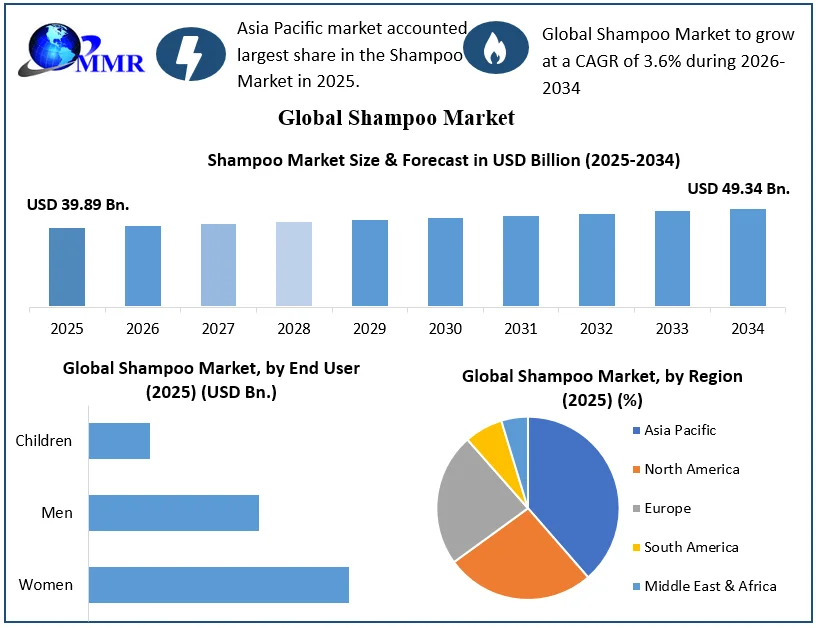
The Global Shampoo Market was valued at USD 39.89 Billion in 2025 and is projected to reach USD 49.34 Billion by 2034, growing at a CAGR of 3.6% during the forecast period 2026–2034.
Global Shampoo Market Overview:
The shampoo market refers to the demand for products used to clean and unclog hair follicles by removing dirt, excess oil, sweat, and other impurities. Shampoo market products are anti-dandruff and anti-hair-loss shampoos, herbal and medicated liquid soaps, moisturizing and dry shampoos, and professional hair care products for salons. Shampoo is necessary for hygiene and grooming purposes and is among the most popular personal care items. With the growing awareness of scalp care importance and changing lifestyles, the global shampoo market growth makes it a significant market for stakeholders. Shampoo industry is also driven by the need for beauty salons, hotels, and personal care sectors to provide products to their clients.
The shampoo market is expected to change as consumers become more interested in buying sulfate-free, silicone-free, herbal, and customized hair care items. Thus, the need for shampoos with natural ingredients, vitamins, proteins, and those that target scalp care and hair nourishment create new opportunities for market growth. There is also a rising demand from individuals and businesses, including salons, hotels, and personal care service providers, for high-class and affordable hair care products. The shampoo market trends are also influenced by the need for value packaging and affordable pricing, particularly in emerging countries. Asia Pacific is the biggest region in the shampoo market due to its significant contribution from China, India, and Japan. The key manufacturers in the shampoo market are Procter & Gamble (Pantene, Head & Shoulders), Unilever (Dove, Sunsilk), L’Oréal Group (Kérastase), and Kao Corporation (Essential). Moreover, the shampoo market size growth is driven by the rising sales through e-commerce, sustainable and innovative packaging, and new product developments.
Maximize Market Research (MMR) experts study the shampoo market size, market growth, market share, market analysis, and forecast to help manufacturers, investors, and suppliers understand the potential of the shampoo market. Our research sheds light on market demands, emerging trends, and innovations to help stakeholders make informed decisions. MMR experts analyze the rising demand for anti-dandruff, anti-hair-loss, moisturizing, herbal shampoos, and high-end hair care salon products. We also discuss how various factors such as product pricing, ingredients, brand, and online sales channel affect the shampoo market trends. MMR research emphasizes the shampoo market opportunities in emerging economies, scalp care products, customized hair care products, and eco-friendly packaging. The shampoo market forecast is highly competitive as it involves the demand for everyday hygiene and hair care shampoo and professional salon hair care products. Maximize Market Research (MMR) evaluates the global shampoo market by value, volume, product type, and region to help investors and manufacturers identify the most promising segments for expansion and investment.
Shampoo Market Size, Growth and Share Analysis
To know about the Research Methodology :- Request Free Sample Report
Global Shampoo Market Dynamics:
Global Shampoo Market Drivers: Rising Awareness of Hair Care and Routine Purchases Propels Growth
The rising awareness about the need for hair care and scalp care is one of the key drivers influencing the shampoo market growth. Customers frequently purchase products for dandruff removal, strengthening, moisture retention, and regular washing. A drastic change in lifestyle, environment, and the use of chemical hair products trigger the need for a shampoo tailored to one’s hair type and concern. Shampoo is a product that is bought on a regular basis as every household tends to use these products at least twice a month. For instance, a family of four buying two 200 ml shampoo bottles every month will spend about 4.8L of product per year. The increase in disposable income empowers customers to spend more on products with niche hair care benefits, such as keratin, biotin, coconut oil, and other additives. The urban buyer is willing to pay a premium for grade quality whereas the value-conscious buyer will stick to economic-sized packages and affordable shampoos. Such demand fluctuations stimulate the market growth and propel the product range extension.
Global Shampoo Market Restraints: Skyrocketing Prices of Premium Shampoo Hinders Growth
With the rise of premium quality shampoos, the price of high-end haircare products becomes one of the key restraints of the shampoo market growth. In developing countries, such as India, the buyer is highly conscious about the purchasing power and the need to invest in products which will deliver tangible results. Usually, the higher-end shampoos contain ingredients that are targeted for specific scalp and hair concerns. An illustrative example would be a premium 250 ml shampoo costing around INR 600, while an entry-level product costs INR 200 for the same volume. In value-for-money categories, the customer will opt for an ordinary shampoo instead of a premium one, thereby explaining the lower demand for high-end shampoos. The ingredient, packaging, shipping, and retail margin add up to the final selling price, thus, making it difficult for a small-time manufacturer to compete with the big-league brands that provide discounts with every purchase. Thus, the lower end of the market is highly influenced by price sensitivity, where the customer will opt for a 50 ml or 100 ml travel-size pack. These factors become significant while analyzing the market forecast, market size, and opportunities for expensive shampoos.
Global Shampoo Market Opportunities: Rising Demand for Scalp Care and Affordable Niche Shampoos Grows Market
Scalp care products and those targeting a specific hair concern represent a massive opportunity for brands. The shampoo market opportunities are mostly driven by the rising awareness about the need to care for the scalp. The growing popularity of herbal shampoos and salon-grade haircare products will further propel the need for products with unique efficacy against hair loss, dandruff, dryness, oil production, hair breakage, and split ends. There is a need to fill the gap between the premium and economy shampoos, where a customer expects a product that will deliver visible results within a reasonable timeframe. An effective haircare product should be able to target a specific hair concern. For example, the brand could provide a series of shampoos, conditioners, and treatments with varying concentrations of salicylic acid, niacinamide, aloe, argan oil, keratin, and herbal ingredients. The brand could also introduce different sizes of the same product to suit the varied purchasing capacity and individual needs of the customers. There is a growing demand for niche shampoos that would suit specific hair types and concerns. A product could range from a 100 ml travel pack to a 250 ml regular size and a family pack of 500 ml. Another opportunity includes the production and sale of refills in concentrated form. Additionally, the online marketing strategy helps brands sell their products without having to depend on a physical retail store. Salon haircare brands and dermatology products could also be a lucrative segment to target.
Global Shampoo Market
Challenges: Brand Image Competition and Customer Dissatisfaction Complicates Growth
The brand image competition and rising demand for effective shampoos is a challenge which makes it hard to scale the business and sustain growth. The big brands have a significant advantage since they can afford expensive marketing campaigns and sponsorships. It is challenging to compete against well-known brands that guarantee quality service and products. Furthermore, the customer has specific expectations from a haircare product which could be defined by brand image and perceived quality. They expect the shampoo to wash their hair effectively, cleanse the scalp, retain moisture, and improve hair quality without damaging it. Additionally, every buyer has different hair, scalp type, and water quality, which means that a particular formulation might work for a certain buyer, while not being effective enough for another. The brand will have to invest more in R&D, ingredient safety, and packaging to ensure that the product does not cause harm and provides the intended result. For example, it might become necessary to provide four different shampoos for dry and oily scalp, curly hair, straight hair, color-treated hair, and those with split ends. It will require additional resources, time, and capital expenditure to conduct the necessary tests. The growing counterfeit problem, changing government regulations, and rising concerns from customers pose a significant threat to the business. It will be challenging to ensure that each batch of the product is consistently high quality. These issues are significant in market opportunity analysis as they reflect the market share, size, and growth rate in a given period.
Global Shampoo Market Trend
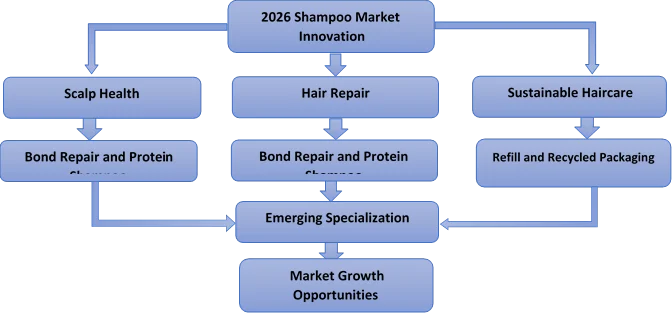
Rising Demand for Scalp Health, Bond-Repair Technology, and Sustainable Packaging Creates New Market Opportunities
1. Scalp Health
Increased consumer awareness about dandruff, dryness, and sensitive scalp issues drives the demand for scalp care shampoos. It stimulates the market growth and creates opportunities for emerging scalp care products.
2. Hair Repair
Consumers’ growing interest in hair repair shampoos that prevent breakage spurs the market demand for innovative products. It creates opportunities for manufacturers to develop protein-enriched and bond-repairing shampoos.
3. Sustainable Haircare
The rising consumer preference for eco-friendly shampoo packaging encourages companies to use recycled materials and introduces new market opportunities through sustainable haircare innovations.
4. Anti-Dandruff and Sensitive Scalp Shampoo
Spiked demand for mild shampoos for sensitive scalps and dandruff control drives the market growth for anti-dandruff haircare products. The limited supply of affordable products creates opportunities for manufacturers.
5. Bond Repair and Protein Shampoos
The emergence of hair repair technologies prompts the introduction of keratin protein, bond repair, and protein-enriched shampoos. It creates opportunities for innovative products for damaged hair.
6. Refill and Recycled Packaging
The consumer preference for recyclable materials and convenient refill pouches promotes sustainable packaging and creates a market gap for affordable products with recycled materials.
7. Emerging Specialization
The increased consumer interest in shampoos for dry scalp, oily scalp, dandruff, and color-treated hair encourages emerging specialization and creates opportunities for market growth in specified products.
8. Market Growth Opportunities
The growing consumer interest in scalp care, hair repair, and sustainable haircare products creates opportunities for xmanufacturers to develop novel products, expand online sales, and specialize in affordable products.
Global Shampoo Market Segment Analysis:
Global Shampoo Market, by Product
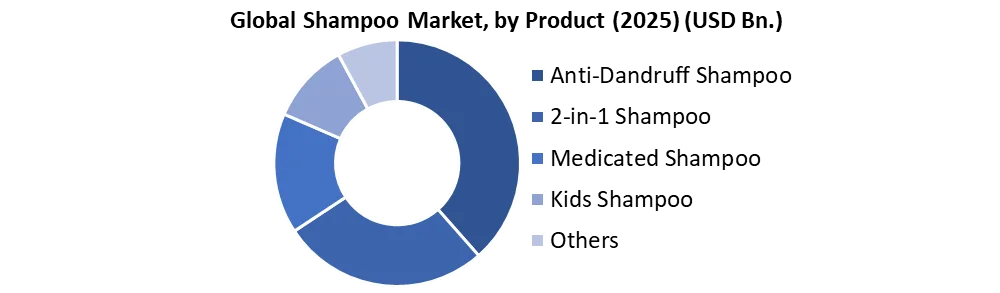
The Shampoo Market, by Product, is segmented into 2-in-1 Shampoo, Anti-Dandruff, Kids Shampoo, Medicated Shampoo, and Others. The Anti-Dandruff segment is highly attractive as customers are keen on treating and preventing dandruff and irritated scalps. The 2-in-1 Shampoo segment is one of the most popular as it offers a combination of two hair care benefits in one product. Similarly, the Kids Shampoo segment is in demand as parents prefer a gentle and mild shampoo for their children. The Medicated Shampoo segment has a promising demand as people are more conscious about the health benefits of medicated treatments. The rising popularity of affordable price range anti-dandruff shampoo shows a market gap that can benefit the manufacturers.
Global Shampoo Market, by Distribution Channel
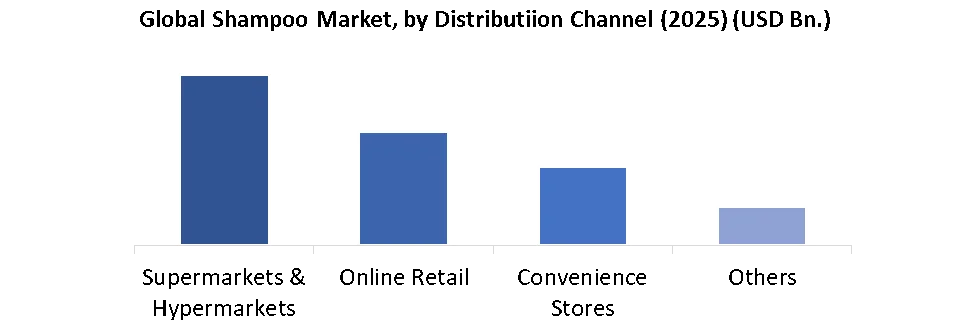
The Shampoo Market, by Distribution Channel, is divided into Convenience Stores, Supermarkets & Hypermarkets, Online Retail, and Others. The most popular segment is Supermarkets & Hypermarkets as they offer a variety of products at reasonable prices with an easy shopping experience. The Convenience Stores segment is equally important as it offers affordable pricing and round-the-year accessibility to a moderate range of products. The Online Retail segment has seen a significant rise in the last few years as customers prefer buying online offers convenience and home delivery. Moreover, the customers can compare different brands and products before buying. However, there is a market gap as some customers still find it difficult to shop online due to geographical constraints and a lack of technical know-how. Thus, the market can witness more growth as the penetration of e-commerce is increasing across the world.
Global Shampoo Market Regional Insights:
Asia Pacific is a highest region markets for shampoo due to the high consumer base, disposable income, and rising popularity of hair care in China, India, Japan, and South Korea, in particular. Moreover, the demand for scalp care shampoos and herbal products motivates manufacturers to enter the market and increase their share. This growth is also promoted by the availability of retail stores, online selling, and affordable price ranges.
North America’s market for shampoo is characterized by an increase in demand due to the high purchasing capacity of consumers and their interest in premium, sulfate-free, and herbal products. The customers are interested in buying shampoos that provide scalp care and nourishment and solve specific hair problems. Moreover, the rising number of salons and changing consumer preferences towards online shopping impact the market growth. However, the high prices of premium products motivate manufacturers to offer affordable products.
Europe has a strong demand for shampoo for hair care due to the customers’ interest in purchasing products with organic ingredients, natural formulas, and eco-friendly packaging. The market is competitive due to the presence of key players in Germany, France, the United Kingdom, and Italy. The rising use of herbal shampoos and the introduction of innovative products, such as refillable ones, promote market growth. However, the demand for affordable products motivates manufacturers to introduce new items and solutions.
South America’s market for shampoo is growing as more people want to buy products for hair care. They are interested in buying herbal products that would solve specific hair problems. This demand is mainly impacted by the rising number of supermarkets, beauty shops, and online stores. Moreover, the appearance of chain salons promotes the market’s growth. Thus, manufacturers are motivated to introduce products for scalp care and affordable hair care shampoos.
Middle East and Africa are increasing in terms of market share for shampoo due to the growing customer base and their interest in hair care. The demand is impacted by the rising number of beauty salons and changing consumer preferences towards hair care products. In particular, the need for anti-dandruff and moisturizing shampoos is growing. Moreover, online shopping availability motivates the market to grow. However, limited access to affordable products makes a gap that manufacturers can fill in.
Global Shampoo Market Recent Developments
| Date | Company | Type | Development |
| July-2026 | Procter & Gamble (Head & Shoulders) | Partnership | Head & Shoulders announced its partnership with USA Gymnastics at the 2026 U.S. Classic. The company added the USA Gymnastics endorsement to its platform, including the brand’s Official Shampoo of USA Gymnastics. In addition, the company improved its marketing campaign for scalp care products and increased consumer engagement. |
| July-2026 | Kao Corporation (Liese) | Product Launch & Expansion | Kao announced the Liese hair care product launch in seven Asian countries. The company expects to sell shampoos and conditioners with a unique H–Linx TECH technology that repairs colored hair in August 2026. |
| July-2026 | Unilever (TRESemmé) | Product Launch | Unilever announced the launch of TRESemmé Professional hair care products in the UK and Ireland. It entails shampoos, conditioners, and hair treatments made with professional technology. As a consequence, the company’s TRESemmé salon-quality hair care products improved their presence in the market. |
| June-2026 | L'Oréal | Acquisition Agreement | L’Oréal news stated that they had an agreement to buy a majority of Innovist, an Indian personal care group. It implies that the company will invest in its growth and digital transformation in the country and propel it to the next level as an incubator for L’Oréal’s digital-first beauty and personal care brands. |
| March-2026 | Henkel (Schwarzkopf) | Product Launch & Retail Partnership | Schwarzkopf announced the launch of KERATÎME Care & Styling products in Walmart stores throughout the United States. The brand entails Multiplex Bonding Technology hair care products for consumers’ hair repair and is the company’s extensive professional hair care collection for home use. |
Global Shampoo Market Competitive Landscape
The shampoo market competitors focus on the demand for product development, pricing, and promotional activities to acquire a larger market share. Therefore, the market is full of well-known brands, such as Procter & Gamble, Unilever, L’Oréal, Kao Corporation, Henkel, and Kenvue, which provide a wide range of products. Many companies offer a variety of products under the same label, such as Head & Shoulders, Pantene, Dove, Sunsilk, Kérastase, and Schwarzkopf. These companies fight for a bigger market share by introducing anti-dandruff, hair repair, moisturizing, and dandruff shampoo creams. Additionally, firms invest more in research, advertisement, and modernized marketing to enlarge the market size. For example, some companies offer sulfate-free, herbal, organic, and hair bond repair shampoos to meet the customers’ demands. The high competition between firms in the premium quality segment increases the risk of failure, creating opportunities for new entrants to capture the market by introducing cheaper products. Also, the leading firms in the market tend to sell their products through various channels, such as supermarkets, online platforms, beauty retailers, and salons. The competition for the Asia pacific region is intense because of its significant population and rising living standards. Furthermore, market research reveals that the shampoo market growth will be detected in scalp care, personalization, haircare, and eco-friendly packaging. Thus, companies should invest more in the development of better products and promote their brands to increase the sales of their products.
Global Shampoo Market Scope: Inquire before buying
| Shampoo Market | |||
|---|---|---|---|
| Report Coverage | Details | ||
| Base Year: | 2025 | Forecast Period: | 2026-2034 |
| Historical Data: | 2020 to 2025 | Market Size in 2025: | 35.89 USD Billion |
| Forecast Period 2026-2034 CAGR: | 3.6% | Market Size in 2034: | 49.34 USD Billion |
| Segments Covered: | by Product | 2-in-1 Shampoo Anti-Dandruff Kids Shampoo Medicated Shampoo Others |
|
| by Distribution Channel | Convenience Stores Supermarkets & Hypermarkets Online Retail Others |
||
| by End User | Men Women Children |
||
Global Shampoo Market, by Region
Asia Pacific (China, South Korea, Japan, India, Australia, Indonesia, Malaysia, Vietnam, Taiwan, Bangladesh, Pakistan and Rest of APAC)
Europe (UK, France, Germany, Italy, Spain, Sweden, Austria and Rest of Europe)
North America (United States, Canada and Mexico)
Middle East and Africa (South Africa, GCC, Egypt, Nigeria and Rest of ME&A)
South America (Brazil, Argentina Rest of South America)
Global Shampoo Market Key Players
1. The Procter & Gamble Company
2. Unilever PLC
3. L'Oréal S.A.
4. Henkel AG & Co. KGaA
5. Kao Corporation
6. Kenvue Inc.
7. Shiseido Company, Limited
8. Amorepacific Corporation
9. LG Household & Health Care Ltd.
10. Colgate-Palmolive Company
11. Beiersdorf AG
12. Revlon, Inc.
13. Natura Cosméticos S.A.
14. Grupo Boticário
15. Dabur India Limited
16. Patanjali Ayurved Limited
17. Emami Limited
18. Marico Limited
19. Himalaya Wellness Company
20. Godrej Consumer Products Limited
21. The Estée Lauder Companies Inc.
22. Coty Inc.
23. Church & Dwight Co., Inc.
24. Lion Corporation
25. Wella Company
26. John Paul Mitchell Systems
27. Davines Group S.p.A.
28. Moroccanoil
29. Giovanni Cosmetics, Inc.
30. Oriflame Cosmetics
31. Amway Corporation
32. The Hain Celestial Group, Inc.
33. Forest Essentials
34. Mamaearth (Honasa Consumer Limited)
35. Lotus Herbals Pvt. Ltd.
36. Biotique
37. VLCC Health Care Limited
38. Khadi Natural Healthcare
39. Ryo Hair Care (Amorepacific)
40. L'Occitane International S.A.
41. The Body Shop
42. Aveda (The Estée Lauder Companies)
43. OUAI Haircare (Procter & Gamble)
44. Function of Beauty
45. Prose
46. Living Proof
47. Olaplex
48. Virtue Labs
49. Briogeo Hair Care
50. Mielle Organics (Procter & Gamble)
Frequently Asked Questions
1. What is the projected Global Shampoo Market size and growth rate?
Ans. The market reached USD 39.89 Billion in 2025 and anticipates a 3.6% CAGR, achieving a USD 49.34 Billion valuation by 2034 through consistent industry growth drivers.
2. Which region holds the largest Global Shampoo Market share through 2034?
Ans. Asia Pacific holds the largest Global Shampoo Market share.
3. What are the leading Shampoo Market trends 2026 for product innovation?
Ans. Consumers increasingly pivot toward medicated scalp health and sulfate-free formulations. Industry leaders emphasize natural, botanical ingredients and professional-grade hair repair solutions to capture premium segments.
4. How is the medicated hair care segment influencing industry growth drivers?
Ans. Specialized scalp treatments, like anti-dandruff and dermatological-grade solutions, dominate market shares. High consumer spending on clinical-strength products fuels significant growth within the medicated shampoo category.
5. How is digitalization impacting Global Shampoo Market distribution channel dynamics?
Ans. Online retail experiences rapid expansion through 2034. Digitalization, aggressive e-commerce discounts, and the convenience of subscription-based purchasing models drive this segment’s high growth rate.
6. What role does sustainability play in current Shampoo Market share analysis?
Ans. The shift toward clean-beauty, herbal shampoos, and plastic-free alternatives like solid bars is accelerating. Sustainability initiatives and eco-friendly packaging remain critical competitive factors for manufacturers.
7. How do recent strategic acquisitions affect the competitive landscape?
Ans. Major players like Henkel and Unilever are acquiring premium, niche brands to enhance portfolios. These strategic moves strengthen presence in high-end repair and men's grooming.