
Rolling Stock Market– Industry Structure Evaluation, Demand Drivers Analysis, Regional Growth Analysis and Identification, Competitive Positioning Review & Global Market Size Forecast to 2032
Overview
Global Rolling Stock Market size was valued at USD 70.65 Bn. in 2025, and the total Rolling Stock Market revenue is expected to grow by 7.2% from 2026 to 2032, reaching nearly USD 114.94 Bn.
Global Rolling Stock Market Overview
The Rolling Stock Market includes the production, distribution, and servicing of rail trains, i.e., locomotives, passenger coaches, freight wagons, and metro/transit units, as described in this report.
The Global Rolling Stock Market is driven by urbanization, government expenditures on rail infrastructure, and a move towards sustainable transport. The report identifies demand-supply drivers, with rising orders for energy-efficient, high-speed trains, specifically in Asia-Pacific and Europe, while supply chain issues and raw materials prices affect production schedules.
In 2025, the Asia-Pacific region was the top performer, mainly because of metro network growth in China and India. In comparison, Europe and North America are moving more slowly, focusing on upgrading old trains and investing in freight rail.
Key companies in the market include CRRC Corporation (China), Alstom (France), Siemens Mobility (Germany), and Wabtec Corporation (U.S.). These companies are known for their strong strategies and innovations. The report also shows a shift in demand from freight to passenger transport, although freight still needs more investment and growth.
Looking ahead from 2025 to 2032, market growth driven by metro expansion, replacing old trains, and the rise of autonomous and connected train technologies. This report helps readers understand market trends, major players, and future opportunities.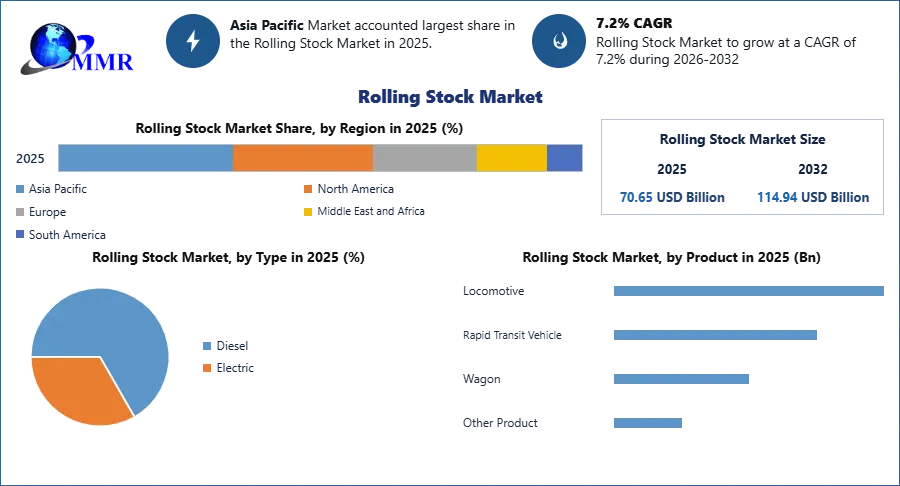 To know about the Research Methodology:-Request Free Sample Report
Global Rolling Stock Market Dynamics
Revolution in Rail Electrification & Automation to Drive Global Rolling Stock Market Growth
The rail industry is changing with battery-electric, hydrogen-powered, and autonomous trains getting traction. Alstom's Coradia iLint (a hydrogen train) and Siemens' Mireo Plus B (a battery-electric train) are setting new standards, and CRRC's autonomous metro systems are growing significantly in Asia. Governments are increasing the pressure for zero-emission rail networks, where the EU will not allow any new diesel trains after 2035. All this momentum is driving a higher demand for next-gen rolling stock, and it is forecasted that global rail electrification investments will grow at a CAGR of 8% through 2025.
Urbanization & High-Speed Rail Expansion to Drive Global Rolling Stock Market Growth
In the Asia-Pacific region, China and India lead with the most aggressive growth plans in regard to metro and high-speed rail (HSR) networks. China intends to double its HSR network by 2035. India's government thrashed out existing projects before launching the Vande Bharat Express and fast-paced metro projects. Europe is modernizing its aged fleets. Germany and France together have committed €7B+ in new trains. The United States is investing in Amtrak upgrades and its California HSR system.
Global Rolling Stock Market Segment Analysis
Based on type, the diesel segment dominated the Rolling Stock market. This is mainly due to the ability of diesel locomotives to operate well in areas with limited electrification or perform freight responsibilities in regions that are maximizing heavy haul weight in long hauls. Almost all rail freight in North America is still provided by diesel rolling stock as it provides the highest level of torque, is the most reliable in designated outlying areas, and the upfront cost to purchase is significantly less than electric. It should not be a shock that industries like mining, agriculture, and intermodal logistics predominantly rely on diesel rolling stock to proceed through their operations without reliance on overhead electrification.
Conversely, electric rolling stock is rapidly growing, particularly in the passenger rail and urban transit space, because of government incentives, a decrease in operational costs, and zero direct emissions. Yet, diesel rolling stock is still the dominant force in freight and regional rail operations, providing market leadership for now and the mid-term. Electric rolling stock may gain traction as infrastructure is enabled, but diesel will continue to play an essential role in heavy-haul, non-electrified rail networks.
Based on Train Type, the rail freight industry dominates the market, having the largest share of the market because of its vital mode of transport for bulk cargo from ship to supply chain logistics. Freight has always been a staple mode of transport in the mining, agricultural, and manufacturing sectors due to the vehicle's ability to economically haul significant amounts of loads over vast distances. Because of the high torque and reliability of diesel locomotives, the rail freight segment still dominates, especially in regions with lesser electrified rail systems, the sustainable movement is now instigating renewed innovation with hybrid and hydrogen fuel cell freight trains, which will enable this segment to continue to support working industries while being more environmentally conscious.
The passenger rail segment is now also experiencing quicker adoption rates with the rise of urbanization, government investments into high-speed rail, and as demand for eco-friendly public transit grows. Urban cities have started to build and expand electric multiple units (EMUs) and metro systems across all continents to help attract and provide transport from vehicular traffic, to create a reduction in congestion and carbon output. Even though it holds a lesser share of the market, the passenger rail segment has a sharper growth curve, supported by current smart city initiatives to embrace the opportunities presented by mobility solutions that can be put in place to fit the changing public transport initiatives across the globe.
Rolling Stock Market Regional Analysis
The Rolling Stock Market is segmented into various regions such as North America, Europe, the Middle East & Africa, South America, and the Asia Pacific. The Asia Pacific region is dominating the global market and is estimated to maintain dominance over the forecast period, owing to the adoption of rail transportation for passengers and goods. Also, the regional market growth can be attributed to the increasing investments in electric trains and metro trains in countries such as India, Taiwan, China, and other countries.
The Middle East & Africa region is expected to be fast-growing over the forecast period. The mining and oil & gas industries are increasing applications for the transportation of goods is leading to the growth of the rolling stock market globally. The regional market is also driven by the increasing use of rolling stock owing to their high torque power and enhanced safety. The report also helps in understanding Rolling Stock Market dynamics, structure by analysing the market segments, and projects the Rolling Stock Market size. Clear representation of competitive analysis of key players by Application, price, financial position, Product portfolio, growth strategies, and regional presence in the Rolling Stock Market makes the report an investor’s guide.
Global Rolling Stock Market Competitive Landscape
The Global Rolling Stock Market is competitive, with CRRC Corporation (China) being the world's largest producer, utilizing economies of scale, state financing, and assertive pricing to win contracts in Asia, Africa, and Latin America. Alstom (France) and Siemens Mobility (Germany) are top companies in high-end rail technologies—Alstom with its hydrogen fuel cell-powered Coradia iLint and Siemens with AI-based Railigent predictive maintenance systems. Wabtec (U.S.) continues to be North America's freight rail leader, being the first to develop battery-diesel hybrid locomotives and digital freight.
Hitachi Rail (Japan/UK) leads in high-speed rail (HS2, Shinkansen) and driverless metro systems, while Stadler Rail (Switzerland) takes a dominant share in regional trains, tramways, and bespoke solutions for low-density routes. Hyundai Rotem (Korea) is increasing its presence in metropolitan transit and high-speed rail through government support. Moreover, Titagarh Rail Systems (India) and CAF (Spain) are also coming up as prominent regional players, bidding for metro and light rail orders in expanding markets. The competitive scenario gets an added push by joint ventures, localization efforts, and R&D in automation and alternative propulsion, as makers compete to gain a grip in an increasingly innovation-based business.
Global Rolling Stock Market Key Trends
1. Green Transition The hydrogen and battery train revolution is picking up speed with Alstom’s Coradia iLint (Europe) and CRRC’s hydrogen trams (Asia) spearheading commercialization efforts. By 2025, there will be over 300 zero-emission trains that will be operational as regulations on diesel become more stringent (the EU’s 2035 mandate) and green subsidies become more readily available.
2. Digitalization & Automation Smart trains are transforming rail networks, through Siemens’ AI-enabled Railigent to reduce failures, and Hitachi's driverless metros to enhance efficiency, cutting downtime by 30%. Global Rolling Stock Market Key Highlights
Global market analysis and forecast, in terms of value.
Comprehensive study and analysis of market drivers, restraints, and opportunities influencing the growth of the Global Rolling Stock Market. Global market segmentation on the basis of type, source, end-user, and region (country-wise) has been provided. Global market strategic analysis with respect to individual growth trends, future prospects, along with the contribution of various sub-market stakeholders, has been considered under the scope of study. Global market analysis and forecast for five major regions, namely North America, Europe, Asia Pacific, the Middle East & Africa (MEA), and Latin America, along with country-wise segmentation.
Profiles of key industry players, their strategic perspective, market positioning, and analysis of core competencies are further profiled. Competitive developments, investments, strategic expansion, and the competitive landscape of the key players operating in the Global Market are also profiled.
Recent Industry Developments (2025–2026)
| Exact Date | Company | Development | Impact |
|---|---|---|---|
| 18 March 2026 | Stadler Rail AG | The company reported a 13% rise in sales for the 2025 fiscal year, reaching 3.7 billion CHF despite significant supply chain disruptions caused by regional flooding. | This financial performance underscores the market's resilience and high demand for hydrogen-powered and specialized rolling stock solutions. |
| 05 February 2026 | Siemens Mobility / Stadler | A consortium led by Siemens Mobility signed a framework contract with DSB for the delivery of 226 fully automated S-Tog trainsets. | The agreement facilitates a transition to GoA4 driverless operation, expected to increase network capacity in Copenhagen by up to 35%. |
| 26 January 2026 | Siemens Mobility / NEWAG | The companies signed a Memorandum of Understanding (MoU) to jointly develop and assess high-speed rolling stock technologies for the Polish market. | This strategic collaboration aims to strengthen technological self-reliance and infrastructure modernization for upcoming high-speed rail projects in Eastern Europe. |
| 13 October 2025 | Sumitomo Corporation | In partnership with Nippon Sharyo, the firm clinched a major contract to supply 48 subway cars for Phase 2A of the Jakarta Mass Rapid Transit (MRT). | The deal expands urban transit capacity in Southeast Asia, supporting the shift toward integrated rail systems in rapidly growing metropolitan areas. |
| 19 June 2025 | Alstom SA | Alstom was awarded a $158 million contract by Chennai Metro Rail Limited (CMRL) to commission 96 Metropolis metro cars for Phase II. | This development highlights the ongoing modernization of Indian urban rail and the global demand for sustainable rapid transit vehicles. |
| 01 March 2025 | Wabtec Corporation | The company announced the $960 million acquisition of Dellner Couplers, integrating a massive installed base of 100,000 couplers into its portfolio. | The acquisition solidifies Wabtec's dominance in the aftermarket and components segment, projected to add $250 million in revenue within the first year. |
Global Rolling Stock Market Scope: Inquire before buying
| Rolling Stock Market | |||
|---|---|---|---|
| Report Coverage | Details | ||
| Base Year: | 2025 | Forecast Period: | 2026-2032 |
| Historical Data: | 2020 to 2025 | Market Size in 2025: | 70.65 USD Billion |
| Forecast Period 2026-2032 CAGR: | 7.2% | Market Size in 2032: | 114.94 USD Billion |
| Segments Covered: | by Product | Locomotive Rapid Transit Vehicle Wagon Other Product |
|
| by Type | Diesel Electric |
||
| by Train Type | Rail Freight Passenger Rail |
||
| by Application | Passenger Transportation Freight Transportation |
||
Rolling Stock Market, by Region
North America (United States, Canada and Mexico)
Europe (United Kingdom, France, Germany, Italy, Spain, Sweden, Russia, Rest of Europe)
Asia Pacific (China, Japan, South Korea, India, Australia, Malaysia, Thailand, Vietnam, Indonesia, Philippines, Rest of APAC)
Middle East and Africa (South Africa, GCC, Nigeria, Egypt, Turkey, Rest of MEA)
South America (Brazil, Argentina, Colombia, Chile, Peru, Rest of South America)
Key Players / Competitores Proflies Coverd Rolling Stock Market Report in Strategic Perspective
- CRRC Corporation Limited
- Siemens AG
- Wabtec Corporation
- Hitachi Ltd.
- Stadler Rail AG
- Construcciones y Auxiliar de Ferrocarriles (CAF)
- Kawasaki Heavy Industries Ltd.
- Hyundai Rotem Company
- Mitsubishi Heavy Industries Ltd.
- The Greenbrier Companies Inc.
- Trinity Industries Inc.
- Transmashholding (TMH)
- Bombardier Transportation
- Patentes Talgo S.L.U.
- Pesa Group
- Škoda Group
- BEML Limited
- Titagarh Rail Systems Limited
- National Railway Equipment Co. (NRE)
- Caterpillar Inc.
- The Kinki Sharyo Co. Ltd.
- Nippon Sharyo Ltd.
- IHI Corporation
- Tatravagonka a.s. Poprad