
Robotic Nurse Assistant Market Size by Product Type, End-User, Region, Industry-Wide Analysis, Competitive Landscape Assessment & Long-Term Forecast to 2032
Overview
The Global Robotic Nurse Assistant Market size was valued at USD 1194.39 Mn in 2024 and the total Robotic Nurse Assistant revenue is expected to grow at a CAGR of 19.9% from 2025 to 2032, reaching nearly USD 5101.54 Mn.
Global Robotic Nurse Assistant Market Overview:
Robotic nurses assist patients in moving about or performing simple duties such as collecting vital signs or giving medicine. As a result, robotic nurses function as gateways for doctors to connect with patients over long distances. These robotic nurses perform a variety of functions, including aiding elderly and handicapped patients with everyday tasks, communicating with patients, monitoring patients, and obtaining patient records. These robots are also assisting in lowering nurse-to-patient demographic ratios in nations where healthcare personnel are in limited supply. As a result, robotic nursing assistants provide basic advantages related to safe patient lifting that are comparable to those gained from current traditional techniques, such as a decreased prevalence of clinician workplace injuries, worker's compensation payments, and missed work time.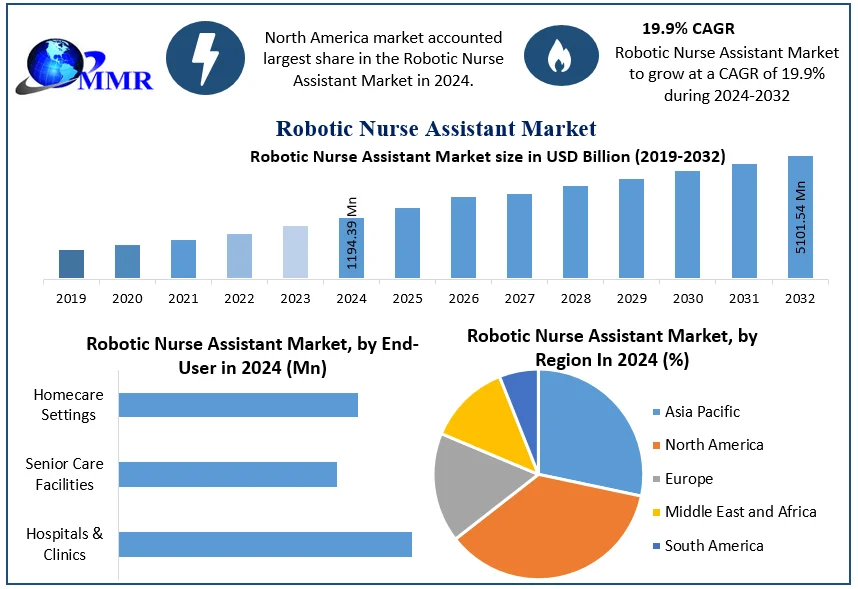 To know about the Research Methodology :- Request Free Sample Report
2024 is considered as a base year to forecast the market from 2025 to 2032. 2024’s market size is estimated on real numbers and outputs of the key players and major players across the globe. Past five years trends are considered while forecasting the market through 2032. 2020 is a year of exception and analyzed specially with the impact of lockdown by region.
Global Robotic Nurse Assistant Market Dynamics:
The market for robotic nurse assistants for various assistance day-to-day duties is increasing as the world's senior population grows. According to the World Bank statistics, in 2016, 27% of Japan's population was over 65 years old. Aside from the United States, roughly 15% of the entire population is 65 years or older, and also more than 20% of the European population is 65 years or older in 2016. Additionally, in the approaching years, significant technical developments along with increased research investment in healthcare, robotics are likely to promote demands for robotic nurses.
Advancing technological breakthroughs, as well as increased research investment in healthcare robots and the expanding trend of artificial intelligence in healthcare, are projected to propel the market forward. As per the International Federation of Robotics (IFR), robot sales surged by 15% to 253,748 units in 2015, while the technology sector increased by over 41%. One of the primary drivers of the global robotic nurse assistant industry is the growing population of elderly people. Researchers created robotic nurse assistants to lower high patient-to-nurse proportion as well as other concerns such as a lack of skilled employees and time constraints to monitor patients.
However, constraints such as the heavy cost of robotic systems, as well as safety issues, are likely to limit market growth. Furthermore, tremendous advancements in software programming skills, as well as new vision and motion systems, are rapidly increasing the breadth of robotic systems. The new robotic lab assistant can detect that vessel and draw blood with minimal discomfort and anxiety. In pharmaceutical labs, the robots also prepare and administer drugs. Robotic carts transport bed linens and even foods from floor to floor in larger installations, riding lifts and maneuvering through automatic doors.
Global Robotic Nurse Assistant Market Segment Analysis:
Based on the Product Type, the global Robotic Nurse Assistant market is segmented into Independence Support Robots, Daily Care & Transportation Robots, and Autonomous Mobile Robots. The independence support robots segment held the largest market share of 42.7 % in 2024. The demand for autonomous supporting robots has grown as the old and crippled population has grown, necessitating constant nursing attention. Additionally, these robots relieve humans of mundane jobs and improve the precision of repeated operations, all of which contribute to the segment's expansion.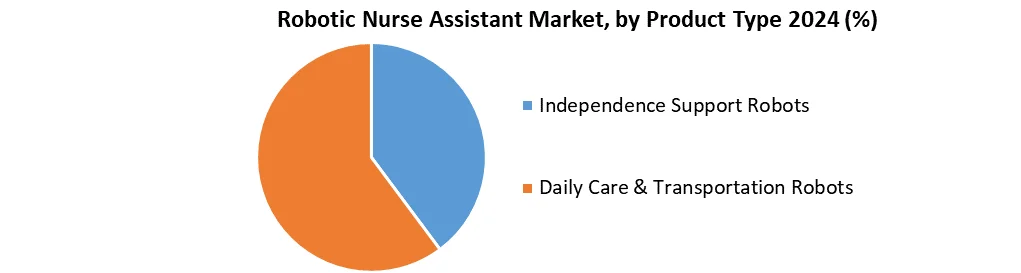 The daily care & transportation robots segment is expected to hold the largest market share of xx % by 2032. Such robots automate operations that have a favorable impact on hospital workflows, consequently increasing performance and enhance treatment quality. Furthermore, one important key factor propelling the growth of this market is the increasing need for nurse assistance robots to assist healthcare staff in executing daily activities more efficiently.
Based on the End-User, the global Robotic Nurse Assistant market is segmented into Hospitals & Clinics, Senior Care Facilities, and Homecare Settings. The hospitals & clinics segment is expected to hold the largest market share of xx% in the global robotic nurse assistant market with such a value of USD 182.4 million by 2032. The robotic nursing assistant market is expected to grow due to a shortage of nurses in different countries and the growing deployment of surgical robots in hospitals and clinics.
However, the senior care facilities segment is expected to grow at a higher CAGR of xx% in the global robotic nurse assistant market during the forecast period 2025-2032. Due to the worlds burgeoning geriatric population. As per the CIA World Fact Book, those aged 60 and up made up 12.3 percent of the worldwide in 2015, and this number is anticipated to rise to 21.5 percent by 2050. Additionally, the increased use of healthcare robots to assist the elderly is likely to boost this segment's growth during the forecast period.
Global Robotic Nurse Assistant Market Regional Insights:
North America dominates the global Robotic Nurse Assistant market during the forecast period 2025-2032. North America held the largest market share of 40.5% in 2024. Due to this region's growing geriatric population. As per World Health Organization (WHO) forecasts, the worldwide population of old persons aged 65 and over would grow from 727 million in 2020 to over 1.5 billion in 2050, based on data from the National Institute on Aging in the United States. The most recent technological advancements have been developed to preserve the nurse-to-patient ratio, therefore supporting regional market growth.
Asia Pacific is expected to grow at a higher CAGR of 21.7% in the global robotic nurse assistant market during the forecast period 2025-2032. The region's continually increasing healthcare infrastructure and investment, along with rising healthcare expenditure is estimated to function as high-impact contributing drivers to the robotic nurse assistant market. Furthermore, owing to a nursing shortage in Japan, the Japanese government is heavily supporting the development of healthcare robots in the nation by providing subsidies to researchers and manufacturers.
The objective of the report is to present a comprehensive analysis of the global Robotic Nurse Assistant Market to the stakeholders in the industry. The past and current status of the industry with the forecasted market size and trends are presented in the report with the analysis of complicated data in simple language. The report covers all the aspects of the industry with a dedicated study of key players that include market leaders, followers, and new entrants.
PORTER, PESTEL analysis with the potential impact of micro-economic factors of the market have been presented in the report. External as well as internal factors that are supposed to affect the business positively or negatively have been analyzed, which will give a clear futuristic view of the industry to the decision-makers.
The reports also helps in understanding the global Robotic Nurse Assistant Market dynamic, structure by analyzing the market segments and project the global Robotic Nurse Assistant Market size. Clear representation of competitive analysis of key players by product, price, financial position, product portfolio, growth strategies, and regional presence in the global Robotic Nurse Assistant Market make the report investor’s guide.
Global Robotic Nurse Assistant Market Scope: Inquire before buying
| Global Robotic Nurse Assistant Market | |||
|---|---|---|---|
| Report Coverage | Details | ||
| Base Year: | 2024 | Forecast Period: | 2025-2032 |
| Historical Data: | 2019 to 2024 | Market Size in 2024: | USD 1194.39 Mn |
| Forecast Period 2025 to 2032 CAGR: | 19.9% | Market Size in 2032: | USD 5101.54 Mn. |
| Segments Covered: | By Product Type | Independence Support Robots Daily Care & Transportation Robots Autonomous Mobile Robots |
|
| By End-User | Hospitals & Clinics Senior Care Facilities Homecare Settings |
||
Global Robotic Nurse Assistant Market, by Region
North America (United States, Canada and Mexico)
Europe (UK, France, Germany, Italy, Spain, Sweden, Austria, Turkey, Russia and Rest of Europe)
Asia Pacific (China, India, Japan, South Korea, Australia, ASEAN and Rest of APAC)
Middle East and Africa (South Africa, GCC, Egypt, Nigeria and Rest of ME&A)
South America (Brazil, Argentina, Columbia and Rest of South America)
Global Robotic Nurse Assistant Market Key Players
1. Hstar Technologies
2. Diligent Robotics
3. Toyota Motor Corporation
4. RIKEN-SRK
5. SoftBank Robotics
6. Panasonic
7. Fraunhofer IPA
8. Aethon
9. Hitachi
10. JoiceCare AB
11. Georgia Tech
12. GeckoSystems International Corporation
13. Human-Interactive Robot Research
Frequently Asked Questions:
1] What segments are covered in market report?
Ans. The segments covered in market report are based on Product Type, and End-User.
2] Which region is expected to hold the highest share in the global market?
Ans. North America is expected to hold the highest share in the global market.
3] What is the market size of global market by 2032?
Ans. The market size of global market by 2032 is USD 5101.54 Mn.
4] Who are the top key players in the global Robotic Nurse Assistant Market?
Ans. Hstar Technologies, Diligent Robotics, Toyota Motor Corporation, RIKEN-SRK, SoftBank Robotics, are the top key players in the global Robotic Nurse Assistant Market.
5] What was the Global Robotic Nurse Assistant Market size in 2024?
Ans. The Global Robotic Nurse Assistant Market size was USD 1194.39 Mn in 2024.