
Residential Robotic Vacuum Cleaner Market by Charging Type, Type, Operation Mode, Distribution Channel and Region – Global Market Size Estimation, Industry-Wide Analysis, Competitive Landscape Assessment & Long-Term Forecast to 2032
Overview
The report provides a comprehensive analysis of the Global Residential Robotic Vacuum Cleaner Market, which was valued at USD 3,711.42 Million in 2025 and is projected to reach USD 7,485.97 Million by 2032, growing at a CAGR of 11% during the forecast period. The study offers detailed insights into market size, regional market share, pricing analysis, technology-based segmentation, competitive landscape, and smart home market trends shaping the future of the industry.
Residential Robotic Vacuum Cleaner Market Key Highlights
• The Residential Robotic Vacuum Cleaner Market is projected to grow from USD 3,711.42 million in 2025 to USD 7,485.97 million by 2032, registering a CAGR of 11%, driven by increasing adoption of smart home automation, AI-powered cleaning technologies, and connected household appliances.
• Asia-Pacific accounts for the largest market share owing to its strong electronics manufacturing ecosystem, growing disposable income, and increasing smart home penetration. North America represents the fastest-growing premium market, with the United States, China, South Korea, Japan, and Germany emerging as key demand centers.
• LiDAR-based and AI-powered robotic vacuum cleaners dominate the premium product segment across developed economies due to superior navigation accuracy, intelligent mapping, and advanced obstacle detection capabilities. Meanwhile, affordable gyroscope-based robotic vacuum cleaners continue to drive sales volume across emerging markets through expanding e-commerce platforms.
• Self-emptying, vacuum-and-mop combination, and multifunction robotic vacuum cleaners are witnessing the fastest adoption, supported by growing demand for hands-free cleaning, pet hair removal, improved indoor hygiene, and the rapid expansion of direct-to-consumer (D2C) brands and online retail channels.
• Smart home ecosystem integration, energy-efficient technologies, sustainability initiatives, and compatibility with voice assistants such as Amazon Alexa, Google Assistant, and Apple HomeKit are reshaping product innovation and consumer purchasing preferences, creating significant long-term growth opportunities for manufacturers.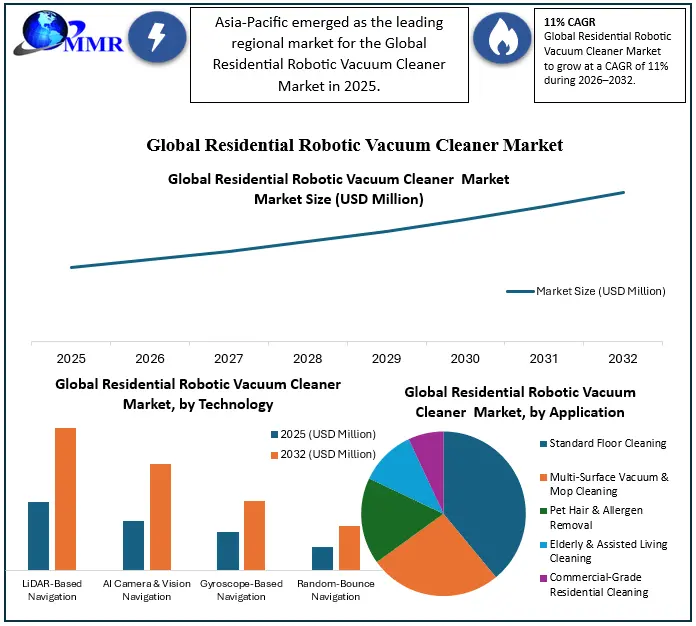
To know about the Research Methodology :- Request Free Sample Report
Global Residential Robotic Vacuum Cleaner Market Dynamics
The Global Residential Robotic Vacuum Cleaner Market is witnessing one of the most significant transformations within the consumer electronics industry as robotic cleaning devices evolve from premium household gadgets into mainstream smart home appliances. Rising awareness regarding home automation, increasing consumer preference for intelligent household solutions, and rapid advancements in artificial intelligence (AI), LiDAR navigation, computer vision, and Internet of Things (IoT) technologies are accelerating product adoption worldwide.
Growing urbanization, busy lifestyles, increasing participation of dual-income households, and heightened awareness regarding indoor hygiene are encouraging consumers to invest in autonomous cleaning solutions that minimize manual effort while improving cleaning efficiency. Manufacturers are continuously introducing advanced robotic vacuum cleaners equipped with intelligent room mapping, obstacle avoidance, self-emptying docking stations, app-based controls, and voice assistant integration, enhancing convenience and overall user experience.
Furthermore, the rapid expansion of smart home ecosystems and connected appliances is creating favorable market conditions for robotic vacuum cleaner manufacturers. Increasing investments in AI-enabled navigation systems, enhanced battery technologies, multifunction cleaning capabilities, and sustainable product designs are expected to strengthen market growth throughout the forecast period. As demand for intelligent home automation continues to rise globally, the Residential Robotic Vacuum Cleaner Market is expected to witness sustained expansion, supported by continuous technological innovation, premium product development, and increasing penetration across both developed and emerging economies.
Global Residential Robotic Vacuum Cleaner Regional Insights
Regional trends highlight clear growth patterns in the robotic vacuum cleaner market.
Asia Pacific (38.4%) leads in volume share, driven by strong manufacturing bases, tech-savvy consumers, and high smart home penetration in China, South Korea, and Japan.
North America (27.6%) follows a premium trajectory, supported by strong brand loyalty (iRobot Roomba), demand for voice-assistant integration, and high disposable income.
Europe (21.8%) is driven by energy efficiency mandates and smart appliance adoption in Germany, UK, and France.
South America (6.9%) and MEA (5.3%) remain emerging markets, with increasing adoption through mass e-commerce and urban household growth.
The smart home integration movement is driving innovation in the robotic vacuum cleaner market, with brands shifting to app-controlled, voice-activated, multi-floor mapping, and selfmaintaining autonomous systems. Innovation is focused on AI obstacle avoidance, longer battery life, quieter motors, biodegradable dustbags, and subscription-based maintenance services.
In terms of applications, standard floor vacuuming remains dominant, while multi-surface mopping and vacuuming combos are the fastest-growing segment driven by pet owners and allergy-sensitive consumers. Commercial-grade home cleaning is emerging as a high-growth area, and smart home bundle packages provide steady volume growth. Increasing investments are also seen in products targeting allergen reduction and elderly-friendly autonomous home care.
Competition is intensifying, with iRobot (Amazon) and Ecovacs leading in navigation technology and brand recognition, while Roborock, Dreame Technology, and Shark dominate value-premium and mid-tier segments. Other players like Dyson, Samsung, and Xiaomi (Mijia) are strengthening positions in premium design and ecosystem-integrated applications.
| Platform | Share |
| Amazon | 38% |
| Best Buy / Electronics Retailers | 20% |
| Walmart.com | 17% |
| Costco / Club Stores | 13% |
| Others (D2C, regional) | 12% |
Price segmentation reveals clear market layers. Premium products priced USD 500–1,500+ thrive in North America, Europe, and Japan due to advanced AI features, brand equity, and durable build quality. Mass-market formats priced USD 150–300 dominate India, Southeast Asia, Brazil, and South Africa where affordability dictates volume.
Residential Robotic Vacuum Cleaner Market Scope: Inquire before buying
| Global Residential Robotic Vacuum Cleaner Market | |||
|---|---|---|---|
| Report Coverage | Details | ||
| Base Year: | 2025 | Forecast Period: | 2026-2032 |
| Historical Data: | 2020 to 2025 | Market Size in 2025: | USD 3,711.42 Million |
| Forecast Period 2026 to 2032 CAGR: | 11% | Market Size in 2032: | USD 7,485.97 Million |
| Segments Covered: | by Technology | LiDAR-Based Navigation AI Camera & Vision Navigation Gyroscope-Based Navigation Random-Bounce Navigation |
|
| by Product Type | Robot Vacuum Only Robot Vacuum & Mop Combo Self-Emptying Robot Vacuum Self-Washing & Auto-Refilling Robot Vacuum |
||
| by Application | Standard Floor Cleaning Multi-Surface Vacuum & Mop Cleaning Pet Hair & Allergen Removal Elderly & Assisted Living Cleaning Commercial-Grade Residential Cleaning |
||
| By Distribution Channel | Online Retail Supermarkets & Hypermarkets Electronics Retail Stores Specialty Smart Home & Appliance Stores B2B Distribution |
||
North America (United States, Canada, and Mexico)
Europe (UK, France, Germany, Italy, Spain, Sweden, Austria, and the Rest of Europe)
Asia Pacific (China, South Korea, Japan, India, Australia, ASEAN, Indonesia, Philippines, Malaysia, Vietnam, Thailand, ASEAN, Rest of Asia Pacific)
Middle East & Africa (South Africa, GCC, Nigeria, Rest of ME&A)
South America (Brazil, Argentina, Rest of South America)
Key Players – Residential Robotic Vacuum Cleaner Market
| Company Name | Core Competencies |
| iRobot Corporation | AI-powered robotic vacuum cleaners, Roomba ecosystem, smart home integration |
| SharkNinja | Self-emptying robot vacuums, powerful suction technology, mid-premium product portfolio |
| Neato Robotics | LiDAR navigation, D-shape cleaning technology, precision corner cleaning |
| bObsweep | Pet hair cleaning solutions, allergen control, autonomous home cleaning |
| Matic Robotics | AI-first autonomous home robotics, intelligent navigation, next-generation robotics |
| Ecovacs Robotics | DEEBOT robotic vacuum series, AI object recognition, vacuum & mop technology |
| Roborock Technology | LiDAR mapping, intelligent navigation, premium robotic cleaning solutions |
| Dreame Technology | Self-washing systems, AI navigation, premium smart home appliances |
| Xiaomi (Mijia) | IoT ecosystem integration, affordable smart home products, robotic floor cleaning |
| ILIFE Robotics | Cost-effective robotic vacuums, wet & dry cleaning, entry-level automation |
| Narwal Robotics | Self-cleaning mopping technology, premium floor care automation |
| Lefant | Ultra-slim robotic vacuums, pet-friendly cleaning solutions, compact navigation |
| Trifo | AI vision navigation, security camera integration, multifunction robotic cleaners |
| SwitchBot | Smart home ecosystem integration, connected automation devices |
| Keenon Robotics | Intelligent robotics, AI navigation, residential and commercial robotic solutions |
| Proscenic | App-controlled robotic vacuum cleaners, smart home compatibility |
| Toshiba Lifestyle | Smart home appliances, robotic cleaning technologies, consumer electronics |
| Panasonic Corporation | Smart home appliances, automated floor cleaning systems, energy-efficient technologies |
| Samsung Electronics | Jet Bot AI series, SmartThings ecosystem, AI vision sensors |
| LG Electronics | ThinQ AI integration, premium robotic vacuum systems, connected appliances |
| Dyson Ltd. | Premium robotic vacuum technology, digital motor engineering, advanced filtration |
| Miele | German engineering, premium home appliances, long-life robotic vacuum systems |
| Vorwerk | Kobold robotic cleaning systems, premium household appliances, direct sales network |
| Cecotec | Conga robotic vacuum series, value-premium smart cleaning solutions |
| Philips | Smart household appliances, connected cleaning technologies, energy-efficient products |
| Bosch Home Appliances | Intelligent home appliances, robotic cleaning innovation, connected home ecosystem |
| Siemens Home Appliances | Premium household automation, smart cleaning technologies, IoT connectivity |
| Electrolux AB | Sustainable home appliances, robotic floor care, advanced cleaning solutions |
| Rowenta (Groupe SEB) | Robotic vacuum cleaners, high-performance floor care, premium consumer appliances |
| Haier Smart Home | Smart appliance ecosystem, AI-enabled home appliances, robotic floor care |
Frequently Asked Questions
Q1. What is the market size of the Global Residential Robotic Vacuum Cleaner Market in 2025?
The Global Residential Robotic Vacuum Cleaner Market was valued at USD 3,711.42 million in 2025.
Q2. What is the expected market size of the Residential Robotic Vacuum Cleaner Market by 2032?
The market is projected to reach USD 7,485.97 million by 2032, driven by increasing adoption of smart home technologies and AI-enabled cleaning solutions.
Q3. What is the projected CAGR of the Residential Robotic Vacuum Cleaner Market during the forecast period?
The market is expected to register a CAGR of 11.0% during the forecast period from 2025 to 2032.
Q4. Which region dominates the Global Residential Robotic Vacuum Cleaner Market?
Asia-Pacific dominates the global market owing to its strong manufacturing base, increasing smart home adoption, rising disposable income, and growing demand across China, Japan, South Korea, and India.
Q5. Which region is expected to witness the fastest growth during the forecast period?
North America is anticipated to witness the fastest growth due to increasing demand for premium robotic vacuum cleaners, high smart home penetration, and rapid adoption of AI-powered home automation technologies.
Q6. What are the key factors driving the Residential Robotic Vacuum Cleaner Market?
Major growth drivers include increasing smart home adoption, advancements in artificial intelligence and LiDAR navigation, rising consumer preference for automated household cleaning, expanding e-commerce channels, and growing demand for energy-efficient home appliances.