
Rechargeable Poly Lithium-Ion Battery Market Size by Structure, Application, Region – Segment-Level Market Assessment, Growth Opportunity Analysis, Competitive Mapping & Forecast to 2029
Overview
Rechargeable Poly Lithium-Ion Battery Market is expected to reach US $ 208.01 billion by 2029, thanks to growth in the Structure, and Application segment. The report analyzes market dynamics by region and end-user industries.
Rechargeable Poly Lithium-Ion Battery Market Overview:
The rechargeable poly lithium-ion battery market was valued at US $ 125.50 Bn. in 2021, and it is expected to reach US $ 208.01 Bn. by 2029 with a CAGR of 6.52% during the forecast period.
A lithium-ion polymer battery is a lithium-ion rechargeable battery that uses a polymer electrolyte rather than a liquid electrolyte. This electrolyte is made out of semisolid (gel) polymers with high conductivity. These batteries have higher specific energy than other lithium battery types and are utilized in applications where weight is a key factor, such as mobile devices, radio-controlled planes, and some electric vehicles. A microporous separator is placed between the electrodes to prevent them from immediately contacting. This allows only the ions, not the electrode particles, to migrate from one side to the other.
These batteries work on the principle of lithium-ion electron transfer and de-intercalation from a positive electrode material and a negative electrode material, with a conducting media provided by a liquid electrolyte. Based on the packing or pouch-like form, the batteries are extremely light. When compared to other battery technologies, the primary benefit of using lithium-ion batteries is their low maintenance.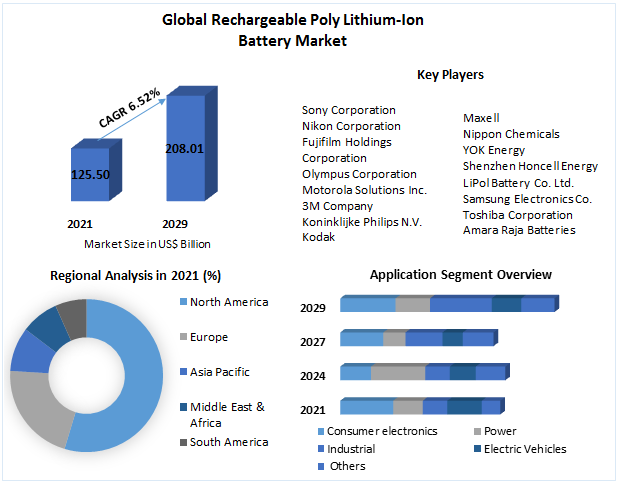 To know about the Research Methodology :- Request Free Sample Report
COVID–19 Influence on Global Rechargeable Poly Lithium-Ion Battery Market:
Owing to the COVID-19 pandemic, many battery production companies were forced to halt operations to comply with new government regulations. This pause in operations has a direct impact on the revenue flow of the rechargeable poly lithium-ion battery market. The COVID-19 supply chain block of raw materials and intermediates influenced manufacturers. The cost of logistics increased during the first few months of the pandemic. Companies were forced to review their industry strategies as a result of the ongoing pandemic. The report provides more information about each region's impact, allowing users to plan their actions and take significant steps toward recovery after an epidemic.
Rechargeable Poly Lithium-Ion Battery Market Dynamics:
Rising need for batteries from the automotive industry
Since the lithium-ion battery is light in weight and provides high-energy density solutions, the market is primarily driven by rising demand for rechargeable poly lithium-ion batteries in both electric vehicles and grid storage. Over the next few years, market growth is expected to be driven by an increase in electric vehicle (EV) registrations and a reduction in lithium-ion battery costs. Also, the global market for rechargeable poly lithium-ion batteries is expected to grow because of the increase in electric vehicle sales and a shift in customer preferences.
The demand for energy-efficient and the environmentally friendly product has shifted the attention to electric vehicles (EV). Hybrid electric vehicles (HEVs), which combine a battery and a combustion engine, have seen massive growth in popularity. EVs' batteries can be hooked into the electric grid or an authorized public charging station for recharge. Since HEVs use both fuel and electricity, the battery can recover energy lost during braking by using the electric motor. Thus, the growing popularity of electric vehicles in the market is expected to drive the demand for poly lithium-ion batteries over the forecast period.
Increasing use of portable electronic goods
Rechargeable Poly Lithium-Ion Battery batteries are found in laptops, hybrid electric vehicles (HEVs), electric cars (EVs), and digital cameras, among other consumer electronics. The battery's compact size and efficiency, when compared to conventional parts, have increased product demand and market adoption. Since lithium metal is naturally unstable when charged, experts have focused their attention on non-lithium ions.
Non-metallic lithium-ion batteries have twice the energy efficiency of cadmium-nickel batteries. The high-energy-density batteries provide outstanding low-temperature, load, and cycle properties. As a result, it quickly became an essential source of power for video and audio equipment, laptop computers, cell phones, and other portable devices. Thus, the increasing use of portable electronic goods is expected to drive the growth of the market over the forecast period.
Zinc-ion battery as an alternative
The major factors limiting the growth of the market are the high cost of the production of the batteries and the ease of availability of different alternatives like Zinc-ion batteries. Zinc-ion batteries are safer than lithium-ion batteries. Lithium has the ability to react violently, especially when combined with other elements, related to the use of a flammable electrolyte. Zinc-ion batteries by itself is not a problem as it uses water-based chemistry that prevents fires from igniting.
Rechargeable Poly Lithium-Ion Battery Market Segment Analysis:
Based on Structure, the global rechargeable poly lithium-ion battery market is segmented into two types are as follows, cylindrical battery, and prismatic battery.
In 2021, the cylindrical battery segment was dominant and held 57.6% of the overall market share. This segment is anticipated to grow at a CAGR of xx% during the forecast period as consumer electronics and electric vehicles are two of the most common uses for this product. The growing demand for consumer electronic devices is also driving the segment further. The growing popularity of consumer electronic devices, such as laptops, has resulted in increased production of the item.
Also, trends like "bring your own device" have increased demand for the product. The design factors have evolved, and demand for laptops and ultra-books exists both in the corporate and in the personal sector, driving the market further. Expansion and growth in disposable income in Asia Pacific's emerging economies are also expected to support the market growth.
The prismatic battery structure, also known as a flat rectangular battery. This segment is expected to grow at a CAGR of 7.1% during the forecast period. The prismatic structure saves space by sheltering a higher-energy lithium polymer, which is found in tablets and ultra-thin notebooks.
Based on Application, the global rechargeable poly lithium-ion battery market is segmented into five types as follows, consumer electronics, power, industrial, electric vehicles, and others.
In 2021, the electric vehicles segment was dominant and held 32.2% of the overall market share. The requirement for ecologically friendly and energy-efficient products has generated demand in electric vehicles that use rechargeable poly lithium-ion batteries. The segment is expected to be driven by rising customer interest in such batteries and rising sales of lithium-ion battery automobiles. For example, in 2021, The Promaster PLI-12B, a lightweight battery with a capacity of 1300 mAh, was launched by Kodak.
Over the projected period, the consumer electronics application segment is expected to grow at a modest rate of xx%. This is related to the high reliability and the durability of batteries used in electronic devices like smartphones and laptops.
Rechargeable Poly Lithium-Ion Battery Market Regional Insights:
In 2021, Asia Pacific was dominant among all the regions accounting for 33% of the overall market share in terms of revenue. It is expected to continue the dominance growing at a CAGR of xx% over the forecast period. This is because of the high level of customer awareness about the importance of maintaining an environmentally friendly atmosphere. The customers in this region can afford the product since they have a lot of valuable cash. Over the forecast period, rising demand for tablets and mobile phones in countries such as India, China, Thailand, and Japan are expected to drive the market growth in this region.
Since of the rising consumer electronics and electric car sales in nations like the United States and Mexico, North America is expected to grow significantly over the forecast period. The market is expected to be driven by the rising demand for batteries in mobile phones thanks to its improved efficiency and longer battery life. Since of their great awareness of the need for energy-efficient batteries, Europe and North America are important regional markets.
The objective of the report is to present a comprehensive analysis of the global rechargeable poly lithium-ion battery market to the stakeholders in the industry. The past and current status of the industry with the forecasted market size and trends are presented in the report with the analysis of complicated data in simple language. The report covers all the aspects of the industry with a dedicated study of key players that include market leaders, followers, and new entrants.
PORTER, PESTEL analysis with the potential impact of micro-economic factors of the market have been presented in the report. External as well as internal factors that are supposed to affect the business positively or negatively have been analyzed, which will give a clear futuristic view of the industry to the decision-makers.
The report also helps in understanding the global Rechargeable Poly Lithium-Ion Battery market dynamics, structure by analyzing the market segments and project the global rechargeable poly lithium-ion battery market size. Clear representation of competitive analysis of key players by product, price, financial position, product portfolio, growth strategies, and regional presence in the global rechargeable poly lithium-ion battery market make the report investor’s guide.
Rechargeable Poly Lithium-Ion Battery Market Scope: Inquire before buying
| Global Rechargeable Poly Lithium-Ion Battery Market | |||
|---|---|---|---|
| Report Coverage | Details | ||
| Base Year: | 2021 | Forecast Period: | 2022-2029 |
| Historical Data: | 2017 to 2021 | Market Size in 2021: | US $ 125.50Bn. |
| Forecast Period 2022 to 2029 CAGR: | 6.52% | Market Size in 2029: | US $ 208.01 Bn. |
| Segments Covered: | by Structure | • Cylindrical battery • Prismatic battery |
|
| by Application | • Consumer electronics • Power • Industrial • Electric Vehicles • Others |
||
Rechargeable Poly Lithium-Ion Battery Market, by Region
• North America (United States, Canada and Mexico)
• Europe (UK, France, Germany, Italy, Spain, Sweden, Austria and Rest of Europe)
• Asia Pacific (China, South Korea, Japan, India, Australia, Indonesia, Malaysia, Vietnam, Taiwan, Bangladesh, Pakistan and Rest of APAC)
• Middle East and Africa (South Africa, GCC, Egypt, Nigeria and Rest of ME&A)
• South America (Brazil, Argentina Rest of South America)
Global Rechargeable Poly Lithium-Ion Battery Market Key Players
• Sony Corporation
• Nikon Corporation
• Fujifilm Holdings Corporation
• Olympus Corporation
• Motorola Solutions Inc.
• 3M Company
• Koninklijke Philips N.V.
• Kodak
• Maxell
• Nippon Chemicals
• YOK Energy
• Shenzhen Honcell Energy Co. Ltd.
• LiPol Battery Co. Ltd.
• Samsung Electronics Co. Ltd.
• Toshiba Corporation
• Amara Raja Batteries
• Exide Industries
• Tata Chemicals Ltd.
• Others
Frequently Asked Questions:
1. What is the forecast period considered for the Rechargeable Poly Lithium-Ion Battery market report?
Ans. The considered forecast period for the Rechargeable Poly Lithium-Ion Battery market is 2022-2029.
2. Which key factors are hindering the growth of the Rechargeable Poly Lithium-Ion Battery market?
Ans. The high production cost of the batteries and ease of availability of its alternatives are the key factors expected to hinder the growth of the rechargeable poly lithium-ion battery market during the forecast period.
3. What is the compound annual growth rate (CAGR) of the Rechargeable Poly Lithium-Ion Battery market for the next 8 years?
Ans. The global Rechargeable Poly Lithium-Ion Battery market is expected to grow at a CAGR of 6.52% during the forecast period (2022-2029).
4. What are the key factors driving the growth of the Rechargeable Poly Lithium-Ion Battery market?
Ans. The increasing demand from the automotive industry for electric vehicles and the increasing use of consumer electronics are the key factors expected to drive the growth of the rechargeable poly lithium-ion battery market during the forecast period.
5. Which are the worldwide major key players covered for the Rechargeable Poly Lithium-Ion Battery market report?
Ans. Sony Corporation, Nikon Corporation, Fujifilm Holdings Corporation, Olympus Corporation, Motorola Solutions Inc., 3M Company, Koninklijke Philips N.V., Kodak, Maxell, Nippon Chemicals, YOK Energy, Shenzhen Honcell Energy Co. Ltd., LiPol Battery Co. Ltd., Samsung Electronics Co. Ltd., Toshiba Corporation, Amara Raja Batteries, Exide Industries, Tata Chemicals Ltd., and Others.