Global Solvents Market by Type, by Application, by Source, by End User and Regional Insights 2034

4.2%
CAGR (2026-2034)
69.46 USD Bn.
Forecast Market Size
303
Report Pages
150
Market Tables

Overview

The Global Solvent was valued at USD 69.46 Billion in 2025 and is projected to reach USD 100.59 Billion by 2034, growing at a CAGR of 4.2% during the forecast period 2026–2034.

Parameter Values
Market Size (2025) USD 69.46 Billion
Market Size (2034) USD 100.59 Billion
CAGR 4.2%
Historical Period 2020 to 2025
Forecast Period 2026 to 2034

Solvents Market Overview

Solvents are liquids that are used to dissolve, blend, clean, extract, or carry other materials during manufacturing and product formulation. The Solvent Market involves solvents used in paints and coatings, adhesives, printing inks, pharmaceuticals, cosmetics, cleaning products, chemicals, and various industrial applications. Solvents are essential to many manufacturing processes, as they help control thickness and consistency, promote blending and mixing, assist with drying, clean surfaces and equipment, and facilitate other operations. The industries that use them are involved in a broad scope of products and processes, and the solvents play an essential role in achieving the desired performance and compatibility. The overall market size for solvents is expanding as manufacturing activity rises across the globe, and the product is present in a diverse range of consumer goods and industrial applications.

The market considers demand for better, less toxic, and lower-emission products with enhanced quality and performance. Thus, the consumption of low-VOC, bio-based, and high-purity solvents is rising, but petrochemical-based products retain a significant presence. The market has several key participants, including paint and coatings, pharmaceuticals, chemical manufacturing, automotive, construction, electronics, and cleaning products. The main growth drivers are emerging trends in the use of green solvents and products with specific applications, and the market gap lies in the ability to provide products with proven performance at an affordable price. The overall opportunity is to address the demand for green solvents and capitalize on the gap between the established quality of traditional products and the need for environmentally friendly alternatives.

Asia Pacific is the leading region due to it’s extensive manufacturing base, large-scale chemical production, and growing construction and automotive industries. The demand for solvents is also supported by the expanding pharmaceutical sector and consumer-product industries. North America and Europe are also prominent regions with significant solvent manufacturing activity and large-scale industrial applications. The key producers of solvents in the market include BASF, Dow, Shell, ExxonMobil, Eastman Chemical, Lyondell Basell, and INEOS. MMR’s research indicates that the market growth will be driven by the demand for the product in industrial applications, including coatings and chemicals. The market research also supports the rising consumption of specialized solvents and those that are safe for the environment, with the key opportunity lying in the capacity to address the gap and achieve sustainable growth.

Global Solvents Market Growth and Share Analysis
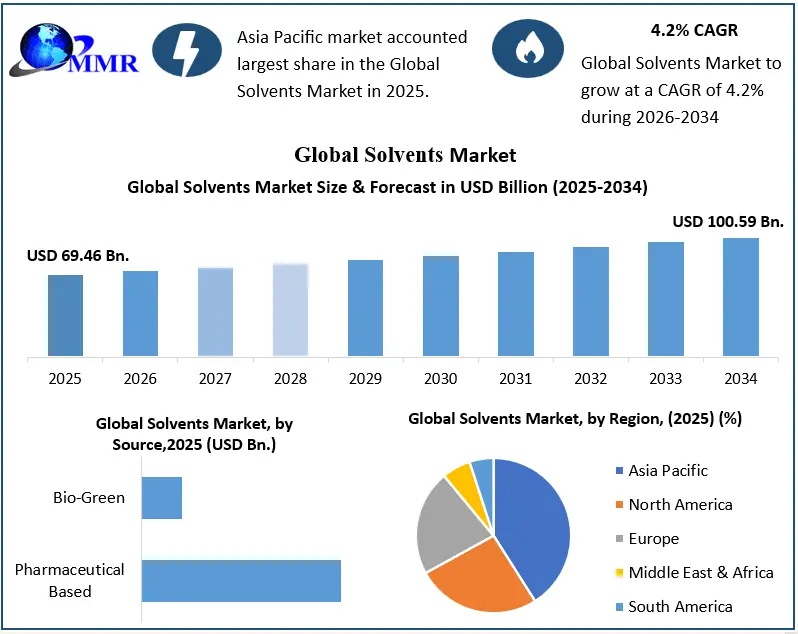
Solvents Market Growth

To know about the Research Methodology :- Request Free Sample Report

Solvents Market Dynamic

Driver - Rising Industrial Demand Supports Market Growth

Solvents are used in paints, coatings, pharmaceuticals, adhesives, cleaning products and chemical processing. Increased construction, automotive, packaging, healthcare and manufacturing activities drive the demand for solvents and contribute to market growth. Additionally, rising industrial expenditure in emerging economies also boosts the overall demand for solvents. As solvents have diverse applications, suppliers have extensive customer base and can capture significant market share.

Restraint - Environmental and Health Concerns Limit Conventional Solvents

Use of traditional solvents emits volatile organic compounds and requires stringent measures during handling, storage and disposal. Such regulations increase the expenditure incurred by manufacturers on emissions control and occupational safety. Additionally, the replacement of certain traditional solvents with water-based and low emission solvents in some industries reduces the demand for traditional solvents. Such factors hamper the market growth and suppress the market share of manufacturers.

Opportunity - Bio-Based Solvents Create New Market Potential

The rising demand for bio-based, low volatile organic compound emitting and specialty solvents presents market opportunities for key manufacturers. The pharmaceuticals, electronics, coatings and personal care industries demand high-performance products with reduced environmental impact. There is a large gap between the performance offered by traditional solvents and the performance demanded by the industry. It will be possible for manufacturers to address this performance gap and increase their market potential.

Challenge - Cost and Performance Balance Remains Difficult

Varying industry requirements of purity levels, rate of evaporation, solvent strength and chemical compatibility pose challenges to manufacturers. The need to develop products with specific attributes requires extensive research and development activities as well as high expenditure on production. At the same time, manufacturers are required to offer products at competitive rates to maintain high sales volumes. Fluctuating raw material and energy prices further challenge the ability of manufacturers to remain consistent with respect to quality and cost. Such issues are likely to reduce the market share of manufacturers that are unable to manage these factors efficiently.

Global Solvents Market Trends

Trend What is Changing
Bio-Based Solvents Shift toward renewable raw materials
Low-VOC Solvents Lower-emission formulations gain demand
High-Purity Solvents More use in pharma and electronics
Solvent Recovery Reuse and recycling increase
Specialty Solvents Application-specific products expand
Water-Based Systems Conventional solvent use declines in some applications
Green Chemistry Safer formulations gain importance
Circular Manufacturing Closed-loop production models expand
Sustainable Production Lower-carbon manufacturing increases
Regulatory Reformulation Companies modify products to meet stricter rules

Solvents Market Segment Analysis

By Application, This market is categorized into Paints and Coatings, Adhesives, Cleaning Agents, Solvent Markets, and Cosmetics. Paints and Coatings use solvents to modify coatings’ consistency, ensure even application, and enable proper drying in construction, automotive, and industrial applications. Adhesives use solvents for bonding, and applications require proper adhesion and performance. Cleaning Agents rely on solvents for degreasing and removing unwanted substances and contaminants from industrial and domestic surfaces. Furthermore, Solvent Markets cover a broad range of chemical and process uses that require dissolving, blending, and carrying of materials. Cosmetics use select solvents in the production of perfumes, creams, and other personal care products. These applications contribute to the overall market size and demand, and the industry’s growth will create new opportunities for manufacturers to innovate and introduce products with desirable properties for automotive, construction, and industrial applications.
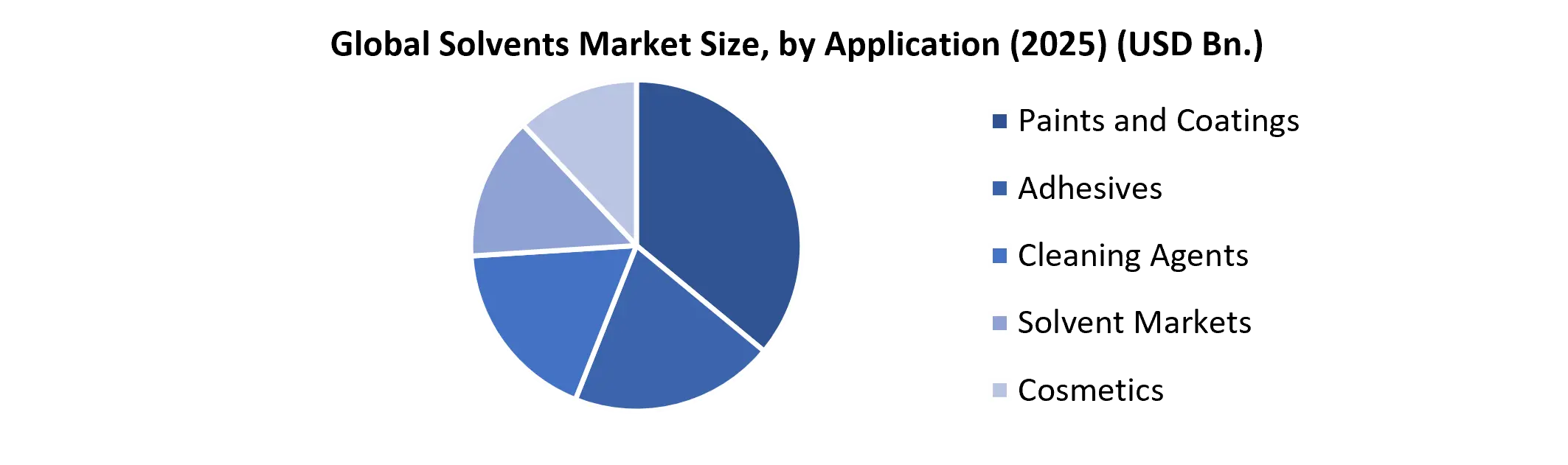
Solvents Market Size by Application
By End User, The Solvents Market is classified into Automotive, Construction, Electronics, Food and Beverage, and Textiles. Automotive uses solvents in process applications such as coating, cleaning, and maintenance products. Similarly, Construction relies on solvents for applications such as paints, adhesives, and sealants. Electronics require solvents across various applications, including cleaning, precision manufacturing, and other process applications. Furthermore, Food and Beverage depend on solvents for cleaning processes, extractions, and other manufacturing applications. Textiles use solvents in dyes, finishing products, and processing. Overall, these applications impact the overall market size. Notably, the industry gap for environmentally friendly products will motivate the growth of this market segment and create opportunities for manufacturers to invest in research to develop and introduce new products with enhanced specifications.
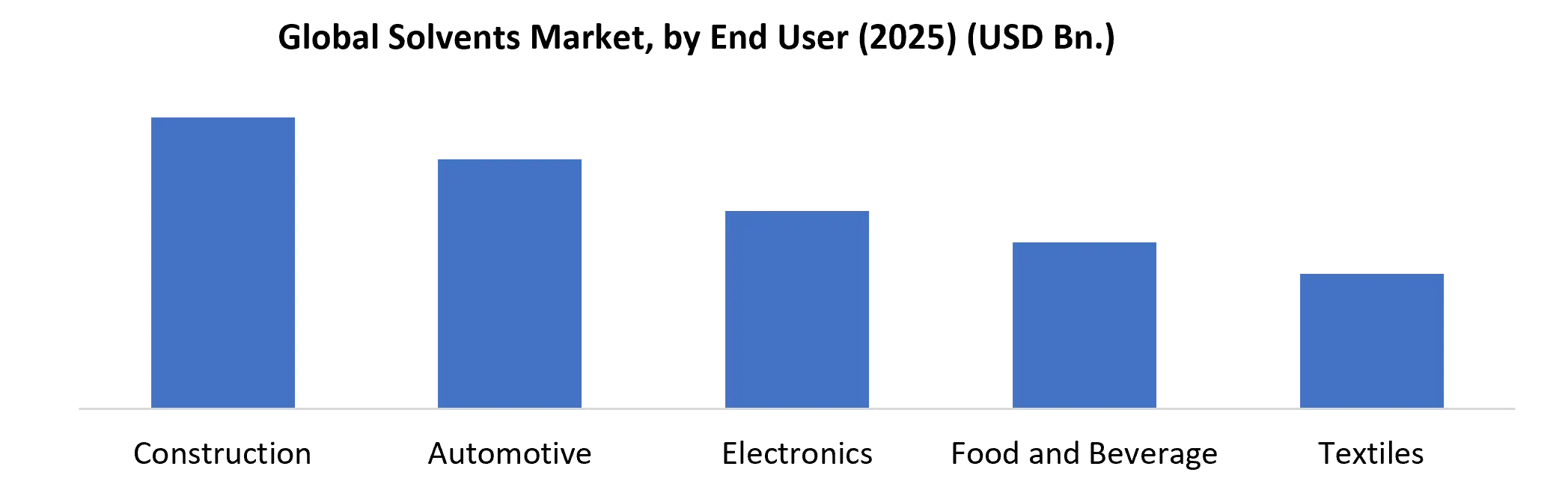
Solvents Market By End User

Solvents Market Regional Analysis

Asia Pacific is a leading Region for this industry because of the region’s extensive manufacturing activities, construction, automotive, electronics, and textiles industries. Key countries in this region include China, India, Japan, South Korea, and others.

North America has a high demand for solvents in the automotive, construction, electronics, food processing, and other manufacturing activities. Additionally, the region has a large market for high-purity solvents, including industrial/chemical-grade, electronic-grade, and laboratory-grade products.

Europe has a high demand for solvents in the automotive and construction industries and the cosmetics manufacturing sector. Moreover, the market gap for low-toxicity and environmentally friendly products and processes will motivate the growth of the segment and create opportunities for manufacturers to invest in research and develop products with improved specifications.

South America is a growing market for solvents as the region experiences an increase in construction, automotive, textile activities, and food processing activities. Key countries in this region are Brazil, Argentina, and others.
The Middle East & Africa region is witnessing an upsurge in construction, manufacturing, automotive maintenance and repair, and other commercial activities. This growth will stimulate demand for solvents in this region, mainly for cleaning applications. Although there is no significant local production of specialty solvents, the market gap creates opportunities for manufacturers to invest in the research and development of products with improved specifications.

Global Solvents Market Competitive Landscape

The Global Solvents Market’s competitive landscape is dominated by the leading companies, including BASF, Dow, Shell, ExxonMobil, Eastman Chemical, LyondellBasell and INEOS, which compete on the quality of products, price, production volumes and supply networks. The overall market size is increasing due to the rising demand for solvents in paints and coatings, adhesives, cleaning agents, automotive, electronics and other industries. In addition, the companies focus on producing high purity, low VOC and bio-based solvents and address the customers’ evolving needs and sustainability goals.

The market’s growth forecast through 2029 implies that the competition will be primarily based on the provision of clean technology, sustainable and specialty products and those tailored to specific applications. It makes the gap between the established chemical producers and those offering a safer, more cost-effective and environmentally friendly product profile significant. The emerging demand for new solvent products and technologies in developing countries can benefit the companies that offer a wide range of products, have an extensive distribution network, provide good technical support and have localized production. Moreover, the market will grow as a result of increased demand for sophisticated products in developing countries.

Global Solvents Market Recent Development

Date Recent Development
September-2026 BASF announced product price changes for selected Trilon chelating agents in North America due to the evolving chemical supply-demand dynamics.
July-2026 The company also stated that it will invest €200 million in expanding the production of oxygenated solvents by 80,000 metric tons per annum at its Ludwigshafen site through closed-loop solvent recovery technologies.
April-2026 Shrieve Chemical Company bought Vertex Bio Solvents, a manufacturer of patented solvent blends derived from bio-based sources, to augment its sustainable and bio-based solvents business
March-2026 BASF launched reduced product carbon footprint (rPCF) grades of butanediol (BDO), tetrahydrofuran (THF), polytetrahydrofuran (PolyTHF®), and N-methyl pyrrolidone (NMP) at its Ludwigshafen Verbund site.
March-2026 ExxonMobil announced a hike in the price of its hydrocarbon solvents by up to $0.06 per pound and unveiled its plan to increase the production capacity of high-performance industrial solvents to address coatings, adhesives, and specialty chemical end-users’ rising demand for its products.

Solvents Market Scope: Inquire before buying

Solvents Market
Report Coverage Details
Base Year: 2025 Forecast Period: 2026-2034
Historical Data: 2020 to 2025 Market Size in 2025: 69.46 USD Billion
Forecast Period 2026-2034 CAGR: 4.2% Market Size in 2034: 100.59 USD Billion
Segments Covered: by Type Alcohols
Glycol Ethers
Aromatic
Esters
Ketones
Aliphatic
by Application Paints and Coatings
Adhesives
Cleaning Agents
Solvent Markets
Cosmetics
by Source Pharmaceutical Based
Bio-Green
by End User Automotive
Construction
Electronics
Food and Beverage
Textiles

Solvents Market, by Region

North America (United States, Canada and Mexico)
Europe (UK, France, Germany, Italy, Spain, Sweden, Austria and Rest of Europe)
Asia Pacific (China, South Korea, Japan, India, Australia, Indonesia, Malaysia, Vietnam, Taiwan, Bangladesh, Pakistan and Rest of APAC)
Middle East and Africa (South Africa, GCC, Egypt, Nigeria and Rest of ME&A)
South America (Brazil, Argentina Rest of South America)

Solvents Market, Key Players

1. BASF SE
2. Dow Inc.
3. Exxon Mobil Corporation
4. Shell plc
5. LyondellBasell Industries N.V.
6. Eastman Chemical Company
7. INEOS Group
8. SABIC
9. Huntsman Corporation
10. Honeywell International Inc.
11. Celanese Corporation
12. Ashland Inc.
13. Arkema S.A.
14. Solvay S.A.
15. Mitsubishi Chemical Group Corporation
16. Sumitomo Chemical Co., Ltd.
17. LG Chem Ltd.
18. Formosa Plastics Corporation
19. Sasol Limited
20. TotalEnergies SE
21. Chevron Phillips Chemical Company LLC
22. Clariant AG
23. Idemitsu Kosan Co., Ltd.
24. Braskem S.A.
25. Cargill, Incorporated
26. Archer Daniels Midland Company (ADM)
27. Bharat Petroleum Corporation Limited
28. BP p.l.c.
29. OQ Chemicals
30. Gandhar Oil Refinery (India) Limited
31. GROUPE BERKEM
32. Reliance Industries Limited
33. China Petroleum & Chemical Corporation (Sinopec)
34. China National Petroleum Corporation (CNPC)
35. PetroChina Company Limited
36. SK geo centric Co., Ltd.
37. PTT Global Chemical Public Company Limited
38. Petronas Chemicals Group Berhad
39. LG International / LX International
40. Monument Chemical
41. KH Neochem Co., Ltd.
42. Lotte Chemical Corporation
43. Maruzen Petrochemical Co., Ltd.
44. Recochem Inc.
45. Greenfield Global Inc.

Frequently Asked Questions

1. Which region has the largest share in Global Solvents Market?
Ans: Asia Pacific region holds the highest share in 2025.

2. What was the Global Solvents Market size in 2025?
Ans: The Global Solvents Market size was USD 69.46 Billion in 2025.

3. What segments covered in Global Solvents market?
Ans: Solvents Market is segmented such as Type, Application, Source and Region.

4. Who are the key players in Global Solvents market?
Ans: The important key players in the Solvents Market are – Royal Dutch Shell, Eastman Chemical Company, BASF SE, ExxonMobil Corporation, Ashland Global Holdings, Celanese Corporation, Huntsman Corporation, Solvay, Honeywell International, Ineos Group, Sasol Solvents, Dow Chemicals, Chr Hansen Holding A/S, Ajinomoto, Indene Spa, Martin Bauer Group, Frutarom Ltd.

5. What is the study period of this market?
Ans: The Global Solvents Market is studied from 2020 to 2034.

Table of Contents

1. Solvents Market Introduction 1.1. Study Assumption and Market Definition 1.2. Scope of the Study 1.3. Executive Summary 2. Global Solvents Market: Competitive Landscape 2.1. MMR Competition Matrix 2.2. Competitive Landscape 2.3. Key Players Benchmarking 2.3.1. Company Name 2.3.2. Business Segment 2.3.3. End-user Segment 2.3.4. Revenue (2025) 2.3.5. Company Locations 2.4. Leading Solvents Market Companies, by market capitalization 2.5. Market Structure 2.5.1. Market Leaders 2.5.2. Market Followers 2.5.3. Emerging Players 2.6. Mergers and Acquisitions Details 3. Solvents Market: Dynamics 3.1. Solvents Market Trends by Region 3.1.1. North America Solvents Market Trends 3.1.2. Europe Solvents Market Trends 3.1.3. Asia Pacific Solvents Market Trends 3.1.4. Middle East and Africa Solvents Market Trends 3.1.5. South America Solvents Market Trends 3.2. Solvents Market Dynamics by Region 3.2.1. North America 3.2.1.1. North America Solvents Market Drivers 3.2.1.2. North America Solvents Market Restraints 3.2.1.3. North America Solvents Market Opportunities 3.2.1.4. North America Solvents Market Challenges 3.2.2. Europe 3.2.2.1. Europe Solvents Market Drivers 3.2.2.2. Europe Solvents Market Restraints 3.2.2.3. Europe Solvents Market Opportunities 3.2.2.4. Europe Solvents Market Challenges 3.2.3. Asia Pacific 3.2.3.1. Asia Pacific Solvents Market Drivers 3.2.3.2. Asia Pacific Solvents Market Restraints 3.2.3.3. Asia Pacific Solvents Market Opportunities 3.2.3.4. Asia Pacific Solvents Market Challenges 3.2.4. Middle East and Africa 3.2.4.1. Middle East and Africa Solvents Market Drivers 3.2.4.2. Middle East and Africa Solvents Market Restraints 3.2.4.3. Middle East and Africa Solvents Market Opportunities 3.2.4.4. Middle East and Africa Solvents Market Challenges 3.2.5. South America 3.2.5.1. South America Solvents Market Drivers 3.2.5.2. South America Solvents Market Restraints 3.2.5.3. South America Solvents Market Opportunities 3.2.5.4. South America Solvents Market Challenges 3.3. PORTER's Five Forces Analysis 3.4. PESTLE Analysis 3.5. Technology Roadmap 3.6. Regulatory Landscape by Region 3.6.1. North America 3.6.2. Europe 3.6.3. Asia Pacific 3.6.4. Middle East and Africa 3.6.5. South America 3.7. Key Opinion Leader Analysis For Solvents Industry 3.8. Analysis of Government Schemes and Initiatives For Solvents Industry 3.9. Solvents Market Trade Analysis 3.10. The Global Pandemic Impact on Solvents Market 4. Solvents Market: Global Market Size and Forecast by Segmentation (in USD Billion) 2025-2034 4.1. Solvents Market Size and Forecast, by Type (2025-2034) 4.1.1. Alcohols 4.1.2. Glycol Ethers 4.1.3. Aromatic 4.1.4. Esters 4.1.5. Ketones 4.1.6. Aliphatic 4.2. Solvents Market Size and Forecast, by Application (2025-2034) 4.2.1. Paints and Coatings 4.2.2. Adhesives 4.2.3. Cleaning Agents 4.2.4. Solvent Markets 4.2.5. Cosmetics 4.3. Solvents Market Size and Forecast, by Source (2025-2034) 4.3.1. Pharmaceutical Based 4.3.2. Bio-Green 4.4. Solvents Market Size and Forecast, by End User (2025-2034) 4.4.1. Automotive 4.4.2. Construction 4.4.3. Electronics 4.4.4. Food and Beverage 4.4.5. Textiles 4.5. Solvents Market Size and Forecast, by Region (2025-2034) 4.5.1. North America 4.5.2. Europe 4.5.3. Asia Pacific 4.5.4. Middle East and Africa 4.5.5. South America 5. North America Solvents Market Size and Forecast by Segmentation (in USD Billion) 2025-2034 5.1. North America Solvents Market Size and Forecast, by Type (2025-2034) 5.1.1. Alcohols 5.1.2. Glycol Ethers 5.1.3. Aromatic 5.1.4. Esters 5.1.5. Ketones 5.1.6. Aliphatic 5.2. North America Solvents Market Size and Forecast, by Application (2025-2034) 5.2.1. Paints and Coatings 5.2.2. Adhesives 5.2.3. Cleaning Agents 5.2.4. Solvent Markets 5.2.5. Cosmetics 5.3. North America Solvents Market Size and Forecast, by Source (2025-2034) 5.3.1. Pharmaceutical Based 5.3.2. Bio-Green 5.4. North America Solvents Market Size and Forecast, by End User (2025-2034) 5.4.1. Automotive 5.4.2. Construction 5.4.3. Electronics 5.4.4. Food and Beverage 5.4.5. Textiles 5.5. North America Solvents Market Size and Forecast, by Country (2025-2034) 5.5.1. United States 5.5.1.1. United States Solvents Market Size and Forecast, by Type (2025-2034) 5.5.1.1.1. Alcohols 5.5.1.1.2. Glycol Ethers 5.5.1.1.3. Aromatic 5.5.1.1.4. Esters 5.5.1.1.5. Ketones 5.5.1.1.6. Aliphatic 5.5.1.2. United States Solvents Market Size and Forecast, by Application (2025-2034) 5.5.1.2.1. Paints and Coatings 5.5.1.2.2. Adhesives 5.5.1.2.3. Cleaning Agents 5.5.1.2.4. Solvent Markets 5.5.1.2.5. Cosmetics 5.5.1.3. United States Solvents Market Size and Forecast, by Source (2025-2034) 5.5.1.3.1. Pharmaceutical Based 5.5.1.3.2. Bio-Green 5.5.1.4. United States Solvents Market Size and Forecast, by End User (2025-2034) 5.5.1.4.1. Automotive 5.5.1.4.2. Construction 5.5.1.4.3. Electronics 5.5.1.4.4. Food and Beverage 5.5.1.4.5. Textiles 5.5.2. Canada 5.5.2.1. Canada Solvents Market Size and Forecast, by Type (2025-2034) 5.5.2.1.1. Alcohols 5.5.2.1.2. Glycol Ethers 5.5.2.1.3. Aromatic 5.5.2.1.4. Esters 5.5.2.1.5. Ketones 5.5.2.1.6. Aliphatic 5.5.2.2. Canada Solvents Market Size and Forecast, by Application (2025-2034) 5.5.2.2.1. Paints and Coatings 5.5.2.2.2. Adhesives 5.5.2.2.3. Cleaning Agents 5.5.2.2.4. Solvent Markets 5.5.2.2.5. Cosmetics 5.5.2.3. Canada Solvents Market Size and Forecast, by Source (2025-2034) 5.5.2.3.1. Pharmaceutical Based 5.5.2.3.2. Bio-Green 5.5.2.4. Canada Solvents Market Size and Forecast, by End User (2025-2034) 5.5.2.4.1. Automotive 5.5.2.4.2. Construction 5.5.2.4.3. Electronics 5.5.2.4.4. Food and Beverage 5.5.2.4.5. Textiles 5.5.3. Mexico 5.5.3.1. Mexico Solvents Market Size and Forecast, by Type (2025-2034) 5.5.3.1.1. Alcohols 5.5.3.1.2. Glycol Ethers 5.5.3.1.3. Aromatic 5.5.3.1.4. Esters 5.5.3.1.5. Ketones 5.5.3.1.6. Aliphatic 5.5.3.2. Mexico Solvents Market Size and Forecast, by Application (2025-2034) 5.5.3.2.1. Paints and Coatings 5.5.3.2.2. Adhesives 5.5.3.2.3. Cleaning Agents 5.5.3.2.4. Solvent Markets 5.5.3.2.5. Cosmetics 5.5.3.3. Mexico Solvents Market Size and Forecast, by Source (2025-2034) 5.5.3.3.1. Pharmaceutical Based 5.5.3.3.2. Bio-Green 5.5.3.4. Mexico Solvents Market Size and Forecast, by End User (2025-2034) 5.5.3.4.1. Automotive 5.5.3.4.2. Construction 5.5.3.4.3. Electronics 5.5.3.4.4. Food and Beverage 5.5.3.4.5. Textiles 6. Europe Solvents Market Size and Forecast by Segmentation (in USD Billion) 2025-2034 6.1. Europe Solvents Market Size and Forecast, by Type (2025-2034) 6.2. Europe Solvents Market Size and Forecast, by Application (2025-2034) 6.3. Europe Solvents Market Size and Forecast, by Source (2025-2034) 6.4. Europe Solvents Market Size and Forecast, by End User (2025-2034) 6.5. Europe Solvents Market Size and Forecast, by Country (2025-2034) 6.5.1. United Kingdom 6.5.1.1. United Kingdom Solvents Market Size and Forecast, by Type (2025-2034) 6.5.1.2. United Kingdom Solvents Market Size and Forecast, by Application (2025-2034) 6.5.1.3. United Kingdom Solvents Market Size and Forecast, by Source (2025-2034) 6.5.1.4. United Kingdom Solvents Market Size and Forecast, by End User (2025-2034) 6.5.2. France 6.5.2.1. France Solvents Market Size and Forecast, by Type (2025-2034) 6.5.2.2. France Solvents Market Size and Forecast, by Application (2025-2034) 6.5.2.3. France Solvents Market Size and Forecast, by Source (2025-2034) 6.5.2.4. France Solvents Market Size and Forecast, by End User (2025-2034) 6.5.3. Germany 6.5.3.1. Germany Solvents Market Size and Forecast, by Type (2025-2034) 6.5.3.2. Germany Solvents Market Size and Forecast, by Application (2025-2034) 6.5.3.3. Germany Solvents Market Size and Forecast, by Source (2025-2034) 6.5.3.4. Germany Solvents Market Size and Forecast, by End User (2025-2034) 6.5.4. Italy 6.5.4.1. Italy Solvents Market Size and Forecast, by Type (2025-2034) 6.5.4.2. Italy Solvents Market Size and Forecast, by Application (2025-2034) 6.5.4.3. Italy Solvents Market Size and Forecast, by Source (2025-2034) 6.5.4.4. Italy Solvents Market Size and Forecast, by End User (2025-2034) 6.5.5. Spain 6.5.5.1. Spain Solvents Market Size and Forecast, by Type (2025-2034) 6.5.5.2. Spain Solvents Market Size and Forecast, by Application (2025-2034) 6.5.5.3. Spain Solvents Market Size and Forecast, by Source (2025-2034) 6.5.5.4. Spain Solvents Market Size and Forecast, by End User (2025-2034) 6.5.6. Sweden 6.5.6.1. Sweden Solvents Market Size and Forecast, by Type (2025-2034) 6.5.6.2. Sweden Solvents Market Size and Forecast, by Application (2025-2034) 6.5.6.3. Sweden Solvents Market Size and Forecast, by Source (2025-2034) 6.5.6.4. Sweden Solvents Market Size and Forecast, by End User (2025-2034) 6.5.7. Austria 6.5.7.1. Austria Solvents Market Size and Forecast, by Type (2025-2034) 6.5.7.2. Austria Solvents Market Size and Forecast, by Application (2025-2034) 6.5.7.3. Austria Solvents Market Size and Forecast, by Source (2025-2034) 6.5.7.4. Austria Solvents Market Size and Forecast, by End User (2025-2034) 6.5.8. Rest of Europe 6.5.8.1. Rest of Europe Solvents Market Size and Forecast, by Type (2025-2034) 6.5.8.2. Rest of Europe Solvents Market Size and Forecast, by Application (2025-2034) 6.5.8.3. Rest of Europe Solvents Market Size and Forecast, by Source (2025-2034) 6.5.8.4. Rest of Europe Solvents Market Size and Forecast, by End User (2025-2034) 7. Asia Pacific Solvents Market Size and Forecast by Segmentation (in USD Billion) 2025-2034 7.1. Asia Pacific Solvents Market Size and Forecast, by Type (2025-2034) 7.2. Asia Pacific Solvents Market Size and Forecast, by Application (2025-2034) 7.3. Asia Pacific Solvents Market Size and Forecast, by Source (2025-2034) 7.4. Asia Pacific Solvents Market Size and Forecast, by End User (2025-2034) 7.5. Asia Pacific Solvents Market Size and Forecast, by Country (2025-2034) 7.5.1. China 7.5.1.1. China Solvents Market Size and Forecast, by Type (2025-2034) 7.5.1.2. China Solvents Market Size and Forecast, by Application (2025-2034) 7.5.1.3. China Solvents Market Size and Forecast, by Source (2025-2034) 7.5.1.4. China Solvents Market Size and Forecast, by End User (2025-2034) 7.5.2. S Korea 7.5.2.1. S Korea Solvents Market Size and Forecast, by Type (2025-2034) 7.5.2.2. S Korea Solvents Market Size and Forecast, by Application (2025-2034) 7.5.2.3. S Korea Solvents Market Size and Forecast, by Source (2025-2034) 7.5.2.4. S Korea Solvents Market Size and Forecast, by End User (2025-2034) 7.5.3. Japan 7.5.3.1. Japan Solvents Market Size and Forecast, by Type (2025-2034) 7.5.3.2. Japan Solvents Market Size and Forecast, by Application (2025-2034) 7.5.3.3. Japan Solvents Market Size and Forecast, by Source (2025-2034) 7.5.3.4. Japan Solvents Market Size and Forecast, by End User (2025-2034) 7.5.4. India 7.5.4.1. India Solvents Market Size and Forecast, by Type (2025-2034) 7.5.4.2. India Solvents Market Size and Forecast, by Application (2025-2034) 7.5.4.3. India Solvents Market Size and Forecast, by Source (2025-2034) 7.5.4.4. India Solvents Market Size and Forecast, by End User (2025-2034) 7.5.5. Australia 7.5.5.1. Australia Solvents Market Size and Forecast, by Type (2025-2034) 7.5.5.2. Australia Solvents Market Size and Forecast, by Application (2025-2034) 7.5.5.3. Australia Solvents Market Size and Forecast, by Source (2025-2034) 7.5.5.4. Australia Solvents Market Size and Forecast, by End User (2025-2034) 7.5.6. Indonesia 7.5.6.1. Indonesia Solvents Market Size and Forecast, by Type (2025-2034) 7.5.6.2. Indonesia Solvents Market Size and Forecast, by Application (2025-2034) 7.5.6.3. Indonesia Solvents Market Size and Forecast, by Source (2025-2034) 7.5.6.4. Indonesia Solvents Market Size and Forecast, by End User (2025-2034) 7.5.7. Malaysia 7.5.7.1. Malaysia Solvents Market Size and Forecast, by Type (2025-2034) 7.5.7.2. Malaysia Solvents Market Size and Forecast, by Application (2025-2034) 7.5.7.3. Malaysia Solvents Market Size and Forecast, by Source (2025-2034) 7.5.7.4. Malaysia Solvents Market Size and Forecast, by End User (2025-2034) 7.5.8. Vietnam 7.5.8.1. Vietnam Solvents Market Size and Forecast, by Type (2025-2034) 7.5.8.2. Vietnam Solvents Market Size and Forecast, by Application (2025-2034) 7.5.8.3. Vietnam Solvents Market Size and Forecast, by Source (2025-2034) 7.5.8.4. Vietnam Solvents Market Size and Forecast, by End User (2025-2034) 7.5.9. Taiwan 7.5.9.1. Taiwan Solvents Market Size and Forecast, by Type (2025-2034) 7.5.9.2. Taiwan Solvents Market Size and Forecast, by Application (2025-2034) 7.5.9.3. Taiwan Solvents Market Size and Forecast, by Source (2025-2034) 7.5.9.4. Taiwan Solvents Market Size and Forecast, by End User (2025-2034) 7.5.10. Rest of Asia Pacific 7.5.10.1. Rest of Asia Pacific Solvents Market Size and Forecast, by Type (2025-2034) 7.5.10.2. Rest of Asia Pacific Solvents Market Size and Forecast, by Application (2025-2034) 7.5.10.3. Rest of Asia Pacific Solvents Market Size and Forecast, by Source (2025-2034) 7.5.10.4. Rest of Asia Pacific Solvents Market Size and Forecast, by End User (2025-2034) 8. Middle East and Africa Solvents Market Size and Forecast by Segmentation (in USD Billion) 2025-2034 8.1. Middle East and Africa Solvents Market Size and Forecast, by Type (2025-2034) 8.2. Middle East and Africa Solvents Market Size and Forecast, by Application (2025-2034) 8.3. Middle East and Africa Solvents Market Size and Forecast, by Source (2025-2034) 8.4. Middle East and Africa Solvents Market Size and Forecast, by End User (2025-2034) 8.5. Middle East and Africa Solvents Market Size and Forecast, by Country (2025-2034) 8.5.1. South Africa 8.5.1.1. South Africa Solvents Market Size and Forecast, by Type (2025-2034) 8.5.1.2. South Africa Solvents Market Size and Forecast, by Application (2025-2034) 8.5.1.3. South Africa Solvents Market Size and Forecast, by Source (2025-2034) 8.5.1.4. South Africa Solvents Market Size and Forecast, by End User (2025-2034) 8.5.2. GCC 8.5.2.1. GCC Solvents Market Size and Forecast, by Type (2025-2034) 8.5.2.2. GCC Solvents Market Size and Forecast, by Application (2025-2034) 8.5.2.3. GCC Solvents Market Size and Forecast, by Source (2025-2034) 8.5.2.4. GCC Solvents Market Size and Forecast, by End User (2025-2034) 8.5.3. Nigeria 8.5.3.1. Nigeria Solvents Market Size and Forecast, by Type (2025-2034) 8.5.3.2. Nigeria Solvents Market Size and Forecast, by Application (2025-2034) 8.5.3.3. Nigeria Solvents Market Size and Forecast, by Source (2025-2034) 8.5.3.4. Nigeria Solvents Market Size and Forecast, by End User (2025-2034) 8.5.4. Rest of ME&A 8.5.4.1. Rest of ME&A Solvents Market Size and Forecast, by Type (2025-2034) 8.5.4.2. Rest of ME&A Solvents Market Size and Forecast, by Application (2025-2034) 8.5.4.3. Rest of ME&A Solvents Market Size and Forecast, by Source (2025-2034) 8.5.4.4. Rest of ME&A Solvents Market Size and Forecast, by End User (2025-2034) 9. South America Solvents Market Size and Forecast by Segmentation (in USD Billion) 2025-2034 9.1. South America Solvents Market Size and Forecast, by Type (2025-2034) 9.2. South America Solvents Market Size and Forecast, by Application (2025-2034) 9.3. South America Solvents Market Size and Forecast, by Source (2025-2034) 9.4. South America Solvents Market Size and Forecast, by End User (2025-2034) 9.5. South America Solvents Market Size and Forecast, by Country (2025-2034) 9.5.1. Brazil 9.5.1.1. Brazil Solvents Market Size and Forecast, by Type (2025-2034) 9.5.1.2. Brazil Solvents Market Size and Forecast, by Application (2025-2034) 9.5.1.3. Brazil Solvents Market Size and Forecast, by Source (2025-2034) 9.5.1.4. Brazil Solvents Market Size and Forecast, by End User (2025-2034) 9.5.2. Argentina 9.5.2.1. Argentina Solvents Market Size and Forecast, by Type (2025-2034) 9.5.2.2. Argentina Solvents Market Size and Forecast, by Application (2025-2034) 9.5.2.3. Argentina Solvents Market Size and Forecast, by Source (2025-2034) 9.5.2.4. Argentina Solvents Market Size and Forecast, by End User (2025-2034) 9.5.3. Rest Of South America 9.5.3.1. Rest Of South America Solvents Market Size and Forecast, by Type (2025-2034) 9.5.3.2. Rest Of South America Solvents Market Size and Forecast, by Application (2025-2034) 9.5.3.3. Rest Of South America Solvents Market Size and Forecast, by Source (2025-2034) 9.5.3.4. Rest Of South America Solvents Market Size and Forecast, by End User (2025-2034) 10. Company Profile: Key Players 10.1. BASF SE 10.1.1. Company Overview 10.1.2. Business Portfolio 10.1.3. Financial Overview 10.1.4. SWOT Analysis 10.1.5. Strategic Analysis 10.1.6. Scale of Operation (small, medium, and large) 10.1.7. Details on Partnership 10.1.8. Regulatory Accreditations and Certifications Received by Them 10.1.9. Awards Received by the Firm 10.1.10. Recent Developments 10.2. Dow Inc. 10.3. Exxon Mobil Corporation 10.4. Shell plc 10.5. LyondellBasell Industries N.V. 10.6. Eastman Chemical Company 10.7. INEOS Group 10.8. SABIC 10.9. Huntsman Corporation 10.10. Honeywell International Inc. 10.11. Celanese Corporation 10.12. Ashland Inc. 10.13. Arkema S.A. 10.14. Solvay S.A. 10.15. Mitsubishi Chemical Group Corporation 10.16. Sumitomo Chemical Co., Ltd. 10.17. LG Chem Ltd. 10.18. Formosa Plastics Corporation 10.19. Sasol Limited 10.20. TotalEnergies SE 10.21. Chevron Phillips Chemical Company LLC 10.22. Clariant AG 10.23. Idemitsu Kosan Co., Ltd. 10.24. Braskem S.A. 10.25. Cargill, Incorporated 10.26. Archer Daniels Midland Company (ADM) 10.27. Bharat Petroleum Corporation Limited 10.28. BP p.l.c. 10.29. OQ Chemicals 10.30. Gandhar Oil Refinery (India) Limited 10.31. GROUPE BERKEM 10.32. Reliance Industries Limited 10.33. China Petroleum & Chemical Corporation (Sinopec) 10.34. China National Petroleum Corporation (CNPC) 10.35. PetroChina Company Limited 10.36. SK geo centric Co., Ltd. 10.37. PTT Global Chemical Public Company Limited 10.38. Petronas Chemicals Group Berhad 10.39. LG International / LX International 10.40. Monument Chemical 11. Key Findings 12. Industry Recommendations 13. Solvents Market: Research Methodology 14. Terms and Glossary

Custom Market Research Services

We Will Customise The Research For You, In Case The Report Listed Above Does Not Meet With Your Requirements