
Global Rapid Liquid Printing Market by Offering-wise, Application, Industry, by Material Type, Region and Forecast 2034
Overview
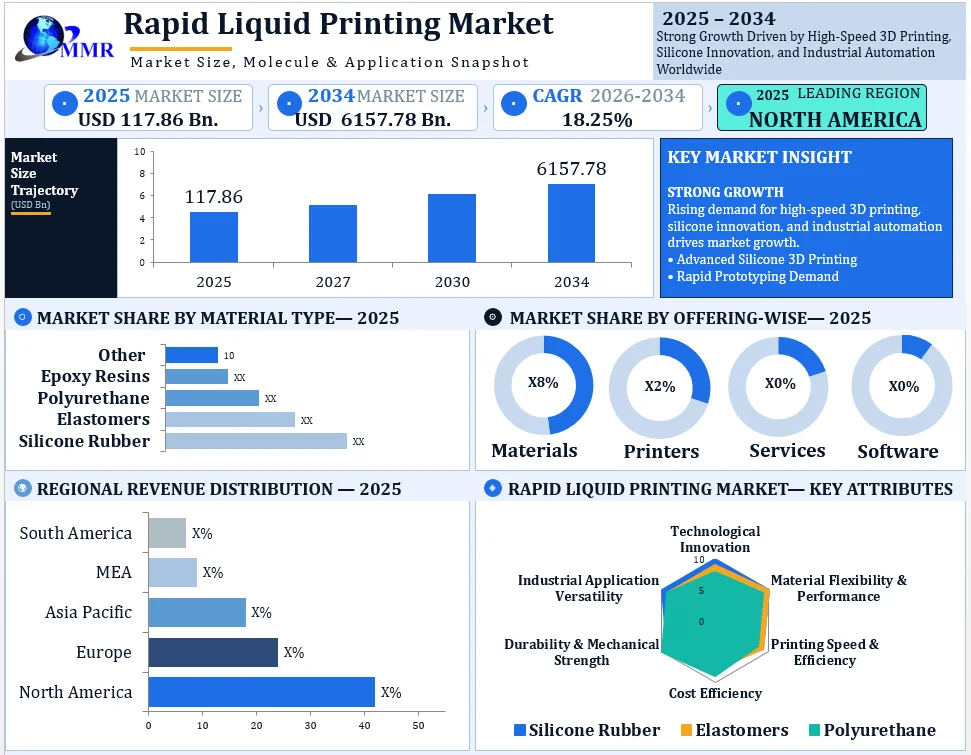
The Global Rapid Liquid Printing Market was valued at USD 117.86 Billion in 2025 and is projected to reach USD 6157.78 Billion by 2034, growing at a CAGR of 18.25% during the forecast period 2026–2034.
Global Rapid Liquid Printing Market Overview:
The Rapid Liquid Printing Market focuses on advanced additive manufacturing technology that uses robotic liquid deposition and gel-based suspension systems to produce complex three-dimensional objects without conventional layer-by-layer fabrication. Rapid Liquid Printing (RLP) technology supports silicone rubber, elastomers, and flexible polymer materials for customized industrial products. The Rapid Liquid Printing Market growth reflects increasing demand for high-speed 3D printing, rapid prototyping, industrial automation, and cost-efficient manufacturing. Industries adopt gel-supported 3D printing, robotic liquid printing, and advanced additive manufacturing solutions to reduce production time, improve design flexibility, and minimize material waste.
The Rapid Liquid Printing Market trends highlight growing interest in robotic automation, digital manufacturing, customized production, and advanced 3D printing materials. Major potential buyers include automotive manufacturers, healthcare companies, furniture producers, industrial designers, and consumer goods manufacturers. The Rapid Liquid Printing Market opportunities concentrate on automotive components, flexible medical products, customized furniture, and industrial prototyping. North America represents a leading innovation region, supported by additive manufacturing research and technology development, while Asia Pacific offers potential opportunities through industrial modernization. Key industry participants include Rapid Liquid Print, MIT Self-Assembly Lab, and Steelcase, with Rapid Liquid Print developing gel-supported printing solutions for flexible industrial products.
Maximize Market Research (MMR)'s Rapid Liquid Printing Market analysis examines the Global Rapid Liquid Printing Market size, market share, growth drivers, industry trends, competitive landscape, and investment opportunities through 2034. The research framework covers market segmentation by offering, material, application, end-use industry, and region, including printing equipment, materials, services, rapid prototyping, and customized manufacturing. The Rapid Liquid Printing Market forecast focuses on technology adoption, printing efficiency, material innovation, production scalability, and emerging business opportunities, supporting strategic decisions for manufacturers, technology providers, and investors.
Global Rapid Liquid Printing Market Key Highlights
Global Rapid Liquid Printing Market Growth and Share Analysis
To know about the Research Methodology :- Request Free Sample Report
Rapid Liquid Printing Market Dynamics:
Drivers: Rising Demand for Advanced 3D Printing and Industrial Automation
• High-Speed Additive Manufacturing: Increasing demand for rapid prototyping and faster production supports Rapid Liquid Printing Market growth.
• Industrial Automation Adoption: Robotic liquid deposition and automated 3D printing systems improve manufacturing efficiency and design flexibility.
• Customized Product Manufacturing: Growing demand for complex geometries, flexible components, and personalized products drives Rapid Liquid Printing technology adoption.
• Reduced Material Waste: Gel-supported 3D printing minimizes conventional support structures and supports efficient material utilization.
Restraints: High Equipment Costs and Limited Commercial Adoption
• High Initial Investment: Advanced robotic printing equipment, control systems, and specialized materials increase Rapid Liquid Printing system costs.
• Limited Technology Availability: A relatively small commercial supplier base restricts widespread adoption of industrial rapid liquid printing solutions.
• Material Compatibility Restrictions: Specific liquid polymers, silicone formulations, and curing requirements limit the range of printable materials.
• Uncertain Return on Investment: Limited large-scale commercial adoption makes cost justification difficult for small and medium-sized manufacturers.
Opportunities: Healthcare Innovation and Customized Industrial Applications
• Medical Device Manufacturing: Silicone-based 3D printing creates opportunities for customized medical components, flexible devices, and patient-specific products.
• Automotive Component Development: Rapid Liquid Printing applications support innovative automotive interior designs, flexible components, and complex prototypes.
• Furniture and Consumer Product Design: Advanced liquid printing technology enables customized furniture, ergonomic products, and unique industrial designs.
• Additive Manufacturing Services: On-demand 3D printing, product development, and specialized prototyping services create new Rapid Liquid Printing Market business opportunities.
Challenges: Production Scalability and Technical Performance
• Manufacturing Scalability: Maintaining consistent print quality across larger production volumes creates challenges for Rapid Liquid Printing commercialization.
• Dimensional Accuracy: Controlling liquid material flow, curing behavior, and shape retention affects printed component precision.
• Post-Processing Complexity: Cleaning support gel, curing printed materials, and finishing components increase production workflow requirements.
• Quality Certification: Industrial applications require reliable mechanical performance, repeatable production results, and compliance with application-specific quality standards.
Global Rapid Liquid Printing Market Trends
| Key Market Trends | Technology and Product Insights | Market Impact and Growth Opportunities |
|---|---|---|
| High-Speed Rapid Liquid Printing Technology |
Gel-supported 3D printing and robotic liquid deposition enable complex product manufacturing. Specific Rapid Liquid Printing processes report printing speeds up to 200 times faster than selected conventional 3D printing methods. |
Increasing demand for high-speed additive manufacturing, rapid prototyping, and industrial 3D printing solutions supports Rapid Liquid Printing Market growth. |
| Advanced Silicone and Elastomer 3D Printing |
Platinum-cured silicone, flexible polymers, and multi-durometer elastomers support customized components. Commercial systems offer material hardness ranging from Shore 00-50 to Shore 50A. |
Growing adoption of silicone 3D printing, flexible polymer manufacturing, and customized elastomer products creates opportunities in healthcare, automotive, and industrial applications. |
| Robotic Automation and Digital Manufacturing |
Six-axis robotic systems, automated liquid extrusion, and digital printing software support non-planar toolpaths, intricate geometries, and automated manufacturing workflows. |
Advancements in robotic 3D printing, Industry 4.0, smart manufacturing, and automated additive manufacturing improve production flexibility and support technology adoption. |
| Customized and Tooling-Free Manufacturing |
Gel-based suspension printing enables intricate lattice structures, internal cavities, flexible components, and customized product geometries without dedicated molds in suitable applications. |
Rising demand for on-demand 3D printing, mass customization, rapid product development, and tooling-free manufacturing supports specialized manufacturing services. |
| Healthcare and Medical Device Applications |
Rapid Liquid Printing supports prototypes of silicone prosthetics, flexible medical components, inflatable bladders, and patient-specific product designs. |
Expanding interest in medical 3D printing, personalized healthcare devices, silicone medical components, and customized prosthetics creates potential new application opportunities, subject to regulatory requirements. |
| Sustainable and Material-Efficient Additive Manufacturing |
Reusable suspension gels, controlled liquid deposition, and reduced sacrificial support requirements support efficient material utilization and complex printing processes. |
Increasing focus on sustainable 3D printing, material-efficient manufacturing, reduced production waste, and resource optimization influences Rapid Liquid Printing Market technology development. |
Rapid Liquid Printing Market Segment Analysis:
Global Rapid Liquid Printing Market Segment, by Material Type
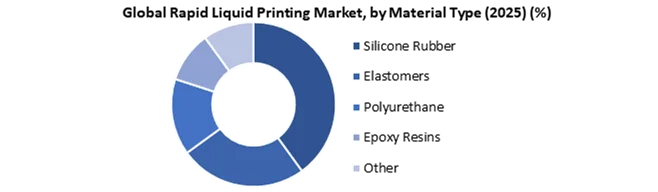
The Rapid Liquid Printing Market by Material Type includes Silicone Rubber, Elastomers, Polyurethane, Epoxy Resins, and Other Liquid Polymers, supporting advanced additive manufacturing, flexible product design, and customized industrial applications. The Silicone Rubber segment plays a significant role in rapid liquid printing technology due to its flexibility, durability, thermal stability, and suitability for complex 3D-printed components. The Elastomers segment supports flexible industrial parts, customized seals, and medical device prototypes, while Polyurethane offers abrasion resistance and mechanical versatility for suitable industrial manufacturing applications. Epoxy Resins provide rigidity, dimensional stability, and structural performance in compatible liquid printing processes, while Other Liquid Polymers create opportunities for specialty materials and advanced formulations. Increasing demand for silicone 3D printing, gel-supported additive manufacturing, robotic liquid deposition, high-performance elastomer printing, and customized polymer components supports Rapid Liquid Printing Market growth, material innovation, and emerging industrial manufacturing opportunities through 2034.
Global Rapid Liquid Printing Market Segment, by End User
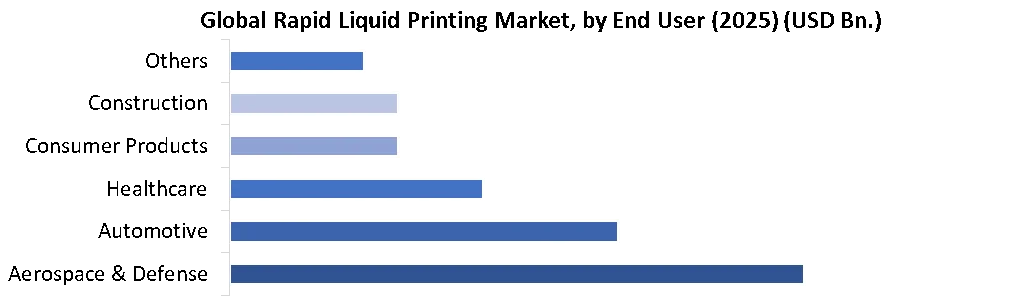
The Rapid Liquid Printing Market by Industry includes Aerospace & Defense, Automotive, Healthcare, Consumer Products, Construction, and Others, reflecting emerging applications for advanced additive manufacturing and customized 3D printing solutions. The Aerospace & Defense segment explores rapid liquid printing for lightweight prototypes, complex geometries, and flexible components, while the Automotive segment focuses on customized silicone seals, interior components, and rapid prototyping. The Healthcare segment presents opportunities for silicone medical devices, prosthetic components, and patient-specific product development, subject to regulatory requirements. Consumer Products benefit from customized footwear, furniture, and flexible product designs, while Construction explores architectural models and specialized polymer components. Other industries include industrial machinery, robotics, and product design services. Increasing demand for gel-supported 3D printing, robotic liquid deposition, silicone additive manufacturing, tooling-free production, and high-speed industrial prototyping supports Rapid Liquid Printing Market growth, technology innovation, and investment opportunities through 2034.
Rapid Liquid Printing Market Regional Insights:
The North America Rapid Liquid Printing Market represents a leading center for additive manufacturing innovation, supported by advanced 3D printing research, robotic automation, and industrial technology development. The United States drives innovation through MIT's Self-Assembly Lab and Rapid Liquid Print, which focus on gel-supported 3D printing, silicone additive manufacturing, and high-speed liquid printing technology. Growing demand for rapid prototyping, customized medical devices, and automotive components supports regional market opportunities.
The Europe Rapid Liquid Printing Market benefits from industrial automation, advanced polymer manufacturing, and growing interest in customized production technologies. Germany, France, the United Kingdom, and Italy support potential applications for robotic liquid deposition, elastomer 3D printing, digital manufacturing, and industrial additive manufacturing solutions. Automotive engineering, healthcare technology, and industrial product innovation create opportunities for regional market expansion.
The Asia Pacific Rapid Liquid Printing Market presents significant growth potential through expanding automotive manufacturing, electronics production, industrial automation, and smart factory development. China, Japan, South Korea, and India offer opportunities for high-speed 3D printing, silicone rubber printing, robotic additive manufacturing, and customized polymer components. Increasing investment in advanced manufacturing technologies supports regional market opportunities through 2034.
The Middle East & Africa Rapid Liquid Printing Market offers emerging opportunities through industrial diversification, smart manufacturing, and advanced production technology investment. Saudi Arabia, the UAE, and South Africa present potential demand for silicone additive manufacturing, robotic 3D printing, rapid prototyping services, and customized industrial components. Aerospace, healthcare, construction, and industrial innovation create opportunities for specialized additive manufacturing solutions.
The South America Rapid Liquid Printing Market presents opportunities across automotive manufacturing, healthcare innovation, consumer product development, and industrial prototyping. Brazil, Argentina, and Chile offer potential applications for gel-supported 3D printing, flexible polymer manufacturing, robotic liquid deposition, and on-demand additive manufacturing services. Growing interest in customized production and digital manufacturing supports the regional Rapid Liquid Printing Market outlook through 2034.
Global Rapid Liquid Printing Market Recent Developments
| Date | Recent Developments |
|---|---|
| October 2026 |
Formlabs launches Form Studio 1, a professional resin 3D printer featuring advanced liquid resin curing technology. The product supports high-speed additive manufacturing, customized prototyping, and precision polymer printing applications. |
| August 2026 |
Carbon, Inc. launches DB 4000, an FDA-cleared, high-impact denture base resin for its M-Series 3D printers, expanding advanced liquid resin additive manufacturing, dental 3D printing, and customized medical product applications. |
| June 2026 |
Bluestar Silicones completes its rebranding following the acquisition of a majority stake in Elkem's silicones division. The development strengthens the broader silicone materials supply chain relevant to elastomer 3D printing and advanced polymer manufacturing. |
| April 2026 |
Stratasys Ltd. expands its additive manufacturing portfolio with the J850 Core PolyJet printer, P3 MED Silicone 25A material, and advanced software solutions, supporting silicone 3D printing, medical device prototyping, and industrial polymer manufacturing. |
| January 2026 |
Rapid Liquid Print (RLP) announces a strategic partnership with Amecos GmbH for European distribution and commercialization of its Levity platform, featuring gel-supported silicone 3D printing and a 50 × 50 × 50 cm build volume. |
Global Rapid Liquid Printing Market Competitive Landscape
The Rapid Liquid Printing Market competitive landscape includes specialized additive manufacturing companies, robotic 3D printing technology developers, silicone material suppliers, and advanced polymer manufacturing providers. Rapid Liquid Print represents a key technology provider, offering gel-supported silicone 3D printing systems for customized industrial components, flexible products, and complex geometries. The MIT Self-Assembly Lab contributes to Rapid Liquid Printing technology research, while Steelcase demonstrates applications in furniture design and manufacturing. Major companies in the broader additive manufacturing industry include Stratasys, 3D Systems, Formlabs, Carbon, and Materialise, which offer complementary 3D printing technologies, materials, and software solutions. The Rapid Liquid Printing Market competition focuses on printing speed, material compatibility, product customization, dimensional accuracy, manufacturing efficiency, and industrial automation.
The Rapid Liquid Printing Market competitive analysis highlights strategic partnerships, product launches, technology innovation, distribution expansion, and advanced material development as important business strategies. Leading Rapid Liquid Printing Market technology providers prioritize high-speed 3D printing, robotic liquid deposition, silicone elastomer processing, and tooling-free additive manufacturing. Rapid Liquid Print's Levity industrial 3D printer offers a 50 × 50 × 50 cm build volume, supporting customized silicone components and complex product designs. Increasing interest in rapid prototyping, medical device manufacturing, automotive components, flexible polymers, and on-demand production creates opportunities for advanced additive manufacturing solutions. The Global Rapid Liquid Printing Market growth outlook through 2034 emphasizes production scalability, material innovation, technical expertise, and customized industrial applications across North America, Europe, Asia Pacific, the Middle East & Africa, and South America.
Rapid Liquid Printing Market Scope: Inquire before buying
| Rapid Liquid Printing Market | |||
|---|---|---|---|
| Report Coverage | Details | ||
| Base Year: | 2025 | Forecast Period: | 2026-2034 |
| Historical Data: | 2020 to 2025 | Market Size in 2025: | 117.86 USD Billion |
| Forecast Period 2026-2034 CAGR: | 18.25% | Market Size in 2034: | 6157.78 USD Billion |
| Segments Covered: | by Offering-wise | Materials Printers Services Software |
|
| by Material Type | Silicone Rubber Elastomers Polyurethane Epoxy Resins Other |
||
| by Application | Prototyping Functional Tooling Others |
||
| by Industry | Aerospace & Defense Automotive Healthcare Consumer Products Construction Others |
||
Rapid Liquid Printing Market, by Region
North America (United States, Canada and Mexico)
Europe (UK, France, Germany, Italy, Spain, Sweden, Austria and Rest of Europe)
Asia Pacific (China, South Korea, Japan, India, Australia, Indonesia, Malaysia, Vietnam, Taiwan, Bangladesh, Pakistan and Rest of APAC)
Middle East and Africa (South Africa, GCC, Egypt, Nigeria and Rest of ME&A)
South America (Brazil, Argentina Rest of South America)
Rapid Liquid Printing Market, Key Players are:
1. Rapid Liquid Print
2. Stratasys Ltd.
3. 3D Systems Corporation
4. Carbon, Inc.
5. Formlabs, Inc.
6. Materialise NV
7. Autodesk, Inc.
8. Dassault Systèmes SE
9. HP Inc.
10. EOS GmbH
11. Proto Labs, Inc.
12. Markforged
13. XJet Ltd.
14. voxeljet AG
15. Optomec, Inc.
16. Asiga
17. Nexa3D
18. Meltio
19. Steelcase Inc.
20. GE Aerospace
21. Renishaw plc
22. Nano Dimension Ltd.
23. UltiMaker
24. BCN3D Technologies
25. Farsoon Technologies
26. TRUMPF SE + Co. KG
27. AddUp
28. Prodways Group
29. INTAMSYS
30. UnionTech
31. Bambu Lab
32. ZRapid Technologies
33. Shining 3D
34. Zortrax S.A.
35. Tiertime
36. 3DCeram
37. Lynxter
38. 3Deus Dynamics
39. innovatiQ GmbH
40. San Draw Inc.
41. Spectroplast AG
42. Prayasta 3D Inventions Pvt. Ltd.
43. Evonik Industries AG
44. Arkema SA
45. BASF SE
46. Covestro AG
47. Wacker Chemie AG
48. Elkem ASA
49. Shin-Etsu Chemical Co., Ltd.
50. Henkel AG & Co. KGaA
Frequently Asked Questions:
1. What is the Global Rapid Liquid Printing Market size in 2025?
The Global Rapid Liquid Printing Market size stands at USD 117.86 Million in 2025, supported by demand for high-speed additive manufacturing, silicone 3D printing, and robotic liquid deposition technology.
2. What is the Rapid Liquid Printing Market forecast and CAGR through 2034?
The Rapid Liquid Printing Market is projected to reach USD 6,157.78 Million by 2034, registering a CAGR of 18.25% during 2026–2034.
3. What are the major growth drivers of the Rapid Liquid Printing Market?
Key Rapid Liquid Printing Market growth drivers include industrial automation, rapid prototyping, customized product manufacturing, tooling-free production, and demand for high-speed 3D printing solutions.
4. What are the major materials and technologies used in Rapid Liquid Printing?
The Rapid Liquid Printing Market by Material Type includes Silicone Rubber, Elastomers, Polyurethane, Epoxy Resins, and Others. Gel-supported additive manufacturing and robotic liquid deposition support complex product designs.
5. Which industries and applications drive Rapid Liquid Printing Market demand?
Major Rapid Liquid Printing Market applications include prototyping, functional component manufacturing, and tooling. Key industries include Automotive, Healthcare, Aerospace & Defense, Consumer Products, and Construction.
6. Which region leads the Rapid Liquid Printing Market, and where are the growth opportunities?
North America represents a leading innovation hub for Rapid Liquid Printing technology, while Asia Pacific offers emerging growth opportunities through smart manufacturing, industrial automation, and advanced 3D printing adoption.
7. Who are the leading companies in the Global Rapid Liquid Printing Market?
Major Rapid Liquid Printing Market key players include Rapid Liquid Print, Stratasys, 3D Systems, Carbon, Formlabs, and Materialise. Rapid Liquid Print specializes in gel-supported printing, while the other companies participate in broader additive manufacturing technologies.