
Composite AI Market Size by Offering, Industry Vertical, Technique, Application, Region – Revenue Pool Analysis, Margin Structure Assessment, Capital Flow Trends, Competitive Benchmarking & Forecast to 2032
Overview
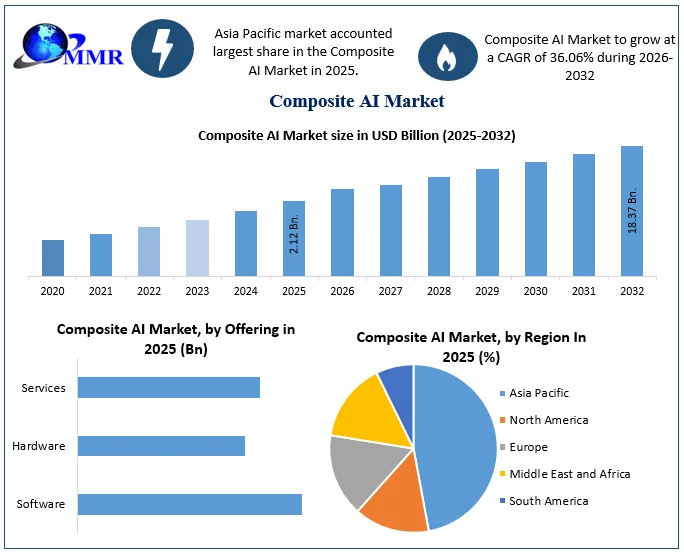
The Global Composite AI Market size was valued at USD 2.12 Billion in 2025 and the total Composite AI revenue is expected to grow at a CAGR of 36.06 % from 2026 to 2032, reaching nearly USD 18.37 Billion By 2032.
Composite AI Market Definition:
Composite AI is an approach to artificial intelligence (AI) that combines different AI techniques to solve complex problems. It is also known as multidisciplinary AI or hybrid AI. Composite AI systems are designed to take advantage of the strengths of different AI techniques to achieve better results than any single technique. Artificial Intelligence is becoming the Offering with the greatest potential to reshape how organization develop their activities and generate value through new business models. Composite AI systems take a holistic approach to problem-solving, considering all aspects of the problem and using the most appropriate AI technique for each aspect.
To know about the Research Methodology :- Request Free Sample Report
Composite AI Market Overview:
AI is becoming increasingly adopted across various industries, including healthcare, finance, manufacturing, and retail. High adoption is driving the demand for composite AI solutions, which offer more sophisticated and effective AI capabilities compared to single-technique AI solutions. The amount and complexity of data are growing exponentially, making it challenging to analyze and extract meaningful insights using traditional methods. Composite AI can effectively handle complex data sets by combining different AI techniques, such as machine learning, natural language processing, and computer vision. Composite AI is poised to play a transformative role in the future of AI, enabling organizations to tackle complex challenges, gain valuable insights from data, and achieve operational excellence. As AI continues to evolve, Composite AI will become increasingly essential for organizations seeking to harness the power of AI to drive innovation and success. The global Composite AI market is dominated by a few large players, such as IBM, Microsoft, Google, and Amazon. Prominent companies are offering a comprehensive range of composite AI solutions, including platforms, tools, and services and also actively investing in research and development to advance composite AI technology and develop innovative solutions. IBM is a leading provider of AI solutions, including composite AI solutions. The company's Watson AI platform is a comprehensive platform for developing and deploying composite AI models. IBM also offers a wide range of consulting and support services to help organizations adopt composite AI.
Insights are crucial for modern businesses to thrive in today's competitive landscape. Without a clear understanding of their data, businesses risk making poor decisions that could jeopardize their success. AI techniques, particularly machine learning (ML) and natural language processing (NLP), have emerged as powerful tools for extracting actionable insights from unstructured data, which often holds valuable information about customer behavior, market trends, and potential risks.
Composite AI Market Dynamics:
Composite AI is expected to become A Game Changer Technology for Industry Vertical
Composite AI is indeed a game-changer in the field of artificial intelligence. It's an approach that combines different AI techniques to create more powerful, versatile, and adaptable AI systems. By integrating various AI components and technologies, composite AI overcomes the limitations of single-technique AI and tackles complex problems that were previously intractable. An composite AI is expected to become a game-changer technology for industry verticals. Composite AI systems is used to diagnose diseases, develop personalized treatment plans, and monitor patient health. For instance, composite AI algorithms can analyze medical images, such as X-rays and MRI scans, to identify abnormalities and assist in diagnosis. It is also to detect fraud, assess risk, and optimize financial portfolios. For example, composite AI algorithms can analyze financial transactions to detect patterns that indicate fraudulent activity in Banking and financial sector. Composite AI systems is used to personalize customer experiences, optimize product pricing, and manage inventory levels in the retail Industry. For example, composite AI algorithms help to analyze customer data to recommend products that are likely to be of interest to individual customers.
An increase in adoption of AI in edge computing across the globe one of the key drivers behind the Composite AI Market Growth
North America is at the forefront of AI adoption in edge computing, with major players like IBM, Microsoft, and Amazon Web Services (AWS) offering comprehensive edge computing solutions. The region is also home to a thriving startup ecosystem focused on developing innovative edge AI applications. Walmart is using edge AI to optimize inventory management and improve customer experiences in its stores. Europe is making significant strides in edge AI adoption and Composite AI technology, driven by initiatives like the European AI Alliance and the European Commission's commitment to digital transformation. The region is particularly focused on using edge AI for industrial applications, such as predictive maintenance and anomaly detection. Siemens is using edge AI for predictive maintenance in industrial machinery to reduce downtime and improve efficiency. The Asia Pacific region is rapidly adopting AI in edge computing, with countries like China, India, and South Korea leading the way. The region's growing adoption of IoT devices and the increasing demand for real-time data processing are driving the demand for edge AI solutions. China is using edge AI to manage traffic flow, optimize energy consumption, and improve public safety in its cities.
The integration of artificial intelligence (AI) with other technologies is a significant trend in the Composite AI Market that is transforming various industries
Artificial intelligence (AI) is rapidly transforming various industries by integrating with other technologies. The transformation is leading to the development of more sophisticated and powerful AI systems that are capable of solving complex problems and automating tasks that were previously thought to be the exclusive domain of humans. AI is increasingly being used to analyze the vast amounts of data generated by IoT devices, which helps to improve decision-making, predict customer behavior, and optimize operations. AI applications are increasingly being deployed in the cloud, which makes them easier to scale and manage. Cloud computing also makes it possible to share AI resources with others that accelerate innovation. Researchers are developing new AI algorithms that are more efficient and accurate than ever before. These algorithms are making it possible to apply AI to a wider range of problems. The integration of AI with other technologies is still in its early stages, but it is already having a profound impact on the world. As AI continues to develop, the integration of the Composite AI is expected to increase at a more than 35% growth rate during the forecast period.
Composite AI Market Dynamics Snapshot: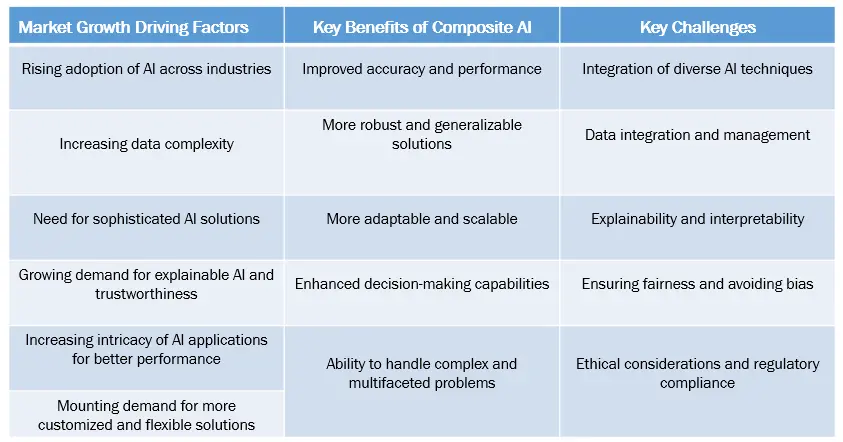
Composite AI Market Segment Analysis:
Based on the Offering, Composite AI Market is segmented into Software, Hardware and Services. The hardware segment consists of the components like Processors, Memory Units, Network Equipment and Others. The composite AI hardware market is a highly competitive market with a number of large and established players. The major players are focusing on developing innovative AI-powered hardware that meets the needs of their customers. They are also investing heavily in research and development to stay ahead of the competition. The composite AI hardware market offers a number of opportunities for growth. The increasing adoption of AI technologies across various industries is creating a demand for more sophisticated AI-powered hardware. Additionally, the growing demand for personalized and predictive AI solutions is creating opportunities for new entrants to the market. The high cost of AI-powered hardware can be a barrier to adoption for some businesses. Additionally, the lack of skilled AI hardware engineers is expected to limit the positive growth revenue for businesses to develop and maintain AI hardware systems.
The Software segment includes the module like AI development Platform and Tools, ML Framworks and AI Middleware. An increase in increasing adoption of AI technologies across various industries is creating a demand for more sophisticated AI software solutions. Additionally, the growing demand for personalized and predictive AI solutions are expected to create opportunities for new entrants in the Composite AI market. The demand for AI software is expected to be driven by businesses of all sizes, from small and medium-sized businesses (SMBs) to large enterprises.
Based on the Technique, machine learning is expected to be the most dominant force in the composite AI market. The technology has its ability to learn from data and make predictions without being explicitly programmed. Machine learning is already being used in a wide variety of applications, including fraud detection, customer service, and medical diagnosis.
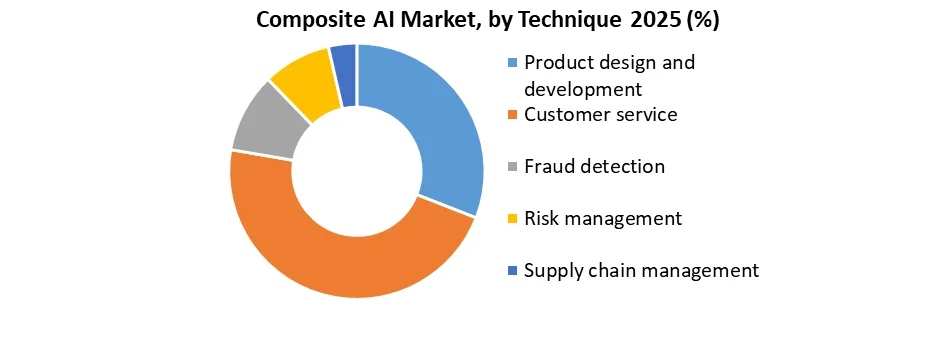
By Application, Composite AI Market is segmented into product design and development, customer service, fraud detection, risk management and supply chain management. The product design and development segment are expected to hold the more than 25% share in the Composite AI Market during the forecast period. Product design and development is expected to be the largest application area for composite AI in 2025, as businesses increasingly adopt AI-powered tools to automate design tasks, optimize product performance, and personalize products for individual customers.
Customer service is another significant application area, where AI chatbots and virtual assistants are being used to provide 24/7 customer support and handle routine inquiries. Fraud detection is also a growing application area for composite AI, as businesses leverage AI algorithms to identify and prevent fraudulent transactions. Risk management is another important application area, where AI is being used to assess and mitigate risks associated with investments, loans, and other financial activities. Supply chain management is also benefiting from composite AI, as businesses use AI to optimize logistics, predict demand, and manage inventory levels. Key players operating in the Composite AI market are focusing on the integration of the Composite AI technology. For instance, Amazon is using composite AI to personalize product recommendations for its customers. Netflix is using composite AI to recommend movies and TV shows that are more likely to appeal to its customers.
In the Industry Vertical Segment, Banking and financial services is projected to be dominant share in the composite AI market. The BFSI industry is awash in data, with data volumes growing at an exponential rate. The data is complex and unstructured, making it difficult to analyze and extract insights from. Composite AI helps to make sense of this data and extract valuable insights in BFSI industry. Fraud is a major problem for the BFSI industry, costing businesses billions of dollars each year. Composite AI is used to detect fraud more effectively by identifying patterns and anomalies in data. Customers are increasingly demanding personalized experiences from their banks and financial institutions. The Composite technology used to personalize customer experiences by understanding customer needs and preferences and tailoring products and services.
Composite AI Market Regional Insights:
Artificial intelligence (AI) is rapidly reshaping economies and societies. AI-driven products and services are already a crucial part of most people’s routines in North America. Governments across North America are actively promoting the adoption of AI in various industries, recognizing its transformative potential. The initiatives include funding research and development, providing tax incentives for AI adoption, and establishing AI centers of excellence. North America boasts a robust research and development ecosystem for composite AI, with world-class universities, research institutions, and private companies collaborating to advance the field. The region has seen early and widespread adoption of AI across various industries, including healthcare, automotive, and retail. An early adoption of technology is expected to creat a thriving market for composite AI solutions, attracting further investment and innovation. North America is home to a plethora of renowned AI companies, including IBM, Microsoft, Google, Amazon, Salesforce, Adobe, SAP, Oracle, Cisco, and Hewlett Packard Enterprise (HPE). These companies are at the forefront of AI innovation, constantly pushing the boundaries of what's possible with composite AI solutions.
Composite AI Market Competitive Landscape:
The composite AI market is a rapidly growing and evolving space, with a number of key players emerging as leaders in the field. Many companies are focusing on the development of innovative AI solutions that are addressing a wide range of challenges across industries. AI technology is constantly evolving, with new algorithms and techniques being developed all the time, which is also leading to the development of more powerful and sophisticated composite AI systems. Google AI is one of the leading research labs in the field of composite AI. The company is working on a number of different projects, including developing new AI algorithms, designing new AI systems, and applying AI to real-world problems. SAS is a provider of business analytics software. The company is developing AI solutions that can help businesses to analyze their data and make better decisions. Opentext is a provider of enterprise content management software. The company is developing AI solutions that can help businesses to manage their unstructured data.
In 2025, Amazon SageMaker Model Registry is announced. SageMaker Model Registry is a centralized repository for managing machine learning models. SageMaker Model Registry makes it easy for developers to track the lineage of their models and deploy them to production. In February 2025, Amazon Web Services (AWS) and Hugging Face announced a collaboration to make generative AI more accessible and cost-efficient. AWS will make it easy for developers to find, deploy, and manage Hugging Face models on AWS. It includes Hugging Face models into Amazon SageMaker, AWS's machine learning platform. AWS and Hugging Face will work together to make it easier for developers to collaborate on generative AI projects to create tools and resources that make it easy for developers to share code, data, and models.
Composite AI Market Scope: Inquiry Before Buying
| Composite AI Market | |||
|---|---|---|---|
| Report Coverage | Details | ||
| Base Year: | 2025 | Forecast Period: | 2026-2032 |
| Historical Data: | 2020 to 2025 | Market Size in 2025: | USD 2.12 Bn. |
| Forecast Period 2026 to 2032 CAGR: | 36.06% | Market Size in 2032: | USD 18.37 Bn. |
| Segments Covered: | by Offering | Software Hardware Services |
|
| by Industry Vertical | Data processing Pattern recognition Machine learning Natural language processing |
||
| by Technique | Product design and development Customer service Fraud detection Risk management Supply chain management |
||
| by Application | Banking and financial services Healthcare Retail Manufacturing Transportation and logistics Others |
||
Composite AI Market, by Region
North America (United States, Canada, and Mexico)
Europe (UK, France, Germany, Italy, Spain, Sweden, Austria, and the Rest of Europe)
Asia Pacific (China, South Korea, Japan, India, Australia, Indonesia, Malaysia, Vietnam, Taiwan, Bangladesh, Pakistan, and the Rest of APAC)
Middle East and Africa (South Africa, GCC, Egypt, Nigeria, and the Rest of ME&A)
South America (Brazil, Argentina Rest of South America)
Composite AI Market, Key Players
1. OpenAI
2. Google DeepMind
3. IBM
4. Microsoft
5. Facebook AI Research (FAIR)
6. Amazon AI
7. NVIDIA
8. Intel AI
9. Salesforce Einstein
10. C3.ai
11. UiPath
12. Palantir Technologies
13. SAS Institute
14. Blackswan Technologies
15. Oracle
16. Opentext
17. Zest AI
18. Datarobot
FAQs:
1. What are the growth drivers for the Composite AI Market?
Ans. Increasing AI adoption, Growing Complexity of Data and Problems and Advancements in AI Technologies are expected to be the major drivers for the Composite AI Market.
2. What is the major restraint for the Composite AI Market growth?
Ans. Data privacy concern is expected to be the major restraining factor for the Composite AI Market growth.
3. Which region is expected to lead the global Composite AI Market during the forecast period?
Ans. Asia Pacific is expected to lead the global Composite AI Market during the forecast period.
4. What is the projected market size & and growth rate of the Composite AI Market?
Ans. The Composite AI Market size was valued at USD 2.12 Billion in 2025 and the total Composite AI revenue is expected to grow at a CAGR of 36.06% from 2026 to 2032, reaching nearly USD 18.37 Billion By 2032.
5. What segments are covered in the Composite AI Market report?
Ans. The segments covered in the Composite AI Market report are Offering, Technique, Application, Industry Vertical and Region.