
Procalcitonin Test Kits Market - Industry Structure Evaluation, Demand Drivers Analysis, Regional Growth Analysis and Identification, Competitive Positioning / Landscape Review & Global Market Size Forecast to 2034
Overview
The Procalcitonin Test Kits Market size was valued at USD 1177.15 Million in 2025 and the total Procalcitonin Test Kits revenue is expected to grow at a CAGR of 6.56% from 2026 to 2034, reaching nearly USD 2085.35 Million by 2034.
Procalcitonin (PCT), the biomarker of choice to aid in the diagnosis of sepsis.
The procalcitonin test is carried out to determine the risk that a critically ill person will progress to severe sepsis and septic shock, or the risk of the person dying.The PCT test help to distinguish between bacterial and non-bacterial causes of infections, such as meningitis and pneumonia.
The report on the Global Procalcitonin Test Kit Market gives an estimation of the development of the market based on historical studies and also provides forecasts on the basis of a comprehensive research. The report gives a complete market analysis for the forecast period from 2026 to 2034. The market is divided into various segments with an in-depth outlook of the competitors and a listing of the profiled key players. Leading players in the global Procalcitonin test kits market includs bioMérieux SA, F. Hoffmann-La Roche Ltd., Thermo Fisher Scientific, RayBiotech, Inc., Hangzhou Kitgen Biotechnology Co. The market size in terms of revenue and volume is calculated and provided for the study period along with the dynamics of the market such as the drivers and the restraints.
Procalcitonin Test Kits Market Growth Outlook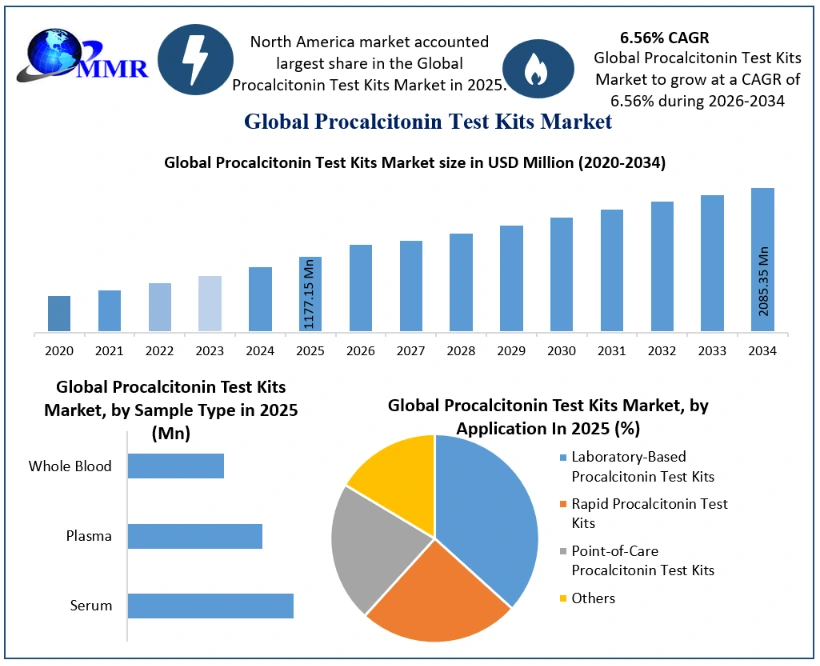
To know about the Research Methodology :- Request Free Sample Report
Procalcitonin Test Kits Market Dynamics
High prevalence and rise in incidence rates of sepsis, pneumonia meningitis, and lower respiratory tract infections across the globe primarily drives the global procalcitonin test kits market. The technological advancements in early detection of procalcitonin levels in the blood such as EIA testing, ELISA testing, and point-of-care testing is likely to drive the market during the forecast period. Increase in usage of procalcitonin test for the optimization of course of antibiotic treatment, newer regulatory guidelines emphasizing the increased usage of procalcitonin tests in the golden hours of treatment, and increased levels of awareness about the rapid procalcitonin tests are likely to contribute to the growth of the market during the forecast period.
Immunoassay test kit held the 65% share in the global market.
Procalcitonin has been regarded as a useful marker in the clinic. Immunoassay test reflects the effectiveness of antibiotics and may be used to guide antibiotic treatment, reduce the abuse of antibiotics which may benefit the reduction of the waste of treatment and avoid bacterial drug resistance. A rapid, user-friendly, inexpensive, and quantitative method for immunoassay test detection is very necessary to meet the widespread application in the clinic.
Hospitals segment commended the largest market share of xx% by 2034.
PCT tests are mostly employed in hospitals for fast and accurate detection and monitoring of PCT, helps in antibiotic treatment decision-making, especially in intensive care units (ICU).Availability of variety of PCT immunoassays for clinical applications, such as PCT detection kits based on chemiluminescence immunoassays (CLIA), enzyme-linked fluorescent assays (ELISA) and immunochromatographic tests (ICT) is increased the growth of global procalcitonin test kits market in the forecast period.Procalcitonin test kits accurately quantify the serum PCT with high sensitivity and accuracy, the large-scale testing equipment availabilityin under-equipped locales or emergency medicine wards and ICUs.
Economic forces driving health care services from North America
Well-established health care facilities, sophisticated health care systems, intrinsically highly valuable quality of health care services are provided by the government of North America. The high prevalence of sepsis, meningitis, and other bacterial infections in the region is driving the global market in the forecast period. The rapidly growing number of hospitals and diagnostic laboratories, and improving healthcare infrastructure in North America are drivers for the growth of the global market.
Procalcitonin Test Kits Market Recent Developments:
| Date | Company | Development | Impact |
|---|---|---|---|
| 22 March 2026 | University of Liverpool | Researchers published findings from the Phase 3 PRONTO trial in The Lancet, validating procalcitonin-guided algorithm evaluation alongside NEWS2 for emergency sepsis management. | The clinical trial demonstrated a 17% relative reduction in sepsis mortality in emergency departments through targeted biomarker-guided care protocols. |
| 27 July 2026 | Thermo Fisher Scientific | Thermo Fisher Scientific presented its B·R·A·H·M·S Procalcitonin (PCT) assay portfolio on the KRYPTOR platform at ADLM 2026 to optimize critical care diagnostic workflows. | The automated immunoassay system enhances rapid differential diagnosis of severe bacterial infections and antibiotic stewardship in hospital ICUs. |
| 28 July 2026 | Thermo Fisher Scientific | Thermo Fisher Scientific showcased new clinical performance data for expanding its B·R·A·H·M·S PCT assay applications into pediatric emergency medicine. | The effort supports ongoing regulatory submissions to enable biomarker-guided antimicrobial management in febrile infant populations. |
| 24 October 2026 | F. Hoffmann-La Roche Ltd | Roche Diagnostics released updated clinical guidance for its Elecsys B·R·A·H·M·S PCT electrochemiluminescence immunoassay to support serial procalcitonin monitoring in septic shock. | The quantitative updates enable clinicians to better track treatment response and therapeutic de-escalation timelines in intensive care settings. |
Procalcitonin Test Kits Market Scope: Inquire before Buying
| Global Procalcitonin Test Kits Market | |||
|---|---|---|---|
| Report Coverage | Details | ||
| Base Year: | 2025 | Forecast Period: | 2026-2034 |
| Historical Data: | 2020 to 2025 | Market Size in 2025: | US $ 1177.15 Mn. |
| Forecast Period 2026 to 2034 CAGR: | 6.56% | Market Size in 2034: | US $ 2085.35 Mn. |
| Segments Covered: | by Product Type | Laboratory-Based Procalcitonin Test Kits Rapid Procalcitonin Test Kits Point-of-Care Procalcitonin Test Kits Others |
|
| by Technology | Chemiluminescence Immunoassay (CLIA) Fluorescence Immunoassay (FIA) Enzyme-Linked Immunosorbent Assay (ELISA) Immunochromatographic/Lateral Flow Assay Others |
||
| by Sample Type | Serum Plasma Whole Blood |
||
| by Testing Setting | Central Laboratory Testing Point-of-Care Testing |
||
| by Application | Sepsis & Systemic Bacterial Infections Respiratory Tract Infections Antimicrobial Resistance (AMR) & Antibiotic Stewardship Post-Surgical Infection Monitoring Other Bacterial Infections |
||
| By End User | Hospitals Diagnostic Laboratories Physician Offices & Clinics Other Healthcare Facilities |
||
Procalcitonin Test Kits Market, by Region
North America (United States, Canada and Mexico)
Europe (UK, France, Germany, Italy, Spain, Sweden, Austria and Rest of Europe)
Asia Pacific (China, South Korea, Japan, India, Australia, Indonesia, Malaysia, Vietnam, Taiwan, Bangladesh, Pakistan and Rest of APAC)
Middle East and Africa (South Africa, GCC, Egypt, Nigeria and Rest of ME&A)
South America (Brazil, Argentina Rest of South America)
Procalcitonin Test Kits Market Key Players
North America:
1. Thermo Fisher Scientific Inc. (BRAHMS)
2. Abbott Laboratories
3. Danaher Corporation (Beckman Coulter)
4. QuidelOrtho Corporation
5. Diazyme Laboratories, Inc.
6. RayBiotech, Inc.
Others
Europe:
7. F. Hoffmann-La Roche Ltd. (Roche Diagnostics)
8. bioMérieux SA
9. Siemens Healthineers AG
10. DiaSorin S.p.A.
11. Fujirebio
12. Radiometer Medical ApS
13. DiaSys Diagnostic Systems GmbH
14. DRG Instruments GmbH
Others
Asia Pacific:
15. Boditech Med Inc.
16. Getein Biotech, Inc.
17. Guangzhou Wondfo Biotech Co., Ltd.
18. Shenzhen New Industries Biomedical Engineering Co., Ltd. (Snibe)
19. Beijing Hotgen Biotech Co., Ltd.
20. Sichuan Maccura Biotechnology Co., Ltd.
21. Vazyme Biotech Co., Ltd.
22. Autobio Diagnostics Co., Ltd.
23. Shenzhen Mindray Bio-Medical Electronics Co., Ltd.
24. AccuBioTech Co., Ltd.
25. Hangzhou AllTest Biotech Co., Ltd.
26. Hangzhou Biotest Biotech Co., Ltd.
27. Hangzhou Kitgen Biotechnology Co., Ltd.
28. Shanghai Kehua Bio-engineering Co., Ltd.
29. Ningbo MedicalSystem Biotechnology Co., Ltd.
30. Lumigenex (Suzhou) Co., Ltd.
Frequently Asked Questions:
1. Which region has the largest share in Global Procalcitonin Test Kits Market?
Ans: North America region held the highest share in 2025.
2. What is the growth rate of Global Procalcitonin Test Kits Market?
Ans: The Global Procalcitonin Test Kits Market is growing at a CAGR of 6.56% during forecasting period 2026-2034.
3. What is scope of the Global Procalcitonin Test Kits Market report?
Ans: Global Procalcitonin Test Kits Market report helps with the PESTEL, PORTER, COVID-19 Impact analysis, Recommendations for Investors & Leaders, and market estimation of the forecast period.
4. Who are the key players in Global Procalcitonin Test Kits Market?
Ans: The important key players in the Global Procalcitonin Test Kits Market are – bioMérieux SA, F. Hoffmann-La Roche Ltd., Thermo Fisher Scientific, RayBiotech, Inc., Hangzhou Kitgen Biotechnology Co., Ltd., Radiometer, EKF Diagnostics Holdings plc, Merck KGaA, Abbott laboratories, and Laboratory Corporation of America Holdings
5. What is the study period of this Market?
Ans: The Global Procalcitonin Test Kits Market is studied from 2020 to 2034.
Table of Contents
1.1 Executive Market Landscape and Industry Overview
1.1.1 Global Procalcitonin Test Kits Market Size (USD Bn. and Volume 000’ Units), 2025–2034
1.1.2 Market Definition, Scope, and Key Segmentation Criteria for Global Procalcitonin Test Kits Market
1.1.3 Global Procalcitonin Test Kits Market Ecosystem: Brands, Suppliers, Distributors, and Retail Channels
1.1.4 Competitive Landscape Overview: Brands, Participants, Regional Specialists, and New Entrants in the Global Procalcitonin Test Kits Market
1.1.5 Revenue at Stake: TAM / SAM / SOM + Revenue Leakage Analysis
1.1.6 Total Addressable Procalcitonin Test Kits Opportunity
1.1.7 Estimated Revenue Leakage from Existing Customer Base
1.2 Global Procalcitonin Test Kits Market Dynamics
1.2.1 Procalcitonin Test Kits Market Trends
1.2.2 Procalcitonin Test Kits Market DROC
1.2.2.1 Drivers
1.2.2.2 Restraints
1.2.2.3 Opportunities
1.2.2.4 Challenges
1.2.3 PORTER’s Five Forces Analysis
1.2.3.1 Supplier Power
1.2.3.2 Buyer Power
1.2.3.3 Threat of Substitutes
1.2.3.4 Threat of New Entrants
1.2.3.5 Competitive Rivalry
1.2.4 PESTLE Analysis
1.3 Antimicrobial Resistance (AMR) Impact on Procalcitonin Test Demand
1.3.1 Global AMR Burden & Bacterial Infection Prevalence Analysis
1.3.2 AMR-Driven Demand for Rapid Procalcitonin Testing
1.3.3 PCT-Guided Antibiotic Initiation & Discontinuation Analysis
1.3.4 Antibiotic Stewardship Program Adoption in Hospitals
1.3.5 Reduction in Unnecessary Antibiotic Prescriptions Through PCT Testing
1.3.6 PCT Testing Demand in Sepsis & Critical Care
1.3.7 PCT Utilization in Respiratory Tract Infection Management
1.4 Central Laboratory vs Point-of-Care PCT Testing
1.4.1 Testing Volume & Market Share Comparison
1.4.2 Turnaround Time Comparison
1.4.3 Test Accuracy & Sensitivity Benchmarking
1.4.4 Cost per Test Comparison
1.4.5 Analyzer & Infrastructure Requirements
1.4.6 Hospital, ICU & Emergency Department Utilization
1.4.7 Centralized vs Decentralized Testing Adoption
1.4.8 Future Testing Setting Shift (2025–2034)
1.5 Rapid PCT Test Adoption & Deployment Analysis
1.5.1 Rapid PCT Test Penetration by Region
1.5.2 Hospital & Emergency Department Adoption
1.5.3 ICU and Sepsis Testing Demand
1.5.4 Tests per Patient & Testing Frequency
1.5.5 Rapid vs Conventional PCT Test Comparison
1.5.6 Point-of-Care Analyzer Installed Base
1.5.7 Clinical Workflow & Turnaround-Time Benefits
1.5.8 Future Rapid PCT Deployment Outlook (2025–2034)
1.6 Pricing Analysis & Cost Structure Evaluation (2025)
1.6.1 PCT Test ASP by Product Type (USD/Test)
1.6.2 Laboratory vs Rapid vs POC Test Pricing
1.6.3 Country-wise PCT Test Price Benchmarking
1.6.4 Manufacturer-wise ASP Comparison
1.6.5 Reagent & Consumable Cost Analysis
1.6.6 Manufacturing Cost Structure (%)
1.6.7 Distributor & Hospital Procurement Margins
1.7 PCT-Guided Antibiotic Stewardship Program Analysis
1.7.1 Hospital Antibiotic Stewardship Program Adoption
1.7.2 PCT-Guided Antibiotic Initiation & Discontinuation
1.7.3 PCT Testing Protocols in ICU & Emergency Care
1.7.4 Antibiotic Treatment Duration Reduction
1.7.5 Clinical Outcomes & Antibiotic Exposure Assessment
1.7.6 Country-wise Stewardship Program Adoption
1.7.7 Impact on PCT Test Demand (2025–2034)
1.8 Antibiotic Usage Reduction Through PCT-Guided Testing
1.8.1 Antibiotic Days-of-Therapy Reduction
1.8.2 Unnecessary Antibiotic Prescription Reduction
1.8.3 Antibiotic Initiation vs Discontinuation Decisions
1.8.4 ICU & Sepsis Patient Impact
1.8.5 Respiratory Infection Patient Impact
1.8.6 Hospital Length-of-Stay Assessment
1.8.7 AMR Reduction Potential
1.9 PCT Testing Frequency & Tests per Patient Assessment
1.9.1 Initial vs Repeat PCT Testing
1.9.2 Average Tests per Patient
1.9.3 Testing Frequency by Clinical Condition
1.9.4 ICU vs General Ward Testing Frequency
1.9.5 Sepsis Patient Testing Frequency
1.9.6 Serial PCT Monitoring Practices
1.9.7 Testing Volume Impact Analysis
1.10 Respiratory Infection & Antibiotic Prescription Analysis
1.10.1 PCT Testing in Lower Respiratory Tract Infections
1.10.2 Antibiotic Prescription Rate Assessment
1.10.3 Bacterial vs Viral Infection Differentiation
1.10.4 PCT-Guided Antibiotic Initiation
1.10.5 Antibiotic Duration & Discontinuation
1.10.6 Outpatient vs Inpatient Testing
1.10.7 Impact on PCT Test Consumption
1.11 Government Policies and Economy Regulatory Landscape
1.11.1 PCT Test Regulatory Approval Framework
1.11.2 AMR National Action Plans
1.11.3 Antibiotic Stewardship Policies
1.11.4 Clinical Guidelines for PCT Testing
1.11.5 Diagnostic Test Reimbursement Policies
1.11.6 Point-of-Care Testing Regulations
1.11.7 Country-wise Regulatory Comparison
1.11.8 Regulatory Impact on Market Adoption
1.12 Investment & Capacity Expansion Analysis
1.12.1 PCT Test Kit Manufacturing Capacity
1.12.2 Capacity Utilization Assessment
1.12.3 New Manufacturing Facility Investments
1.12.4 Production Line Expansion
1.12.5 POC Diagnostic Platform Investments
1.12.6 R&D Investment in Rapid PCT Testing
1.12.7 Geographic Manufacturing Footprint
1.12.8 Strategic Partnerships & Distribution Expansion
1.12.9 Future Capacity Expansion Plans (2026–2034)
1.13 Comparative Analysis: Testing Setting in Procalcitonin Test Kits Market
1.13.1 Central Laboratory vs Point-of-Care Market Share
1.13.2 Testing Volume Comparison
1.13.3 ASP per Test Comparison
1.13.4 Turnaround Time Benchmarking
1.13.5 Accuracy & Clinical Performance Comparison
1.13.6 Equipment & Infrastructure Requirements
1.13.7 Cost per Test Comparison
1.13.8 Hospital Workflow Integration
1.13.9 Adoption by Clinical Setting
1.13.10 YoY Growth Comparison (2025–2034)
1.14 Demand of Technology in Procalcitonin Test Kits: Market Share and YoY Growth (2025–2034)
1.14.1 Chemiluminescence Immunoassay (CLIA) in Global Procalcitonin Test Kits Market Share (%) By Region 2025
1.14.1.1 North America
1.14.1.2 Europe
1.14.1.3 Asia Pacific
1.14.1.4 Middle East and Africa
1.14.1.5 South America
1.14.2 Technology-wise Market Share Analysis
1.14.3 CLIA, FIA, ELISA & Lateral Flow Test Demand
1.14.4 Technology-wise Testing Volume
1.14.5 Technology-wise YoY Growth (2025–2032)
1.14.6 Laboratory vs Rapid Technology Adoption
1.14.7 Technology Penetration by Region
1.14.8 Emerging PCT Testing Technology Outlook
1.15 Import–Export Analysis of Procalcitonin Test Kits 2025
1.15.1 Country-wise Import & Export Value
1.15.2 Import & Export Volume
1.15.3 Major Importing & Exporting Countries
1.15.4 Average Import/Export Price per Test
1.15.5 Key Trade Routes & Supplier Countries
1.15.6 Trade Dependency & Domestic Supply Assessment
1.15.7 Tariff and Regulatory Impact on Trade
1.16 PCT Cut-off Levels & Clinical Decision-Making Assessment
1.16.1 PCT Concentration Threshold Assessment
1.16.2 Low vs Elevated PCT Level Interpretation
1.16.3 Antibiotic Initiation Decision Thresholds
1.16.4 Antibiotic Discontinuation Criteria
1.16.5 Sepsis Risk Assessment Using PCT Levels
1.16.6 Serial PCT Measurement & Clinical Monitoring
1.16.7 PCT Cut-off Variation by Clinical Application
1.16.8 Clinical Guideline Comparison
1.17 AMR Burden vs Procalcitonin Testing Adoption by Country
1.17.1 Country-wise AMR Burden Assessment
1.17.2 PCT Testing Volume & Penetration
1.17.3 AMR Prevalence vs PCT Test Utilization
1.17.4 Antibiotic Consumption vs PCT Testing Adoption
1.17.5 Hospital Antibiotic Stewardship Penetration
1.17.6 High-AMR/Low-PCT Adoption Opportunity Countries
1.17.7 Country Opportunity & Adoption Matrix
1.18 Customer Buying Behavior & OEM Supplier Selection Criteria
1.18.1 Hospital & Laboratory Purchasing Patterns
1.18.2 Test Accuracy & Reliability Requirements
1.18.3 Price and Cost-per-Test Sensitivity
1.18.4 Turnaround Time Requirements
1.18.5 Analyzer Compatibility & Installed Base
1.18.6 Reagent Supply & Availability
1.18.7 Supplier Brand, Service & Technical Support
1.19 Sepsis Diagnosis & PCT Testing Utilization Analysis
1.19.1 Global Sepsis Patient Testing Pool
1.19.2 PCT Testing Rate Among Suspected Sepsis Cases
1.19.3 Tests per Sepsis Patient
1.19.4 Initial vs Serial PCT Testing
1.19.5 ICU & Emergency Department Utilization
1.19.6 PCT vs Other Sepsis Biomarkers
1.19.7 Hospital Protocol & Guideline Adoption
1.19.8 Sepsis-Driven PCT Test Demand Outlook
1.20 Future Technology Roadmap for Procalcitonin Test Kits (2025–2034)
1.20.1 Next-Generation Rapid PCT Assays
1.20.2 High-Sensitivity PCT Testing Development
1.20.3 Multiplex Biomarker Testing Platforms
1.20.4 Microfluidic & Lab-on-Chip PCT Testing
1.20.5 Portable & Handheld PCT Analyzers
1.20.6 Digital and Connected POC Diagnostics
1.20.7 AI-Assisted Clinical Decision Support
1.21 Patent Landscape & Intellectual Property Analysis
1.21.1 Global Procalcitonin Test Kit Patent Filing Trends
1.21.2 Patent Filing Trends by Year (2020–2025)
1.21.3 Country-wise Patent Filing & Grant Analysis
1.21.4 Leading Patent Applicants & Assignees
1.21.5 Manufacturer-wise Patent Portfolio Benchmarking
1.21.6 Patent Analysis by PCT Detection Technology
1.21.7 Rapid & Point-of-Care PCT Testing Patent Landscape
1.21.8 Immunoassay & Biomarker Detection Technology Patents
1.22 Licensing Agreements, Deal Structures & Financial Terms Analysis
1.22.1 Procalcitonin Technology Licensing Landscape
1.22.2 Key Licensor–Licensee Mapping
1.22.3 PCT Assay & Biomarker Licensing Agreements
1.22.4 Patent Licensing & Intellectual Property Agreements
1.22.5 Exclusive vs Non-Exclusive Licensing Models
1.22.6 Geographic & Application-Based Licensing Rights
1.22.7 Technology Transfer & Know-how Agreements
1.22.8 OEM and Private-Label Licensing Arrangements
1.22.9 Analyzer–Reagent Licensing & Platform Agreements
1.22.10 Deal Value & Upfront Payment Analysis
1.23 Global Procalcitonin Test Kits Market: Market Size and Forecast by Segmentation (by Value in USD Billion & Volume in 000' Units) (2025–2034)
1.23.1 Global Procalcitonin Test Kits Market Size and Forecast, By Product Type
1.23.1.1 Laboratory-Based Procalcitonin Test Kits
1.23.1.2 Rapid Procalcitonin Test Kits
1.23.1.3 Point-of-Care Procalcitonin Test Kits
1.23.1.4 Others
1.23.2 Global Procalcitonin Test Kits Market Size and Forecast, By Technology
1.23.2.1 Chemiluminescence Immunoassay (CLIA)
1.23.2.2 Fluorescence Immunoassay (FIA)
1.23.2.3 Enzyme-Linked Immunosorbent Assay (ELISA)
1.23.2.4 Immunochromatographic/Lateral Flow Assay
1.23.2.5 Others
1.23.3 Global Procalcitonin Test Kits Market Size and Forecast, By Sample Type
1.23.3.1 Serum
1.23.3.2 Plasma
1.23.3.3 Whole Blood
1.23.4 Global Procalcitonin Test Kits Market Size and Forecast, By Testing Setting
1.23.4.1 Central Laboratory Testing
1.23.4.2 Point-of-Care Testing
1.23.5 Global Procalcitonin Test Kits Market Size and Forecast, By Application
1.23.5.1 Sepsis & Systemic Bacterial Infections
1.23.5.2 Respiratory Tract Infections
1.23.5.3 Antimicrobial Resistance (AMR) & Antibiotic Stewardship
1.23.5.4 Post-Surgical Infection Monitoring
1.23.5.5 Other Bacterial Infections
1.23.6 Global Procalcitonin Test Kits Market Size and Forecast, By End User
1.23.6.1 Hospitals
1.23.6.2 Diagnostic Laboratories
1.23.6.3 Physician Offices & Clinics
1.23.6.4 Other Healthcare Facilities
1.23.7 Global Procalcitonin Test Kits Market Size and Forecast, By Region
1.23.7.1 North America
1.23.7.1.1 United States
1.23.7.1.2 Canada
1.23.7.1.3 Mexico
1.23.7.2 Europe
1.23.7.2.1 United Kingdom
1.23.7.2.2 France
1.23.7.2.3 Germany
1.23.7.2.4 Italy
1.23.7.2.5 Spain
1.23.7.2.6 Sweden
1.23.7.2.7 Russia
1.23.7.2.8 Rest of Europe
1.23.7.3 Asia Pacific
1.23.7.3.1 China
1.23.7.3.2 S. Korea
1.23.7.3.3 India
1.23.7.3.4 Japan
1.23.7.3.5 Australia
1.23.7.3.6 Indonesia
1.23.7.3.7 Philippines
1.23.7.3.8 Malaysia
1.23.7.3.9 Vietnam
1.23.7.3.10 Thailand
1.23.7.3.11 Rest of Asia Pacific
1.23.7.4 Middle East and Africa
1.23.7.4.1 South Africa
1.23.7.4.2 Saudi Arabia
1.23.7.4.3 United Arab Emirates (UAE)
1.23.7.4.4 Oman
1.23.7.4.5 Qatar
1.23.7.4.6 Kuwait
1.23.7.4.7 Turkey
1.23.7.4.8 Egypt
1.23.7.4.9 Nigeria
1.23.7.4.10 Rest of ME&A
1.23.7.5 South America
1.23.7.5.1 Brazil
1.23.7.5.2 Argentina
1.23.7.5.3 Chile
1.23.7.5.4 Colombia
1.23.7.5.5 Rest Of South America
SECTION 2 – COMPETITIVE INTELLIGENCE & INDUSTRIAL ECOSYSTEM
2.1 Market Structure: Fragmentation vs Consolidation
2.1.1 Market Concentration Assessment
2.1.2 Organized vs Emerging Player Landscape
2.1.3 Global vs Regional Player Positioning
2.1.4 Top Players’ Competitive Influence
2.1.5 Technology-Based Market Concentration
2.1.6 Consolidation Drivers & Entry Barriers
2.1.7 Future Consolidation Outlook
2.2 Key Players: Role-Based Landscape
2.2.1 PCT Assay & Reagent Manufacturers
2.2.2 Rapid/POC Test Kit Manufacturers
2.2.3 Immunoassay Platform Providers
2.2.4 Analyzer & Diagnostic System Manufacturers
2.2.5 OEM & Private-Label Suppliers
2.2.6 Distributors & Channel Partners
2.2.7 Emerging Diagnostic Technology Companies
2.3 Manufacturer-wise Product & Technology Benchmarking
2.3.1 PCT Product Portfolio Comparison
2.3.2 CLIA, FIA, ELISA & Lateral Flow Capabilities
2.3.3 Laboratory vs POC Product Positioning
2.3.4 Detection Range & Assay Performance
2.3.5 Turnaround Time Benchmarking
2.3.6 Analyzer Compatibility
2.3.7 Test Throughput Comparison
2.3.8 Product Pricing & Competitive Positioning
2.4 MMR Competitive Matrix
2.4.1 Product Portfolio Strength
2.4.2 Technology Capability
2.4.3 Geographic Presence
2.4.4 PCT Testing Platform Installed Base
2.4.5 Rapid/POC Diagnostic Capability
2.4.6 Regulatory Approval Coverage
2.4.7 Distribution Network Strength
2.4.8 Innovation & R&D Capability
2.4.9 Overall Competitive Positioning
2.5 M&A Landscape
2.5.1 Recent Mergers & Acquisitions
2.5.2 Diagnostic Platform Acquisitions
2.5.3 POC Technology Acquisition Trends
2.5.4 Strategic Investment Activity
2.5.5 Geographic Expansion Through M&A
2.5.6 Portfolio Expansion Strategies
2.5.7 Future Consolidation Potential
2.6 Partnership Opportunities for New Entrants
2.6.1 OEM & Private-Label Partnerships
2.6.2 Hospital & Diagnostic Laboratory Partnerships
2.6.3 Analyzer–Reagent Integration Partnerships
2.6.4 Regional Distributor Partnerships
2.6.5 POC Platform Collaboration
2.6.6 Clinical Validation Partnerships
2.6.7 Technology Licensing Opportunities
2.6.8 Local Manufacturing Partnerships
2.7 Company Profile: Key Players
2.7.1 Detailed Profile Considering the Parameters
2.7.1.1 Overview
2.7.1.2 Business Portfolio
2.7.1.3 Financial Overview
2.7.1.4 SWOT Analysis
2.7.1.5 Strategic Analysis
2.7.1.6 Recent Developments
2.7.2 North America
2.7.2.1 Thermo Fisher Scientific Inc. (BRAHMS)
2.7.2.2 Abbott Laboratories
2.7.2.3 Danaher Corporation (Beckman Coulter)
2.7.2.4 QuidelOrtho Corporation
2.7.2.5 Diazyme Laboratories, Inc.
2.7.2.6 RayBiotech, Inc.
2.7.2.7 Others
2.7.3 Europe
2.7.3.1 F. Hoffmann-La Roche Ltd. (Roche Diagnostics)
2.7.3.2 bioMérieux SA
2.7.3.3 Siemens Healthineers AG
2.7.3.4 DiaSorin S.p.A.
2.7.3.5 Fujirebio
2.7.3.6 Radiometer Medical ApS
2.7.3.7 DiaSys Diagnostic Systems GmbH
2.7.3.8 DRG Instruments GmbH
2.7.3.9 Others
2.7.4 Asia Pacific
2.7.4.1 Boditech Med Inc.
2.7.4.2 Getein Biotech, Inc.
2.7.4.3 Guangzhou Wondfo Biotech Co., Ltd.
2.7.4.4 Shenzhen New Industries Biomedical Engineering Co., Ltd. (Snibe)
2.7.4.5 Beijing Hotgen Biotech Co., Ltd.
2.7.4.6 Sichuan Maccura Biotechnology Co., Ltd.
2.7.4.7 Vazyme Biotech Co., Ltd.
2.7.4.8 Autobio Diagnostics Co., Ltd.
2.7.4.9 Shenzhen Mindray Bio-Medical Electronics Co., Ltd.
2.7.4.10 AccuBioTech Co., Ltd.
2.7.4.11 Hangzhou AllTest Biotech Co., Ltd.
2.7.4.12 Hangzhou Biotest Biotech Co., Ltd.
2.7.4.13 Hangzhou Kitgen Biotechnology Co., Ltd.
2.7.4.14 Shanghai Kehua Bio-engineering Co., Ltd.
2.7.4.15 Ningbo MedicalSystem Biotechnology Co., Ltd.
2.7.4.16 Lumigenex (Suzhou) Co., Ltd.
SECTION 3 – INSIGHTS & ACTIONABLE RECOMMENDATIONS
3.1 Key Findings
3.2 Strategic Moves & Industry Outlook
3.3 Research Methodology