
Printed Circuit Boards (PCBs) Market Size by Product Type, Substrate Type, Laminate Material, Application, End-User, and Region – Global Market Share, Industry Trends, Growth Opportunities, Competitive Landscape & Forecast to 2034
Overview
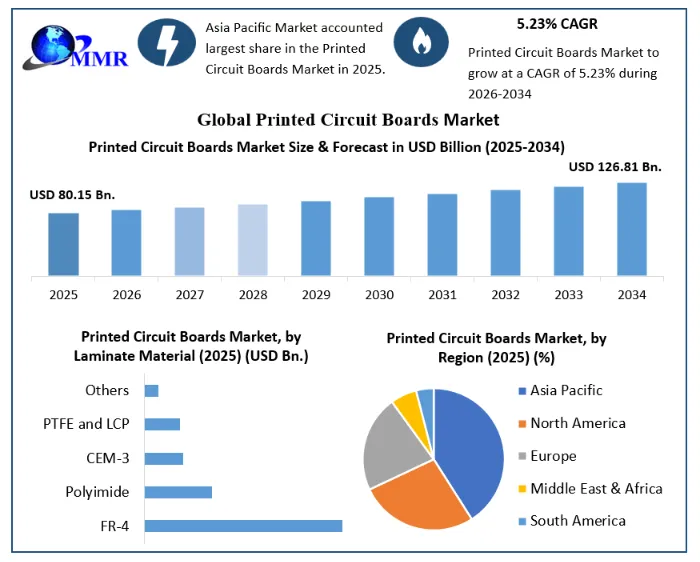
The Global Printed Circuit Boards (PCBs) Market was valued at USD 80.15 Billion in 2025 and is projected to reach USD 126.81 Billion by 2034, growing at a CAGR of 5.23% during the forecast period 2026–2034.
Printed Circuit Boards (PCBs) Market Overview
The Printed Circuit Boards (PCBs) Market includes the design, manufacturing, and distribution of electronic circuit boards that provide electrical connectivity and mechanical support for electronic components. The Global PCB Market covers single-sided PCBs, double-sided PCBs, multilayer PCBs, flexible PCBs, rigid-flex PCBs, and high-density interconnect (HDI) boards. Increasing demand for consumer electronics, automotive electronics, telecommunications equipment, medical devices, and industrial automation systems supports Printed Circuit Boards Market growth. Industries use advanced PCB technology to improve electronic performance, circuit reliability, device miniaturization, and manufacturing efficiency.
The Printed Circuit Boards Market experiences technological advancements through HDI PCB technology, flexible circuit boards, high-frequency PCBs, advanced multilayer PCB manufacturing, and automated PCB assembly. Growing adoption of electric vehicles, 5G infrastructure, AI servers, data centers, IoT devices, and smart electronics strengthens global PCB demand. Major buyers include electronics OEMs, automotive manufacturers, telecom equipment suppliers, and semiconductor companies. Asia Pacific dominates the PCB Market, supported by extensive electronics manufacturing in China, Taiwan, Japan, and South Korea. Increasing investment in electric vehicle PCBs, AI computing hardware, advanced semiconductor packaging, and high-performance electronics creates significant PCB Market opportunities.
The Printed Circuit Boards (PCBs) Market includes leading manufacturers such as Zhen Ding Technology, Unimicron Technology, Compeq Manufacturing, Nippon Mektron, AT&S, TTM Technologies, and Ibiden. For example, Zhen Ding Technology supplies advanced printed circuit boards for consumer electronics, while AT&S specializes in high-performance PCB and IC substrate technologies. Maximize Market Research (MMR) provides comprehensive PCB Market analysis, covering market size, market share, PCB segmentation, technology trends, regional growth, competitive positioning, and investment opportunities. MMR's research identifies high-growth PCB applications, electronics manufacturing trends, supply chain developments, and emerging PCB technologies, supporting manufacturers and investors in evaluating the Global Printed Circuit Boards Market forecast to 2034.
Printed Circuit Boards (PCBs) Market Growth Outlook
To know about the Research Methodology :- Request Free Sample Report
Printed Circuit Boards (PCBs) Market Dynamics:
Due to the growing demand for multi-functional systems, the PCB has become a significant factor in determining the functioning and look of high-tech smart device components. The global printed circuit board market is expected to grow due to the rising demand for electronic equipment and telecommunication devices.
The increased demand for electronic gadgets is the main driver of the global printed circuit board industry. Electronics such as cellphones, computers, and other devices have become a need for many people, and as technology progresses, people need to upgrade to the next level to keep up. PCB is used in industrial equipment such as cell towers, automated machinery, and other machines to achieve rapid operation and waste reduction/process improvement.
Demand for smartphones, computers, and tablets has surged as a result of online classes and work from home; requirements for new medical equipment, among other things, have also increased. In addition, as the world's population grows, so does the market penetration of electronic goods, increasing demand for printed circuit boards.
Market growth is being hampered by stringent restrictions governing e-waste generated from printed circuit boards. Hazardous compounds used in printed circuit boards, including lead (Pb), epoxy resins, cadmium (Cd), and mercury (Hg) do not degrade effectively and may contribute to a considerable portion of e-waste around the world. Regulations have stifled the use of low-cost raw materials in PCB manufacturing, thus reducing the profitability of PCB manufacturers.
PCB Use in Various Industries:
Printed circuit boards serve the industrial sector considerably, particularly enterprises with production lines and manufacturing facilities. These electrical components are not only necessary for day-to-day operations, but they also enable automation, which can help organizations save money and eliminate human error. PCBs can be built specifically to handle high-power applications and the harsh environments that the industrial sector requires.
Printed circuit boards and electronics play an important role in the medical industry. They're employed not only in appliances, but also in monitoring, diagnostic, and therapy equipment. The use of PCBs in the medical field is rapidly growing as technology progresses, opening up new possibilities. In scanning equipment - X-Ray screens, ultrasonic scans, and CT scanners, and some of the other scanners all use electronic components.
Various cutting-edge vehicles have a variety of innovative electronics and electrical equipment that provide more usefulness in the current automobile sector. Circuit boards have gone a long way from the days when automobiles just had a few electronic circuits for the fundamentals, and they have various applications in this industry. For instance, vehicles are increasingly incorporating navigation technologies such as satellite navigation. PCBs are used in all of these systems. Circuit boards are used to monitor and regulate advanced car control systems such as power supply, fuel regulators, and engine management.
Printed Circuit Boards (PCBs) Market Segment Analysis
Printed Circuit Boards (PCBs) Market by Application
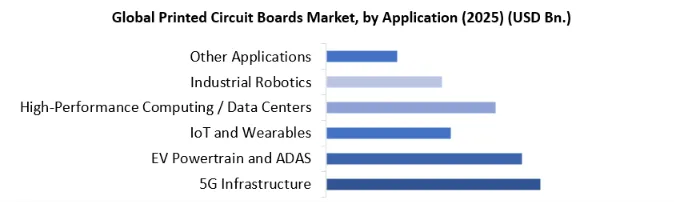
The Printed Circuit Boards (PCBs) Market by Application is segmented into 5G Infrastructure, EV Powertrain and ADAS, IoT and Wearables, High-Performance Computing / Data Centers, Industrial Robotics, and Other Applications. The 5G Infrastructure segment holds a strong market position, supported by increasing demand for high-frequency PCBs, multilayer circuit boards, telecom network equipment, and advanced communication systems. EV Powertrain and ADAS applications drive demand for automotive PCBs, battery management systems, and vehicle safety electronics, while IoT and Wearables support flexible PCB adoption. Increasing investments in AI servers, data center infrastructure, industrial robotics, high-density interconnect (HDI) PCBs, and advanced electronic manufacturing strengthen Global Printed Circuit Boards Market growth.
Printed Circuit Boards (PCBs) Market, by End-User
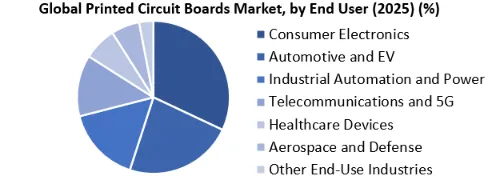
The Printed Circuit Boards (PCBs) Market by End-User is segmented into Consumer Electronics, Automotive and EV, Industrial Automation and Power, Telecommunications and 5G, Healthcare Devices, Aerospace and Defense, and Other End-Use Industries. The Consumer Electronics segment maintains a leading market position due to extensive demand for smartphone PCBs, laptop circuit boards, tablets, smart home devices, and electronic accessories. Automotive and EV manufacturers increasingly adopt high-performance automotive PCBs and rigid-flex circuit boards, while industrial automation companies require reliable PCBs for control systems and power electronics. Growing demand for medical device PCBs, aerospace electronics, 5G telecom equipment, and precision electronic components supports Printed Circuit Boards Market expansion.
Printed Circuit Boards (PCBs) Market Regional Insights:
The Asia Pacific and North American markets dominated the global printed circuit boards (PCBs) market with a fragmented supply base. With the restoration of economic activity, demand for PCB fabrication is expected to increase. It is expected to be bolstered by the simplicity with which supply chain difficulties may be resolved. Consumer and communication industries are expected to be important sources of demand. On the other hand, the amount of electronics in vehicle and medical equipment manufacturing costs is steadily increasing, resulting in increased demand for PCB.
Asia Pacific market expected to grow at a CAGR of xx% during the forecast period, owing to the presence of various semi-conductor manufacturers and the rising adoption of smart devices. The demand for PCBs in India has steadily increased in recent years as a result of increased investment in digitization and favorable government initiatives. The Indian PCB industry is predicted to grow rapidly over the next five years. The Indian government is heavily supporting the production and use of printed circuit boards in the country including "Make in India" and "Digital India" projects.
By easing the tax regime and lowering bureaucratic barriers, the government hopes to encourage manufacturers to set up more local plants in the country. This is predicted to result in considerable progress in a variety of end-use industries (automotive, electrical, and so on), boosting overall PCB demand.
The automotive sector, aircraft for safe navigation and precise surveillance, and the medical sector for novel medical technology, diagnostics, and devices are among PCB's high-demand sectors in North America. Furthermore, rising sales of electric vehicles, as well as the implementation of innovative driver assistance system technology in them, are expected to boost the PCB market demand.
Printed Circuit Boards (PCBs) Market Recent Developments:
| Exact Date | Company | Development | Impact |
|---|---|---|---|
| 03 February 2026 | AT&S | AT&S reported a 10% revenue increase to €1.3 billion for the first three quarters of 2025/26, driven by new production capacities at its Kulim and Leoben facilities. | The expansion successfully scales IC substrate and high-end PCB production to meet surging demand for Generative AI and high-performance computing applications. |
| 01 February 2026 | AT&S | The company restructured its Management Board, appointing Gerrit Steen as CFO and reducing the board to three members to streamline strategic execution. | This reorganization focuses on cost optimization and efficiency, aiming for an additional €160 million in sustainable cost reductions through the 2026 fiscal year. |
| 06 January 2026 | Jabil Inc. | Jabil completed the acquisition of Hanley Energy Group, a provider of energy management and critical power systems for data center infrastructure. | The acquisition integrates specialized power electronics and PCB assembly capabilities, positioning Jabil as a primary hardware partner for AI hyperscale data centers. |
| 01 January 2026 | Shenzhen Kinwong Electronic | Shenzhen Kinwong Electronic submitted its preliminary prospectus to the Hong Kong Stock Exchange for a "A+H" dual-primary listing. | The listing aims to fund the expansion of high-end PCB capacity, targeting the 45.7% revenue share currently driven by its automotive electronics segment. |
| 22 December 2025 | Jabil Inc. | Jabil entered a multi-year manufacturing partnership with a global automotive OEM to support PCB assembly for EV power electronics and battery management. | This partnership underscores the industry shift toward vehicle digitalization, where electric vehicles require 3-5 times more PCBs than conventional internal combustion engines. |
| 04 November 2025 | TTM Technologies | TTM Technologies reported a 19% year-on-year increase in net sales to $774.3 million, fueled by Data Center Computing and Networking demand. | The strong financial performance reflects the strategic pivot toward high-complexity interconnects and an Aerospace & Defense backlog reaching a record $1.6 billion. |
The objective of the report is to present a comprehensive analysis of the Global Printed Circuit Boards (PCBs) Market to the stakeholders in the industry. The past and current status of the industry with the forecasted market size and trends are presented in the report with the analysis of complicated data in simple language. The report covers all the aspects of the industry with a dedicated study of key players that include market leaders, followers, and new entrants.
PORTER, SVOR, PESTEL analysis with the potential impact of micro-economic factors of the market have been presented in the report. External as well as internal factors that are supposed to affect the business positively or negatively have been analysed, which will give a clear futuristic view of the industry to the decision-makers.
The report also helps in understanding the Global Printed Circuit Boards (PCBs) Market dynamics, structure by analyzing the market segments and project the global Printed Circuit Boards (PCBs) market size. Clear representation of competitive analysis of key players By Type, price, financial position, product portfolio, growth strategies, and regional presence in the Global Printed Circuit Boards (PCBs) Market make the report investor’s guide.
Printed Circuit Boards (PCBs) Market Scope: Inquire before buying
| Printed Circuit Boards (PCBs) Market | |||
|---|---|---|---|
| Report Coverage | Details | ||
| Base Year: | 2025 | Forecast Period: | 2026-2034 |
| Historical Data: | 2020 to 2025 | Market Size in 2025: | USD 80.15 Billion |
| Forecast Period 2026-2034 CAGR: | 5.23% | Market Size in 2034: | USD 126.81 Billion |
| Segments Covered: | by Product Type | Standard Multilayer Rigid 1-2 Sided High-Density Interconnect (HDI/Microvia) Flexible Rigid-Flex IC Substrates Other Product Types |
|
| by Substrate Type | Rigid (FR-4, Metal-Core) Flexible Polyimide Rigid-Flex High-Speed/High-Frequency (PTFE, LCP) |
||
| by Laminate Material | FR-4 Polyimide CEM-3 PTFE and LCP Others |
||
| by Application | 5G Infrastructure EV Powertrain and ADAS IoT and Wearables High-Performance Computing / Data Centers Industrial Robotics Other Applications |
||
| by End-User | Consumer Electronics Automotive and EV Industrial Automation and Power Telecommunications and 5G Healthcare Devices Aerospace and Defense Other End-Use Industries |
||
Printed Circuit Boards (PCBs) Market, by Region
North America (United States, Canada and Mexico)
Europe (UK, France, Germany, Italy, Spain, Sweden, Austria and Rest of Europe)
Asia Pacific (China, South Korea, Japan, India, Australia, Indonesia, Malaysia, Vietnam, Taiwan, Bangladesh, Pakistan and Rest of APAC)
Middle East and Africa (South Africa, GCC, Egypt, Nigeria and Rest of ME&A)
South America (Brazil, Argentina Rest of South America)
Printed Circuit Boards (PCBs) Market, Key Players:
1. Unimicron Technology Corporation
2. Ibiden Co. Ltd.
3. Compeq Manufacturing Co. Ltd.
4. Samsung Electro-Mechanics
5. HannStar Board Corporation
6. Dongshan Precision Manufacturing Co. Ltd. (DSBJ)
7. Kinwong Electronic Co. Ltd.
8. Victory Giant Technology
9. Daedeok Electronics Co. Ltd.
10. Jabil Inc.
11. TTM Technologies Inc.
12. Würth Elektronik Group
13. Sumitomo Electric Industries Ltd.
14. Dynamic Electronics Co. Ltd.
15. Flexium Interconnect Inc.
16. RayMing Technology
17. Shenzhen Zhongxinhua Electronics Co. Ltd.
18. Shenzhen Wonderful Technology Co. Ltd.
19. APCT
20. Advanced Circuits Inc.
21. Murrietta Circuits
22. Becker & Müller Schaltungsdruck GmbH
23. Vishal International
24. ATandS Austria Technologie and Systemtechnik AG
25. Benchmark Electronics
26. Cirexx
27. CMK
28. Epec
29. Meiko Electronics
30. Mektec Corporation
31. Multek Limited
32. SEMCO
33. Schweizer Electronic
Frequently Asked Question
1. What is the market size of the Global Printed Circuit Boards (PCBs) Market?
The market is valued at USD 80.15 Billion in 2025 and is projected to reach USD 126.81 Billion by 2034, growing at a CAGR of 5.23%.
2. What are the major growth drivers of the Printed Circuit Boards (PCBs) Market?
Increasing demand for consumer electronics, electric vehicles, 5G infrastructure, AI servers, and industrial automation drives market growth.
3. Which region dominates the Printed Circuit Boards (PCBs) Market?
Asia Pacific dominates the market, supported by extensive electronics manufacturing in China, Taiwan, Japan, and South Korea.
4. Which end-user segment leads the Printed Circuit Boards (PCBs) Market?
Consumer Electronics leads the market, driven by increasing demand for smartphones, laptops, tablets, and smart electronic devices.
5. Who are the key players in the Printed Circuit Boards (PCBs) Market?
Major players include Unimicron Technology, Ibiden, Compeq Manufacturing, Samsung Electro-Mechanics, TTM Technologies, and AT&S.