
Global Phosphine Gas Market Size by End Users, Type, Region and Forecast 2034
Overview
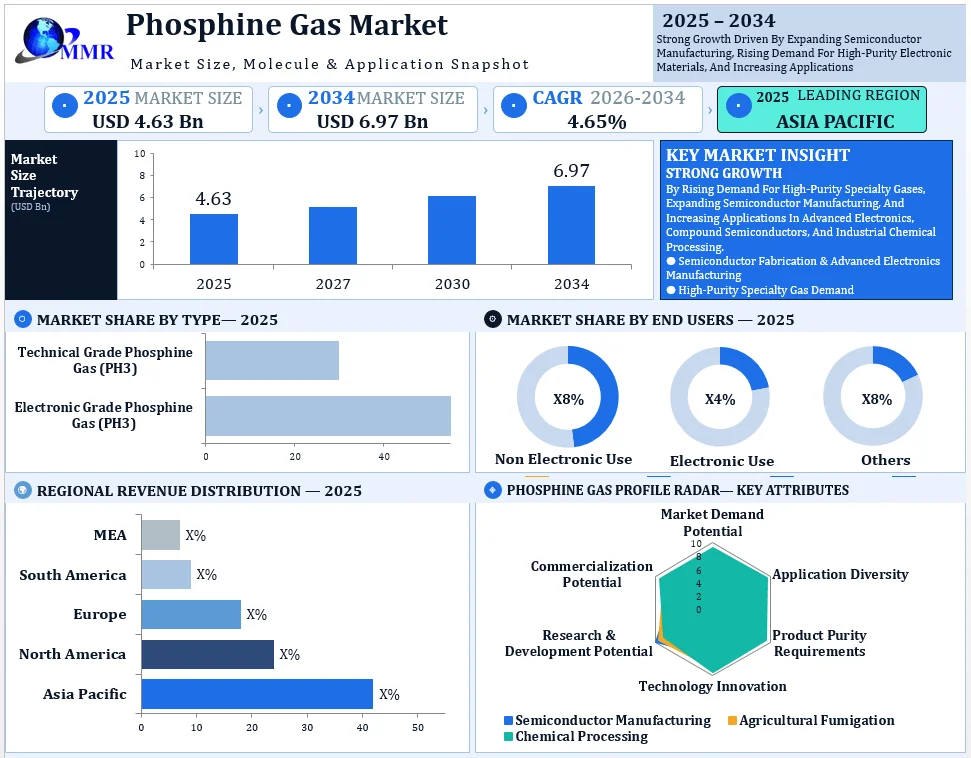
Global Phosphine Gas Market was valued nearly USD 4.63 Bn. in 2025. Phosphine Gas Market size is estimated to grow at a CAGR of 4.65 % & is expected to reach at USD 6.97 Bn. by 2034.
Global Phosphine Gas Market Overview:
The global Phosphine Gas Market research provides an in-depth look at the industry, market, & key players. The demand & supply sides of the market were analysed in the report. The global Phosphine Gas Market study also includes a competitive landscape & trends by market segments, technology, and investment.
Phosphine gas is a poisonous, odorless, & colorless gas. PH3 is the chemical formula for phosphine. Pure phosphine is odorless, however technical grade samples have a rotting fish stench due to the presence of chemical & phosphine. Phosphine is combustible in the air & produces a bright flame when burned. Phosphine is extremely poisonous and can cause respiratory problems as well as endanger life.
Phosphine gas is a poisonous gas that dissolves readily in some solvents but very sparingly in water.
Phosphine fumigation is used to treat grain siold, seed, plant products, dry fruits, dates, & other items for phytosanitary reasons. Phosphine gas is commonly utilised in gaseous form or as an aluminium phosphate pellet that releases phosphine gas when exposed to atmospheric moisture. Furthermore, the consumer electronics industry's growth and increased demand for mobile phones, LED televisions, printers, laptops, and desktop PCs are boosting the phosphine gas market's demand. The plastic industry uses phosphine's crucial role in driving the market to develop flammable kits. In addition, it is chosen as an alternative to incendiaries and flame retardants.
This growth is being fueled by factors like an increase in phosphorus demand, growth in organ phosphorus chemistry, and microelectronics, among others. Fungicidal action has been observed in insecticides containing phosphorus. Pesticides containing PH are successful because they leave no residue on food crops that must be ingested by humans or animals, while also killing pests such as insects, rats, & nematodes that live near these plants. When used correctly, they don't harm soil quality, but they should only be sprayed high up where plant life isn't present.
Global Phosphine Gas Market Growth and Share Analysis
To know about the Research Methodology :- Request Free Sample Report
Global Phosphine Gas Market Dynamics
Drivers: Growing demand for phosphine gas in semiconductor and electronics manufacturing supports market growth, as it is used in semiconductor fabrication and compound semiconductor production. Increasing demand for advanced electronic devices, communication technologies, and photovoltaic applications may further contribute to demand for high-purity specialty gases.
Restraints: The high toxicity and flammability of phosphine gas create significant occupational safety and environmental management concerns. Strict requirements for storage, transportation, monitoring, and industrial handling increase compliance costs and may limit market participation to companies with appropriate safety infrastructure.
Opportunities: Expanding semiconductor manufacturing, compound semiconductor technologies, and photovoltaic production may create growth opportunities for the phosphine gas market. The growing need for high-purity specialty gases in advanced electronics and optoelectronic devices may also encourage investment in gas purification, quality assurance, and specialized supply systems.
Challenges: Maintaining consistent gas purity and ensuring reliable supply are major challenges for market participants, particularly in semiconductor applications where strict material specifications apply. Raw material price fluctuations, specialized transportation requirements, regulatory compliance, and the need for highly controlled industrial facilities can affect operating costs and supply-chain reliability.
Global Phosphine Gas Market Segment Analysis
The application segment is divided into three categories: fumigation, semiconductor, & others (includes intermediates used in flame retardants). The application segment of the phosphine gas market is dominated by the semiconductor sub-segment. Phosphine gas is utilised as a dopant in semiconductor chips and in the production of LEDs. To give LED lights their red and yellow colors, phosphine is utilised. Factors such as energy efficiency, lower operational costs, and durability are boosting market expansion and providing new investment opportunities for market participants. LED lights are also used in LED displays for marketing and advertising.
Global Phosphine Gas Market Regional Analysis:
The Asia Pacific region currently dominates the phosphine gas market and is expected to continue to do so during the estimated period. The phosphine gas market is being boosted by lower electronic prices and increased demand for electronics such as mobile phones, laptops, and LEDs. China, Japan, & India are the most powerful countries in Asia Pacific. China dominates the consumer electronics market and is expected to continue to do so due to increased consumption in the region.
North America represents an important market due to its established semiconductor industry, advanced electronics manufacturing capabilities, and research infrastructure. The United States is a major contributor to regional demand, supported by developments in integrated circuits, compound semiconductors, and specialty materials. Investments in domestic semiconductor manufacturing and advanced electronic technologies continue to influence regional market trends.
Europe’s phosphine gas market is influenced by its semiconductor research ecosystem, specialty chemical industry, and advanced manufacturing sector. Germany, France, and the Netherlands contribute through electronics production, industrial research, and technology development. Demand is also shaped by stringent workplace safety requirements and regulatory standards governing hazardous industrial gases.
South America represents a developing market, with demand influenced by agricultural storage, grain preservation, and industrial chemical applications. Brazil and Argentina are important agricultural economies, where grain storage and pest management contribute to the broader fumigation market. Market development depends on agricultural activity, industrial investment, regulatory requirements, and access to appropriate chemical management infrastructure.
The Middle East and Africa market is influenced by agricultural storage needs, industrial development, and emerging investments in advanced manufacturing. Countries such as Saudi Arabia, the United Arab Emirates, and South Africa contribute to regional industrial activity. Future market development will depend on technology investment, demand from relevant end-use industries, regulatory compliance, and the availability of suitable industrial infrastructure.
The objective of the report is to present a comprehensive analysis of the Phosphine Gas Market to the stakeholders in the industry. The past and current status of the industry with the forecasted Market size and trends are presented in the report with the analysis of complicated data in simple language. The report covers all the aspects of the industry with a dedicated study of key players that include Market leaders, followers, and new entrants.
PORTER, PESTEL analysis with the potential impact of micro-economic factors of the Market have been presented in the report. External as well as internal factors that are supposed to affect the business positively or negatively have been analyzed, which will give a clear futuristic view of the industry to the decision-makers.
The report also helps in understanding the Phosphine Gas Market dynamics, structure by analyzing the Market segments and project the Phosphine Gas Market size. Clear representation of competitive analysis of key players by Type, price, financial position, Type portfolio, growth strategies, and regional presence in the Phosphine Gas Market make the report investor’s guide.
Global Phosphine Gas Market Competitive Landscape
The global Phosphine Gas Market is characterized by competition among specialty gas manufacturers, chemical companies, and semiconductor materials suppliers. Market competition is influenced by product purity, quality consistency, technological capabilities, supply reliability, and regulatory compliance. The semiconductor industry plays an important role in shaping demand for high-purity specialty gases, particularly as advanced electronics manufacturing continues to expand.
The broader specialty gas and semiconductor materials industries include established companies such as Linde plc, Air Liquide S.A., Air Products and Chemicals, Inc., Taiyo Nippon Sanso Corporation, Entegris, Inc., Merck KGaA, Resonac Holdings Corporation, and SK Materials Co., Ltd. These companies participate in different areas of industrial gases, specialty chemicals, electronic materials, or gas-delivery technologies; their specific involvement in phosphine gas varies.
Competitive positioning is shaped by investment in advanced materials, quality-control systems, research and development, and semiconductor industry relationships. Companies also focus on operational efficiency and supply-chain resilience to respond to changing industrial requirements. Stringent safety standards and specialized manufacturing requirements influence market entry, while technological developments in semiconductor fabrication continue to affect demand patterns and competitive dynamics.
Global Phosphine Gas Market Recent Developments:
| Date | Company | Development | Impact |
|---|---|---|---|
| 26 March 2026 |
UPL Limited |
UPL Limited advanced its commercial warehouse fumigant portfolio by introducing safer, highly efficient phosphine gas and metal phosphide formulations for bulk commodity storage protection. |
The upgraded formulations enable grain storage facilities to meet tighter phytosanitary standards while minimizing active residual concentrations in stored agricultural produce. |
| 01 June 2026 |
Detia Degesch Group |
Detia Degesch Group acquired the eFUME cylinderized phosphine-based fumigation business from Draslovka Holding a.s. to strengthen its post-harvest crop protection offerings. |
The acquisition significantly expands global deployment of high-speed phosphine treatments specifically tailored for quarantine insect prevention in the fresh fruit and perishables trade. |
| 26 July 2026 |
Safe Work Australia |
Safe Work Australia finalized regulatory transition standards reducing the workplace exposure limit (WEL) for airborne phosphine gas from 0.3 ppm to a 0.05 ppm 8-hour TWA effective December 2026. |
The mandate drives widespread industrial adoption of ultra-sensitive continuous phosphine gas detection sensors and automated ventilation controls across bulk grain handlers. |
| 11 September 2026 |
Air Products and Chemicals, Inc. |
Air Products and Chemicals secured commercial supply agreements to deliver ultra-high purity cylinderized phosphine dopant gas to advanced DRAM and NAND semiconductor fabrication facilities in Asia. |
The long-term contracts strengthen high-purity phosphine supply infrastructure required for next-generation silicon substrate deposition and atomic doping processes. |
Global Phosphine Gas Market Scope: Inquiry Before Buying
| Phosphine Gas Market | |||
|---|---|---|---|
| Report Coverage | Details | ||
| Base Year: | 2025 | Forecast Period: | 2026-2034 |
| Historical Data: | 2020 to 2025 | Market Size in 2025: | USD 4.63 Bn. |
| Forecast Period 2026 to 2034 CAGR: | 4.65% | Market Size in 2034: | USD 6.97 Bn. |
| Segments Covered: | by End Users | Non Electronic Use Electronic Use |
|
| by Type | Electronic Grade Phosphine Gas (PH3) Technical Grade Phosphine Gas (PH3) |
||
Global Phosphine Gas Market, by Region
North America (United States, Canada and Mexico)
Europe (UK, France, Germany, Italy, Spain, Sweden, Austria and Rest of Europe)
Asia Pacific (China, South Korea, Japan, India, Australia, Indonesia, Malaysia, Vietnam, Taiwan, Bangladesh, Pakistan and Rest of APAC)
Middle East and Africa (South Africa, GCC, Egypt, Nigeria and Rest of ME&A)
South America (Brazil, Argentina Rest of South America)
Global Phosphine Gas Market key Players:
1. Linde plc
2. Air Liquide S.A.
3. Air Products and Chemicals, Inc.
4. Nippon Sanso Holdings Corporation
5. Messer Group GmbH
6. Iwatani Corporation
7. Taiyo Nippon Sanso Corporation
8. Matheson Tri-Gas, Inc.
9. MKS Instruments, Inc.
10. Entegris, Inc.
11. Merck KGaA
12. Versum Materials
13. Resonac Holdings Corporation
14. Sumitomo Seika Chemicals Company, Limited
15. ADEKA Corporation
16. Kanto Denka Kogyo Co., Ltd.
17. Showa Denko Materials
18. SK Materials Co., Ltd.
19. Wonik Materials Co., Ltd.
20. Hansol Chemical Co., Ltd.
21. OCI Company Ltd.
22. Foosung Co., Ltd.
23. Hyosung Chemical Corporation
24. Mitsui Chemicals, Inc.
25. Mitsubishi Chemical Group Corporation
26. Fujifilm Corporation
27. Shin-Etsu Chemical Co., Ltd.
28. Air Water Inc.
29. Osaka Gas Chemicals Co., Ltd.
30. Sumitomo Chemical Co., Ltd.
31. Tokyo Ohka Kogyo Co., Ltd.
32. JSR Corporation
33. DuPont de Nemours, Inc.
34. Honeywell International Inc.
35. BASF SE
36. Solvay S.A.
37. KMG Chemicals, Inc.
38. Linde Electronics
39. Air Liquide Electronics
40. Air Products Electronics
Frequently Asked Questions:
1. Which region has the largest share in Global Phosphine Gas Market?
Ans: Asia Pacific region held the highest share in 2025.
2. What is the growth rate of Global Phosphine Gas Market?
Ans: The Global Phosphine Gas Market is growing at a CAGR of 4.65% during forecasting period 2026-2034.
3. What is scope of the Global Phosphine Gas Market report?
Ans: Global Phosphine Gas Market report helps with the PESTEL, PORTER, COVID-19 Impact analysis, Recommendations for Investors & Leaders, and market estimation of the forecast period.
4. Who are the key players in Global Phosphine Gas Market?
Ans: The important key players in the Global Phosphine Gas Market are – CYTEC SOLVAY GROUP, Praxair Inc, Air Products, Chemicals Inc, BASF SE, The Linde Group., Nippon Chemical Industrial, Pentagon Chemicals, Bhagwati Chemicals, Gasco, and Others.
5. What is the study period of this Market?
Ans: The Global Phosphine Gas Market is studied from 2020 to 2034.