Oil Free Air Compressor Market by Type, Product, Power Rating, End-User and Region – Global Market Size Estimation, Industry-Wide Analysis, Competitive Landscape Assessment & Long-Term Forecast to 2032

4.2%
CAGR (2026-2032)
14.96 USD Bn.
Market Size
314
Report Pages
161
Market Tables

Overview

Oil Free Air Compressor Market was valued at USD 14.96 billion in 2025, and total global Oil-Free Air Compressor Market revenue is expected to grow at a CAGR of 4.2% from 2026to 2032, reaching nearly USD 19.96 billion. Rising demand for clean and contaminant-free compressed air in industries.

Global Oil Free Air Compressor Market Introduction

A compressor is a pre-lubricated mechanical device that boosts a gas's pressure by reducing its volume without using oil. These are made to work without the use of any oil in the compression chamber. CFM (cubic feet per minute of intake air) and HP (horsepower) are the two units of measurement for an oil-free compressor (horsepower).

Compressed air is a commodity on par with energy, water, and heat, and it's used in almost every industrial manufacturing operation. In almost all manufacturing plants, compressed air is used to power machines, tools, processes, and automation, as well as to transport materials related to production processes in various ways.
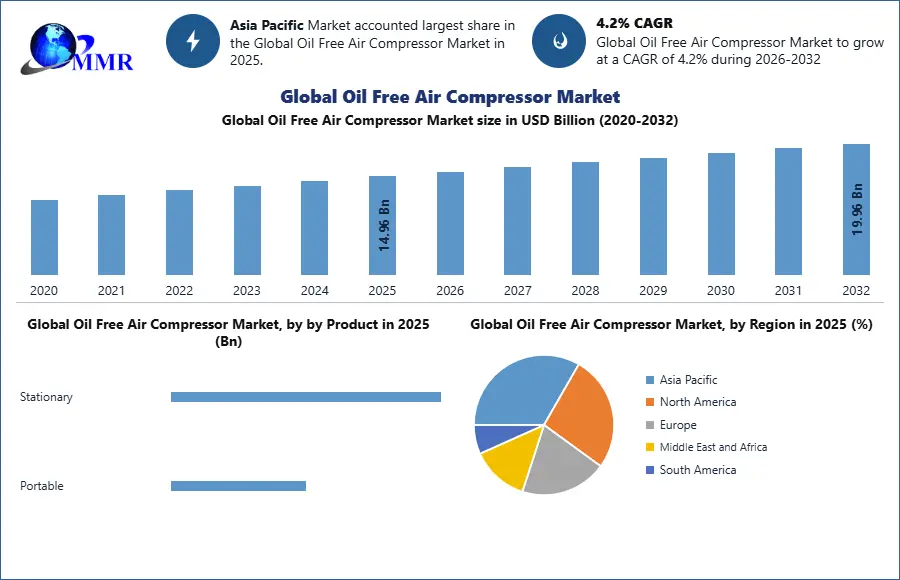
Global Oil Free Air Compressor MarketTo know about the Research Methodology :- Request Free Sample Report

Global Oil Free Air Compressor Market Dynamics

Rising Demand for Contamination-Free Compressed Air Accelerates Global Oil Free Air Compressor Market Growth

The increasing demand for clean and contamination-free compressed air across multiple industries is a major driver fueling the growth of the Global Oil Free Air Compressor Market. Industries such as pharmaceuticals, food & beverages, electronics, healthcare, chemicals, and semiconductor manufacturing are rapidly adopting oil free air compressors to maintain strict product quality and regulatory compliance standards. These compressors eliminate the risk of oil contamination during production processes, making them highly suitable for sensitive industrial applications. Growing industrial automation, expansion of manufacturing facilities, and rising investments in high-purity production environments are further increasing the demand for energy-efficient oil free air compressor systems. In addition, stringent environmental regulations and ISO Class 0 air quality standards are encouraging industries to replace conventional lubricated compressors with advanced oil free compressor technologies. The rising focus on operational efficiency, low maintenance costs, and sustainable industrial equipment is also supporting market expansion. Furthermore, technological advancements such as variable speed drive systems, smart monitoring technologies, and energy recovery solutions are significantly improving compressor performance and accelerating the growth of the Global Oil Free Air Compressor Market.

High Initial Investment and Maintenance Complexity Restrict Oil Free Air Compressor Market Expansion

The high initial installation cost associated with oil free air compressor systems remains a major restraint limiting the growth of the Global Oil Free Air Compressor Market. Oil free compressors require advanced engineering designs, specialized materials, and sophisticated cooling systems, making them more expensive compared to conventional oil-lubricated compressors. Small and medium-sized enterprises often face budget limitations, restricting large-scale adoption of premium oil free technologies. In addition, maintaining oil free compressor systems requires skilled technicians and regular servicing of critical components such as bearings, seals, and air filtration systems. Improper maintenance can reduce equipment efficiency and increase operational downtime. Furthermore, energy consumption concerns in certain high-pressure applications and fluctuating raw material prices affecting compressor manufacturing costs create additional market challenges. Limited awareness regarding long-term cost benefits in developing economies also slows the adoption of oil free compressed air systems across industrial sectors.

Expansion of Semiconductor, Healthcare, and Sustainable Manufacturing Industries Creates New Opportunities in the Global Oil Free Air Compressor Market

Rapid expansion of semiconductor manufacturing, healthcare infrastructure, and sustainable industrial operations is creating significant growth opportunities in the Global Oil Free Air Compressor Market. Semiconductor fabrication facilities increasingly require ultra-clean compressed air systems to maintain precision manufacturing and prevent contamination during chip production processes. Similarly, hospitals, pharmaceutical companies, and biotechnology laboratories are adopting oil free compressors to ensure sterile and high-purity operational environments. The growing emphasis on green manufacturing and carbon emission reduction is also encouraging industries to invest in energy-efficient and environmentally friendly compressor technologies. Emerging economies in Asia-Pacific, particularly China, India, South Korea, and Southeast Asia, are witnessing substantial industrialization and infrastructure development, creating strong demand for advanced compressed air systems. In addition, increasing integration of IoT-enabled monitoring systems, predictive maintenance technologies, and AI-based energy optimization solutions is expected to create new revenue opportunities for manufacturers operating in the Global Oil Free Air Compressor Market.

Global Oil Free Air Compressor Market Segment Analysis

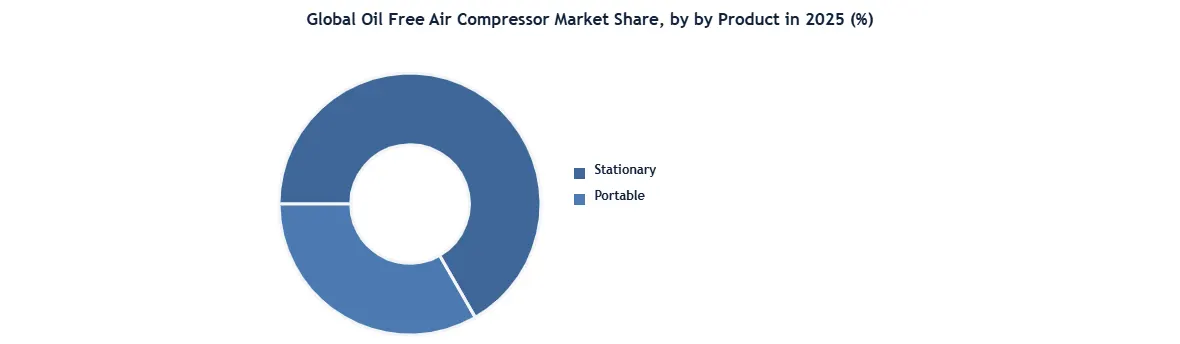
Based on Product, Stationary compressors lead the market in 2024 because most industrial and manufacturing facilities require a stable, high-capacity air supply that cannot be achieved by portable units. They are designed for continuous operation, offering higher output and better energy efficiency for large-scale processes. Stationary units also support integration with plant-wide compressed air systems, enabling better monitoring, control, and reduced downtime. Industries like food & beverage, pharmaceuticals, and automotive rely on stationary compressors to meet strict hygiene and operational standards. Moreover, stationary compressors have longer lifespans and can be customized for specific industrial needs, making them the preferred choice over portable options.
Global Oil Free Air Compressor Market Regional Insights

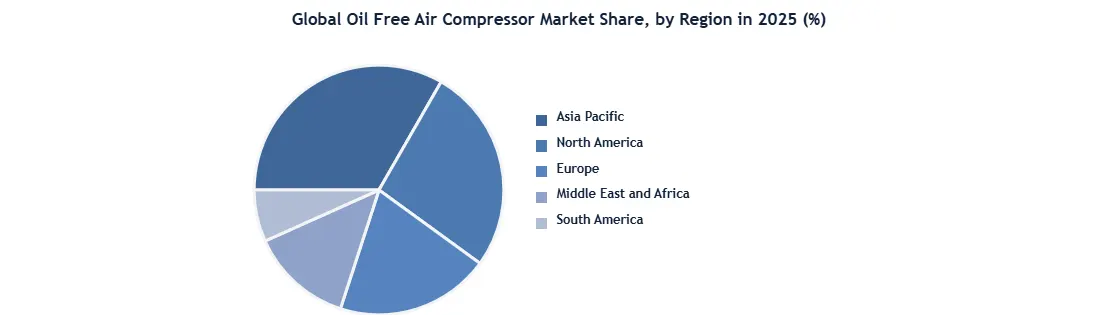
Due to increased expenditure on infrastructure development and manufacturing facilities, the Asia Pacific market is expected to grow at the fastest CAGR during the forecast period. Latin America, the Middle East, and Africa are also expected to grow significantly in the future, owing to changing regulatory conditions and growing awareness of the importance of using environmentally friendly and sustainable products.

The Middle East region's adoption of these compressors has been fuelled by an increasing need to increase power generation capacities in order to efficiently meet the demand of a growing population. Furthermore, the market's untapped potential for downstream operations in developing countries such as Kuwait, the United Arab Emirates, and Qatar provides new growth opportunities.

In 2025, the North American and European regions saw significant development. However, due to the saturation of end-use industries, market shares in these regions are expected to decline over the forecast period. Furthermore, the widespread financial crisis and European economic downturn have harmed product demand.
Global Oil Free Air Compressor Market Recent Development:

  • In January 2026, Ingersoll Rand introduced the LS Series low-pressure oil-free screw air compressors in India. The new compressors deliver ISO Class 0 certified oil-free air and are specifically designed for industries such as pharmaceuticals, cement, food processing, and power generation. The systems also include advanced control technologies for enhanced energy efficiency and operational reliability.
  • In July 2025, Atlas Copco expanded its oil-free compressor portfolio by launching advanced ZR and ZT series compressors for pharmaceutical and industrial manufacturing applications. The new models feature Variable Speed Drive (VSD) technology, improved airflow systems, and enhanced energy-efficient designs to support contamination-free compressed air operations.
  • In October 2025, Hitachi Industrial Equipment Systems launched the G Series oil-free scroll air compressors capable of operating efficiently in high-temperature industrial environments up to 45°C. The compressors include compact designs and digital monitoring systems to improve industrial air management and operational performance.
  • In September 2024, Hitachi Global Air Power expanded the Sullair DS Series oil-free rotary screw compressor lineup with 280–450 kW models designed for large-scale industrial operations. The compressors feature AirLinx remote monitoring systems, compact two-stage air ends, and advanced rotor coating technologies for improved efficiency and serviceability.
  • In June 2025, CompAir introduced an upgraded Ultima oil-free air compressor range with dual high-speed permanent magnetic motors and IE5+IES2 efficiency ratings. The compressors are designed to deliver reduced footprint, lower noise levels, and up to 90% heat recovery for industrial energy optimization.
  • In February 2025, ELGi Equipments introduced STABILISOR technology for industrial air compressor systems. The technology is designed to balance air supply and demand, reduce unnecessary compressor load cycles, improve energy efficiency, and extend equipment lifespan in industrial facilities.
  • In 2025, Kaeser Kompressoren continued expanding its intelligent compressor technologies by focusing on predictive maintenance systems, remote monitoring solutions, and energy-efficient oil-free rotary compressor innovations for manufacturing and electronics industries.

Global Oil Free Air Compressor Market Report Scope: Inquire before buying

Global Oil Free Air Compressor Market
Report Coverage Details
Base Year: 2025 Forecast Period: 2026-2032
Historical Data: 2020 to 2025 Market Size in 2025: 14.96 USD Billion
Forecast Period 2026-2032 CAGR: 4.2% Market Size in 2032: 19.96 USD Billion
Segments Covered: by Product Stationary
Portable
by Technology Reciprocating
Rotary/Screw
Centrifugal
Others
by Power Below 15kW
15-55kW
55-160kW
Above 160 kW
by End-User Automotive
Food & Beverage
Pharmaceuticals
Electronics & Semiconductors
Healthcare
Others

Oil Free Air Compressor Market, by Region

North America (United States, Canada and Mexico)
Europe (UK, France, Germany, Italy, Spain, Sweden, Austria, Turkey, Russia and Rest of Europe)
Asia Pacific (China, India, Japan, South Korea, Australia, ASEAN and Rest of APAC)
Middle East and Africa (South Africa, GCC, Egypt, Nigeria and Rest of ME&A)
South America (Brazil, Argentina, Columbia and Rest of South America)

Oil Free Air Compressor Market, Key Players are

  1. Atlas Copco.
  2. Ingersoll Rand
  3. Sullair
  4. Kaeser Kompressoren
  5. Gardner Denver
  6. Bauer Compressors
  7. Elgi Equipments Limited
  8. Boge Compressors
  9. Quincy Compressor
  10. CompAir
  11. Hitachi Industrial Equipment Systems Co., Ltd.
  12. Mitsubishi Heavy Industries
  13. Airpack
  14. Zen Air Tech Private Limited
  15. Frank Technologies Pvt Ltd
  16. FS-Curtis
  17. Air Services Company
  18. Direct Air & Pipework Ltd
  19. BEKO Technologies
  20. ALMiG Kompressoren GmbH
  21. Airman
  22. Powerex (Pinnacle)
  23. Champion (Permanent Products)
  24. Kobelco (Kobe Steel)
  25. Aerzen
  26. HANWHA Power Systems
  27. MINNUO Group
  28. Shanghai Sollant Energy Saving Technology Co. Ltd.
  29. Air Squared
  30. Neuman & Esser Group (NEA)
  31. Others

Table of Contents

1. Oil Free Air Compressor Market: Executive Summary 1.1. Executive Summary 1.2. Market Size (2025) & Forecast (2026-2032), 1.3. Market Size (Value in USD, Volume in 000'Units) and Market Share (%) – By Segments, Regions, and Country 2. Competitive Landscape 2.1. MMR Competition Matrix 2.2. Competitive Positioning Of Global Key Players 2.3. Key Players Benchmarking 2.3.1 Company Name 2.3.2 Headquarters 2.3.3 Product Portfolio 2.3.4 Power capacity 2.3.5 Technology Utilization 2.3.6 End-User 2.3.7 Revenue (USD Million, 2025) 2.3.8 Gross Margin (%) 2.3.9 Year-on-Year Growth (%) 2.3.10 Market Share (%) (2025), By Region 2.3.11 Product Performance & Reliability Ratings 2.3.12 Certification & Compliance Strength 2.3.13 R&D & Innovation Capability 2.3.14 Manufacturing Scale & Localization 2.3.15 Recent Developments 2.3.16 Geographical Presence 2.3.17 Strategic Partnerships & Alliances 2.4. Market Structure 2.4.1 Market Leaders 2.4.2 Market Followers 2.4.3 Emerging Players 2.5. Production Capacity Of Oil Free Air Compressor (2025) 2.6. Tier 1 vs Tier 2 Supplier Mapping (2025) 2.6.1 Tier 1 Suppliers 2.6.2 Leading Oil-Free Air Compressor Manufacturers 2.6.3 Global Technology Providers 2.6.4 Major Industrial Equipment Suppliers 2.6.5 Large-Scale OEM Suppliers 2.6.6 Global Distributors and Service Providers 2.6.7 Tier 2 Suppliers 2.6.8 Mid-Range Oil-Free Air Compressor Manufacturers 2.6.9 Regional Equipment Suppliers 2.6.10 Niche Technology Developers 2.6.11 Local Distributors and Service Providers 2.6.12 Specialty Component Suppliers 2.7 Strategic Developments, M&A, and Alliances 2.7.1 Strategic Developments 2.7.2 Technological Advancements 2.7.3 Product Innovations 2.7.4 Market Expansion 2.7.5 Mergers & Acquisitions (M&A) 2.7.6 Acquisitions by Major Oil-Free Air Compressor Manufacturers 2.7.7 Strategic Mergers in the Streaming and Content Distribution Sector 2.7.8 Strategic Alliances 2.7.9 Platform Collaborations 2.7.10 Content Distribution Partnerships 2.7.11 Cross-Industry Partnerships 2.8. Brand Strength, Reputation, and Trust-Based Competition 2.8.1 Reputation for Reliability and Quality 2.8.2 Customer Trust and Loyalty 2.8.3 Brand Differentiation through Innovation 2.8.4 Industry Recognition and Certifications 2.8.5 Customer-Centric Approach 2.8.6 Market Leadership and Established Presence 2.8.7 Competitive Pricing and Value Proposition 2.8.8 Sustainability and Environmental Reputation 3. Market Dynamics 3.1. Market Trends 3.2. Oil Free Air Compressor Market Dynamics 3.2.1 Drivers 3.2.2 Restraints 3.2.3 Opportunities 3.2.4 Challenges 3.3. PORTER’s Five Forces Analysis 3.4. PESTLE Analysis 3.5. Value Chain Analysis 3.6. Key Opinion Leader Analysis For the Global Industry 4. Technological Innovations & Advancements 4.1 Energy Efficiency Improvements 4.2 Integration of IoT and Smart Technology 4.3 Eco-Friendly Refrigerants and Sustainable Solutions 4.4 Noise Reduction Technologies 4.5 Enhanced Compression Technology (e.g., Rotary/Screw) 4.6 Digital Controls and Automation 4.7 Variable Speed Drives (VSD) for Performance Optimization 4.8 Advanced Materials for Durability and Performance 4.9 Miniaturization and Compact Designs 4.10 Advanced Diagnostics and Predictive Maintenance 5. Pricing & Revenue Models Analysis 5.1 Historical Pricing Trends of Oil Free Air Compressor Product (2020–2025) (USD) 5.2 Cost Structure of Oil Free Air Compressor, by Power (2025) (%) 5.3 Pay-Per-Use or Leasing Models for Industrial Applications 5.4 Bundled Pricing (Compressor + Maintenance) 5.5 Volume-Based Pricing for Large-Scale Industrial Clients 5.6 Premium Pricing for High-End, Energy-Efficient Models 5.7 Discounts and Incentives for Long-Term Contracts 5.8 Value-Based Pricing for Eco-Friendly and Smart Compressors 5.9 Region-Based Pricing Strategies 6. Supply Chain & Operational Insights 6.1 Global Sourcing of Raw Materials 6.2 Manufacturing and Assembly Locations 6.3 Supplier Relationship Management 6.4 Inventory Management and Lead Time Optimization 6.5 Logistics and Distribution Networks 6.6 Customization and Local Production for Regional Markets 6.7 Quality Control and Compliance with Industry Standards 6.8 After-Sales Service and Maintenance Network 6.9 Technology Integration in Supply Chain 6.10 Sustainability in Operations 7. Growth of Smart Oil Free Air Compressors by Top End‑Use Industries (2025–2032) 7.1 Oil Free Air Compressor in Automotive Sector Growth Rate % 2025–2032 by Region 7.2 Oil Free Air Compressor in Food & Beverage Sector Growth Rate % 2025–2032 by Region 7.3 Electronics & Semiconductors Sector Growth Rate % by Region. 7.4 Adoption of smart compressors for better control, efficiency, and reduced downtime. 8. Trade, Export, and Import Intelligence 8.1 Top Exporting Countries of Oil Free Air Compressors (2025) 8.2 Top Importing Countries of Oil Free Air Compressors (2025) 8.3 Trade Balance and Surplus/Deficit Analysis for Oil Free Air Compressors by Region 8.4 Tariff and Non‑Tariff Barriers Impacting Oil Free Air Compressor Trade 8.5 Cross‑Border Supply Chain and Logistics Trends 9. Investment Landscape & Growth Opportunities 9.1 Venture Capital and Private Equity Investments 9.2 Strategic Investments by OEMs and Industry Leaders 9.3 Opportunities in Emerging Markets (Asia‑Pacific, Latin America, MEA) 9.4 Green and Energy‑Efficient Technology Investments 9.5 Expansion of After‑Sales, Service & Maintenance Infrastructure 9.6 Collaborations and Technology Licensing Opportunities 9.7 Opportunities in Smart & IoT‑Enabled Compressor Solutions 9.8 Public–Private Partnerships in Industrial Automation Initiatives 9.9 Growth Potential in Healthcare, Electronics & Semiconductor Sectors 9.10 Investment in Local Manufacturing and Regional Production Hubs 10. Policy, Regulatory, and Compliance Environment 10.1 Environmental Regulations on Emissions and Energy Efficiency 10.2 Industrial Safety Standards and Compliance Requirements 10.3 Regional Certification Requirements (e.g., ISO, CE, UL) 10.4 Government Policies Promoting Clean and Oil‑Free Technologies 10.5 Import/Export and Trade Compliance Rules 10.6 Energy Consumption and Efficiency Standards 10.7 Local Regulatory Frameworks for Manufacturing and Operation 10.8 Product Labeling and Safety Compliance Mandates 10.9 Regulations on Noise and Workplace Safety 10.10 Penalties, Audits, and Enforcement Mechanisms 11. Demand of Technology in Oil Free Air Compressor: Market Share and YoY Growth (2025–2032) 11.1 Reciprocating Technology Demand in Global Oil Free Air Compressor Market Share (%) By Region 2025 11.2 North America 11.3 Europe 11.4 Asia Pacific 11.5 Middle East and Africa 11.6 South America 11.7 Rotary/Screw in Global Oil Free Air Compressor Market YoY Growth Rate (%) 2025–2032 11.8 Region wise Consumption of Oil Free Air Compressor by Technology 2025 11.9 Adoption of Centrifugal technology in Oil Free Air Compressor Industry 2025 12. Customer Insights & Buying Behavior Analysis 12.1 Customer Preferences and Priorities in Oil-Free Air Compressor Selection 12.2 Key Purchase Decision Drivers in the Oil-Free Air Compressor Market 12.3 Industry-Specific Demands for Oil-Free Air Compressors 12.4 The Role of After-Sales Support in Oil-Free Air Compressor Purchases 12.5 Regional Differences in Oil-Free Air Compressor Demand and Preferences 12.6 Brand Loyalty and Trust Factors in Oil-Free Air Compressor Purchases 12.7 Impact of Online and Offline Channels on Oil-Free Air Compressor Buying Behavior 12.8 Price Sensitivity and Its Impact on Oil-Free Air Compressor Purchases 13. Oil Free Air Compressor Market: Global Market Size and Forecast by Segmentation (by Value in USD Million & Volume in 000'Units) (2025-2032) 13.1. Global Oil Free Air Compressor Market Size and Forecast, by Product 13.1.1 Stationary 13.1.2 Portable 13.2. Global Oil Free Air Compressor Market Size and Forecast, by Technology 13.2.1 Reciprocating 13.2.2 Rotary/Screw 13.2.3 Centrifugal 13.2.4 Others 13.3. Global Oil Free Air Compressor Market Size and Forecast, by Power 13.3.1 Below 15kW 15-55kW 55-160kW 55.1 Above 160 kW 13.4. Global Oil Free Air Compressor Market Size and Forecast, by End-User 13.4.1 Automotive 13.4.2 Food & Beverage 13.4.3 Pharmaceuticals 13.4.4 Electronics & Semiconductors 13.4.5 Healthcare 13.4.6 Others 13.5. Global Oil Free Air Compressor Market Size and Forecast, by Region 13.5.1 North America 13.5.2 Europe 13.5.3 Asia Pacific Middle East and Africa 13.5.4 South America 14. North America Oil Free Air Compressor Market Size and Forecast by Segmentation (by Value in USD Million & Volume in 000'Units) (2025-2032) 14.1. North America Market Size and Forecast, by Product 14.2. North America Market Size and Forecast, by Technology 14.3. North America Market Size and Forecast, by Power 14.4. North America Market Size and Forecast, by End-User 14.5. North America Market Size and Forecast, by Country 14.5.1 United States 14.5.2 United States Market Size and Forecast, by Product 14.5.3 United States Market Size and Forecast, by Technology 14.5.4 United States Market Size and Forecast, by Power 14.5.5 United States Market Size and Forecast, by End-User 14.5.6 United States Market Size and Forecast, by Technology 14.5.7 United States Market Size and Forecast, by End-User 14.5.8 United States Market Size and Forecast, by Sales Channel 14.5.9 Canada 14.5.10 Mexico 15. Europe Oil Free Air Compressor Market Size and Forecast by Segmentation (by Value in USD Million & Volume in 000'Units) (2025-2032) 15.1. Europe Market Size and Forecast, by Product 15.2. Europe Market Size and Forecast, by Technology 15.3. Europe Market Size and Forecast, by Power 15.4. Europe Market Size and Forecast, by End-User 15.5. Europe Market Size and Forecast, by Country 15.5.1 United Kingdom 15.5.2 France 15.5.3 Germany 15.5.4 Italy 15.5.5 Spain 15.5.6 Netherlands 15.5.7 Belgium 15.5.8 Russia 15.5.9 Turkey 15.5.10 Sweden 15.5.11 Poland 15.5.12 Rest of Europe 16. Asia Pacific Oil Free Air Compressor Market Size and Forecast by Segmentation (by Value in USD Million & Volume in 000'Units) (2025-2032) 16.1. Asia Pacific Market Size and Forecast, by Product 16.2. Asia Pacific Market Size and Forecast, by Technology 16.3. Asia Pacific Market Size and Forecast, by Power 16.4. Asia Pacific Market Size and Forecast, by End-User 16.5. Asia Pacific Market Size and Forecast, by Country 16.5.1 China 16.5.2 South Korea 16.5.3 Japan 16.5.4 India 16.5.5 Taiwan 16.5.6 Australia 16.5.7 Indonesia 16.5.8 Philippines 16.5.9 Malaysia 16.5.10 Vietnam 16.5.11 Thailand 16.5.12 Rest of Asia Pacific 17. Middle East and Africa Oil Free Air Compressor Market Size and Forecast by Segmentation (by Value in USD Million & Volume in 000'Units) (2025-2032) 17.1. Middle East and Africa Market Size and Forecast, by Product 17.2. Middle East and Africa Market Size and Forecast, by Technology 17.3. Middle East and Africa Market Size and Forecast, by Power 17.4. Middle East and Africa Market Size and Forecast, by End-User 17.5. Middle East and Africa Market Size and Forecast, by Country 17.5.1 South Africa 17.5.2 GCC 17.5.3 Egypt 17.5.4 Nigeria 17.5.5 Rest of ME&A 18. South America Oil Free Air Compressor Market Size and Forecast by Segmentation (by Value in USD Million & Volume in 000'Units) (2025-2032) 18.1. South America Market Size and Forecast, by Product 18.2. South America Market Size and Forecast, by Technology 18.3. South America Market Size and Forecast, by Power 18.4. South America Market Size and Forecast, by End-User 18.5. South America Market Size and Forecast, by Country 18.5.1 Brazil 18.5.2 Argentina 18.5.3 Colombia 18.5.4 Chile 18.5.5 Rest Of South America 19. Company Profile: Key Players 19.1. Atlas Copco. 19.1.1 Company Overview 19.1.2 Business Portfolio 19.1.3 Financial Overview 19.1.4 SWOT Analysis 19.1.5 Strategic Analysis 19.1.6 Recent Developments 19.2. Ingersoll Rand 19.3. Sullair 19.4. Kaeser Kompressoren 19.5. Gardner Denver 19.6. Bauer Compressors 19.7. Elgi Equipments Limited 19.8. Boge Compressors 19.9. Quincy Compressor 19.10. CompAir 19.11. Hitachi Industrial Equipment Systems Co., Ltd. 19.12. Mitsubishi Heavy Industries 19.13. Airpack 19.14. Zen Air Tech Private Limited 19.15. Frank Technologies Pvt Ltd 19.16. FS-Curtis 19.17. Air Services Company 19.18. Direct Air & Pipework Ltd 19.19. BEKO Technologies 19.20. ALMiG Kompressoren GmbH 19.21. Airman 19.22. Powerex (Pinnacle) 19.23. Champion (Permanent Products) 19.24. Kobelco (Kobe Steel) 19.25. Aerzen 19.26. HANWHA Power Systems 19.27. MINNUO Group 19.28. Shanghai Sollant Energy Saving Technology Co. Ltd. 19.29. Air Squared 19.30. Neuman & Esser Group (NEA) 19.30.1 Others 20. Key Findings 21. Analyst Recommendations 22. Research Methodology

Custom Market Research Services

We Will Customise The Research For You, In Case The Report Listed Above Does Not Meet With Your Requirements