Flue Gas Treatment Systems Market – Global Market Size, Strategic Growth Drivers, Risk Assessment Framework, Regulatory Landscape Review, Competitive Intensity Mapping & Long-Term Industry Outlook to 2034

7.1%
CAGR (2026-2034)
80.11 USD Bn.
Forecast Market Size
329
Report Pages
147
Market Tables

Overview

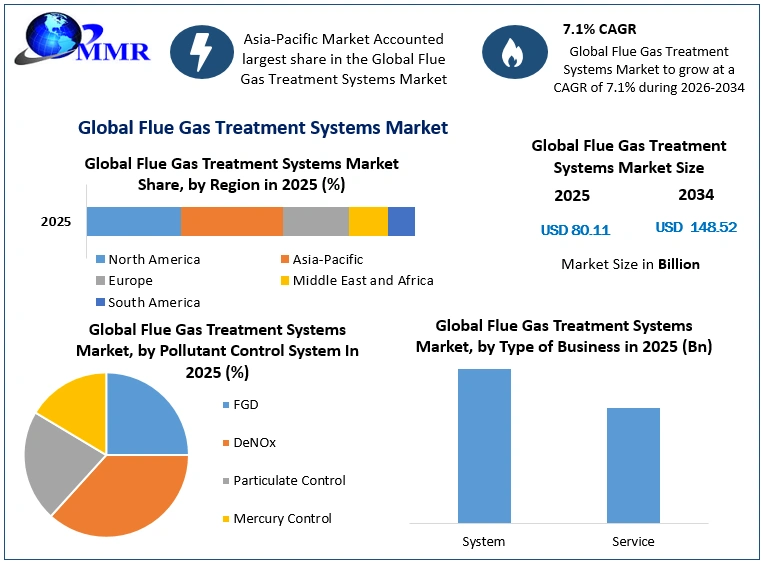
The Global Flue Gas Treatment Systems Market is estimated to be valued at USD 80.11 billion in 2025. The market is expected to reach USD 148.52 billion by 2034, exhibiting a compound annual growth rate (CAGR) of 7.10% from 2026 to 2034.

Global Flue Gas Treatment Systems Market Overview

Flue gas treatment systems refer to the equipment, which consists of a bag filter, a dry reactor, and a multi-cyclone that collects any remaining pollutants and makes sure that emissions meet strict emission regulations. Global flue gas treatment systems are used to purify the gas produced by energy from waste before it is released into the environment. Flue gas is a kind of gas that is present in the atmosphere and passes through a flue. A flue is a pipe used for conveying satanist gas through a fireplace, oven, furnace, boiler, or steam generator. Flue gas is emitted when coal, oil, natural gas, wood, or any other fuel is ignited in any industrial furnace, steam-generating boiler, or large combustion device. Flue gas usually consists of carbon dioxide, water vapor, nitrogen, and oxygen, along with pollutants like particulate matter, carbon monoxide, nitrogen oxides, and sulfur oxides. Fun gas tram systems are some tools and technologies bundled together to eliminate hazardous gas elements like nitrogen oxides and sulfur oxides from industries. These systems use devices such as electrostatic precipitators and scrubbers, which are at least 90% successful in removing environmentally unfriendly pollutants.

The increasing demand for global flue gas treatment systems market from metal-forging industries due to the presence of harmful compounds like sulfur in the smoke, coupled with the growing infrastructure and construction industry globally, will drive the growth of the market in the forecast period. Flue gas treatment systems are mainly developed to control the emissions of various pollutants, including fly ash, sulfur dioxide, nitrogen oxides, and volatile organic compounds that may cause air pollution. Moreover, these systems are utilized by various end-user industries namely cement, iron, power, chemical, and petrochemical, in emerging economies majorly India, China, and Indonesia, the demand for cement has increased due to which the project based on infrastructure developments has also increased, which further drives the global flue gas treatment systems market growth in the upcoming years.

Key Companies Insights:

• In 2025, Babcock & Wilcox Enterprises, Inc. (B&W) expanded its environmental technologies division with a new USD 120 Billion contract in Asia for a full-suite flue gas desulfurization (FGD) system. The company also enhanced its SPIG cooling system offerings through a strategic collaboration in Europe.
• GE Power secured new service contracts in 2025 with coal-fired utilities in the Middle East and Southeast Asia, offering upgrades to existing wet scrubbers and NOx control systems. The company is leveraging its AI-based monitoring platform for operational optimization.

Global Flue Gas Treatment Systems Market Growth and Share Analysis
Global Flue Gas Treatment Systems Market Growth

To know about the Research Methodology :- Request Free Sample Report

Global Flue Gas Treatment Systems Market Dynamics:

Global Flue Gas Treatment Systems Market Drivers:

Growing Construction and Re-Construction Activities of the Market The global flue gas treatment systems market is projected to boost due to increased construction and re-construction activities in both developed and developing countries, resulting in increased cement use and stricter government regulations on pollution and effluent emissions Hue gis treatment in a method of removing or reducing pollutants and other ambil gases emitted by the combustion of fossil fuels at power plants, industrial fascines, manufacturing units, and other industrial facilities.

When fossil fuels like kerosene, coal, natural gas, wood, diesel, and others are bound to produce electricity or heat, they emit mercury, carbon dioxide, sulfur dioxide, sulfides, and other particles known as flue gases. The unity of these dangerous flue gases also contains nitrogen oxides. If flue gas from industrial buildings, manufacturing units, and power plants is not handled, it can contaminate the air in neighboring areas and spread further. Moreover, the demand for cement is being driven by increased infrastructure projects such as flyovers, tunnels, bridges, dams, highways, and construction activity in the commercial sector. As a result, Gaffur oxides and dioxides are released into the environment during cement manufacturing and pyro-stage combustion.

Global Flue Gas Treatment Systems Market Restraints:

The extraction and use of fossil fuels emits around 22 billion tonnes of carbon dioxide into the atmosphere each year, and the volume of emissions is steadily increasing. Therefore, new environmental rules to reduce VOC emissions have been enacted to identify, assess, and eliminate the root source of these emissions to save the environment. Therefore, this factor is projected to be one of the primary drivers of the global flue gas treatment market growth in the upcoming years. Environmental rules have resulted in an implicit pollution tax that has been increased in recent years for US manufacturing enterprises. Manufacturers in many industrial verticals have been pushed to create product improvements and promote the cause of a clean environment and lower VOC emissions due to a strict regulatory framework.

Global Flue Gas Treatment Systems Market Segmentation

Based on the Pollutant Control System, The particle control segment dominated the Global Flue Gas Treatment Systems Market in the year 2025 and is expected to continue its dominance during the forecast period. The particle control segment accounted for the highest proportion of the flue gas treatment systems market based on the pollutant control system. Therefore, during the projection period, this market sector is expected to maintain its dominance.

Moreover, the increased consumption of electrostatic precipitators and bag filters in various end-use industries, including power, cement, iron & start nonferrous metal, and chemical & petrochemical, can be attributed to the increase in the particulate control segment of the growth of the market. Various technologies to limit mercury emissions are projected to promote the growth of the market in multiple nations, such as the United States, India, and China, in the next eight years.

Based on the Type of Business, The system segment dominated the Global Market in the year 2025 and is expected to continue its dominance during the forecast period. The types of business, in the system segment, are expected to lead the flue gas treatment systems market during the forecast period. The rising installation of new gas treatment systems and the upgrading of existing ones in several industries can be attributed to the expiration of this system segment of the market.

Based on the End User, the power segment dominated the Global flue gas treatment systems Market in the year 2025 and is expected to continue its dominance during the forecast period. The power segment is expected to lead the flue gas treatment systems market. The increasing number of coal-based power plants in countries such as China, Japan, Poland, and India, and increased adherence to environmental rules by various businesses, can be linked to expanding this section of the market in the upcoming years.

Global Flue Gas Treatment Systems Market Regional Insights:

The Asia Pacific region dominated the global flue gas treatment systems market in 2025 and is expected to continue its dominance during the forecast period. The Asia Pacific area has the greatest market for flue gas treatment systems. The Asia Pacific flue gas treatment systems market is expected to grow due to the region's substantial industrial base and increasing demand for flue gas treatment systems from the cement and power industries. Additionally, multiple government initiatives in the Asia Pacific region to attract investments from various multinational firms are projected to fuel the growth of the Asia Pacific flue gas treatment systems market during the forecast period.

In North America, the market is pushed by rapid industrialization and increased infrastructure. in the future years, the market aided by an increase in demand for power and dependence on coal. In addition, new participants are exploring technology in high-performing equipment and lower costs. The Europe region tends to hold significant global market growth owing to the ring number of coal-fired power plants and a growing chemical and petrochemical industry. Furthermore, as the region continues to urbanize, there is a greater demand for new infrastructure, which has raised the need for cement.

Flue Gas Treatment Systems Market Competitive Landscape:

Babcock & Wilcox is a dominant force in the global flue gas treatment systems market, with a strong legacy in power and industrial emissions control. The company provides a broad portfolio including wet and dry flue gas desulfurization (FGD) systems, DeNOx solutions, electrostatic precipitators (ESP), and multi-pollutant control systems. In 2025, B&W reported over USD 400 Billion in environmental segment revenues, with approximately USD 120 Billion generated directly from flue gas treatment projects, including a major contract in Asia for a wet FGD system at a coal-fired plant. B&W’s competitive edge lies in its advanced SPIG cooling integration and its proprietary "Absorption Plus" technology, which enables higher SOx removal efficiency. The company has a robust presence in North America and Asia-Pacific and competes aggressively through turnkey EPC services and long-term O&M contracts. Rivalry is intense with Mitsubishi and GE Power, particularly in utility-scale projects.

Mitsubishi Heavy Industries Ltd. (MHI) is another global leader in flue gas treatment, particularly known for its ammonia-based DeNOx and wet FGD systems, which have been widely implemented in coal-fired power plants and waste incineration facilities across Asia and Europe. In 2025, MHI invested heavily in carbon capture-integrated flue gas systems, aligning with decarbonization trends. The division recorded estimated revenues of over $300 Billion from air quality control systems (AQCS), with strategic wins in Japan, India, and Germany. MHI’s differentiator is its in-house engineering for large-scale systems and ability to integrate flue gas cleaning with CO₂ capture—seen in its JERA Yokosuka project. Its rivalry with B&W is notable in Asia, while it competes with FLSmidth and Andritz in Europe. MHI's vertical integration, broad R&D base, and long-term presence give it a stable market share despite growing competition.

General Electric (GE) Power, through its Air Quality Control Systems division (formerly Alstom), holds a substantial global share in the flue gas treatment market, particularly in ESP, wet and semi-dry FGD, and DeNOx technologies. In 2025, GE reported approximately USD 250 Billion in AQCS revenues, supported by contracts in the Middle East and Southeast Asia, including retrofit projects for SO₂ and NOx reduction in aging coal fleets. GE’s solutions are enhanced by digital analytics through its Predix platform, offering real-time emissions monitoring and predictive maintenance, which gives it a technological edge over competitors. The company focuses on turnkey installations and servicing for both new builds and retrofits. Despite divestments in other sectors, GE Power maintains a strong footprint in utility and industrial applications globally, although it faces stiff competition from MHI in high-efficiency systems and from B&W in North America.

Flue Gas Treatment Systems Market Recent Industry Developments

Date Company Development Impact
04 February 2025 ANDRITZ ANDRITZ completed the acquisition of LDX Solutions, a major supplier of air pollution control technologies with approximately $100 million in annual revenue. This acquisition expands ANDRITZ's North American footprint and strengthens its environmental portfolio across circulating dry scrubbers, wet scrubbers, and WESP systems.
07 July 2025 Valmet Valmet secured an order from Kraftringen Energi to supply a biomass boiler and integrated flue gas handling equipment for a new CHP plant in Sweden. The system features baghouse filtration, SCR DeNOx technology, and heat recovery integration designed for future carbon capture readiness.
29 September 2025 Babcock & Wilcox Babcock & Wilcox received a $40 million contract to supply advanced Wet Gas Scrubbing (WGS) technology to a petroleum refinery in Canada. The deployment enables significant reduction of SO2, NOx, and particulate emissions to meet stringent industrial air quality standards.
23 December 2025 US EPA The US EPA issued its official Deadline Extensions Rule governing environmental compliance for flue gas desulfurization wastewater and bottom ash transport water. The regulatory mandate drives utility operators toward accelerated adoption of zero liquid discharge (ZLD) and advanced wastewater treatment systems.
20 March 2026 Everbright Environment Everbright Environment expanded its global technology roadmap by commercializing a novel fly ash recirculation treatment process and upgrading flue gas systems across multiple waste-to-energy projects. The upgrade improves operational efficiency and emissions control while expanding the company's asset-light service model in international markets.

Flue Gas Treatment Systems Market: Inquire Before Buying

Flue Gas Treatment Systems Market
Report Coverage Details
Base Year: 2025 Forecast Period: 2026-2034
Historical Data: 2020 to 2025 Market Size in 2025: USD 80.11 Bn.
Forecast Period 2026 to 2034 CAGR: 7.10% Market Size in 2034: USD 148.52 Bn.
Segments Covered: by Pollutant Control System FGD
DeNOx
Particulate Control
Mercury Control
by Type of Business System
Service
by End User Cement
Power
Iron
Steel

Global Flue Gas Treatment Systems Market, By Region

North America (United States, Canada, and Mexico)
Europe (UK, France, Germany, Italy, Spain, Russia, Rest of Europe)
Asia Pacific (China, South Korea, Japan, India, Australia, Rest of Asia Pacific)
Middle East and Africa (South Africa, Saudi Arabia, UAE, Rest of the Middle East &Africa)
South America (Brazil, Argentina, Rest of South America)

Global Flue Gas Treatment Systems Market key players

1. Agilis Technology
2. AMEC Foster Wheeler (now part of Wood Group)
3. Classifier Milling Systems
4. Clyde Bergemann Power Group
5. Doosan Lentjes
6. FLSmidth
7. General Electric (GE Power)
8. Marsulex Environmental Technologies
9. Mitsubishi Hitachi Power Systems, Ltd. (MHPS)
10. Thermax Limited
11. Babcock & Wilcox Enterprises Inc.
12. Siemens Energy
13. Andritz AG
14. Hamon Group
15. Hitachi Zosen Inova AG
16. Ducon Technologies Inc.
17. Alstom SA
18. Lurgi GmbH
19. John Wood Group PLC
20. EnviroCare International Inc.

Frequently Asked Questions:

1] What segments are covered in the Global Market report?
Ans. The segments covered in the Global Market report are based on Pollutant Control Systems, Type of Business, End-User, and Region.

2] Which End-Users are expected to hold the highest share in the Global Market?
Ans. The Asia-Pacific Region End-Users are expected to hold the highest share of the Global Asia-Pacific Flue Gas Treatment Systems Market.

3] What is the market size of the Global Market by 2034?
Ans. The market size of the Global Market by 2034 is expected to reach USD 148.52 Bn.

4] What is the forecast period for the Global Market?
Ans. The forecast period for the Global Market is 2026-2034.

5] What was the Global Flue Gas Treatment Systems Market size in 2025?
Ans: The Global Flue Gas Treatment Systems Market size was USD 80.11 billion in 2025.

Table of Contents

1. Global Flue Gas Treatment Systems Market Introduction 1.1. Study Assumption and Market Definition 1.2. Scope of the Study 1.3. Executive Summary 2. Global Global Flue Gas Treatment Systems Market: Competitive Landscape 2.1. MMR Competition Matrix 2.2. Competitive Landscape 2.3. Key Players Benchmarking 2.3.1. Company Name 2.3.2. Business Segment 2.3.3. End-user Segment 2.3.4. Revenue (2025) 2.3.5. Company Locations 2.4. Leading Global Flue Gas Treatment Systems Market Companies, by market capitalization 2.5. Market Structure 2.5.1. Market Leaders 2.5.2. Market Followers 2.5.3. Emerging Players 2.6. Mergers and Acquisitions Details 3. Global Flue Gas Treatment Systems Market: Dynamics 3.1. Global Flue Gas Treatment Systems Market Trends by Region 3.1.1. North America Global Flue Gas Treatment Systems Market Trends 3.1.2. Europe Global Flue Gas Treatment Systems Market Trends 3.1.3. Asia Pacific Global Flue Gas Treatment Systems Market Trends 3.1.4. Middle East and Africa Global Flue Gas Treatment Systems Market Trends 3.1.5. South America Global Flue Gas Treatment Systems Market Trends 3.2. Global Flue Gas Treatment Systems Market Dynamics by Region 3.2.1. North America 3.2.1.1. North America Global Flue Gas Treatment Systems Market Drivers 3.2.1.2. North America Global Flue Gas Treatment Systems Market Restraints 3.2.1.3. North America Global Flue Gas Treatment Systems Market Opportunities 3.2.1.4. North America Global Flue Gas Treatment Systems Market Challenges 3.2.2. Europe 3.2.2.1. Europe Global Flue Gas Treatment Systems Market Drivers 3.2.2.2. Europe Global Flue Gas Treatment Systems Market Restraints 3.2.2.3. Europe Global Flue Gas Treatment Systems Market Opportunities 3.2.2.4. Europe Global Flue Gas Treatment Systems Market Challenges 3.2.3. Asia Pacific 3.2.3.1. Asia Pacific Global Flue Gas Treatment Systems Market Drivers 3.2.3.2. Asia Pacific Global Flue Gas Treatment Systems Market Restraints 3.2.3.3. Asia Pacific Global Flue Gas Treatment Systems Market Opportunities 3.2.3.4. Asia Pacific Global Flue Gas Treatment Systems Market Challenges 3.2.4. Middle East and Africa 3.2.4.1. Middle East and Africa Global Flue Gas Treatment Systems Market Drivers 3.2.4.2. Middle East and Africa Global Flue Gas Treatment Systems Market Restraints 3.2.4.3. Middle East and Africa Global Flue Gas Treatment Systems Market Opportunities 3.2.4.4. Middle East and Africa Global Flue Gas Treatment Systems Market Challenges 3.2.5. South America 3.2.5.1. South America Global Flue Gas Treatment Systems Market Drivers 3.2.5.2. South America Global Flue Gas Treatment Systems Market Restraints 3.2.5.3. South America Global Flue Gas Treatment Systems Market Opportunities 3.2.5.4. South America Global Flue Gas Treatment Systems Market Challenges 3.3. PORTER's Five Forces Analysis 3.4. PESTLE Analysis 3.5. Technology Roadmap 3.6. Regulatory Landscape by Region 3.6.1. North America 3.6.2. Europe 3.6.3. Asia Pacific 3.6.4. Middle East and Africa 3.6.5. South America 3.7. Key Opinion Leader Analysis For Global Flue Gas Treatment Systems Industry 3.8. Analysis of Government Schemes and Initiatives For Global Flue Gas Treatment Systems Industry 3.9. Global Flue Gas Treatment Systems Market Trade Analysis 3.10. The Global Pandemic Impact on Global Flue Gas Treatment Systems Market 4. Global Flue Gas Treatment Systems Market: Global Market Size and Forecast by Segmentation (in USD Billion) 2025-2034 4.1. Global Flue Gas Treatment Systems Market Size and Forecast, by Pollutant Control System (2025-2034) 4.1.1. FGD 4.1.2. DeNOx 4.1.3. Particulate Control 4.1.4. Mercury Control 4.2. Global Flue Gas Treatment Systems Market Size and Forecast, by Type of Business (2025-2034) 4.2.1. System 4.2.2. Service 4.3. Global Flue Gas Treatment Systems Market Size and Forecast, by End User (2025-2034) 4.3.1. Cement 4.3.2. Power 4.3.3. Iron 4.3.4. Steel 4.4. Global Flue Gas Treatment Systems Market Size and Forecast, by Region (2025-2034) 4.4.1. North America 4.4.2. Europe 4.4.3. Asia Pacific 4.4.4. Middle East and Africa 4.4.5. South America 5. North America Global Flue Gas Treatment Systems Market Size and Forecast by Segmentation (in USD Billion) 2025-2034 5.1. North America Global Flue Gas Treatment Systems Market Size and Forecast, by Pollutant Control System (2025-2034) 5.1.1. FGD 5.1.2. DeNOx 5.1.3. Particulate Control 5.1.4. Mercury Control 5.2. North America Global Flue Gas Treatment Systems Market Size and Forecast, by Type of Business (2025-2034) 5.2.1. System 5.2.2. Service 5.3. North America Global Flue Gas Treatment Systems Market Size and Forecast, by End User (2025-2034) 5.3.1. Cement 5.3.2. Power 5.3.3. Iron 5.3.4. Steel 5.4. North America Global Flue Gas Treatment Systems Market Size and Forecast, by Country (2025-2034) 5.4.1. United States 5.4.1.1. United States Global Flue Gas Treatment Systems Market Size and Forecast, by Pollutant Control System (2025-2034) 5.4.1.1.1. FGD 5.4.1.1.2. DeNOx 5.4.1.1.3. Particulate Control 5.4.1.1.4. Mercury Control 5.4.1.2. United States Global Flue Gas Treatment Systems Market Size and Forecast, by Type of Business (2025-2034) 5.4.1.2.1. System 5.4.1.2.2. Service 5.4.1.3. United States Global Flue Gas Treatment Systems Market Size and Forecast, by End User (2025-2034) 5.4.1.3.1. Cement 5.4.1.3.2. Power 5.4.1.3.3. Iron 5.4.1.3.4. Steel 5.4.2. Canada 5.4.2.1. Canada Global Flue Gas Treatment Systems Market Size and Forecast, by Pollutant Control System (2025-2034) 5.4.2.1.1. FGD 5.4.2.1.2. DeNOx 5.4.2.1.3. Particulate Control 5.4.2.1.4. Mercury Control 5.4.2.2. Canada Global Flue Gas Treatment Systems Market Size and Forecast, by Type of Business (2025-2034) 5.4.2.2.1. System 5.4.2.2.2. Service 5.4.2.3. Canada Global Flue Gas Treatment Systems Market Size and Forecast, by End User (2025-2034) 5.4.2.3.1. Cement 5.4.2.3.2. Power 5.4.2.3.3. Iron 5.4.2.3.4. Steel 5.4.3. Mexico 5.4.3.1. Mexico Global Flue Gas Treatment Systems Market Size and Forecast, by Pollutant Control System (2025-2034) 5.4.3.1.1. FGD 5.4.3.1.2. DeNOx 5.4.3.1.3. Particulate Control 5.4.3.1.4. Mercury Control 5.4.3.2. Mexico Global Flue Gas Treatment Systems Market Size and Forecast, by Type of Business (2025-2034) 5.4.3.2.1. System 5.4.3.2.2. Service 5.4.3.3. Mexico Global Flue Gas Treatment Systems Market Size and Forecast, by End User (2025-2034) 5.4.3.3.1. Cement 5.4.3.3.2. Power 5.4.3.3.3. Iron 5.4.3.3.4. Steel 6. Europe Global Flue Gas Treatment Systems Market Size and Forecast by Segmentation (in USD Billion) 2025-2034 6.1. Europe Global Flue Gas Treatment Systems Market Size and Forecast, by Pollutant Control System (2025-2034) 6.2. Europe Global Flue Gas Treatment Systems Market Size and Forecast, by Type of Business (2025-2034) 6.3. Europe Global Flue Gas Treatment Systems Market Size and Forecast, by End User (2025-2034) 6.4. Europe Global Flue Gas Treatment Systems Market Size and Forecast, by Country (2025-2034) 6.4.1. United Kingdom 6.4.1.1. United Kingdom Global Flue Gas Treatment Systems Market Size and Forecast, by Pollutant Control System (2025-2034) 6.4.1.2. United Kingdom Global Flue Gas Treatment Systems Market Size and Forecast, by Type of Business (2025-2034) 6.4.1.3. United Kingdom Global Flue Gas Treatment Systems Market Size and Forecast, by End User (2025-2034) 6.4.2. France 6.4.2.1. France Global Flue Gas Treatment Systems Market Size and Forecast, by Pollutant Control System (2025-2034) 6.4.2.2. France Global Flue Gas Treatment Systems Market Size and Forecast, by Type of Business (2025-2034) 6.4.2.3. France Global Flue Gas Treatment Systems Market Size and Forecast, by End User (2025-2034) 6.4.3. Germany 6.4.3.1. Germany Global Flue Gas Treatment Systems Market Size and Forecast, by Pollutant Control System (2025-2034) 6.4.3.2. Germany Global Flue Gas Treatment Systems Market Size and Forecast, by Type of Business (2025-2034) 6.4.3.3. Germany Global Flue Gas Treatment Systems Market Size and Forecast, by End User (2025-2034) 6.4.4. Italy 6.4.4.1. Italy Global Flue Gas Treatment Systems Market Size and Forecast, by Pollutant Control System (2025-2034) 6.4.4.2. Italy Global Flue Gas Treatment Systems Market Size and Forecast, by Type of Business (2025-2034) 6.4.4.3. Italy Global Flue Gas Treatment Systems Market Size and Forecast, by End User (2025-2034) 6.4.5. Spain 6.4.5.1. Spain Global Flue Gas Treatment Systems Market Size and Forecast, by Pollutant Control System (2025-2034) 6.4.5.2. Spain Global Flue Gas Treatment Systems Market Size and Forecast, by Type of Business (2025-2034) 6.4.5.3. Spain Global Flue Gas Treatment Systems Market Size and Forecast, by End User (2025-2034) 6.4.6. Sweden 6.4.6.1. Sweden Global Flue Gas Treatment Systems Market Size and Forecast, by Pollutant Control System (2025-2034) 6.4.6.2. Sweden Global Flue Gas Treatment Systems Market Size and Forecast, by Type of Business (2025-2034) 6.4.6.3. Sweden Global Flue Gas Treatment Systems Market Size and Forecast, by End User (2025-2034) 6.4.7. Austria 6.4.7.1. Austria Global Flue Gas Treatment Systems Market Size and Forecast, by Pollutant Control System (2025-2034) 6.4.7.2. Austria Global Flue Gas Treatment Systems Market Size and Forecast, by Type of Business (2025-2034) 6.4.7.3. Austria Global Flue Gas Treatment Systems Market Size and Forecast, by End User (2025-2034) 6.4.8. Rest of Europe 6.4.8.1. Rest of Europe Global Flue Gas Treatment Systems Market Size and Forecast, by Pollutant Control System (2025-2034) 6.4.8.2. Rest of Europe Global Flue Gas Treatment Systems Market Size and Forecast, by Type of Business (2025-2034) 6.4.8.3. Rest of Europe Global Flue Gas Treatment Systems Market Size and Forecast, by End User (2025-2034) 7. Asia Pacific Global Flue Gas Treatment Systems Market Size and Forecast by Segmentation (in USD Billion) 2025-2034 7.1. Asia Pacific Global Flue Gas Treatment Systems Market Size and Forecast, by Pollutant Control System (2025-2034) 7.2. Asia Pacific Global Flue Gas Treatment Systems Market Size and Forecast, by Type of Business (2025-2034) 7.3. Asia Pacific Global Flue Gas Treatment Systems Market Size and Forecast, by End User (2025-2034) 7.4. Asia Pacific Global Flue Gas Treatment Systems Market Size and Forecast, by Country (2025-2034) 7.4.1. China 7.4.1.1. China Global Flue Gas Treatment Systems Market Size and Forecast, by Pollutant Control System (2025-2034) 7.4.1.2. China Global Flue Gas Treatment Systems Market Size and Forecast, by Type of Business (2025-2034) 7.4.1.3. China Global Flue Gas Treatment Systems Market Size and Forecast, by End User (2025-2034) 7.4.2. S Korea 7.4.2.1. S Korea Global Flue Gas Treatment Systems Market Size and Forecast, by Pollutant Control System (2025-2034) 7.4.2.2. S Korea Global Flue Gas Treatment Systems Market Size and Forecast, by Type of Business (2025-2034) 7.4.2.3. S Korea Global Flue Gas Treatment Systems Market Size and Forecast, by End User (2025-2034) 7.4.3. Japan 7.4.3.1. Japan Global Flue Gas Treatment Systems Market Size and Forecast, by Pollutant Control System (2025-2034) 7.4.3.2. Japan Global Flue Gas Treatment Systems Market Size and Forecast, by Type of Business (2025-2034) 7.4.3.3. Japan Global Flue Gas Treatment Systems Market Size and Forecast, by End User (2025-2034) 7.4.4. India 7.4.4.1. India Global Flue Gas Treatment Systems Market Size and Forecast, by Pollutant Control System (2025-2034) 7.4.4.2. India Global Flue Gas Treatment Systems Market Size and Forecast, by Type of Business (2025-2034) 7.4.4.3. India Global Flue Gas Treatment Systems Market Size and Forecast, by End User (2025-2034) 7.4.5. Australia 7.4.5.1. Australia Global Flue Gas Treatment Systems Market Size and Forecast, by Pollutant Control System (2025-2034) 7.4.5.2. Australia Global Flue Gas Treatment Systems Market Size and Forecast, by Type of Business (2025-2034) 7.4.5.3. Australia Global Flue Gas Treatment Systems Market Size and Forecast, by End User (2025-2034) 7.4.6. Indonesia 7.4.6.1. Indonesia Global Flue Gas Treatment Systems Market Size and Forecast, by Pollutant Control System (2025-2034) 7.4.6.2. Indonesia Global Flue Gas Treatment Systems Market Size and Forecast, by Type of Business (2025-2034) 7.4.6.3. Indonesia Global Flue Gas Treatment Systems Market Size and Forecast, by End User (2025-2034) 7.4.7. Malaysia 7.4.7.1. Malaysia Global Flue Gas Treatment Systems Market Size and Forecast, by Pollutant Control System (2025-2034) 7.4.7.2. Malaysia Global Flue Gas Treatment Systems Market Size and Forecast, by Type of Business (2025-2034) 7.4.7.3. Malaysia Global Flue Gas Treatment Systems Market Size and Forecast, by End User (2025-2034) 7.4.8. Vietnam 7.4.8.1. Vietnam Global Flue Gas Treatment Systems Market Size and Forecast, by Pollutant Control System (2025-2034) 7.4.8.2. Vietnam Global Flue Gas Treatment Systems Market Size and Forecast, by Type of Business (2025-2034) 7.4.8.3. Vietnam Global Flue Gas Treatment Systems Market Size and Forecast, by End User (2025-2034) 7.4.9. Taiwan 7.4.9.1. Taiwan Global Flue Gas Treatment Systems Market Size and Forecast, by Pollutant Control System (2025-2034) 7.4.9.2. Taiwan Global Flue Gas Treatment Systems Market Size and Forecast, by Type of Business (2025-2034) 7.4.9.3. Taiwan Global Flue Gas Treatment Systems Market Size and Forecast, by End User (2025-2034) 7.4.10. Rest of Asia Pacific 7.4.10.1. Rest of Asia Pacific Global Flue Gas Treatment Systems Market Size and Forecast, by Pollutant Control System (2025-2034) 7.4.10.2. Rest of Asia Pacific Global Flue Gas Treatment Systems Market Size and Forecast, by Type of Business (2025-2034) 7.4.10.3. Rest of Asia Pacific Global Flue Gas Treatment Systems Market Size and Forecast, by End User (2025-2034) 8. Middle East and Africa Global Flue Gas Treatment Systems Market Size and Forecast by Segmentation (in USD Billion) 2025-2034 8.1. Middle East and Africa Global Flue Gas Treatment Systems Market Size and Forecast, by Pollutant Control System (2025-2034) 8.2. Middle East and Africa Global Flue Gas Treatment Systems Market Size and Forecast, by Type of Business (2025-2034) 8.3. Middle East and Africa Global Flue Gas Treatment Systems Market Size and Forecast, by End User (2025-2034) 8.4. Middle East and Africa Global Flue Gas Treatment Systems Market Size and Forecast, by Country (2025-2034) 8.4.1. South Africa 8.4.1.1. South Africa Global Flue Gas Treatment Systems Market Size and Forecast, by Pollutant Control System (2025-2034) 8.4.1.2. South Africa Global Flue Gas Treatment Systems Market Size and Forecast, by Type of Business (2025-2034) 8.4.1.3. South Africa Global Flue Gas Treatment Systems Market Size and Forecast, by End User (2025-2034) 8.4.2. GCC 8.4.2.1. GCC Global Flue Gas Treatment Systems Market Size and Forecast, by Pollutant Control System (2025-2034) 8.4.2.2. GCC Global Flue Gas Treatment Systems Market Size and Forecast, by Type of Business (2025-2034) 8.4.2.3. GCC Global Flue Gas Treatment Systems Market Size and Forecast, by End User (2025-2034) 8.4.3. Nigeria 8.4.3.1. Nigeria Global Flue Gas Treatment Systems Market Size and Forecast, by Pollutant Control System (2025-2034) 8.4.3.2. Nigeria Global Flue Gas Treatment Systems Market Size and Forecast, by Type of Business (2025-2034) 8.4.3.3. Nigeria Global Flue Gas Treatment Systems Market Size and Forecast, by End User (2025-2034) 8.4.4. Rest of ME&A 8.4.4.1. Rest of ME&A Global Flue Gas Treatment Systems Market Size and Forecast, by Pollutant Control System (2025-2034) 8.4.4.2. Rest of ME&A Global Flue Gas Treatment Systems Market Size and Forecast, by Type of Business (2025-2034) 8.4.4.3. Rest of ME&A Global Flue Gas Treatment Systems Market Size and Forecast, by End User (2025-2034) 9. South America Global Flue Gas Treatment Systems Market Size and Forecast by Segmentation (in USD Billion) 2025-2034 9.1. South America Global Flue Gas Treatment Systems Market Size and Forecast, by Pollutant Control System (2025-2034) 9.2. South America Global Flue Gas Treatment Systems Market Size and Forecast, by Type of Business (2025-2034) 9.3. South America Global Flue Gas Treatment Systems Market Size and Forecast, by End User (2025-2034) 9.4. South America Global Flue Gas Treatment Systems Market Size and Forecast, by Country (2025-2034) 9.4.1. Brazil 9.4.1.1. Brazil Global Flue Gas Treatment Systems Market Size and Forecast, by Pollutant Control System (2025-2034) 9.4.1.2. Brazil Global Flue Gas Treatment Systems Market Size and Forecast, by Type of Business (2025-2034) 9.4.1.3. Brazil Global Flue Gas Treatment Systems Market Size and Forecast, by End User (2025-2034) 9.4.2. Argentina 9.4.2.1. Argentina Global Flue Gas Treatment Systems Market Size and Forecast, by Pollutant Control System (2025-2034) 9.4.2.2. Argentina Global Flue Gas Treatment Systems Market Size and Forecast, by Type of Business (2025-2034) 9.4.2.3. Argentina Global Flue Gas Treatment Systems Market Size and Forecast, by End User (2025-2034) 9.4.3. Rest Of South America 9.4.3.1. Rest Of South America Global Flue Gas Treatment Systems Market Size and Forecast, by Pollutant Control System (2025-2034) 9.4.3.2. Rest Of South America Global Flue Gas Treatment Systems Market Size and Forecast, by Type of Business (2025-2034) 9.4.3.3. Rest Of South America Global Flue Gas Treatment Systems Market Size and Forecast, by End User (2025-2034) 10. Company Profile: Key Players 10.1. Agilis Technology 10.1.1. Company Overview 10.1.2. Business Portfolio 10.1.3. Financial Overview 10.1.4. SWOT Analysis 10.1.5. Strategic Analysis 10.1.6. Scale of Operation (small, medium, and large) 10.1.7. Details on Partnership 10.1.8. Regulatory Accreditations and Certifications Received by Them 10.1.9. Awards Received by the Firm 10.1.10. Recent Developments 10.2. AMEC Foster Wheeler (now part of Wood Group) 10.3. Classifier Milling Systems 10.4. Clyde Bergemann Power Group 10.5. Doosan Lentjes 10.6. FLSmidth 10.7. General Electric (GE Power) 10.8. Marsulex Environmental Technologies 10.9. Mitsubishi Hitachi Power Systems, Ltd. (MHPS) 10.10. Thermax Limited 10.11. Babcock & Wilcox Enterprises Inc. 10.12. Siemens Energy 10.13. Andritz AG 10.14. Hamon Group 10.15. Hitachi Zosen Inova AG 10.16. Ducon Technologies Inc. 10.17. Alstom SA 10.18. Lurgi GmbH 10.19. John Wood Group PLC 10.20. EnviroCare International Inc. 11. Key Findings 12. Industry Recommendations 13. Global Flue Gas Treatment Systems Market: Research Methodology 14. Terms and Glossary

Custom Market Research Services

We Will Customise The Research For You, In Case The Report Listed Above Does Not Meet With Your Requirements