
Nonylphenol Market – Global Market Size, Strategic Growth Drivers, Risk Assessment Framework, Regulatory Landscape Review, Competitive Intensity Mapping & Long-Term Industry Outlook to 2034
Overview
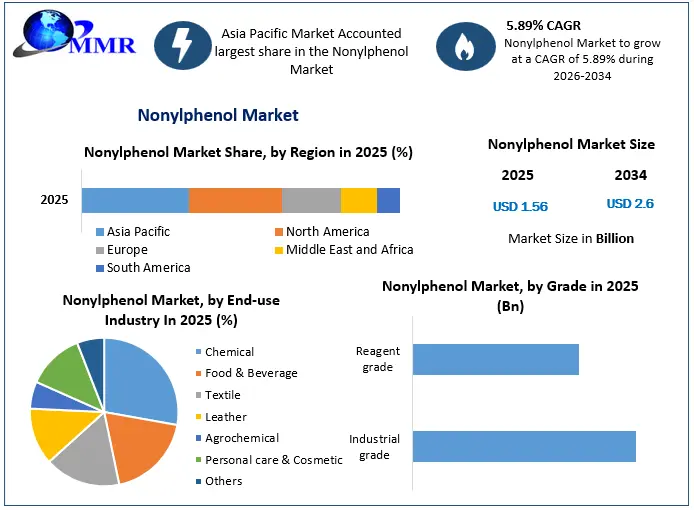
By 2034, the Nonylphenol Market is expected to reach US $ 2.6 Billion, thanks to growth in the Grade, and End-use Industry segment. The report analyzes market dynamics by region and end-user industries.
Nonylphenol Market Overview:
The nonylphenol market was valued at US $ 1.56 Bn. in 2025, and it is expected to reach US $ 2.6 Bn. by 2034 with a CAGR of 5.89% during the forecast period.
Nonylphenols are the group of chemical compounds that are made up of phenol with a 9-carbon tail. They can have a variety of structures, all of which are alkylphenols. Antioxidants, laundry and dish detergents, lubricating oil agents, solubilizers, and emulsifiers, are all made with them. They are widely involved in the epoxy formulation in North America, while their use in Europe has been discontinued.
These chemicals also serve as intermediates to the non-ionic surfactants like alkylphenol, ethoxylates, and nonylphenol ethoxylates, which are useful in detergents, paints, insecticides, personal care products, and plastics. Based on its capacity to function with estrogenic-like activity, nonylphenol has gained attention because of its widespread presence in the environment and its possible role as an endocrine disruptor and xenoestrogen.
Nonylphenol Market Analysis from 2025 to 2034
To know about the Research Methodology :- Request Free Sample Report
Nonylphenol Market Dynamics:
The food and beverage industry are growing
Nonylphenol is in high demand from the packaging industry, which uses it to make polymers and plastics. It is a polymer resin commonly used in food packaging and polyethylene plastic. The government of India is expected to invest Rs. 40 crore (US $0.0062 billion) to enhance the country's domestic plastics production. As per Invest India, India's food processing industry is expected to be worth more than half a trillion dollars by 2026.
As per the USDA (United States Department of Agriculture), the total value of retail food and beverage sales in Japan was US $484.32 billion in 2019, up 2.7% over the previous year. In several regions, greater personal incomes have resulted in increased demand for the food and beverage industry, supporting the packaging industry. As a result, the nonylphenol market is being driven by the growing food and beverage industry.
Nonylphenol’s toxicity in water.
One of the most well-known examples of continual, bio - accumulative, and toxic compounds is nonylphenol, which is known for its high aquatic toxicity to fish and wildlife (PBTs). As per the ECHA (European Chemicals Agency) company classification, nonylphenol is poisonous to aquatic life with long-term effects, causes severe eye damage, is harmful if swallowed, and causes skin irritation too.
Nonylphenol has being discontinued out of detergents in the United States, Europe, and China, while nonylphenol ethoxylates (NPEs) have been restricted in the textile and leather industries in Denmark. In 2003, the European Union issued Directive 2003/53/EC, which prohibits the marketing and use of products and product compositions containing more than 0.1% NPE or NP9. It also set a limit of 0.01% for NPE concentration in textiles entering the market after 2022 in 2017.
Although it is prohibited in cosmetics, there are no particular regulations for the chemical in India. IS 470 (Part-II): In 2009, the Bureau of Indian Standards banned the consumption of nonylphenol in cosmetics and personal care. NPEs are prohibited in formulations containing more than 0.1% of the material under EU REACH (Registration, Evaluation, Authorisation, and Restriction of Chemicals). As a result, nonylphenol's aquatic toxicity is expected to hamper the nonylphenol market over the forecast period.
Nonylphenol Market Segment Analysis:
Based on Grade, the global Nonylphenol market is segmented into two types as follows, Industrial grade, and Reagent grade. In 2025, the Industrial grade segment was dominant and held xx% of the overall market share. This segment is anticipated to grow at a CAGR of xx% over the forecast period. Since the production of various industries like food & beverage, cosmetic, pharmaceuticals, and many others is rising, the demand for nonylphenol is also increasing.
Based on End-use Industry, the global nonylphenol market is segmented into seven types as follows, chemical, food & beverage, textile, leather, agrochemical, personal care & cosmetic, and others. In 2025, the Chemical industry segment was dominant and held xx% of the overall market share. It is expected to continue its dominance by growing at a CAGR of xx% over the forecast period thanks to the growing use of nonylphenol as an intermediate in the chemical industry for a variety of compounds. It is usually processed further to obtain nonylphenol ethoxylates (NPE), which are often used as emulsifiers, detergents, antioxidants, and cleansers in a variety of other industrial applications.
In the oilfield chemical sector, nonylphenol ethoxylates are used to demulsify crude oil and reduce surface tension in water, which helps in the removal of dirt particles from the surface. Nonylphenol is also used as a chemical intermediate or precursor in the production of phenolic oxides, phenolic resins, epoxy resins, paints, and tire and mining additives. As a result of the growing use of nonylphenol in the chemical segment, the nonylphenol market is expected to grow over the forecast period.
The report has covered the market trends from 2025 to forecast the market through 2034. 2025 is considered a base year however 2025's numbers are on the real output of the companies in the market. Special attention is given to 2020 and the effect of lockdown on the demand and supply, and also the impact of lockdown for the next two years on the market. Some companies have done well in lockdown also and specific strategic analysis of those companies is done in the report.
Nonylphenol Market Regional Insights:
In 2025, Asia Pacific was dominant among all the regions accounting for 42.50% of the overall market share in terms of revenue. It is also expected to continue its dominance over the forecast period thanks to growing chemical industries in the region. The chemical sector in the region is growing in response to the rising population and per capita income. As per the ECIC (European Chemical Industry Council), China was the world's largest chemical producer in 2019, with US $1406.26 billion in sales, accounting for 35.8% of worldwide chemical sales.
Brazil, Russia, India, and China (BRIC) countries accounted for 42.8% of worldwide chemical sales in 2021. Six of the top ten chemical producers are Asian, accounting for US $2213.86 billion in sales, or 51.5% of the global market. China's revenues (US $1406.23) are higher than Europe and the United States combined (US $663.22 billion + US $549.36 billion). The Chemicals & Petrochemicals market is anticipated to reach US $300 billion by 2025, as per Invest India, with petrochemical demand expected to rise at a 7.5% CAGR from FY 2019 to FY 2023, and polymer demand expected to grow at 8%.
As a result of the growing chemical industry, demand for nonylphenol is expected to rise, driving the nonylphenol market in the Asia Pacific region during the forecast period.
The objective of the report is to present a comprehensive analysis of the global nonylphenol market to the stakeholders in the industry. The past and current status of the industry with the forecasted market size and trends are presented in the report with the analysis of complicated data in simple language. The report covers all the aspects of the industry with a dedicated study of key players that include market leaders, followers, and new entrants.
PORTER, PESTEL analysis with the potential impact of micro-economic factors of the market have been presented in the report. External as well as internal factors that are supposed to affect the business positively or negatively have been analyzed, which will give a clear futuristic view of the industry to the decision-makers.
The report also helps in understanding the global nonylphenol market dynamics, structure by analyzing the market segments and project the global Nonylphenol market size. Clear representation of competitive analysis of key players by product, price, financial position, product portfolio, growth strategies, and regional presence in the global nonylphenol market make the report investor’s guide.
Nonylphenol Market Recent Industry Developments
| Date | Company | Development | Impact |
|---|---|---|---|
| 15 September 2025 | SI Group | SI Group unveiled its WESTON 705 Antioxidant, a next-generation liquid phosphite designed as a nonylphenol-free alternative for plastics and elastomers. | The launch enhances polymer thermal stability while reducing overall environmental impact by 20%, offering regulatory-compliant solutions for global resin formulators. |
| 12 June 2026 | Ministry of Commerce & Industry (India) | India initiated an anti-dumping investigation on imports of para-nonylphenol originating from Russia and Taiwan following domestic industry petitions. | The trade action aims to safeguard domestic nonylphenol producers against underpriced foreign imports and stabilize pricing across the local chemical supply chain. |
Nonylphenol Market Scope: Inquire before buying
| Nonylphenol Market | |||
|---|---|---|---|
| Report Coverage | Details | ||
| Base Year: | 2025 | Forecast Period: | 2026-2034 |
| Historical Data: | 2020 to 2025 | Market Size in 2025: | US $ 1.56 Bn. |
| Forecast Period 2026 to 2034 CAGR: | 5.89% | Market Size in 2034: | US $ 2.6 Bn. |
| Segments Covered: | by Grade | Industrial grade Reagent grade |
|
| by End-use Industry | Chemical Food & Beverage Textile Leather Agrochemical Personal care & Cosmetic Others |
||
Nonylphenol Market, by Region
North America (United States, Canada and Mexico)
Europe (UK, France, Germany, Italy, Spain, Sweden, Austria and Rest of Europe)
Asia Pacific (China, South Korea, Japan, India, Australia, Indonesia, Malaysia, Vietnam, Taiwan, Bangladesh, Pakistan and Rest of APAC)
Middle East and Africa (South Africa, GCC, Egypt, Nigeria and Rest of ME&A)
South America (Brazil, Argentina Rest of South America)
Nonylphenol Market Key Players
Global Nonylphenol contains the commercial production, distribution, and consumption of nonylphenol (C₁₅H₂₄O), a crucial family of aromatic chemical compounds used primarily as an intermediate to manufacture nonylphenol ethoxylates (NPEs), antioxidants, and epoxy resin curing agents. This industrial chemical market serves downstream sectors like surfactants, paints and coatings, and polymer stabilization.
| Company Name | Headquarters | Core Competencies |
| Sasol Limited | Johannesburg, South Africa | Alkylphenols, specialty chemicals, surfactants and chemical intermediates |
| Dover Chemical Corporation | Dover, Ohio, USA | Para-nonylphenol, di-nonylphenol, alkylphenols and specialty chemical additives |
| SI Group, Inc. | Schenectady, New York, USA | Specialty chemicals, antioxidants, polymer additives and alkylphenol-based intermediates |
| PCC Group / PCC Synteza S.A. | Brzeg Dolny, Poland | Nonylphenol, alkylphenols, chemical intermediates and specialty chemicals |
| LG Chem Ltd. | Seoul, South Korea | Petrochemicals, specialty chemicals and chemical intermediates |
| India Glycols Limited | Noida, India | Specialty chemicals, surfactants, chemical intermediates and performance chemicals |
| China Man-Made Fiber Corporation (CMFC) | Taipei, Taiwan | Petrochemicals, phenolic chemicals and specialty chemical products |
| Hangzhou Ruijiang Chemical Co., Ltd. | Hangzhou, China | Nonylphenol, surfactants and specialty chemical intermediates |
| Dhalop Chemicals Pvt. Ltd. | Mumbai, India | Nonylphenol, alkylphenols and specialty chemical intermediates |
| Jiangsu Jiafeng Chemical Industry Co., Ltd. | Jiangsu, China | Nonylphenol and phenolic chemical intermediates |
| Cangzhou DCFC Chemical Co., Ltd. | Cangzhou, China | Alkylphenols, nonylphenol and specialty chemical products |
| Jiangsu Lingfei Technology Co., Ltd. | Jiangsu, China | Phenolic chemicals, nonylphenol and related chemical products |
| Daqing Zhonglan Petrochemical Co., Ltd. | Daqing, China | Petrochemicals and chemical intermediates |
| CNPC Jilin Beifang Chemical Co., Ltd. | Jilin, China | Petrochemicals, chemical intermediates and specialty chemicals |
Frequently Asked Questions:
1. Which region has the largest share in Global Nonylphenol Market?
Ans: Asia Pacific region held the highest share in 2025.
2. What is the growth rate of Global Nonylphenol Market?
Ans: The Global Nonylphenol Market is growing at a CAGR of 5.89% during forecasting period 2026-2034.
3. What is scope of the Global Nonylphenol Market report?
Ans: Global Nonylphenol Market report helps with the PESTEL, PORTER, COVID-19 Impact analysis, Recommendations for Investors & Leaders, and market estimation of the forecast period.
4. Who are the key players in Global Nonylphenol Market?
Ans: The important key players in the Global Nonylphenol Market are – Huntsman, India Glycols, Solvay S.A., Laufer Group, Polimeri, Stepan Company, SI Group, Dover Chemical, Eni, Sasol, PCC Group, Sabic, CMFC, FUCC, Daqing Zhonglan, Jiangsu Jiafeng, Cangzhou DCFC, Jiangsu Lingfei, CNPC Jilin Beifang, and Others
5. What is the study period of this Market?
Ans: The Global Nonylphenol Market is studied from 2020 to 2034.