
Global Non-Directional Radio Beacon Market Size by Type, Application, and Region – Segment-Level Market Assessment, Growth Opportunity Analysis, Competitive Mapping & Forecast to 2030
Overview
Non-Directional Radio Beacon Market is expected to grow at a CAGR of 4.72% during the forecast period and market is expected to reach US$ 354.83 Mn. by 2030.
Global Non-Directional Radio Beacon Market Drivers and Restrains:
A non-directional radio beacon is a low/medium-frequency and ground-based radio transmitter used as a navigation aid for aircraft. It transmits an omnidirectional signal, which is received by an automatic direction finder (ADF) onboard the aircraft.
The report includes the analysis of impact of COVID-19 lock-down on the revenue of market leaders, followers, and disrupters. Since lock down was implemented differently in different regions and countries, impact of same is also different by regions and segments. The report has covered the current short term and long term impact on the market, same will help decision makers to prepare the outline for short term and long term strategies for companies by region.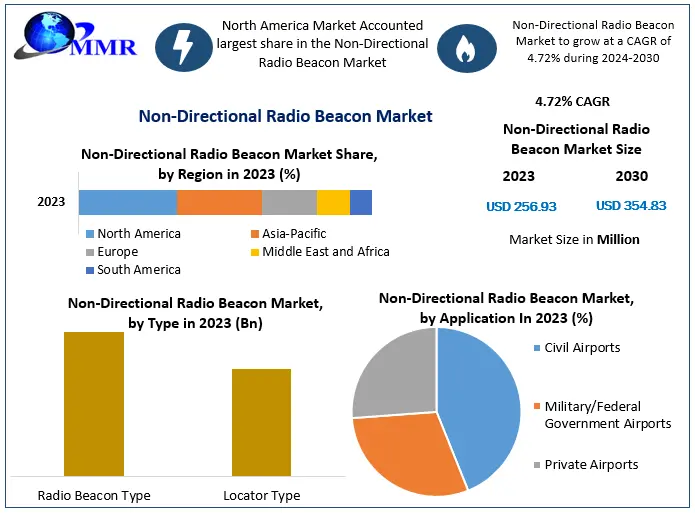 To know about the Research Methodology :- Request Free Sample Report
Non-Directional Radio Beacon Market Overview:
The rising prominence of air travel and the subsequent increase in the number of aircraft, alongside growing international trade are contributing to the increasing number of airports around the globe. As per statistics by the International Air Transport Association (IATA), around 3.8 billion passengers travelled via air in 2022, i.e. around 7% higher than in 2017.
NDRB’s radio frequency used for aviation are made consistent by ICAO, the International Civil Aviation Organization. NDRB be operated on a frequency between 190 to 1800 kHz. In North America, the frequency range is typically from 190 to 625 kHz, for offshore operations in the North Sea 500 to 1250 kHz, and for offshore Brazil, 1500 to 1800 kHz is used.
Non-directional beacon supports have improved and are more precise in aircraft navigation. In addition to transfer out Morse code which helps to identity the location, an NDRB can be used for meteorological information and broadcast weather, as well as surface and terminal information.
NDRBs have continued to provide fundamental and reliable means of aircraft navigation despite the arrival of Global navigation satellite system (GNSS) and modern ground based systems. The decommissioning of NDRB systems does not appear to be likely to occur for many years to come. For this reason manufacturers are financing in the development of modern ultra-reliable systems.
Offshore NDRBs were first introduced in the early 1960’s during early years of petroleum exploration in the Gulf of Mexico. Since that time, NDRBs have become standard equipment on offshore platforms and drill ships to provide highly reliable navigation for helicopter pilots and ADF-equipped crew boats as they support crews on drilling and production platforms. Vector InfoTech are able to provide customers a turnkey NDRB solution from detail design to implementation that helps Marine and Oil & Gas customers to control, monitor NDRB system from local, remote or integration into Control System.
Manufacturers in the non-directional radio beacon are focusing on competitive pricing as the strategy to capture significant market share. Moreover, strategic mergers and acquisitions and technological innovations are also the key focus areas of the manufacturers.
Non-Directional Radio Beacon Market Segmentation Analysis:
Based on type, the non-directional radio beacon market can be segmented into approach NDRB and locator type. The locator type segment is expected to dominate the global non-directional radio beacon market on account of the rising concerns about runway safety. Around 42% of accidents in commercial flights were categorized in the runway safety category, as per the International Civil Aviation Organization (ICAO).
The non-directional radio beacon market can be segmented into civil airports, military airports, and private airports. The civil airports segment is expected to grow at the largest CAGR of xx% during the forecast period, owing to the increasing passenger traffic. The world’s busiest airports, including O’Hare International Airport (U.S.) and Ataturk International Airport (Turkey), among others grew by around 5% in 2023. Additionally, in the same year, there was an increase in total cargo (+7.9%), total international freight (+9.9%), and total aircraft movements (+2.4%), as compared to 2017.
Non-Directional Radio Beacon Market Regional Analysis:
North America is expected to hold the largest market share in the non-directional radio beacon market, owing to the presence of around 19,346 public and private airports as well as a vast number of military airbases in the U.S. and Canada alone. Europe is expected to witness significant growth in the global non-directional radio beacon market, on account for increasing passenger and aircraft movements. The region is expected to build several new airports to reduce the burden or stress on current airports and staff, which would further spur the demand for non-directional radio beacons in the region. However, BREXIT and other geopolitical tensions in Europe may have an adverse effect on the market.
The objective of the report is to present comprehensive assessment projections with a suitable set of assumptions and methodology. The report helps in understanding Global non-directional radio beacon market dynamics, structure by identifying and analyzing the market segments and projecting the global market size. Further, the report also focuses on the competitive analysis of key players by product, price, financial position, growth strategies, and regional presence.
To understand the market dynamics and by region, the report has covered the PEST analysis by region and key economies across the globe, which are supposed to have an impact on market in forecast period. PORTER’s analysis, and SVOR analysis of the market as well as detailed SWOT analysis of key players has been done to analyze their strategies. The report will to address all questions of shareholders to prioritize the efforts and investment in the near future to the emerging segment in the Global non-directional radio beacon market.
Non-directional radio beacon market, Key Highlights:
• Global non-directional radio beacon market analysis and forecast, in terms of value.
• Comprehensive study and analysis of market drivers, restraints and opportunities influencing the growth of the Global non-directional radio beacon market
• Global non-directional radio beacon market segmentation on the basis of type, source, end-user, and region (country-wise) has been provided.
• Global non-directional radio beacon market strategic analysis with respect to individual growth trends, future prospects along with the contribution of various sub-market stakeholders have been considered under the scope of study.
• Global non-directional radio beacon market analysis and forecast for five major regions namely North America, Europe, Asia Pacific, the Middle East & Africa (MEA) and Latin America along with country-wise segmentation.
• Profiles of key industry players, their strategic perspective, market positioning and analysis of core competencies are further profiled.
• Competitive developments, investments, strategic expansion and competitive landscape of the key players operating in the Global non-directional radio beacon market are also profiled.
Scope of the Global Non-Directional Radio Beacon Market: Inquire before buying
| Global Non-Directional Radio Beacon Market | |||
|---|---|---|---|
| Report Coverage | Details | ||
| Base Year: | 2023 | Forecast Period: | 2024-2030 |
| Historical Data: | 2018 to 2023 | Market Size in 2023: | US $ 256.93 Mn. |
| Forecast Period 2024 to 2030 CAGR: | 4.72% | Market Size in 2030: | US $ 354.83 Mn. |
| Segments Covered: | by Type | Radio Beacon Type Locator Type |
|
| by Application | Civil Airports Military/Federal Government Airports Private Airports |
||
Non-Directional Radio Beacon Market, by Region
North America (United States, Canada and Mexico)
Europe (UK, France, Germany, Italy, Spain, Sweden, Austria and Rest of Europe)
Asia Pacific (China, South Korea, Japan, India, Australia, Indonesia, Malaysia, Vietnam, Taiwan, Bangladesh, Pakistan and Rest of APAC)
Middle East and Africa (South Africa, GCC, Egypt, Nigeria and Rest of ME&A)
South America (Brazil, Argentina Rest of South America)
Non-Directional Radio Beacon Market, Key Players are:
AZIMUT JSC
HENAME
NAUTEL
System Interface Limited.
TELERAD
ARC Aviation Renewables
THALE
Southern Avionics Company
Hanjinetc
Tele Supply AS
Mobin Ara Electronic CO., LTD
Systems Interface
TeleSupply
ELNA
Mopiens
JSC Azimut
MAE (Mobin Ara Electronic) CO., LTD
Frequently Asked Questions:
1. Which region has the largest share in Global market ?
Ans: North America region held the highest share in 2023.
2. What is the growth rate of Global market ?
Ans: The Global Non-Directional Radio Beacon Market is growing at a CAGR of 4.72% during forecasting period 2024-2030.
3. What is scope of the Global market report?
Ans: Global market report helps with the PESTEL, PORTER, COVID-19 Impact analysis, Recommendations for Investors & Leaders, and market estimation of the forecast period.
4. Who are the key players in Global market ?
Ans: The important key players in the Global market are – AZIMUT JSC, HENAME, NAUTEL, System Interface Limited., TELERAD, ARC Aviation Renewables, THALE, Southern Avionics Company, Hanjinetc, Tele Supply AS, Mobin Ara Electronic CO., LTD, Systems Interface, Tele Supply, ELNA, Mopiens, JSC Azimut, MAE (Mobin Ara Electronic) CO., LTD
5. What is the study period of this Market?
Ans: The Global market is studied from 2023 to 2030.