
Nanoscale Chemicals and Materials Market – Global Market Size, Strategic Growth Drivers, Risk Assessment Framework, Regulatory Landscape Review, Competitive Intensity Mapping & Long-Term Industry Outlook to 2034
Overview
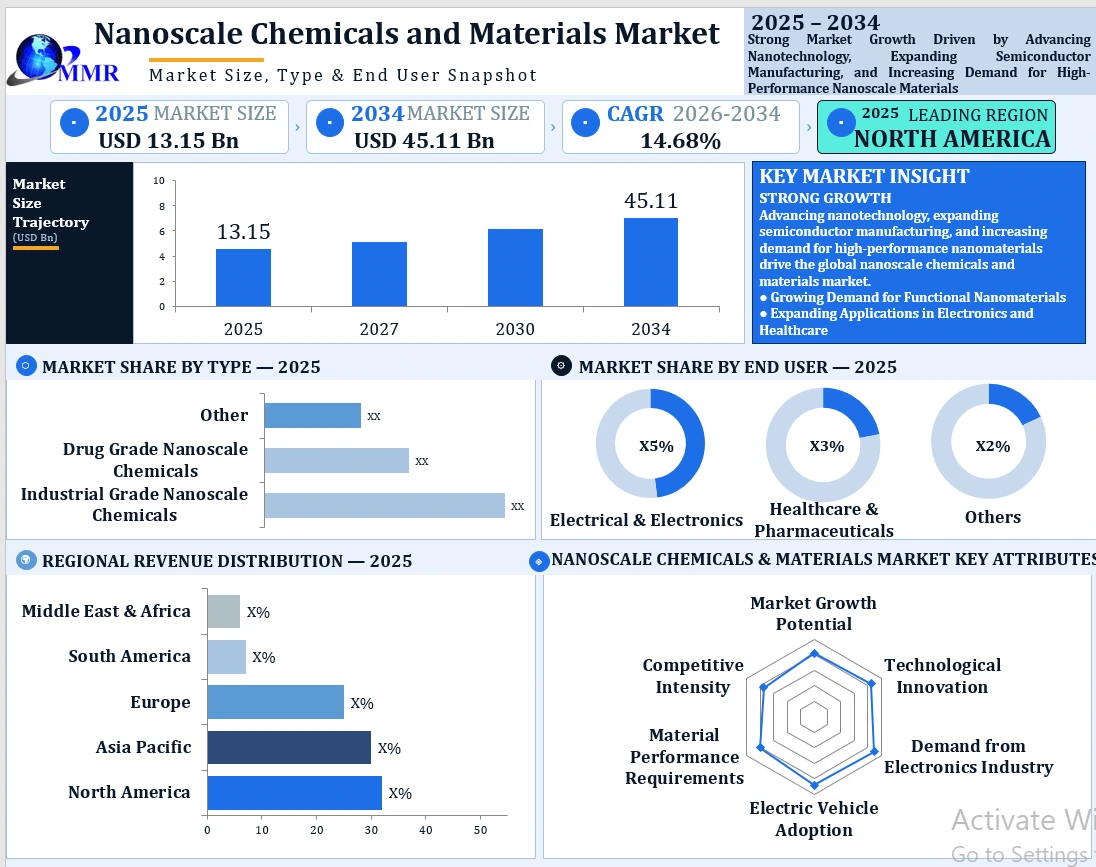
The Global Nanoscale Chemicals and Materials Market is valued at USD 13.15 billion in 2025 and is projected to grow at a CAGR of 14.68% from 2026 to 2034, approaching to USD 45.11 billion by 2034.
Global Nanoscale Chemicals and Materials Market Overview
The Global Nanoscale Chemicals and Materials Market comprises the production and commercialization of engineered chemical substances and materials with nanoscale dimensions, typically ranging from 1 to 100 nanometers. These materials exhibit enhanced physical, chemical, optical, electrical, and mechanical properties. The market includes nanoparticles, carbon nanotubes, graphene, nanosilica, nanometal oxides, nanocoatings, nanocomposites, and other engineered nanomaterials used across electronics, healthcare, pharmaceuticals, automotive, aerospace, energy, and industrial manufacturing.
The market experiences growing demand due to advancements in nanotechnology, semiconductor manufacturing, electric vehicles, energy storage, and advanced healthcare solutions. Nanoscale materials improve product conductivity, durability, thermal stability, chemical resistance, and overall performance in applications such as electronic components, batteries, drug delivery systems, diagnostic devices, protective coatings, and lightweight composites. Continuous innovation in nanoparticle synthesis, surface modification, and nanomaterial manufacturing supports product development, while increasing investment in renewable energy, advanced electronics, and high-performance materials strengthens market growth.
Nanoscale Chemical & Materials Market Size, Growth & Share Analysis
 To know about the Research Methodology :- Request Free Sample Report
Global Nanoscale Chemicals and Materials Market: Key Highlights
- Market Growth: The global nanoscale chemicals and materials market is valued at USD 13.15 billion in 2025 and is projected to reach USD 45.11 billion by 2034, expanding at a CAGR of 14.68%.
- Key Growth Drivers: Increasing demand for advanced semiconductor materials, nanotechnology research, electric vehicles, energy storage, and healthcare applications supports market expansion.
- Leading Region: North America holds a leading position due to its advanced research infrastructure, established manufacturing capabilities, and strong investments in nanotechnology.
- Major Applications: Electronics and semiconductors, healthcare and pharmaceuticals, energy storage, automotive manufacturing, and industrial coatings represent important application areas.
- Competitive Landscape: BASF SE, Evonik Industries AG, Cabot Corporation, Arkema, DuPont, and OCSiAl compete through material innovation, product development, and advanced manufacturing capabilities.
Global Nanoscale Chemicals and Materials Market Dynamics
Global Nanoscale Chemicals and Materials Market Drivers
Growing Demand for Advanced Electronics and Semiconductor Materials
The expansion of semiconductor manufacturing, artificial intelligence infrastructure, and advanced electronic devices drives demand for nanoscale chemicals and materials. Nanomaterials support semiconductor fabrication, electronic packaging, miniaturized components, thermal management, and high-performance coatings. Global semiconductor materials revenue reaches USD 73.2 billion in 2025, reflecting the increasing demand for materials used in advanced chip manufacturing and packaging. This expanding electronics ecosystem creates opportunities for nanoscale materials used in electronic components and precision manufacturing.
Increasing Investment in Nanotechnology Research and Development
Government funding and industrial research strengthen the development of advanced nanomaterials for healthcare, energy, electronics, and industrial applications. The United States' National Nanotechnology Initiative includes USD 2.2 billion in requested funding for 2025, supporting nanoscale science, engineering, and technology research across 12 federal agencies. These investments encourage innovation in nanoparticle synthesis, surface engineering, nanocomposites, and nanotechnology-enabled products, supporting wider commercial adoption.
Global Nanoscale Chemicals and Materials Market Restraints
High Production and Processing Costs
The production of high-purity nanoscale chemicals and materials requires specialized equipment, controlled manufacturing environments, advanced characterization techniques, and precise particle-size management. These requirements increase manufacturing costs, particularly for engineered nanoparticles, carbon nanotubes, graphene, and specialized nanocomposites. Smaller manufacturers face challenges in scaling production while maintaining consistent material quality, limiting adoption in price-sensitive applications.
Environmental, Health, and Safety Concerns
Potential toxicity, occupational exposure, environmental persistence, and disposal requirements create challenges for nanomaterial manufacturers. Companies must evaluate material-specific risks and comply with applicable chemical safety and environmental regulations. These requirements increase testing, handling, documentation, and commercialization costs, particularly for nanoscale materials used in healthcare, consumer products, coatings, and industrial chemicals.
Global Nanoscale Chemicals and Materials Market Opportunities
Expanding Applications in Energy Storage and Renewable Energy
The growing adoption of electric vehicles, battery technologies, solar energy systems, and advanced energy conversion technologies creates opportunities for nanoscale materials. Graphene, carbon nanotubes, metal oxides, and engineered nanoparticles support battery electrodes, conductive coatings, energy conversion systems, and specialized membranes. Advances in material engineering create opportunities to improve energy efficiency, durability, conductivity, and storage performance.
Rising Demand for Healthcare and Biomedical Nanomaterials
Nanotechnology creates opportunities in targeted drug delivery, diagnostic imaging, biosensors, medical devices, and specialized pharmaceutical formulations. Nanoparticles and engineered nanostructures support targeted interactions with biological systems and the development of advanced diagnostic and therapeutic technologies. Increasing investment in nanomedicine and precision healthcare encourages the development of application-specific nanoscale chemicals and materials.
Global Nanoscale Chemicals and Materials Market Challenges
Maintaining Consistent Material Quality at Commercial Scale
Manufacturers face challenges in maintaining consistent particle size, morphology, purity, surface properties, and dispersion during large-scale production. Variations in these characteristics affect material performance, processing efficiency, and compatibility with polymers, coatings, electronic components, and pharmaceutical formulations. Improving manufacturing reproducibility remains important for expanding commercial applications.
Complex Material Integration and Regulatory Requirements
Integrating nanoscale materials into existing industrial processes requires compatibility testing, formulation development, and application-specific performance validation. Manufacturers also address requirements related to material characterization, exposure assessment, product safety, and environmental impact. These technical and regulatory considerations influence commercialization timelines and increase development complexity across the global nanoscale chemicals and materials market.
Global Nanoscale Chemicals and Materials Market Segment Analysis
By End User: The healthcare sector remains a key end-use segment of the global nanoscale chemicals and materials market in 2025, driven by the growing adoption of nanotechnology in pharmaceuticals, medical devices, diagnostics, and therapeutic development. Nanoscale materials support targeted drug delivery, controlled drug release, medical imaging, nanodiagnostics, biosensors, and tissue engineering. Nanoparticles and nanocarriers improve drug solubility, stability, and delivery to specific biological targets, while nanomaterials also support advanced implants and diagnostic technologies. These applications strengthen demand for nanoscale chemicals and materials across pharmaceutical manufacturing, hospitals, diagnostic laboratories, and medical research.
Global Nanoscale Chemicals and Materials Market Regional Analysis:
North America holds a leading position in the global nanoscale chemicals and materials market, supported by advanced research infrastructure, strong nanotechnology investments, and established manufacturing capabilities. The United States drives regional demand through applications in semiconductors, electronics, healthcare, pharmaceuticals, aerospace, and advanced coatings. Collaboration between research institutions, universities, and industrial manufacturers supports innovation in nanoparticles, carbon nanotubes, nanocomposites, and metal oxide nanomaterials. Growing demand for high-performance materials, targeted drug delivery systems, and energy-efficient technologies further strengthens regional market development.
Asia Pacific represents a significant growth region, driven by rapid industrialization, expanding electronics manufacturing, and increasing investments in nanotechnology research and development. China, Japan, South Korea, and India contribute through semiconductor production, automotive manufacturing, battery technologies, and pharmaceutical applications. Rising demand for nanoscale materials in electric vehicles, energy storage systems, protective coatings, and advanced electronic components supports regional adoption. Government initiatives, expanding manufacturing capacity, and the presence of major industrial supply chains further strengthen the region's market position.
Europe maintains a strong presence in the global nanoscale chemicals and materials market through advanced materials research, industrial innovation, and sustainability-focused manufacturing. Germany, France, the United Kingdom, and other European economies support demand through automotive engineering, aerospace, healthcare, electronics, and chemical production. Manufacturers increasingly use nanomaterials to improve product durability, thermal stability, corrosion resistance, and energy efficiency. Research collaborations, environmental performance requirements, and investments in advanced manufacturing technologies support the development and commercialization of nanoscale materials across the region.
South America experiences growing adoption of nanoscale chemicals and materials across industrial manufacturing, healthcare, agriculture, construction, and environmental applications. Brazil and Argentina contribute through their agricultural, chemical, automotive, and industrial sectors. Nanomaterials support the development of protective coatings, advanced composites, water-treatment technologies, and improved agricultural inputs. Increasing interest in industrial modernization, resource efficiency, and advanced material applications creates opportunities for market expansion, while investment requirements and limited specialized manufacturing capacity influence the pace of adoption.
The Middle East & Africa market develops through investments in industrial diversification, infrastructure, energy, healthcare, and advanced manufacturing. Gulf countries support demand through petrochemical production, construction materials, energy technologies, and industrial coatings. In Africa, applications in water treatment, agriculture, healthcare, and environmental management create opportunities for nanoscale material adoption. Increasing interest in durable construction materials, efficient filtration systems, and advanced industrial processes supports market development, while research infrastructure and access to specialized production technologies influence regional growth.
Global Nanoscale Chemicals and Materials Market Competitive Landscape
The Global Nanoscale Chemicals and Materials Market features diversified chemical manufacturers, advanced materials producers, and specialized nanotechnology companies. Competition focuses on material innovation, product purity, manufacturing scalability, surface modification, and application-specific performance. Companies develop engineered nanoparticles, carbon nanotubes, graphene, nanosilica, and other functional nanomaterials for electronics, healthcare, energy storage, coatings, and industrial manufacturing. Competitive differentiation depends on technological expertise, product quality, production capabilities, and the ability to meet evolving industrial requirements.
| Key Player | Key Product Focus | Competitive Strength |
|---|---|---|
| BASF SE | Nanomaterials, catalysts, and functional additives | Broad chemical portfolio and industrial manufacturing capabilities |
| Evonik Industries AG | Fumed silica, specialty nanomaterials, and functional additives | Expertise in surface modification and specialty chemicals |
| Cabot Corporation | Specialty carbons, carbon black, and fumed metal oxides | Strong capabilities in engineered carbon materials |
| Arkema | Carbon nanotubes, specialty polymers, and nanocomposites | Advanced materials expertise and application-focused innovation |
| DuPont | Electronic materials, specialty materials, and advanced composites | Materials engineering and established industrial customer relationships |
| Merck KGaA | Electronic materials and functional specialty materials | Expertise in advanced electronics and high-performance materials |
| OCSiAl | Single-wall carbon nanotubes and nanotube-based additives | Specialized conductive nanomaterials and performance-enhancing solutions |
| Nanophase Technologies Corporation | Engineered nanoparticles, dispersions, and surface-treated materials | Application-specific nanomaterial development |
| American Elements | Nanopowders, metal nanoparticles, and metal oxides | Broad range of advanced materials for research and industrial applications |
| LG Chem | Advanced materials, electronic materials, and battery-related materials | Chemical manufacturing expertise and advanced materials development |
Global Nanoscale Chemicals and Materials Market Recent Developments:
| Date | Company | Development | Impact |
|---|---|---|---|
| 18 March 2026 | Black Swan Graphene Inc. | Black Swan Graphene completed a production capacity expansion at its Consett, UK facility, tripling annual Graphene Nanoplatelets (GNP) manufacturing capacity from 40 tonnes to over 140 tonnes. | The scale-up transitions the company from pilot batches to industrial-scale liquid-phase exfoliation at flow rates up to 22,000 litres per hour to supply polymer, concrete, and composite markets. |
| 01 June 2026 | Carbice | Carbice signed a long-term strategic distribution and R&D partnership with Noctua to commercialize Carbice® IP90 carbon nanotube thermal interface pads globally. | The collaboration scales retail adoption of vertically aligned carbon nanotubes with nanoscale polymer coatings as a permanent, non-degrading alternative to conventional thermal pastes. |
| 04 June 2026 | First Graphene Limited | First Graphene signed a binding agreement to acquire all product lines, manufacturing equipment, and intellectual property of US-based MITO® Material Solutions, Inc. for AU$850,000. | The acquisition expands First Graphene's portfolio into functionalized graphene oxide and hybrid nanomaterial additives while establishing a direct US commercial and defense manufacturing base. |
| 14 September 2026 | Paragraf | Paragraf joined South Korea's newly launched K-Graphene Commercialisation Council as the sole international founding member alongside 25 domestic industry, government, and research partners. | The consortium accelerates the commercial deployment of 2D graphene nanomaterials and wafer-scale graphene electronics through the integrated K-Graphene Foundry ecosystem. |
| 03 November 2026 | Lonza Group AG | Lonza signed a definitive agreement to acquire a US CDMO network from Merck KGaA, including an Indianapolis facility specializing in lipid nanoparticle (LNP) and liposome formulations. | The multi-hundred-million Swiss franc transaction strengthens domestic North American manufacturing capacity for nanoscale drug delivery carriers and aseptic fill-finish biopharmaceuticals. |
Global Nanoscale Chemicals and Materials Market Scope: Inquire before buying
| Global Nanoscale Chemicals and Materials Market | |||
|---|---|---|---|
| Report Coverage | Details | ||
| Base Year: | 2025 | Forecast Period: | 2026-2034 |
| Historical Data: | 2020 to 2025 | Market Size in 2025: | US $13.15 Bn. |
| Forecast Period 2026 to 2034 CAGR: | 14.68% | Market Size in 2034: | US $ 45.11 Bn. |
| Segments Covered: | by Type | Industrial Grade Nanoscale Chemicals Drug Grade Nanoscale Chemicals Other |
|
| by End User | Healthcare and Pharmaceuticals Electrical and Electronics Automotive and Transportation Aerospace and Defence Energy and Power Generation Construction and Infrastructure Agriculture and Food Processing Environmental Management Consumer Goods and Personal Care Industrial Manufacturing |
||
Nanoscale Chemicals and Materials Market, by Region
North America (United States, Canada and Mexico)
Europe (UK, France, Germany, Italy, Spain, Sweden, Austria and Rest of Europe)
Asia Pacific (China, South Korea, Japan, India, Australia, Indonesia, Malaysia, Vietnam, Taiwan, Bangladesh, Pakistan and Rest of APAC)
Middle East and Africa (South Africa, GCC, Egypt, Nigeria and Rest of ME&A)
South America (Brazil, Argentina Rest of South America)
Global Nanoscale Chemicals and Materials Market, Key Players:
- BASF SE
- Akzo Nobel
- Qinhuangdao Taiji Ring Nano-Products Co., Ltd.
- Advanced Nano Products Co., Ltd.
- Nanophase Technologies Corporation
- NanoMas Technologies
- Altairnano
- Carbon Nanotechnologies Incorporated
- American Elements
- Strem Chemicals
- Tokuyama Corporation
- Nanoshel LLC
- Evonik Industries AG
- Cabot Corporation
- Arkema
- DuPont
- Merck KGaA
- OCSiAl
- Resonac Holdings Corporation
- Nanoco Group plc
- CHASM Advanced Materials
- Black Swan Graphene
- SkySpring Nanomaterials, Inc.
- US Research Nanomaterials, Inc.
- NanoAmor
- Nanosys, Inc.
- Nanocyl SA
- CNano Technology Limited
- XG Sciences
- Applied Nanotech, Inc.
- Zyvex Technologies
- Nanologica AB
- Mitsubishi Chemical Group
- Sumitomo Chemical Co., Ltd.
- Toray Industries, Inc.
- 3M
- Thermo Fisher Scientific
- Nanocomposix
- MKNano
- NanoMaterials Technology Pte Ltd
- Canatu Oy
- Frontier Carbon Corporation
- Surrey NanoSystems
- eSpin Technologies, Inc.
- SkyNano, Inc.
Global Nanoscale Chemicals and Materials Market: FAQs
1.What is the global nanoscale chemicals and materials market size in 2025?
Ans. The global nanoscale chemicals and materials market is valued at USD 13.15 billion in 2025.
2.What is the projected market size by 2034?
Ans. The market is projected to reach USD 45.11 billion by 2034.
3.What is the expected CAGR of the nanoscale chemicals and materials market?
Ans. The market is projected to grow at a CAGR of 14.68% during the 2026–2034 forecast period.>
4.Which region leads the global nanoscale chemicals and materials market?
Ans. North America leads the market, supported by advanced nanotechnology research, industrial capabilities, and demand from electronics and healthcare sectors.
5.What are the major growth drivers of the nanoscale chemicals and materials market?
Ans. The major growth drivers include semiconductor manufacturing, nanotechnology research and development, electric vehicle adoption, energy storage innovation, and increasing healthcare applications.