Energy Recovery Ventilator Market Size – Industry Structure Evaluation, Demand Drivers Analysis, Regional Growth Analysis and Identification, Competitive Positioning Review & Global Market Size Forecast to 2034

11.6%
CAGR (2026-2034)
4.38 USD Bn.
Forecast Market Size
330
Report Pages
159
Market Tables

Overview

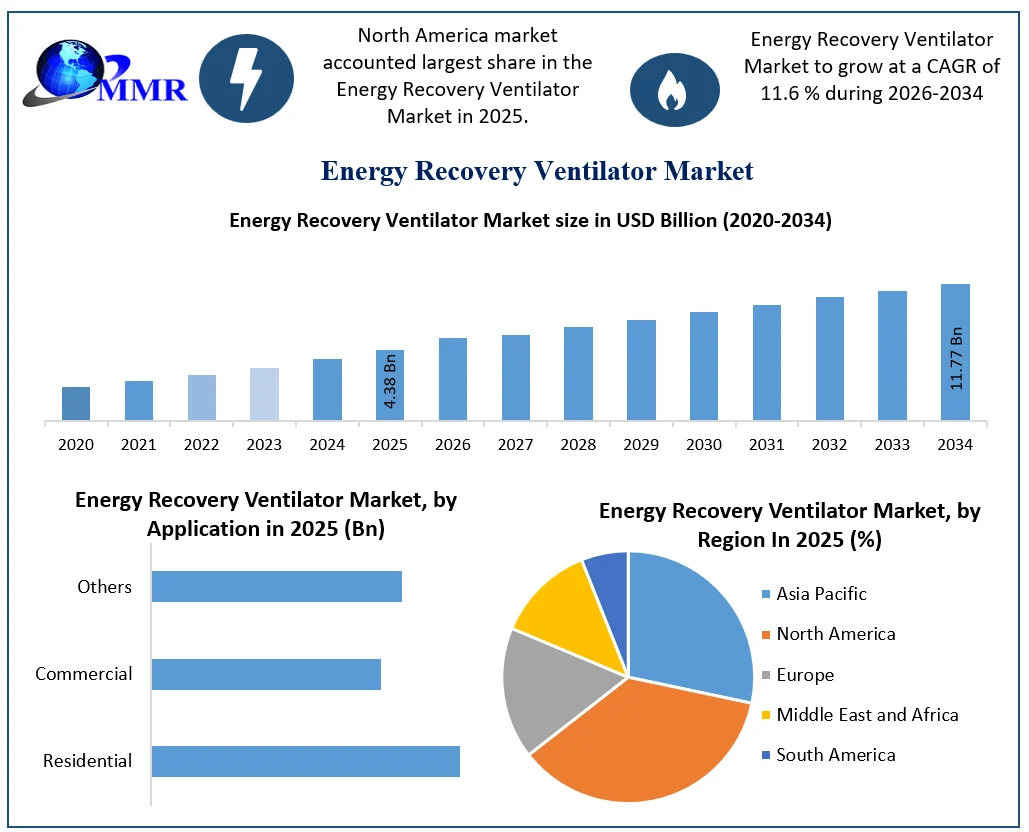
Energy Recovery Ventilator Market size was valued at USD 4.38 Billion in 2025 and the total Energy Recovery Ventilator revenue is expected to grow at a CAGR of 11.6% from 2026 to 2034, reaching nearly USD 11.77 Billion.

Energy Recovery Ventilator Market Overview:

Rise in need for indoor air quality & load drop, positive impact of codes & standards, rise in construction of green buildings, &nonstop advancements in energy recovery ventilator solutions are some of the aspects responsible for increasing the market development. Numerous companies working in energy recovery ventilator market are meaningfully investing on initiatives to support their market position.

For example, in the year 2025, Greenheck unveiled its strategy to increase its manufacturing services in Shelby, North Carolina. Greenheck capitalized approximately USD 60 Mn to increase production of its Devoted Outdoor Air Systems (DOAS), Tempered Air Products (TAP), & Architectural Products.

            Energy Recovery Ventilator Market Size, Share and Growth AnalysisEnergy Recovery Ventilator Market Growth
To Know About The Research Methodology :- Request Free Sample Report

Key Highlights

  1. Robust Market Valuation & Growth: The Global Energy Recovery Ventilator Market was valued at USD 4.38 Billion in 2025 and is projected to reach USD 11.77 Billion by 2034, expanding at a high CAGR of 11.6% over the forecast period (2026–2034).Regional Dominance: North America led the market in 2025, driven by extensive investments in commercial infrastructure, green building developments, and strict adoption across BFSI, retail, healthcare, and IT sectors.Europe’s Expanding Potential: Increasing focus on indoor air quality (IAQ) and a booming European tourism/hospitality sector (pushing new hotel and commercial building developments) are significantly fueling ERV deployment to ensure energy-efficient building performance.Regulatory Compliance Driving Adoption: Mandatory standards such as ASHRAE Standard 62.1 (indoor air quality) and ASHRAE Standard 90.1 are compelling builders to integrate ERV solutions.Active Strategic Expansion: Leading manufacturers are heavily investing in expanding capacity and product capabilities—such as Greenheck’s $60M facility expansion in North Carolina for DOAS/TAP units and Nortek Air Solutions’ introduction of hybrid R7DA units for commercial indoor air quality.
  2. The growth plans contain the purchase of acurrent manufacturing capacity that would support improved demand for Greenheck DOAS & TAP products. In the year 2025, Nortek Air Solutions, LLC, presented R7DA, a combination dedication outdoor air system & conventional space conditioning rooftop unit, to the Mammoth branded R7 Stage production lines for optimum indoor air quality & space comfort in commercial uses. These planned initiatives are estimated to increase the demand for energy recovery ventilator systems during the forecast period.
  3. North America led the energy recovery ventilator market in the year 2025, followed by Europe. In North America, the application of an energy recovery ventilation system is supported by extensive investments from the commercial segment. North America’s market is mainly driven by growing demand for ERV from BFSI, retail, IT and telecom, healthcare, & educational organizations. Growing need for improved indoor air quality is a serious factor prompting the adoption of energy recovery ventilation in Europe.
  4. Booming tourism industry in Europe is pushing the construction of commercial developments& hotels through the region. This influence would play a major role in increasing the installation of energy recovery ventilator systems to confirmenhanced energy performance of commercial buildings in the region. All the influences mentioned above are likely to increase the development of the energy recovery ventilator market
  5. Tourism Industry in Europe: The USA, Germany, & the UK provided nearly a quarter of the global bed nights spent in European cities in the year 2025. Each of these source marketplaces improved by between 4-6 percent since 2025. Spain & Italy restarted positive progress rates as source markets after frequent decreases in number of bed nights spent in European cities over the last few years. The 2025 star development market, China, presented impressive development by 13.2 percent in 2025 to make up about 2 percent of bed nights spent in European cities. In the year 2025, the Chinese market was already rising by 11.4 percent. Japan, however, continued to show a drop in bed nights since the last year (-4.1 percent) & Russia reduced even more with -7.9 percent after having grown by an inspiring 9.4 percent in 2025. The decline of the Russian source market was anticipate dowing to the decrease in the oil costs, devaluation of the ruble, &authorizations taken against Russia since of the country’s fight with Ukraine.

Energy Recovery Ventilator Market DROC

Category Factors & Strategic Analysis
Drivers Stringent Building Codes & Regulations: Adoption of ASHRAE 62.1 and 90.1, alongside LEED green building certifications, mandates effective ventilation and minimum 50% energy recovery efficiency.Surging Demand for Indoor Air Quality (IAQ): Post-pandemic awareness has accelerated demand for continuous fresh air intake while reducing mechanical HVAC cooling and heating loads.Growth in Green Buildings & Sustainable Construction: Expanding commercial construction across North America and Europe prioritizes low-carbon footprint solutions.
Restraints High Initial Capital & Installation Costs: Advanced ERV units and integrated ducting solutions require high upfront expenditure compared to standard ventilation systems.Maintenance & Operational Demands: Periodic filter replacements, core cleaning, and potential core clogging in extreme conditions can increase lifetime operational friction for end-users.
Opportunities Integration with Smart IoT & Home Automation: Development of IoT-enabled smart ERVs with automated humidity/co2 sensors offers optimal energy savings and remote monitoring capabilities.Booming European Tourism & Hospitality Infrastructure: Expansion of hotels, resorts, and commercial complexes across Western and Southern Europe creates continuous demand for commercial-grade ERVs.Hybrid Systems & Renewable Energy Pairing: Integrating ERVs with solar PV and heat pump technologies creates low-net-zero energy building solutions.
Challenges Retrofitting Constraints in Existing Structures: Integrating complex ERV core systems and additional ductwork into older building designs poses major structural and cost challenges.Extreme Climate Performance Risks: Ensuring efficient frost prevention and preventing ice formation in ERV heat exchanger cores during low-temperature/sub-zero winter conditions without excessive defrost energy consumption.

Market Strategic Insights:

Promising Impact of Codes & Standards on Market:

The optimistic impact of codes & standards is one of the key drivers behind improved adoption of energy recovery ventilation technology. For example, ASHRAE’s Standard 62.1, “Ventilation for Satisfactory Indoor Air Quality,” is a key pillar of the Global Mechanical Code from the United States Green Building Council’s LEED ranking system & the Global Code Council as well as somedomestic ventilation codes. This standard describes how much air ventilation should be carried into a building.

Additional, ASHRAE’s Standard 90.1 endorses the use of energy recovery ventilation systems with a least 50 percent recovery efficiency for the separate fan systems designed & developed with fan capabilities of 5,000 cfm or more & an outdoor air supply of least 70 percent. The occurrence of regulatory bodies will play a main role in improving the usage of energy recovery ventilator among the constructions.

The report covers Residential, Commercial, Others analysis, with detailed analysis Global Energy Recovery Ventilator Market industry with the classifications of the market on the, Application Type, Application, Product & region. Analysis of past market dynamics from 2020 to 2025 is given in the report, which will help readers to benchmark the past trends with current market scenarios with the key players' contribution in it. The report has profiled twelve key players in the market from different regions.

However, the report has considered all market leaders, followers, and new entrants with investors while analyzing the market and estimation the size of the same. The manufacturing environment in each region is different and focus is given on the regional impact on the cost of manufacturing, supply chain, availability of raw Products, labor cost, availability of advanced Plastic Application Type, trusted vendors are analyzed and the report has come up with recommendations for a future hot spot in five regions. The major country’s policies about manufacturing & Covid 19 impact on demand side are covered in the report.

Recent Industry Developments

Date Company Development Impact
26 January 2026 Panasonic Corporation Panasonic showcased its new Intelli-Balance Elite and Elite+ ERV series at the AHR Expo 2026 in Las Vegas. It enhances energy efficiency and balanced ventilation compliance for high-performance residential builders.
10 June 2026 Daikin Industries, Ltd. Daikin expanded its R-32 VRV portfolio with the commercial launch of the VKM-JM fresh air solution featuring 74% enthalpic heat recovery. It delivers precise temperature and humidity control while significantly reducing HVAC cooling loads.
18 February 2026 Daikin Industries, Ltd. Daikin launched a vertical DX air handling unit equipped with integrated direct expansion coils for large indoor commercial spaces. It maximizes installation flexibility and eliminates intermediate water circuits for higher system energy efficiency.
14 October 2026 Astberg Ventilation Astberg released its updated 2026 ERV pricing and sizing guide detailing heat-recovery efficiencies of 60% to 80% for tropical climates. It helps homeowners optimize indoor air quality while managing rising whole-home cooling energy costs.
21 September 2026 Carrier Global Corporation Carrier advanced its commercial ventilation offerings by incorporating smart IoT sensors and automated controls across North American ERV product lines. It enables real-time monitoring and reduced energy consumption to meet stricter green building standards.
14 October 2026 Trane Technologies Trane Technologies expanded strategic commercial equipment supply scaling to capture rising infrastructure demand for high-efficiency air cooling and ventilation. It strengthens long-term revenue visibility and market share within commercial building sustainability upgrades.

Energy Recovery Ventilator Market Scope: Inquire before buying

Global Energy Recovery Ventilator Market
Report Coverage Details
Base Year: 2025 Forecast Period: 2026-2034
Historical Data: 2020 to 2025 Market Size in 2025: US $ 4.38 Bn.
Forecast Period 2026 to 2034 CAGR: 11.6% Market Size in 2034: US $ 11.77  Bn.
Segments Covered: by Technology Type Rotary Heat Exchanger
Run-Around Coil
Plate Heat Exchanger
Heat Pipe Heat Exchanger
Others
by Application Residential
Commercial
Others

Energy Recovery Ventilator Market, by Region

North America (United States, Canada and Mexico)
Europe (UK, France, Germany, Italy, Spain, Sweden, Austria and Rest of Europe)
Asia Pacific (China, South Korea, Japan, India, Australia, Indonesia, Malaysia, Vietnam, Taiwan, Bangladesh, Pakistan and Rest of APAC)
Middle East and Africa (South Africa, GCC, Egypt, Nigeria and Rest of ME&A)
South America (Brazil, Argentina Rest of South America)

Energy Recovery Ventilator Market Key Players

1.Mitsubishi Electric Corporation
2.Daikin Industries, Ltd.
3.Panasonic Corporation
4.LG Electronics
5.Johnson Controls
6.Carrier Global Corporation
7.Trane Technologies
8.Fujitsu General Limited
9.Nortek Air Solutions, LLC
10.Greenheck Fan Corporation
11.RenewAire, LLC
12.Zehnder Group AG
13.Systemair AB
14.Aldes Group
15.Holtop (Beijing Holtop Air Conditioning Co., Ltd.)
16.Fantech Inc.
17.Broan-NuTone LLC
18.Vortice S.p.A.
19.FläktGroup
20.Stulz GmbH
21.Klingenburg GmbH
22.Recair B.V.
23.CORE Energy Recovery Solutions
24.ComfoAir (Qingdao ComfoAir Ventilation Co., Ltd.)
25.S&P Sistemas de Ventilación, S.L.U. (Soler & Palau)
26.Trox GmbH
27.Swegon Group AB
28.Blauberg Ventilatoren
29.Rheem Manufacturing Company
30.Lennox International Inc.
31.Skm Air Conditioning
32.DuctSox Corporation
33.Acme Engineering & Manufacturing Corp.
34.Twin Cities Fan
35.Loren Cook Company
36.Captive-Aire Systems
37.VENTS (Vents-USA)
38.Tappan Ventilation
39.Ambiance Ventilation
40.Astberg Ventilation

Frequently Asked Questions:

1. Which region has the largest share in Global Energy Recovery Ventilator Market?
Ans: North America region held the highest share in 2025.

2. What is the growth rate of Global Energy Recovery Ventilator Market?
Ans: The Global Energy Recovery Ventilator Market is growing at a CAGR of 11.6% during forecasting period 2026-2034.

3. What is scope of the Global Energy Recovery Ventilator market report?
Ans: Global Energy Recovery Ventilator Market report helps with the PESTEL, PORTER,  Recommendations for Investors & Leaders, and market estimation of the forecast period.

4. Who are the key players in Global Energy Recovery Ventilator market?
Ans: The important key players in the Global Energy Recovery Ventilator Market are – Daikin, Panasonic Corporation, LG Electronics, Johnson Controls, Munters, Fujitsu General, Carrier Corporation, Nortek Air Solutions, Greenheck Fan, Airxchange Inc., United Technologies Corp., Blue Star Ltd., Mitsubishi Electric Corp. Ltd., Johnson Controls, Renewaire, Reznor and Zehnder America Inc, Ruskin rooftop system, Innovative Drive Solutions., and Reznor HVAC.

5. What is the study period of this market?
Ans: The Global Energy Recovery Ventilator Market is studied from 2020 to 2034.

Table of Contents

1. Energy Recovery Ventilator Market Introduction 1.1. Study Assumption and Market Definition 1.2. Scope of the Study 1.3. Executive Summary 2. Global Energy Recovery Ventilator Market: Competitive Landscape 2.1. MMR Competition Matrix 2.2. Competitive Landscape 2.3. Key Players Benchmarking 2.3.1. Company Name 2.3.2. Business Segment 2.3.3. End-user Segment 2.3.4. Revenue (2025) 2.3.5. Company Locations 2.4. Leading Energy Recovery Ventilator Market Companies, by market capitalization 2.5. Market Structure 2.5.1. Market Leaders 2.5.2. Market Followers 2.5.3. Emerging Players 2.6. Mergers and Acquisitions Details 3. Energy Recovery Ventilator Market: Dynamics 3.1. Energy Recovery Ventilator Market Trends by Region 3.1.1. North America Energy Recovery Ventilator Market Trends 3.1.2. Europe Energy Recovery Ventilator Market Trends 3.1.3. Asia Pacific Energy Recovery Ventilator Market Trends 3.1.4. Middle East and Africa Energy Recovery Ventilator Market Trends 3.1.5. South America Energy Recovery Ventilator Market Trends 3.2. Energy Recovery Ventilator Market Dynamics by Region 3.2.1. North America 3.2.1.1. North America Energy Recovery Ventilator Market Drivers 3.2.1.2. North America Energy Recovery Ventilator Market Restraints 3.2.1.3. North America Energy Recovery Ventilator Market Opportunities 3.2.1.4. North America Energy Recovery Ventilator Market Challenges 3.2.2. Europe 3.2.2.1. Europe Energy Recovery Ventilator Market Drivers 3.2.2.2. Europe Energy Recovery Ventilator Market Restraints 3.2.2.3. Europe Energy Recovery Ventilator Market Opportunities 3.2.2.4. Europe Energy Recovery Ventilator Market Challenges 3.2.3. Asia Pacific 3.2.3.1. Asia Pacific Energy Recovery Ventilator Market Drivers 3.2.3.2. Asia Pacific Energy Recovery Ventilator Market Restraints 3.2.3.3. Asia Pacific Energy Recovery Ventilator Market Opportunities 3.2.3.4. Asia Pacific Energy Recovery Ventilator Market Challenges 3.2.4. Middle East and Africa 3.2.4.1. Middle East and Africa Energy Recovery Ventilator Market Drivers 3.2.4.2. Middle East and Africa Energy Recovery Ventilator Market Restraints 3.2.4.3. Middle East and Africa Energy Recovery Ventilator Market Opportunities 3.2.4.4. Middle East and Africa Energy Recovery Ventilator Market Challenges 3.2.5. South America 3.2.5.1. South America Energy Recovery Ventilator Market Drivers 3.2.5.2. South America Energy Recovery Ventilator Market Restraints 3.2.5.3. South America Energy Recovery Ventilator Market Opportunities 3.2.5.4. South America Energy Recovery Ventilator Market Challenges 3.3. PORTER's Five Forces Analysis 3.4. PESTLE Analysis 3.5. Technology Roadmap 3.6. Regulatory Landscape by Region 3.6.1. North America 3.6.2. Europe 3.6.3. Asia Pacific 3.6.4. Middle East and Africa 3.6.5. South America 3.7. Key Opinion Leader Analysis in the Energy Recovery Ventilator Market 3.8. Analysis of Government Schemes and Initiatives For Global Industry 3.9. Energy Recovery Ventilator Market Trade Analysis 3.10. The Global Pandemic Impact on Energy Recovery Ventilator Market 4. Energy Recovery Ventilator Market: Global Market Size and Forecast by Segmentation (in Billion) 2025-2034 4.1. Energy Recovery Ventilator Market Size and Forecast, by Technology Type (2025-2034) 4.1.1. Rotary Heat Exchanger 4.1.2. Run-Around Coil 4.1.3. Plate Heat Exchanger 4.1.4. Heat Pipe Heat Exchanger 4.1.5. Others 4.2. Energy Recovery Ventilator Market Size and Forecast, by Application (2025-2034) 4.2.1. Residential 4.2.2. Commercial 4.2.3. Others 4.3. Energy Recovery Ventilator Market Size and Forecast, by Region (2025-2034) 4.3.1. North America 4.3.2. Europe 4.3.3. Asia Pacific 4.3.4. Middle East and Africa 4.3.5. South America 5. North America Energy Recovery Ventilator Market Size and Forecast by Segmentation (in Billion) 2025-2034 5.1. North America Energy Recovery Ventilator Market Size and Forecast, by Technology Type (2025-2034) 5.1.1. Rotary Heat Exchanger 5.1.2. Run-Around Coil 5.1.3. Plate Heat Exchanger 5.1.4. Heat Pipe Heat Exchanger 5.1.5. Others 5.2. North America Energy Recovery Ventilator Market Size and Forecast, by Application (2025-2034) 5.2.1. Residential 5.2.2. Commercial 5.2.3. Others 5.3. North America Energy Recovery Ventilator Market Size and Forecast, by Country (2025-2034) 5.3.1. United States 5.3.1.1. United States Energy Recovery Ventilator Market Size and Forecast, by Technology Type (2025-2034) 5.3.1.1.1. Rotary Heat Exchanger 5.3.1.1.2. Run-Around Coil 5.3.1.1.3. Plate Heat Exchanger 5.3.1.1.4. Heat Pipe Heat Exchanger 5.3.1.1.5. Others 5.3.1.2. United States Energy Recovery Ventilator Market Size and Forecast, by Application (2025-2034) 5.3.1.2.1. Residential 5.3.1.2.2. Commercial 5.3.1.2.3. Others 5.3.2. Canada 5.3.2.1. Canada Energy Recovery Ventilator Market Size and Forecast, by Technology Type (2025-2034) 5.3.2.1.1. Rotary Heat Exchanger 5.3.2.1.2. Run-Around Coil 5.3.2.1.3. Plate Heat Exchanger 5.3.2.1.4. Heat Pipe Heat Exchanger 5.3.2.1.5. Others 5.3.2.2. Canada Energy Recovery Ventilator Market Size and Forecast, by Application (2025-2034) 5.3.2.2.1. Residential 5.3.2.2.2. Commercial 5.3.2.2.3. Others 5.3.3. Mexico 5.3.3.1. Mexico Energy Recovery Ventilator Market Size and Forecast, by Technology Type (2025-2034) 5.3.3.1.1. Rotary Heat Exchanger 5.3.3.1.2. Run-Around Coil 5.3.3.1.3. Plate Heat Exchanger 5.3.3.1.4. Heat Pipe Heat Exchanger 5.3.3.1.5. Others 5.3.3.2. Mexico Energy Recovery Ventilator Market Size and Forecast, by Application (2025-2034) 5.3.3.2.1. Residential 5.3.3.2.2. Commercial 5.3.3.2.3. Others 6. Europe Energy Recovery Ventilator Market Size and Forecast by Segmentation (in Billion) 2025-2034 6.1. Europe Energy Recovery Ventilator Market Size and Forecast, by Technology Type (2025-2034) 6.1.1. Rotary Heat Exchanger 6.1.2. Run-Around Coil 6.1.3. Plate Heat Exchanger 6.1.4. Heat Pipe Heat Exchanger 6.1.5. Others 6.2. Europe Energy Recovery Ventilator Market Size and Forecast, by Application (2025-2034) 6.2.1. Residential 6.2.2. Commercial 6.2.3. Others 6.3. Europe Energy Recovery Ventilator Market Size and Forecast, by Country (2025-2034) 6.3.1. United Kingdom 6.3.1.1. United Kingdom Energy Recovery Ventilator Market Size and Forecast, by Technology Type (2025-2034) 6.3.1.1.1. Rotary Heat Exchanger 6.3.1.1.2. Run-Around Coil 6.3.1.1.3. Plate Heat Exchanger 6.3.1.1.4. Heat Pipe Heat Exchanger 6.3.1.1.5. Others 6.3.1.2. United Kingdom Energy Recovery Ventilator Market Size and Forecast, by Application (2025-2034) 6.3.1.2.1. Residential 6.3.1.2.2. Commercial 6.3.1.2.3. Others 6.3.2. France 6.3.2.1. France Energy Recovery Ventilator Market Size and Forecast, by Technology Type (2025-2034) 6.3.2.1.1. Rotary Heat Exchanger 6.3.2.1.2. Run-Around Coil 6.3.2.1.3. Plate Heat Exchanger 6.3.2.1.4. Heat Pipe Heat Exchanger 6.3.2.1.5. Others 6.3.2.2. France Energy Recovery Ventilator Market Size and Forecast, by Application (2025-2034) 6.3.2.2.1. Residential 6.3.2.2.2. Commercial 6.3.2.2.3. Others 6.3.3. Germany 6.3.3.1. Germany Energy Recovery Ventilator Market Size and Forecast, by Technology Type (2025-2034) 6.3.3.1.1. Rotary Heat Exchanger 6.3.3.1.2. Run-Around Coil 6.3.3.1.3. Plate Heat Exchanger 6.3.3.1.4. Heat Pipe Heat Exchanger 6.3.3.1.5. Others 6.3.3.2. Germany Energy Recovery Ventilator Market Size and Forecast, by Application (2025-2034) 6.3.3.2.1. Residential 6.3.3.2.2. Commercial 6.3.3.2.3. Others 6.3.4. Italy 6.3.4.1. Italy Energy Recovery Ventilator Market Size and Forecast, by Technology Type (2025-2034) 6.3.4.1.1. Rotary Heat Exchanger 6.3.4.1.2. Run-Around Coil 6.3.4.1.3. Plate Heat Exchanger 6.3.4.1.4. Heat Pipe Heat Exchanger 6.3.4.1.5. Others 6.3.4.2. Italy Energy Recovery Ventilator Market Size and Forecast, by Application (2025-2034) 6.3.4.2.1. Residential 6.3.4.2.2. Commercial 6.3.4.2.3. Others 6.3.5. Spain 6.3.5.1. Spain Energy Recovery Ventilator Market Size and Forecast, by Technology Type (2025-2034) 6.3.5.1.1. Rotary Heat Exchanger 6.3.5.1.2. Run-Around Coil 6.3.5.1.3. Plate Heat Exchanger 6.3.5.1.4. Heat Pipe Heat Exchanger 6.3.5.1.5. Others 6.3.5.2. Spain Energy Recovery Ventilator Market Size and Forecast, by Application (2025-2034) 6.3.5.2.1. Residential 6.3.5.2.2. Commercial 6.3.5.2.3. Others 6.3.6. Sweden 6.3.6.1. Sweden Energy Recovery Ventilator Market Size and Forecast, by Technology Type (2025-2034) 6.3.6.1.1. Rotary Heat Exchanger 6.3.6.1.2. Run-Around Coil 6.3.6.1.3. Plate Heat Exchanger 6.3.6.1.4. Heat Pipe Heat Exchanger 6.3.6.1.5. Others 6.3.6.2. Sweden Energy Recovery Ventilator Market Size and Forecast, by Application (2025-2034) 6.3.6.2.1. Residential 6.3.6.2.2. Commercial 6.3.6.2.3. Others 6.3.7. Austria 6.3.7.1. Austria Energy Recovery Ventilator Market Size and Forecast, by Technology Type (2025-2034) 6.3.7.1.1. Rotary Heat Exchanger 6.3.7.1.2. Run-Around Coil 6.3.7.1.3. Plate Heat Exchanger 6.3.7.1.4. Heat Pipe Heat Exchanger 6.3.7.1.5. Others 6.3.7.2. Austria Energy Recovery Ventilator Market Size and Forecast, by Application (2025-2034) 6.3.7.2.1. Residential 6.3.7.2.2. Commercial 6.3.7.2.3. Others 6.3.8. Rest of Europe 6.3.8.1. Rest of Europe Energy Recovery Ventilator Market Size and Forecast, by Technology Type (2025-2034) 6.3.8.1.1. Rotary Heat Exchanger 6.3.8.1.2. Run-Around Coil 6.3.8.1.3. Plate Heat Exchanger 6.3.8.1.4. Heat Pipe Heat Exchanger 6.3.8.1.5. Others 6.3.8.2. Rest of Europe Energy Recovery Ventilator Market Size and Forecast, by Application (2025-2034) 6.3.8.2.1. Residential 6.3.8.2.2. Commercial 6.3.8.2.3. Others 7. Asia Pacific Energy Recovery Ventilator Market Size and Forecast by Segmentation (in Billion) 2025-2034 7.1. Asia Pacific Energy Recovery Ventilator Market Size and Forecast, by Technology Type (2025-2034) 7.1.1. Rotary Heat Exchanger 7.1.2. Run-Around Coil 7.1.3. Plate Heat Exchanger 7.1.4. Heat Pipe Heat Exchanger 7.1.5. Others 7.2. Asia Pacific Energy Recovery Ventilator Market Size and Forecast, by Application (2025-2034) 7.2.1. Residential 7.2.2. Commercial 7.2.3. Others 7.3. Asia Pacific Energy Recovery Ventilator Market Size and Forecast, by Country (2025-2034) 7.3.1. China 7.3.1.1. China Energy Recovery Ventilator Market Size and Forecast, by Technology Type (2025-2034) 7.3.1.1.1. Rotary Heat Exchanger 7.3.1.1.2. Run-Around Coil 7.3.1.1.3. Plate Heat Exchanger 7.3.1.1.4. Heat Pipe Heat Exchanger 7.3.1.1.5. Others 7.3.1.2. China Energy Recovery Ventilator Market Size and Forecast, by Application (2025-2034) 7.3.1.2.1. Residential 7.3.1.2.2. Commercial 7.3.1.2.3. Others 7.3.2. S Korea 7.3.2.1. S Korea Energy Recovery Ventilator Market Size and Forecast, by Technology Type (2025-2034) 7.3.2.1.1. Rotary Heat Exchanger 7.3.2.1.2. Run-Around Coil 7.3.2.1.3. Plate Heat Exchanger 7.3.2.1.4. Heat Pipe Heat Exchanger 7.3.2.1.5. Others 7.3.2.2. S Korea Energy Recovery Ventilator Market Size and Forecast, by Application (2025-2034) 7.3.2.2.1. Residential 7.3.2.2.2. Commercial 7.3.2.2.3. Others 7.3.3. Japan 7.3.3.1. Japan Energy Recovery Ventilator Market Size and Forecast, by Technology Type (2025-2034) 7.3.3.1.1. Rotary Heat Exchanger 7.3.3.1.2. Run-Around Coil 7.3.3.1.3. Plate Heat Exchanger 7.3.3.1.4. Heat Pipe Heat Exchanger 7.3.3.1.5. Others 7.3.3.2. Japan Energy Recovery Ventilator Market Size and Forecast, by Application (2025-2034) 7.3.3.2.1. Residential 7.3.3.2.2. Commercial 7.3.3.2.3. Others 7.3.4. India 7.3.4.1. India Energy Recovery Ventilator Market Size and Forecast, by Technology Type (2025-2034) 7.3.4.1.1. Rotary Heat Exchanger 7.3.4.1.2. Run-Around Coil 7.3.4.1.3. Plate Heat Exchanger 7.3.4.1.4. Heat Pipe Heat Exchanger 7.3.4.1.5. Others 7.3.4.2. India Energy Recovery Ventilator Market Size and Forecast, by Application (2025-2034) 7.3.4.2.1. Residential 7.3.4.2.2. Commercial 7.3.4.2.3. Others 7.3.5. Australia 7.3.5.1. Australia Energy Recovery Ventilator Market Size and Forecast, by Technology Type (2025-2034) 7.3.5.1.1. Rotary Heat Exchanger 7.3.5.1.2. Run-Around Coil 7.3.5.1.3. Plate Heat Exchanger 7.3.5.1.4. Heat Pipe Heat Exchanger 7.3.5.1.5. Others 7.3.5.2. Australia Energy Recovery Ventilator Market Size and Forecast, by Application (2025-2034) 7.3.5.2.1. Residential 7.3.5.2.2. Commercial 7.3.5.2.3. Others 7.3.6. Indonesia 7.3.6.1. Indonesia Energy Recovery Ventilator Market Size and Forecast, by Technology Type (2025-2034) 7.3.6.1.1. Rotary Heat Exchanger 7.3.6.1.2. Run-Around Coil 7.3.6.1.3. Plate Heat Exchanger 7.3.6.1.4. Heat Pipe Heat Exchanger 7.3.6.1.5. Others 7.3.6.2. Indonesia Energy Recovery Ventilator Market Size and Forecast, by Application (2025-2034) 7.3.6.2.1. Residential 7.3.6.2.2. Commercial 7.3.6.2.3. Others 7.3.7. Malaysia 7.3.7.1. Malaysia Energy Recovery Ventilator Market Size and Forecast, by Technology Type (2025-2034) 7.3.7.1.1. Rotary Heat Exchanger 7.3.7.1.2. Run-Around Coil 7.3.7.1.3. Plate Heat Exchanger 7.3.7.1.4. Heat Pipe Heat Exchanger 7.3.7.1.5. Others 7.3.7.2. Malaysia Energy Recovery Ventilator Market Size and Forecast, by Application (2025-2034) 7.3.7.2.1. Residential 7.3.7.2.2. Commercial 7.3.7.2.3. Others 7.3.8. Vietnam 7.3.8.1. Vietnam Energy Recovery Ventilator Market Size and Forecast, by Technology Type (2025-2034) 7.3.8.1.1. Rotary Heat Exchanger 7.3.8.1.2. Run-Around Coil 7.3.8.1.3. Plate Heat Exchanger 7.3.8.1.4. Heat Pipe Heat Exchanger 7.3.8.1.5. Others 7.3.8.2. Vietnam Energy Recovery Ventilator Market Size and Forecast, by Application (2025-2034) 7.3.8.2.1. Residential 7.3.8.2.2. Commercial 7.3.8.2.3. Others 7.3.9. Taiwan 7.3.9.1. Taiwan Energy Recovery Ventilator Market Size and Forecast, by Technology Type (2025-2034) 7.3.9.1.1. Rotary Heat Exchanger 7.3.9.1.2. Run-Around Coil 7.3.9.1.3. Plate Heat Exchanger 7.3.9.1.4. Heat Pipe Heat Exchanger 7.3.9.1.5. Others 7.3.9.2. Taiwan Energy Recovery Ventilator Market Size and Forecast, by Application (2025-2034) 7.3.9.2.1. Residential 7.3.9.2.2. Commercial 7.3.9.2.3. Others 7.3.10. Rest of Asia Pacific 7.3.10.1. Rest of Asia Pacific Energy Recovery Ventilator Market Size and Forecast, by Technology Type (2025-2034) 7.3.10.1.1. Rotary Heat Exchanger 7.3.10.1.2. Run-Around Coil 7.3.10.1.3. Plate Heat Exchanger 7.3.10.1.4. Heat Pipe Heat Exchanger 7.3.10.1.5. Others 7.3.10.2. Rest of Asia Pacific Energy Recovery Ventilator Market Size and Forecast, by Application (2025-2034) 7.3.10.2.1. Residential 7.3.10.2.2. Commercial 7.3.10.2.3. Others 8. Middle East and Africa Energy Recovery Ventilator Market Size and Forecast by Segmentation (in Billion) 2025-2034 8.1. Middle East and Africa Energy Recovery Ventilator Market Size and Forecast, by Technology Type (2025-2034) 8.1.1. Rotary Heat Exchanger 8.1.2. Run-Around Coil 8.1.3. Plate Heat Exchanger 8.1.4. Heat Pipe Heat Exchanger 8.1.5. Others 8.2. Middle East and Africa Energy Recovery Ventilator Market Size and Forecast, by Application (2025-2034) 8.2.1. Residential 8.2.2. Commercial 8.2.3. Others 8.3. Middle East and Africa Energy Recovery Ventilator Market Size and Forecast, by Country (2025-2034) 8.3.1. South Africa 8.3.1.1. South Africa Energy Recovery Ventilator Market Size and Forecast, by Technology Type (2025-2034) 8.3.1.1.1. Rotary Heat Exchanger 8.3.1.1.2. Run-Around Coil 8.3.1.1.3. Plate Heat Exchanger 8.3.1.1.4. Heat Pipe Heat Exchanger 8.3.1.1.5. Others 8.3.1.2. South Africa Energy Recovery Ventilator Market Size and Forecast, by Application (2025-2034) 8.3.1.2.1. Residential 8.3.1.2.2. Commercial 8.3.1.2.3. Others 8.3.2. GCC 8.3.2.1. GCC Energy Recovery Ventilator Market Size and Forecast, by Technology Type (2025-2034) 8.3.2.1.1. Rotary Heat Exchanger 8.3.2.1.2. Run-Around Coil 8.3.2.1.3. Plate Heat Exchanger 8.3.2.1.4. Heat Pipe Heat Exchanger 8.3.2.1.5. Others 8.3.2.2. GCC Energy Recovery Ventilator Market Size and Forecast, by Application (2025-2034) 8.3.2.2.1. Residential 8.3.2.2.2. Commercial 8.3.2.2.3. Others 8.3.3. Nigeria 8.3.3.1. Nigeria Energy Recovery Ventilator Market Size and Forecast, by Technology Type (2025-2034) 8.3.3.1.1. Rotary Heat Exchanger 8.3.3.1.2. Run-Around Coil 8.3.3.1.3. Plate Heat Exchanger 8.3.3.1.4. Heat Pipe Heat Exchanger 8.3.3.1.5. Others 8.3.3.2. Nigeria Energy Recovery Ventilator Market Size and Forecast, by Application (2025-2034) 8.3.3.2.1. Residential 8.3.3.2.2. Commercial 8.3.3.2.3. Others 8.3.4. Rest of ME&A 8.3.4.1. Rest of ME&A Energy Recovery Ventilator Market Size and Forecast, by Technology Type (2025-2034) 8.3.4.1.1. Rotary Heat Exchanger 8.3.4.1.2. Run-Around Coil 8.3.4.1.3. Plate Heat Exchanger 8.3.4.1.4. Heat Pipe Heat Exchanger 8.3.4.1.5. Others 8.3.4.2. Rest of ME&A Energy Recovery Ventilator Market Size and Forecast, by Application (2025-2034) 8.3.4.2.1. Residential 8.3.4.2.2. Commercial 8.3.4.2.3. Others 9. South America Energy Recovery Ventilator Market Size and Forecast by Segmentation (in Billion) 2025-2034 9.1. South America Energy Recovery Ventilator Market Size and Forecast, by Technology Type (2025-2034) 9.1.1. Rotary Heat Exchanger 9.1.2. Run-Around Coil 9.1.3. Plate Heat Exchanger 9.1.4. Heat Pipe Heat Exchanger 9.1.5. Others 9.2. South America Energy Recovery Ventilator Market Size and Forecast, by Application (2025-2034) 9.2.1. Residential 9.2.2. Commercial 9.2.3. Others 9.3. South America Energy Recovery Ventilator Market Size and Forecast, by Country (2025-2034) 9.3.1. Brazil 9.3.1.1. Brazil Energy Recovery Ventilator Market Size and Forecast, by Technology Type (2025-2034) 9.3.1.1.1. Rotary Heat Exchanger 9.3.1.1.2. Run-Around Coil 9.3.1.1.3. Plate Heat Exchanger 9.3.1.1.4. Heat Pipe Heat Exchanger 9.3.1.1.5. Others 9.3.1.2. Brazil Energy Recovery Ventilator Market Size and Forecast, by Application (2025-2034) 9.3.1.2.1. Residential 9.3.1.2.2. Commercial 9.3.1.2.3. Others 9.3.2. Argentina 9.3.2.1. Argentina Energy Recovery Ventilator Market Size and Forecast, by Technology Type (2025-2034) 9.3.2.1.1. Rotary Heat Exchanger 9.3.2.1.2. Run-Around Coil 9.3.2.1.3. Plate Heat Exchanger 9.3.2.1.4. Heat Pipe Heat Exchanger 9.3.2.1.5. Others 9.3.2.2. Argentina Energy Recovery Ventilator Market Size and Forecast, by Application (2025-2034) 9.3.2.2.1. Residential 9.3.2.2.2. Commercial 9.3.2.2.3. Others 9.3.3. Rest Of South America 9.3.3.1. Rest Of South America Energy Recovery Ventilator Market Size and Forecast, by Technology Type (2025-2034) 9.3.3.1.1. Rotary Heat Exchanger 9.3.3.1.2. Run-Around Coil 9.3.3.1.3. Plate Heat Exchanger 9.3.3.1.4. Heat Pipe Heat Exchanger 9.3.3.1.5. Others 9.3.3.2. Rest Of South America Energy Recovery Ventilator Market Size and Forecast, by Application (2025-2034) 9.3.3.2.1. Residential 9.3.3.2.2. Commercial 9.3.3.2.3. Others 10. Company Profile: Key Players 10.1. Mitsubishi Electric Corporation 10.1.1. Company Overview 10.1.2. Business Portfolio 10.1.3. Financial Overview 10.1.4. SWOT Analysis 10.1.5. Strategic Analysis 10.1.6. Scale of Operation (small, medium, and large) 10.1.7. Details on Partnership 10.1.8. Regulatory Accreditations and Certifications Received by Them 10.1.9. Awards Received by the Firm 10.1.10. Recent Developments 10.2. aikin Industries, Ltd. 10.3. anasonic Corporation 10.4. G Electronics 10.5. ohnson Controls 10.6. arrier Global Corporation 10.7. rane Technologies 10.8. ujitsu General Limited 10.9. ortek Air Solutions, LLC 10.10. Greenheck Fan Corporation 10.11. RenewAire, LLC 10.12. Zehnder Group AG 10.13. Systemair AB 10.14. Aldes Group 10.15. Holtop (Beijing Holtop Air Conditioning Co., Ltd.) 10.16. Fantech Inc. 10.17. Broan-NuTone LLC 10.18. Vortice S.p.A. 10.19. FläktGroup 10.20. Stulz GmbH 10.21. Klingenburg GmbH 10.22. Recair B.V. 10.23. CORE Energy Recovery Solutions 10.24. ComfoAir (Qingdao ComfoAir Ventilation Co., Ltd.) 10.25. S&P Sistemas de Ventilación, S.L.U. (Soler & Palau) 10.26. Trox GmbH 10.27. Swegon Group AB 10.28. Blauberg Ventilatoren 10.29. Rheem Manufacturing Company 10.30. Lennox International Inc. 10.31. Skm Air Conditioning 10.32. DuctSox Corporation 10.33. Acme Engineering & Manufacturing Corp. 10.34. Twin Cities Fan 10.35. Loren Cook Company 10.36. Captive-Aire Systems 10.37. VENTS (Vents-USA) 10.38. Tappan Ventilation 10.39. Ambiance Ventilation 10.40. Astberg Ventilation 11. Key Findings 12. Industry Recommendations 13. Energy Recovery Ventilator Market: Research Methodology 14. Terms and Glossary

Custom Market Research Services

We Will Customise The Research For You, In Case The Report Listed Above Does Not Meet With Your Requirements