
Military Aircraft Digital Glass Cockpit Systems Market By Product Type, By Offering, By Display Technology, By Cockpit System Architecture, By Aircraft Platform Type, By Application, By End User, By Procurement Type and Regional Insights 2034
Overview
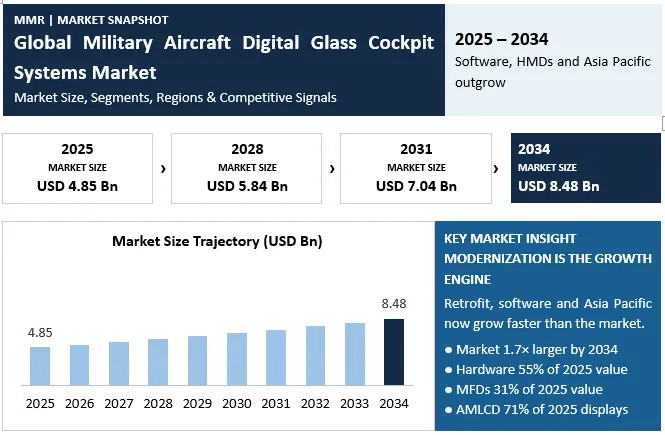
The Global Military Aircraft Digital Glass Cockpit Systems Market was valued at USD 4.85 billion in 2025 and is projected to reach USD 8.48 billion by 2034, growing at a CAGR of 6.4% during 2026–2034, according to Maximize Market Research (MMR). Military aircraft digital glass cockpit systems replace analog dials and gauges with integrated digital displays, mission computers, head-up and helmet-mounted displays and cockpit software, so pilots see flight, navigation, sensor, weapons and threat information on a small set of configurable screens.
This military aircraft glass cockpit market analysis answers both sides of the search: what the market is worth for display makers, avionics integrators and investors, and what air forces, program offices and avionics engineers want to know, from how a glass cockpit works to military aircraft multifunction display systems, military aircraft HUD systems, helmet-mounted displays and military aircraft cockpit modernization.
Hardware anchors the market and air forces are the largest buyers, but growth in the military aircraft digital cockpit market is shifting toward software, helmet-mounted displays, retrofit programs and Asia Pacific as fleets move from analog and early-digital cockpits to open-architecture, software-defined and AI-assisted systems.
Maximize Market Research provides comprehensive analysis of global military aircraft cockpit display systems market size, share, product type, offering, display technology, cockpit system architecture, aircraft platform type, application, end-user, procurement type and regional segmentation, the military aircraft avionics competitive landscape, strategic scenarios and growth opportunities. The report helps avionics and display manufacturers, aircraft OEMs, defense contractors, embedded computing and software suppliers and investors decide which segments, programs and countries to prioritise through 2034.
| 2025 | BASE YEAR | 2034 | FORECAST | GROWTH RATE | LARGEST REGION |
| USD 4.85 Bn | USD 8.48 Bn | 6.4% | North America |
Global Military Aircraft Digital Glass Cockpit Systems Market Overview:
The market is measured at product and service level across military aircraft digital glass cockpit hardware (display units, display controllers and graphics processors, embedded avionics computing and control panels), software and services sold worldwide for fixed-wing combat, fixed-wing non-combat and military rotary-wing aircraft, covering primary flight displays, multi-function displays, head-up displays, helmet-mounted displays and electronic standby systems. Civil aircraft glass cockpits, unmanned aircraft ground control stations and flight simulators are excluded.
Three shifts shape 2026–2034: demand is broadening from new-build fighters into cockpit modernization of legacy fleets, helicopters and mission aircraft; value is moving toward software, helmet-mounted displays and lifecycle services; and growth is rotating toward Asia Pacific, where indigenous fighter and trainer program are scaling. Suppliers are answering with open systems architecture, large-area touchscreen displays, AI-assisted decision support and augmented-reality visualization.
Military Aircraft Digital Glass Cockpit Systems Market Growth and Share Analysis
To know about the Research Methodology :- Request Free Sample Report
Military Aircraft Digital Glass Cockpit Quick Answers: 20 Most-Searched Questions About Military Cockpit Display Systems, Answered in One Line
This report is built around what air force planners, avionics engineers, defense procurement officers, manufacturers and investors actually search for. Use this table for instant answers, then jump to the section named in the last column.
Key Findings: Eight Insights Shaping the Global Military Aircraft Digital Glass Cockpit Systems Market
MMR's analysis of published market data, company filings, defense program announcements and regulatory frameworks points to eight findings that explain where military aircraft cockpit display systems market growth and value are created through 2034.
| Sr.No. | Findings | Evidence | So what |
| 1 | The market grows about 1.7× by 2034 | USD 4.85 Bn (2025) to USD 8.48 Bn (2034) at 6.4% CAGR | Display, processor and software capacity must scale with fleet modernization schedules |
| 2 | Hardware is the base, software the growth edge | Hardware 55% of 2025 value; software 8.8% CAGR | Recurring software upgrades and support become the margin engine |
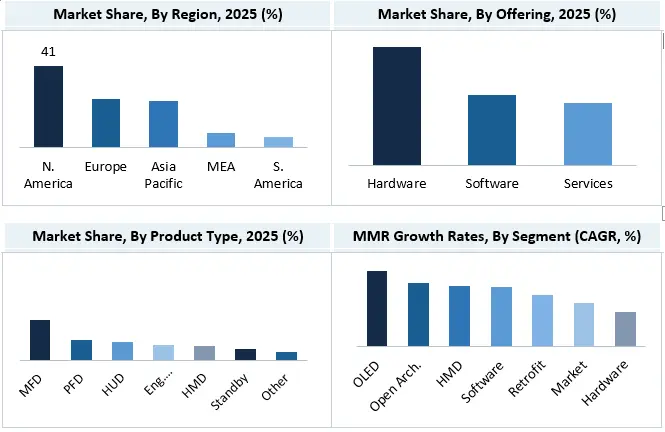
| 3 | North America is the largest region | 41.0% share in 2025, led by US fighter, helicopter and mobility programs | US budgets and programs set display, certification and pricing standards |
| 4 | Asia Pacific is the fastest-growing region | 8.1% CAGR; China, India, Japan and South Korea expand indigenous fleets | Local content and technology transfer decide share gains |
| 5 | Multi-function displays remain the core product | MFDs 31% of 2025 value; AMLCD 71% of display technology | Large-area and touchscreen MFD upgrades anchor demand |
| 6 | Helmet-mounted displays grow faster than the market | HMDs 9.0% CAGR versus 6.4% for the market | Fighter and helicopter helmet programs open new revenue |
| 7 | Retrofit is the second growth engine | Retrofit 42% of 2025 value; 7.7% CAGR | Legacy fleet cockpit modernization offsets new-build cycles |
| 8 | Open architecture and OLED reshape design | Open systems architecture 9.4% CAGR; OLED 11.2% CAGR | Modular, certified, cyber-secure offerings win long-term programs |
Global Military Aircraft Digital Glass Cockpit Systems Market Size, Share and Forecast, 2025–2034
MMR sizes the Global Military Aircraft Digital Glass Cockpit Systems Market at USD 4.85 billion in 2025, rising to USD 5.16 billion in 2026 and USD 8.48 billion in 2034, a 6.4% CAGR. The military aircraft glass cockpit market forecast adds about USD 3.63 billion over the period; about 43% of the 2034 market is revenue that does not exist today. Published estimates differ because of scope: 2025 values from third-party publishers range from about USD 0.2 billion to USD 4.8 billion and growth rates from about 3% to 9%, depending on whether helmet-mounted displays, software, services and retrofit programs are counted. MMR's base includes all of them.
Global Military Aircraft Digital Glass Cockpit Systems Market Dynamics:
Military Aircraft Glass Cockpit Market Growth Drivers: Fleet Modernization, Defense Spending, Situational Awareness and Next-Generation Fighter Programs
The Global Military Aircraft Digital Glass Cockpit Systems Market is supported by sustained defense investment and the long-running replacement of analog cockpits. Global military expenditure reached about USD 2.7 trillion in 2024 according to the Stockholm International Peace Research Institute (SIPRI), and air power modernization, from fifth-generation fighters to upgraded transport, tanker and helicopter fleets, takes a large share of procurement budgets. Digital glass cockpits give pilots a single, configurable view of flight data, navigation, sensors, weapons and threats, which reduces workload and improves situational awareness in contested, night and low-visibility operations. Military aircraft multifunction display systems, head-up displays and helmet-mounted displays are now standard requirements on new combat aircraft and a common objective for cockpit modernization of older fleets. Hardware accounts for about 55% of 2025 value, which gives the market a solid base of display units, processors and control panels, while long service lives of 25 to 40 years create repeated upgrade, repair and support demand. These factors support steady growth across fighter, transport and rotary-wing programs, although purchasing decisions still depend on certification, integration risk and lifecycle cost.
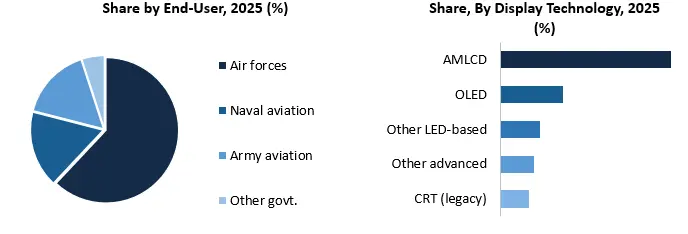
Retrofit, software and helmet displays are adding new layers of demand beyond new-build aircraft. Retrofit and upgrade programs make up about 42% of 2025 value and are projected to grow at 7.7% CAGR, as air forces replace obsolete cathode ray tube and early liquid crystal displays to resolve obsolescence and add moving maps, sensor imagery and digital weapons pages. Helmet-mounted display systems, about 11% of 2025 value, are projected to grow at 9.0% CAGR: in March 2026 the US Navy awarded Collins Elbit Vision Systems a USD 585 million contract for Lot 18 and Lot 19 F-35 helmet-mounted display hardware, confirming the helmet as a primary cockpit interface. Software, including display and visualization software, flight information processing, mission management and human-machine interface software, made up about 24% of 2025 value and is projected to grow at 8.8% CAGR as air forces buy software-defined cockpits that can be upgraded without new hardware. Air forces, the largest end-user group at about 62% of 2025 value, anchor demand in the military aircraft digital cockpit market through long-term program commitments.
Military Aircraft Glass Cockpit Market Restraints:
Integration cost and certification effort are the main restraints. A military glass cockpit must work with mission computers, radars, electronic warfare suites, data links and weapons systems, so each new or upgraded cockpit requires extensive hardware and software integration, flight testing and airworthiness approval. Qualification against environmental, vibration and electromagnetic standards can take years, and a change to one display or software load can trigger re-testing across the aircraft. For retrofit programs on older airframes, cockpit space, wiring and power limits add cost and risk, and some air forces defer upgrades or extend the life of existing displays when budgets tighten. Program delays on large fighter and helicopter projects move revenue between years and add uncertainty for suppliers.
Supply chain, export control and standards challenges also limit growth. Military displays depend on advanced liquid crystal and OLED panels, graphics processors, embedded processors and specialty optical components, and supply exposure to semiconductors, rare materials and a limited number of qualified suppliers can raise prices and lengthen lead times. Tariffs, currency movements and export licensing under ITAR, EAR and national regimes restrict where systems and technology can be sold or produced, which pushes some buyers toward indigenous cockpit programs. Software must meet DO-178C and hardware DO-254 assurance expectations, and defense cybersecurity rules add compliance obligations for secure avionics updates. Defense budgets are also exposed to political cycles, continuing resolutions and shifts in priority between air, land, sea and space programs.
What Are the Biggest Military Aircraft Cockpit Modernization Opportunities Through 2034?
Retrofit programs, software-defined cockpits and helmet-mounted displays represent the most significant opportunities because they extend revenue beyond one-time hardware sales. The retrofit and upgrade segment is projected to grow at 7.7% CAGR as air forces modernize legacy fighters, transports and helicopters rather than replace them. Open systems architecture, projected at 9.4% CAGR, lets operators add applications, sensors and displays through modular software and standard interfaces, which lowers lifecycle cost and favours suppliers with certified, reusable building blocks. AI-enabled decision support, sensor fusion and augmented-reality visualization can turn growing volumes of sensor data into clear pilot cues, supporting software growth of 8.8% CAGR. Suppliers that offer certified, cyber-secure and upgradable cockpit packages may be better positioned to win long-term programs.
Emerging-market expansion, helicopter modernization and sustainment services offer further routes to growth. Asia Pacific is projected to be the fastest-growing region at 8.1% CAGR as China, India, Japan, South Korea, Australia and Taiwan expand fighter fleets and indigenous aircraft programs, while the Middle East adds demand through large fleet purchases and local defense industry development. Military rotary-wing aircraft, about 19% of 2025 value and growing at 7.6% CAGR, offer a large base of attack, utility, naval and search and rescue helicopters that still use analog or first-generation digital cockpits. Services, including integration, testing and certification, maintenance and repair, retrofit and training, make up about 21% of 2025 value and grow at 6.9% CAGR, and long-term support contracts keep suppliers involved across the aircraft life. Next-generation fighter programs, including those in Europe, Japan and South Korea, create opportunities for new large-area, OLED and immersive cockpit designs, and the fighter aircraft digital cockpit remains the most demanding and highest-value application of military aircraft digital avionics.
Military Aircraft Digital Cockpit Trends: Open Architecture, AI Decision Support, Augmented Reality and Touchscreen Displays
Four military aircraft digital cockpit trends stand out through 2034. First, open architecture: modular avionics, standard interfaces and software-defined functions let operators upgrade cockpits faster and at lower cost. Second, large-area and touchscreen displays: panoramic and multi-window screens replace several smaller displays, and OLED technology, projected at 11.2% CAGR, improves brightness, contrast and weight. Third, helmet-mounted and augmented-reality visualization: helmet displays with night vision integration, cueing and projected symbology are moving from fighters into helicopters and mission aircraft. Fourth, AI and sensor fusion: machine learning and fused sensor data support target prioritization, threat awareness and reduced pilot workload, while cybersecurity and secure software updates become essential purchase criteria.
Global Military Aircraft Digital Glass Cockpit Systems Market Segment Analysis:
Military Aircraft Cockpit Display Systems Market by End User and Display Technology: Air Forces, Naval Aviation, Army Aviation and AMLCD and OLED Platforms
Military Aircraft Multifunction Display Systems, HUD Systems, Helmet-Mounted Displays, Offering and Procurement Type Analysis
Multi-function displays are the largest product type at about 31% of 2025 value, driven by tactical, navigation, sensor, engine and weapons-management pages, while primary flight displays hold about 16%, military aircraft HUD systems about 14%, engine and aircraft system monitoring displays about 12%, helmet-mounted displays about 11% and electronic standby displays about 9%. Helmet-mounted display systems are the fastest-growing product type at 9.0% CAGR. By offering, hardware leads at about 55% of 2025 value, followed by software at 24% and services at 21%. AMLCD technology is used in about 71% of 2025 displays, and OEM installation remains the larger procurement route at about 58%, while retrofit and upgrade programs are the fastest at 7.7% CAGR. By platform, fixed-wing combat aircraft hold about 52% of value, fixed-wing non-combat aircraft about 29% and military rotary-wing aircraft about 19%.
| Segmentation | Largest segment (2025 share) | Fastest segment (CAGR) | MMR view |
| Product type | Multi-function displays (31%) | Helmet-mounted displays (9.0%) | Scale MFD base, grow helmet content |
| Offering | Hardware (55%) | Software (8.8%) | Shift value to upgradable software and support |
| Display technology | AMLCD (71%) | OLED (11.2%) | OLED adds brightness, contrast and weight savings |
| Cockpit architecture | Federated (32%) | Open systems architecture (9.4%) | Open standards cut upgrade cost |
| Aircraft platform | Fixed-wing combat (52%) | Military rotary-wing (7.6%) | Helicopter modernization is catching up with fighters |
| Application | Flight instrumentation and monitoring (21%) | Electronic warfare and threat visualization (8.6%) | Mission data grows faster than basic flight data |
| End user | Air forces (62%) | Army aviation (7.4%) | Rotary fleets drive army upgrades |
| Procurement type | OEM installation (58%) | Retrofit and upgrade programs (7.7%) | Retrofit is the second growth engine |
Global Military Aircraft Digital Glass Cockpit Systems Market Regional Analysis:
North America is the largest regional market, accounting for about 41% of global value in 2025. The United States is the principal anchor, supported by the world's largest defense budget, the F-35 program, upgrades to F-15, F-16 and F/A-18 fleets, large transport, tanker and helicopter fleets and the headquarters of leading display and avionics suppliers, including Collins Aerospace, Honeywell, L3Harris, Lockheed Martin, Boeing and Northrop Grumman. Canada contributes through fighter replacement and fleet sustainment, while Mexico is a smaller buyer. The region is mature, so growth is projected at about 5.5% CAGR, led by retrofit, helmet-mounted displays and software. Europe holds about 24% of 2025 value, supported by Eurofighter, Rafale and Gripen fleets, national upgrade programs in the United Kingdom, France, Germany, Italy, Spain and Sweden, and next-generation fighter programs such as GCAP and FCAS; Europe is expected to grow at about 6.0% CAGR.
Asia Pacific is projected to be the fastest-growing region, with an 8.1% CAGR through 2034. China, India, Japan, South Korea, Australia and Taiwan are expanding combat fleets and indigenous aircraft programs, and suppliers such as Hindustan Aeronautics, Bharat Electronics, Samtel Avionics, Korea Aerospace Industries, Hanwha Systems, AVIC and CETC are broadening local avionics capability. Middle East & Africa is a smaller market, about 7% of 2025 value, with growth of about 7.3% CAGR as Saudi Arabia, the United Arab Emirates, Israel, Türkiye and Qatar buy and upgrade combat aircraft and build domestic defense electronics, with Elbit Systems, Israel Aerospace Industries, ASELSAN and EDGE Group as regional suppliers. South America, about 5%, is projected to grow at about 6.4% CAGR, led by Brazil, where Embraer and local avionics firms support fighter, transport and trainer programs, with Argentina, Chile and Colombia adding smaller upgrade demand.
Military Aircraft Avionics Companies and Competitive Landscape:
The military aircraft avionics competitive landscape includes several distinct groups rather than a single set of comparable companies. Global avionics and defense electronics leaders such as Collins Aerospace (RTX), Honeywell Aerospace, L3Harris Technologies, BAE Systems, Thales, Leonardo, Safran and Elbit Systems supply displays, mission computers, helmet systems and integrated cockpit packages. Platform OEMs such as Lockheed Martin, Boeing, Airbus, Dassault Aviation, Saab and Northrop Grumman integrate and specify cockpits for their aircraft. Specialist display, computing and software suppliers, including Astronautics Corporation of America, Barco, Curtiss-Wright, Mercury Systems, Innovative Solutions & Support, Kopin and Avidyne, serve rugged display, embedded computing, standby instrument and micro display niches, and indigenous suppliers such as HAL, BEL, Samtel, AVIC, CETC, KAI and ASELSAN serve national programs. These groups compete on different dimensions and should not be ranked as though they were identical producers.
Competition is increasingly shaped by the ability to combine high-brightness, ruggedized displays with open architecture, certified software and a credible position on retrofit and sustainment. Collins Aerospace and Elbit Systems compete and cooperate in helmet displays through the Collins Elbit Vision Systems joint venture, which won a USD 585 million F-35 helmet contract in March 2026, while Thales supplies Scorpion helmet-mounted display retrofit kits for US Air Force F-16s through the NATO Support and Procurement Agency. Honeywell, L3Harris and BAE Systems couple cockpit displays with mission computers and flight control, and European and Asian suppliers defend home programs through indigenous content requirements. Smaller players differentiate through rugged display engineering, micro displays, standby instruments and price. Consolidation, joint ventures and technology partnerships are likely to continue in the military aircraft avionics market and the military aircraft cockpit display systems market as air forces ask for integrated, upgradable cockpits.
Top Military Aircraft Digital Cockpit Companies: Avionics Leaders, HUD and HMD Specialists, Rugged Display Makers and Platform OEMs
MMR separates participants by role, because a platform OEM, a display specialist and an embedded computing supplier do not compete with each other.
Military Aircraft Digital Cockpit Company Benchmark: Strategic Signals and Program Positions
| Company | Strategic signal |
| Collins Aerospace (RTX) | Collins Elbit Vision Systems JV won USD 585 Mn for F-35 helmet display Lots 18–19 (Mar 2026); Zero-G HMDS+ design review completed (Dec 2025) |
| Elbit Systems | JV partner in Collins Elbit Vision Systems; helmet display and tracking system for Israeli UH-60 fleet (Feb 2026) |
| Thales Group | Scorpion helmet-mounted display retrofit kits for USAF F-16s via NSPA; helicopter helmet display portfolio |
| L3Harris Technologies | Cockpit display and mission avionics supplier for combat and special-mission aircraft |
| Honeywell Aerospace | Integrated avionics, flight displays and flight management for military transport and helicopter platforms |
Global Military Aircraft Digital Glass Cockpit Systems Market Recent Developments,
| Date | Development | Why it matters |
| Dec 2025 | Collins Elbit Vision Systems completes the critical design review of the Zero-G Helmet Mounted Display System+, a sixth-generation HMD | Next-generation helmet display moves toward production |
| Feb 2026 | Elbit Systems wins a contract for helmet display and tracking systems on the Israeli Air Force UH-60 Black Hawk fleet | Helmet displays extend to helicopters |
| Mar 2026 | US Navy awards Collins Elbit Vision Systems USD 585 Mn for Lot 18 and Lot 19 F-35 helmet-mounted display hardware | Confirms the helmet as the F-35 primary display |
| Sep 2026 | CAE wins a USD 42 Mn contract for two Morocco F-16 full mission trainers with a Block 72 cockpit and JHMCS II | Cockpit and helmet content spreads into training |
| Sep 2026 | US Navy orders USD 9.39 Mn of repairs on 314 F/A-18 helmet display units from Collins Elbit | Lifecycle support supports aftermarket demand |
Global Military Aircraft Digital Glass Cockpit Systems Market Scope:Inquire before buying
| Global Military Aircraft Digital Glass Cockpit Systems Market |
|||
|---|---|---|---|
| Report Coverage | Details | ||
| Base Year: |
2025 | Forecast Period: | 2026-2034 |
| Historical Data: |
2020 to 2025 | Market Size in 2025: | USD 4.85 Billion |
| Forecast Period 2026 to 2034 CAGR: |
6.4% | Market Size in 2034: | USD 8.48 Billion |
| Segments Covered: |
By Product Type | Primary Flight Displays (PFDs) Multi-Function Displays (MFDs) Head-Up Display Systems (HUDs) Helmet-Mounted Display Systems (HMDs) Electronic Standby Display Systems Engine and Aircraft System Monitoring Displays Other Cockpit Display Products |
|
| By Offering | Hardware (Cockpit Display Units and Display Panels, Display Controllers and Graphics Processing Units, Embedded Avionics Computing Hardware, Cockpit Control Panels and Interface Units, Other Hardware Components) Software (Cockpit Display and Visualization Software, Flight Information Processing Software, Mission Management and Display Software, Human-Machine Interface Software, Other Cockpit Software) Services (Cockpit System Design and Engineering, Avionics Integration and Installation, Testing and Certification, Maintenance, Repair and Overhaul, Retrofit and Modernization, Training and Technical Support) |
||
| By Display Technology | Active-Matrix Liquid Crystal Display (AMLCD) Technology Organic Light-Emitting Diode (OLED) Technology Other LED-Based Display Technologies Cathode Ray Tube (CRT) Legacy Display Technology Other Advanced Display Technologies |
||
| By Cockpit System Architecture | Federated Cockpit Display Architecture Integrated Modular Avionics (IMA) Architecture Distributed Avionics Architecture Centralized Avionics Architecture Open Systems Architecture-Based Cockpit Systems |
||
| By Aircraft Platform Type | Fixed-Wing Combat Aircraft (Fighter and Interceptor, Ground-Attack and Strike, Bomber) Fixed-Wing Non-Combat Aircraft (Military Transport and Airlift, Aerial Refueling and Tanker, Military Trainer, Intelligence, Surveillance and Reconnaissance, Maritime Patrol and Airborne Command) Military Rotary-Wing Aircraft (Attack, Utility and Transport, Reconnaissance and Surveillance, Maritime and Naval Helicopters) |
||
| By Application | Flight Instrumentation and Monitoring; Navigation and Flight Management Mission and Tactical Information Management Weapons and Stores Management; Engine and Aircraft System Monitoring Communication and Data Link Management Electronic Warfare and Threat Visualization Surveillance and Sensor Information Management Other Military Aviation Applications |
||
| By End User | Air Forces; Naval Aviation Forces Army Aviation Forces Other Government Military Aviation Organizations |
||
| By Procurement Type | Original Equipment Manufacturer (OEM) Installation Retrofit and Upgrade Programs |
||
Global Military Aircraft Digital Glass Cockpit Systems Market, By Region
North America (United States, Canada, Mexico)
Europe (United Kingdom, Germany, France, Italy, Spain, Sweden, Switzerland, Poland, Netherlands, Norway, Türkiye, Russia, Rest of Europe)
Asia Pacific (China, India, Japan, South Korea, Australia, Taiwan, Indonesia, Singapore, Pakistan, Rest of Asia Pacific)
Middle East & Africa (Saudi Arabia, United Arab Emirates, Israel, Türkiye, Qatar, Egypt, South Africa, Rest of Middle East & Africa)
South America (Brazil, Argentina, Chile, Colombia, Rest of South America)
Global Military Aircraft Digital Glass Cockpit Systems Market, Key Players
North America
1. Collins Aerospace (RTX Corporation)
2. Honeywell Aerospace
3. L3Harris Technologies, Inc.
4. BAE Systems, Inc.
5. Northrop Grumman Corporation
6. Lockheed Martin Corporation
7. The Boeing Company
8. General Dynamics Corporation
9. Astronautics Corporation of America
10. Curtiss-Wright Corporation
11. TransDigm Group Incorporated
12. Korry Electronics
13. Mercury Systems, Inc.
14. Innovative Solutions & Support, Inc.
15. Thomas Global Systems, LLC
16. Avidyne Corporation
17. Moog Inc.
18. Teledyne Technologies Incorporated
19. Kopin Corporation
20. Anodyne Electronics Manufacturing Corp.
Europe
21. Thales Group
22. Leonardo S.p.A.
23. Safran S.A.
24. Saab AB
25. Diehl Stiftung & Co. KG
26. HENSOLDT AG
27. Indra Sistemas, S.A.
28. Airbus SE
29. Dassault Aviation S.A.
30. Kongsberg Defense & Aerospace AS
31. Rheinmetall AG
32. Barco NV
33. BAE Systems plc
34. Cobham Limited
35. QinetiQ Group plc
36. Parker Hannifin Corporation
Asia Pacific
37. Hindustan Aeronautics Limited (HAL)
38. Bharat Electronics Limited (BEL)
39. Samtel Avionics Ltd.
40. Bharat Dynamics Limited
41. Mitsubishi Electric Corporation
42. Kawasaki Heavy Industries, Ltd.
43. Japan Aviation Electronics Industry, Ltd.
44. Hanwha Systems Co., Ltd.
45. Korea Aerospace Industries, Ltd.
46. LIG Nex1 Co., Ltd.
47. Samsung Electronics Co., Ltd.
48. Aviation Industry Corporation of China (AVIC)
49. China Electronics Technology Group Corporation (CETC)
50. China North Industries Group Corporation (NORINCO)
51. Singapore Technologies Engineering Ltd. (ST Engineering)
52. Fujitsu Limited
Middle East & Africa
53. Elbit Systems Ltd.
54. Israel Aerospace Industries Ltd. (IAI)
55. Rafael Advanced Defense Systems Ltd.
56. ASELSAN A.Ş.
57. Turkish Aerospace Industries (TAI)
58. Denel SOC Ltd.
59. Paramount Group
60. EDGE Group PJSC
South America
61. Embraer S.A.
62. AEL Sistemas S.A.
63. Akaer Engenharia S.A.
64. Avibras Indústria Aeroespacial S.A.
Global Military Aircraft Digital Glass Cockpit Systems Market FAQs: Frequently Asked Questions
What is the size and forecast of the global military aircraft digital glass cockpit systems market?
MMR values the global military aircraft digital glass cockpit systems market at USD 4.85 billion in 2025, USD 5.16 billion in 2026 and USD 8.48 billion by 2034, a 6.4% CAGR for 2026–2034. Hardware is the largest offering at about 55% of 2025 value, and software is the fastest at 8.8% CAGR.
Which region and country is the largest military aircraft glass cockpit market?
North America holds the largest military aircraft glass cockpit market share at 41.0% in 2025, anchored by the United States, which combines the largest defense budget, the F-35 program, large fleet upgrade requirements and the headquarters of leading avionics suppliers. Asia Pacific is the fastest-growing region at 8.1% CAGR, led by China, India, Japan and South Korea.
Which military aircraft cockpit display segments are growing fastest?
Multi-function displays are the largest product type at about 31% of 2025 value, while helmet-mounted display systems are the fastest at 9.0% CAGR. By technology, AMLCD leads at about 71% and OLED is fastest at 11.2% CAGR; by architecture, open systems architecture is fastest at 9.4% CAGR; and by procurement, retrofit and upgrade programs grow at 7.7% CAGR.
Who are the leading military aircraft avionics and cockpit display companies?
Leading names include Collins Aerospace (RTX), Honeywell Aerospace, L3Harris Technologies, BAE Systems, Thales, Leonardo, Safran and Elbit Systems, alongside platform OEMs such as Lockheed Martin, Boeing, Airbus, Dassault Aviation and Saab, specialist suppliers such as Astronautics, Barco, Curtiss-Wright, Mercury Systems and Kopin, and indigenous suppliers such as HAL, BEL, AVIC, CETC, KAI and ASELSAN.
How does a military aircraft digital glass cockpit work, and what is the difference between PFD, MFD, HUD and HMD?
A glass cockpit receives data from air data, navigation, radar, electro-optical, electronic warfare and weapons systems through avionics buses and mission computers, and display processors render it on screens. A primary flight display shows attitude, altitude, speed and heading; a multi-function display shows reconfigurable navigation, tactical, sensor, engine and weapons pages; a head-up display projects symbology in the pilot's line of sight; and a helmet-mounted display projects it on the visor and follows the pilot's head.
What are digital cockpits used for in combat, transport and special missions?
In combat, military aircraft digital cockpits support target engagement, weapons management, threat awareness and data sharing. In transport and tanker roles they support flight management, navigation and refueling monitoring, and in surveillance, maritime patrol, search and rescue and airborne command roles they present sensor and mission information. Helicopter cockpits add helmet-mounted displays, night operations support and terrain awareness.
Why is military aircraft cockpit modernization important, and which standards apply?
Many fighters, transports and helicopters have service lives of several decades, so analog and early-digital cockpits become obsolete before the airframe does. Cockpit modernization restores supportability and adds moving maps, sensor imagery, digital weapons pages and open architecture. Suppliers must meet MIL-STD-810 environmental, MIL-STD-461 electromagnetic, DO-178C software and DO-254 hardware expectations, defense cybersecurity requirements and ITAR or EAR export rules.
Global Military Aircraft Digital Glass Cockpit Systems Market Research Methodology
MMR sized the market top-down from a 2025 base of USD 4.85 billion and a 6.4% CAGR for 2026–2034, cross-checked bottom-up against fleet size, new aircraft deliveries, retrofit programs and average cockpit system value by platform. Inputs include company filings and investor presentations, defense ministry and procurement announcements, contract awards, program documents, regulatory and standards publications, trade and industry associations and public statistics. Segment shares and growth rates are MMR estimates built on these sources and validated against supplier positioning, program timing and regional defense spending. Published third-party estimates differ because of scope; MMR's base includes hardware, software and services across PFD, MFD, HUD, helmet-mounted display and standby systems, and excludes civil aircraft glass cockpits, unmanned aircraft ground control stations and simulators.