
Microarray Market BY Product Type, By Offering, By Technology, By Detection Technology, By Detection Technology, By Sample Type, By Application, By End User, By Distribution Channel and Regional Insights 2034
Overview
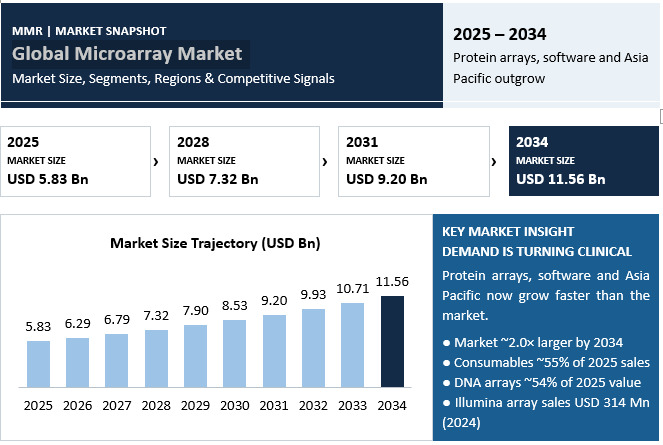
The Global Microarray Market was valued at USD 5.83 billion in 2025 and is projected to reach USD 11.56 billion by 2034, growing at a CAGR of 7.9% during 2026–2034, according to Maximize Market Research (MMR). Microarrays are solid-surface platforms, such as glass slides, silicon chips, beads and membranes, that carry thousands of known probes so laboratories can measure gene expression, genetic variation, proteins and tissue biomarkers in parallel from a single sample.
This microarray market analysis answers both sides of the search: what the market is worth for manufacturers and investors, and what laboratories want to know, from how microarray technology works to gene expression profiling, genotyping and SNP analysis and microarray-based diagnostics.
Consumables anchor the market and pharmaceutical, academic and clinical laboratories are the largest buyers, but microarray market growth is shifting toward protein arrays, software, clinical diagnostics and Asia Pacific as next-generation sequencing (NGS) narrows the role of arrays in discovery.
Maximize Market Research provides comprehensive analysis of global microarray market size, share, product type, offering, technology, application, end-user, channel and regional segmentation, the microarray competitive landscape, strategic scenarios and growth opportunities. The report helps manufacturers, reagent and instrument suppliers, bioinformatics providers, CROs, diagnostic laboratories and investors decide which segments, channels and countries to prioritise through 2034.
| 2025 | BASE YEAR | 2034 | FORECAST | GROWTH RATE | LARGEST REGION |
| USD 5.83 Bn | USD 11.56 Bn | 7.9% | North America |
Global Microarray Market Overview:
The market is measured at product and service level across microarray chips and slides, instruments and scanners, reagents and consumables, software and services sold worldwide for research, clinical, pharmaceutical and agricultural use, covering DNA, RNA, protein, tissue and other specialised arrays. Sequencing instruments are excluded.
Three shifts shape 2026–2034: demand is broadening into clinical diagnostics, population genotyping and pharmaceutical screening; value is moving toward reagents, software and services; and growth is rotating toward Asia Pacific. Vendors are answering sequencing competition with automated array workflows and multi-omic platforms.
Microarray Market Growth Outlook
To know about the Research Methodology :- Request Free Sample Report
Microarray Quick Answers: 20 Most-Searched Questions About Microarrays, Answered in One Line
This report is built around what researchers, laboratory managers, manufacturers and investors actually search for. Use this table for instant answers, then jump to the section named in the last column.
| Question people search | Short answer | Section |
| How big is the microarray market? | USD 5.83 Bn in 2025 (MMR); USD 11.56 Bn by 2034 at 7.9% CAGR | Market Size |
| How fast is the microarray market growing? | 7.9% CAGR on MMR’s base; published estimates range from about 5% to 9% | Market Size |
| Which region has the largest microarray market share? | North America leads with 38.0% share; Asia Pacific is fastest at 9.9% CAGR | Regional |
| What is a microarray? | A slide, chip, bead or membrane carrying thousands of known probes that measure genes, proteins or tissues in parallel | Overview |
| How does microarray technology work? | A labelled sample binds matching probes; a scanner reads the signal; software converts it into expression or genotype data | Technology |
| What is the DNA microarray market? | DNA arrays are the largest product type at about 54% of 2025 value | Segmentation |
| What is the protein microarray market? | About 18% of 2025 value and the fastest product type at 10.2% CAGR | Segmentation |
| What is gene expression profiling? | Measuring the activity of thousands of genes at once; it is the largest application at about 32% of value | Applications |
| What are genotyping and SNP analysis arrays used for? | Detecting genetic variants across large cohorts for population studies, pharmacogenomics and agriculture; about 21% of value | Applications |
| What are microarray-based diagnostics? | Array tests for chromosomal abnormalities, inherited disorders, cancer subtyping and drug response; 9.3% CAGR | Clinical |
| Microarray or next-generation sequencing? | Arrays cost less per sample for known targets and large cohorts; sequencing finds unknown variants and leads discovery | Competitive |
| Which offering is the largest? | Reagents and consumables lead at about 31%; with chips and slides, consumables are about 55% of value | Offering |
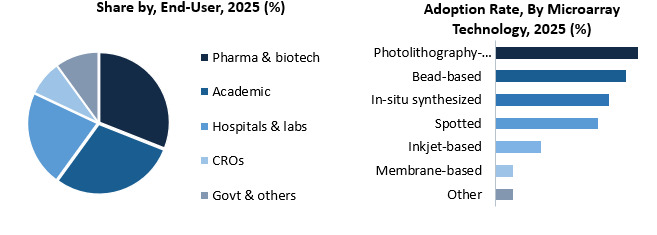
| Which microarray technology is largest? | Photolithography-based arrays at about 25%, followed by bead-based at about 23% | Technology |
| Which detection technology dominates? | Fluorescence, at about 72% of 2025 sales; label-free is the fastest at 11.4% CAGR | Technology |
| Who buys microarrays? | Pharma and biotech 31%, academic and research 29%, hospitals and diagnostic labs 22% of 2025 value | End User |
| What are the main microarray applications? | Gene expression, genotyping, cancer research, drug discovery, clinical diagnostics and proteomics | Applications |
| Who are the leading microarray companies? | Thermo Fisher, Agilent, Illumina, Merck KGaA, Bio-Rad, Revvity, Roche and Qiagen, plus specialists such as OGT and CapitalBio | Competitive |
| Which distribution channel is growing fastest? | Online sales at about 9.0% CAGR; direct sales remain the largest at about 46% | Channels |
| Which regulations apply to diagnostic microarrays? | FDA in vitro diagnostic rules, EU IVDR, ISO 13485 and ISO 15189, plus genetic-data privacy laws | Regulation |
| What does a microarray experiment cost? | Cost depends on array format, batch size and instruments; total cost of ownership matters more than list price | Pricing |
Key Findings: Eight Insights Shaping the Global Microarray Market
MMR’s analysis of published market data, company filings, regulatory frameworks and industry announcements points to eight findings that explain where microarray market growth and value are created through 2034.
| Sr.No. | Findings | Evidence | So what |
| 1 | The market roughly doubles by 2034 | USD 5.83 Bn (2025) to USD 11.56 Bn (2034) at 7.9% CAGR | Reagent supply, scanner capacity and laboratory throughput must scale about 2.0× by 2034 |
| 2 | Consumables are the base, software the growth edge | Consumables ~55% of 2025 value; software and analytical tools 11.0% CAGR | Recurring reagents and analytics become the margin engine |
| 3 | North America is the largest region | 38.0% share in 2025, led by US research, pharma and clinical genomics | US funding and reimbursement set product standards and pricing |
| 4 | Asia Pacific is the fastest-growing region | 9.9% CAGR; China, India, Japan and South Korea expand genomics capacity | Local manufacturing and distribution decide share gains |
| 5 | DNA microarrays remain the core | DNA arrays ~54% of 2025 value; gene expression ~32% of applications | Gene expression profiling and genotyping anchor demand |
| 6 | Protein arrays grow faster than the market | Protein microarrays 10.2% CAGR versus 7.9% for the market | Proteomics and biomarker discovery open new revenue |
| 7 | NGS is both threat and complement | Illumina array sales USD 314 Mn (2024); Thermo Fisher launched SwiftArrayStudio (Oct 2025) | Arrays defend population-scale genotyping while sequencing wins discovery |
| 8 | Clinical diagnostics gains share | Clinical diagnostics 9.3% CAGR; EU IVDR and FDA rules raise entry barriers | Validated, regulated arrays win clinical laboratory contracts |
Global Microarray Market Size, Share and Forecast, 2025–2034
MMR sizes the Global Microarray Market at USD 5.83 billion in 2025, rising to USD 6.29 billion in 2026 and USD 11.56 billion in 2034, a 7.9% CAGR. The microarray market forecast adds about USD 5.73 billion over the period; about 50% of the 2034 market is revenue that does not exist today. Published estimates differ because of scope: 2025 values range from about USD 4.2 billion to USD 6.9 billion and growth rates from about 5% to 9%, depending on whether software, services and tissue arrays are counted. MMR’s base includes all of them.
How Big Is the Global Microarray Market, and How Fast Is It Growing?
Global Microarray Market Dynamics
Global Microarray Market Growth Drivers: Precision Medicine, Gene Expression Profiling, Drug Discovery and Cancer Research
The Global Microarray Market is supported by sustained investment in genomics, precision medicine and biomedical research. Microarrays measure thousands of genes, variants or proteins in a single experiment, which makes them a practical and cost-controlled tool for gene expression profiling, genotyping and SNP analysis, copy number analysis and methylation studies. Government and private funding for genomics and proteomics research, rising pharmaceutical R&D budgets and expanding academic infrastructure keep demand for chips, reagents and scanners resilient. Cancer is a major pull factor: the American Cancer Society projected more than 1.8 million new cancer cases in the United States in 2025, and researchers use gene expression arrays, SNP arrays and tissue microarrays to classify tumours, identify biomarkers and study treatment response. Consumables, including slides, chips, probes, labelling kits and reagents, account for about 55% of 2025 value, which gives the market a recurring revenue base because every experiment consumes new arrays. These factors support steady microarray market growth across research and clinical laboratories, although purchasing decisions still depend on accuracy, throughput and cost per sample.
Clinical translation and automation are adding new layers of demand beyond research use. Microarray-based diagnostics support genetic disease screening, chromosomal abnormality detection, pharmacogenomic testing, infectious disease detection and autoimmune profiling, and clinical diagnostics is projected to grow at 9.3% CAGR, faster than the overall market. Vendors are also making arrays easier to run at scale: in October 2025 Thermo Fisher launched the Applied Biosystems SwiftArrayStudio analyzer with new Axiom arrays, combining four genotyping steps in one instrument and delivering results in as little as 30 hours. Software and analytical tools, including AI-assisted image analysis, normalisation, pathway analysis and cloud data management, made up about 7% of 2025 value and are projected to grow at 11.0% CAGR. Pharmaceutical and biotechnology companies, the largest end-user group at about 31% of 2025 value, use arrays for target identification, toxicogenomics, biomarker validation and preclinical safety work, which keeps repeat consumable demand high.
Global Microarray Market Restraints: Sequencing Competition, Capital Cost, Standardisation and Regulation
Competition from next-generation sequencing is the main restraint. As sequencing costs fall, many discovery and transcriptomic projects that once defaulted to arrays now use RNA sequencing or whole-genome sequencing, which can detect unknown variants and novel transcripts that fixed-probe arrays cannot. Arrays remain cost-effective for large cohorts and known targets, but laboratories weigh the cost per sample, turnaround and data richness of both options, and some budgets are being redirected to sequencing platforms. Illumina, which sells both arrays and sequencers, reported microarray product revenue of USD 314 million in 2024, a small fraction of its total revenue of about USD 4.34 billion in 2025, which illustrates how much larger the sequencing business is. Capital cost is a second constraint: scanners, hybridization stations, liquid-handling systems and bioinformatics infrastructure require upfront spending, and smaller laboratories may rely on service providers rather than buy instruments.
Standardisation, regulation and data-handling challenges also limit growth. Microarray results can vary with probe design, sample quality, hybridization conditions and normalisation methods, so reproducibility and cross-platform comparability require strict quality control. Clinical arrays must meet in vitro diagnostic requirements in the United States and the European Union’s IVDR, and laboratories must follow ISO 13485 and ISO 15189 quality standards, which adds time and cost for suppliers. Genetic data privacy, patient consent and sample-handling rules add further compliance obligations. Supply chains for oligonucleotides, specialty substrates, fluorescent dyes and cold-chain reagents are exposed to price swings, tariffs and currency movements, and research budgets can tighten when public funding is delayed or reduced.
What Are the Biggest Microarray Market Opportunities Through 2034?
Protein microarrays, software and clinical applications represent the most significant opportunities because they extend revenue beyond the sale of standard DNA chips. The protein microarray market is projected to grow at 10.2% CAGR as antibody, antigen, reverse-phase and functional arrays support biomarker discovery, autoantibody profiling and proteomic research. Illumina’s acquisition of SomaLogic, which closed in January 2026, adds large-scale proteomics to a sequencing-led platform and signals strategic interest in protein profiling. AI-enabled data interpretation, cloud-based laboratory information management and predictive analytics can turn array data into clinical and pharmaceutical decisions, supporting software growth of 11.0% CAGR. Suppliers that offer validated panels, automated workflows and clear regulatory pathways may be better positioned to retain customers and sell upgrades.
Emerging-market expansion, contract services and multi-omic integration offer further routes to growth. Asia Pacific is projected to be the fastest-growing region at 9.9% CAGR as China, India, South Korea, Japan and Australia expand genomic research, diagnostic capacity and local manufacturing. Custom array design, contract research and genotyping services, which together make up about 21% of 2025 value and grow at 9.6% CAGR, let laboratories access array capability without buying instruments. Agricultural genomics, including crop and livestock genotyping, food safety testing and environmental microbial profiling, is a smaller but expanding application for high-throughput arrays. Integration of microarrays with next-generation sequencing, for example arrays for screening large cohorts and sequencing for confirmation, can turn a competing technology into a complementary workflow.
Microarray Market Trends: Automation, Multi-Omics, AI Analytics and Clinical Adoption
Four microarray market trends stand out through 2034. First, automation: walk-away analyzers, integrated sample-to-result workflows and plate formats are cutting hands-on time and turnaround, as in Thermo Fisher’s SwiftArrayStudio launch. Second, multi-omics: vendors are combining genotyping, methylation, transcriptomic and protein profiling so one sample yields several data layers; Illumina’s 5-Base DNA Prep, a sequencing workflow released in October 2025, detects variants and methylation together and shows where the wider industry is heading. Third, AI and cloud analytics: machine learning is being applied to image analysis, normalisation, biomarker discovery and predictive modelling. Fourth, clinical adoption: chromosomal microarray testing, pharmacogenomic panels and tumour profiling continue to move array technology from research benches into diagnostic laboratories, where regulatory compliance and reproducibility become the main purchase criteria.
Global Microarray Market Segment Analysis:
Microarray Market by End User and Microarray Technology: Pharma, Academia, Clinical Labs and Fabrication Platforms
DNA Microarray Market, Protein Microarray Market, Offering and Distribution Channel Analysis
DNA microarrays are the largest product type at about 54% of 2025 value, driven by gene expression profiling, genotyping and SNP analysis, copy number analysis and methylation arrays, while RNA arrays hold about 14%, protein arrays about 18% and tissue arrays about 10%. The protein microarray market is the fastest-growing product type at 10.2% CAGR. By offering, reagents and consumables lead at about 31% of 2025 value, followed by chips and slides at 24%, services at 21%, instruments and scanners at 17% and software at 7%. Fluorescence-based detection is used in about 72% of 2025 sales, and direct sales remain the largest channel at about 46%, while online sales are the fastest at about 9.0% CAGR.
| Segmentation | Largest segment (2025 share) | Fastest segment (CAGR) | MMR view |
| Product type | DNA microarrays (54%) | Protein microarrays (10.2%) | Defend the DNA core, scale protein arrays |
| Offering | Reagents and consumables (31%) | Software and analytical tools (11.0%) | Shift value to recurring reagents and analytics |
| Technology | Photolithography-based (25%) | Bead-based (9.2%) | Multiplexing and automation drive upgrades |
| Detection technology | Fluorescence-based (72%) | Label-free (11.4%) | Label-free adds sensitivity and simpler workflows |
| Application | Gene expression analysis (32%) | Proteomics (10.0%) | Research volume anchors; clinical adds growth |
| End user | Pharma and biotech (31%) | Hospitals and diagnostic labs (9.4%) | Clinical labs close the gap with research buyers |
| Sample type | DNA samples (46%) | Protein samples (10.1%) | Protein sample prep is the growth niche |
| Distribution channel | Direct sales (46%) | Online sales (9.0%) | Direct for instruments, online for consumables |
Global Microarray Market Regional Analysis:
North America is the largest regional market, accounting for about 38% of global value in 2025. The United States is the principal anchor, supported by large federal and private research funding, a dense base of pharmaceutical and biotechnology companies, leading academic genomics centres and the headquarters of major microarray vendors, including Thermo Fisher Scientific, Agilent Technologies and Illumina. Clinical genomics, precision oncology and pharmacogenomic testing add steady demand for microarray-based diagnostics, while Canada contributes through publicly funded research institutes and Mexico through expanding diagnostic laboratories. The region is mature, so growth is projected at about 7.0% CAGR, led by clinical applications, protein arrays and software. Europe holds about 27% of 2025 value, supported by strong genomics research in Germany, the United Kingdom, France, Switzerland and the Nordic countries, established contract research and cytogenetics laboratories, and the EU IVDR, which raises the bar for diagnostic arrays; Europe is expected to grow at about 7.4% CAGR.
Asia Pacific is projected to be the fastest-growing region, with a 9.9% CAGR through 2034. China, Japan, South Korea, India and Australia are expanding genomic research, hospital diagnostic capacity and domestic manufacturing; suppliers such as CapitalBio and Macrogen and Indian service providers such as MedGenome and Xcelris Labs are broadening local capability, and agricultural genotyping and population-scale genomic programmes add further demand. Middle East & Africa is a smaller market, about 5% of 2025 value, with growth of about 8.2% CAGR as Gulf countries invest in genomic medicine and molecular diagnostics and South Africa and Egypt strengthen research infrastructure. South America, also about 5%, is projected to grow at about 8.0% CAGR, led by Brazil and Argentina, where clinical laboratories and biotechnology research are developing but remain dependent on import pricing and distribution networks.
| Region | 2025 share | 2025 (USD Bn) | 2034 (USD Bn) | CAGR | Notes |
| North America | 38.0% | 2.39 | 4.39 | 7.0% | US is the anchor; pharma, academic and clinical genomics demand; large research funding base |
| Europe | XX | XX | XX | 7.4% | Germany, UK and France lead; strong cytogenetics labs; IVDR shapes diagnostic arrays |
| Asia Pacific | XX | XX | XX | 9.9% | China, India, Japan and South Korea expand genomics capacity; fastest region |
| Middle East & Africa | XX | XX | XX | 8.2% | Gulf genomic medicine and diagnostics investment; South Africa research base |
| South America | XX | XX | XX | 8.0% | Brazil and Argentina lead; clinical labs and biotech research developing |
Microarray Companies and Competitive Landscape: Who Are the Top Microarray Manufacturers and Players?
The microarray competitive landscape includes several distinct groups rather than a single set of comparable companies. Life-science tool leaders such as Thermo Fisher Scientific (Applied Biosystems and Affymetrix arrays), Agilent Technologies, Illumina, Merck KGaA, Bio-Rad Laboratories, Revvity and Roche supply arrays, instruments, reagents and workflows at global scale. Specialised array developers and service providers, including Oxford Gene Technology, Arrayit, Applied Microarrays, CapitalBio, RayBiotech, LC Sciences, Phalanx Biotech and Macrogen, serve custom, protein, tissue and contract-testing niches. Equipment, software and services suppliers such as Tecan, Molecular Devices, BioDiscovery, Qiagen and Eurofins complete the ecosystem. These groups compete on different dimensions and should not be ranked as though they were identical producers.
Competition is increasingly shaped by the ability to combine accurate, high-density arrays with automation, analytical software and a credible regulatory position. Thermo Fisher, Illumina and Agilent compete directly in population-scale genotyping and cytogenetic arrays, and Thermo Fisher’s October 2025 SwiftArrayStudio launch targets turnaround and throughput. Agilent, with fiscal 2025 revenue of USD 6.95 billion, couples custom arrays and scanners with pathology and diagnostics franchises. Illumina is pairing arrays with sequencing and, after the January 2026 SomaLogic acquisition, with proteomics. Smaller players differentiate through custom design, protein and peptide arrays, tissue microarray services and price. Consolidation and portfolio moves are likely to continue as sequencing pressures standalone array businesses.
Top Microarray Companies: Platform Leaders, Specialist Developers and Service Providers
MMR separates participants by role, because an array platform leader, a specialist developer and a service provider do not compete with each other.
| Group | Examples | Role |
| Global platform and instrument leaders | Thermo Fisher Scientific, Agilent Technologies, Illumina, Merck KGaA, Bio-Rad Laboratories, Revvity, Roche | Arrays, scanners, reagents and global distribution |
| DNA and genomic array specialists | Oxford Gene Technology, CapitalBio, Macrogen, Phalanx Biotech, Applied Microarrays, Arrayit, CustomArray | Cytogenetic, custom and gene expression arrays |
| Protein, tissue and specialised array developers | RayBiotech, Creative Biolabs, LC Sciences, Sengenics, Meso Scale Diagnostics | Antibody, antigen, tissue and peptide arrays |
| Software, bioinformatics and automation suppliers | BioDiscovery, Molecular Devices, Tecan, Qiagen | Analysis software, scanners and liquid handling |
| Reagent and consumable suppliers | Takara Bio, Eurogentec, Miltenyi Biotec, Diagenode | Probes, labelling kits, dyes and sample-prep consumables |
| Services, CROs and diagnostic laboratories | Eurofins, Novogene, BGI Genomics, MedGenome, Xcelris Labs, Fleury | Contract testing, genotyping and clinical services |
Microarray Company Benchmark: Disclosed 2025 Results and Strategic Signals
| Company | Strategic signal |
| Thermo Fisher Scientific | FY2025 revenue USD 44.56 Bn; launched SwiftArrayStudio and new Axiom arrays in Oct 2025 |
| Agilent Technologies | FY2025 revenue USD 6.95 Bn; FY2026 guidance USD 7.3–7.4 Bn; diagnostics and pathology focus |
| Illumina | 2025 revenue about USD 4.34 Bn; array sales USD 314 Mn (2024); SomaLogic closed Jan 2026 |
| Merck KGaA | Panorama protein functional microarray for oncology research (Oct 2025) |
| Oxford Gene Technology | Specialist cytogenetic and custom microarray provider in Europe |
Global Microarray Market Recent Developments, Technology Launches and Industry News | 2025–2026
| Date | Development | Why it matters |
| 4 Aug 2025 | Agilent expands the Dako Omnis line with three new models | Higher throughput for pathology and companion diagnostics |
| 1 Oct 2025 | Merck KGaA launches the Panorama Human Cancer Version 1 protein functional microarray | Protein-level oncology biomarker screening |
| 15 Oct 2025 | Thermo Fisher launches the SwiftArrayStudio analyzer with Axiom PharmacoPro and PangenomePro arrays | Automated genotyping with results in as little as 30 hours |
| 15 Oct 2025 | Illumina releases 5-Base DNA Prep for combined variant and methylation detection | Multi-omic signals from a single sample |
| 24 Nov 2025 | Agilent reports FY2025 revenue of USD 6.95 Bn and guides FY2026 to USD 7.3–7.4 Bn | Life-science tool demand improving |
| Jan 2026 | Illumina completes the SomaLogic acquisition | Adds proteomics to a sequencing-led platform |
| 23 Jan 2026 | Agilent introduces the S540MD slide scanner system for digital pathology | Scales tissue microarray and slide workflows |
| Feb 2026 | Illumina reports 2025 revenue of about USD 4.34 Bn and guides 2026 to USD 4.5–4.6 Bn | Clinical-led genomics demand stabilising |
Global Microarray Market Scope:Inquire before buying
| Global Microarray Market | |||
|---|---|---|---|
| Report Coverage | Details | ||
| Base Year: |
2025 | Forecast Period: | 2026-2034 |
| Historical Data: |
2020 to 2025 | Market Size in 2025: | USD 5.83 Billion |
| Forecast Period 2026 to 2034 CAGR: |
7.9% | Market Size in 2034: | USD 11.56 Billion |
| Segments Covered: |
By Product Type | DNA Microarrays Gene Expression Microarrays SNP Genotyping Microarrays Comparative Genomic Hybridization Microarrays DNA Methylation Microarrays Other DNA Microarray Products RNA Microarrays mRNA Expression Microarrays miRNA Microarrays lncRNA Microarrays Alternative Splicing Microarrays Other RNA Microarray Products Protein Microarrays Analytical Protein Microarrays Functional Protein Microarrays Reverse-Phase Protein Microarrays Antibody Microarrays Other Protein Microarray Products Tissue Microarrays Formalin-Fixed Paraffin-Embedded Tissue Microarrays Frozen Tissue Microarrays Cancer Tissue Microarrays Normal Tissue Microarrays Other Tissue Microarray Products Other Microarray Products Carbohydrate Microarrays Cell-Based Microarrays Peptide Microarrays Small Molecule Microarrays |
|
| By Offering | Products Microarray Chips and Slides Microarray Instruments and Scanners Microarray Reagents and Consumables Microarray Software and Analytical Tools Other Microarray Products Services Custom Microarray Design and Fabrication Services Gene Expression Profiling Services Genotyping and Genetic Analysis Services Protein Microarray Analysis Services Tissue Microarray Preparation Services Bioinformatics and Data Interpretation Services Contract Research and Laboratory Testing Services |
||
| By Technology | Spotted Microarray Technology In-Situ Synthesized Microarray Technology Bead-Based Microarray Technology Photolithography-Based Microarray Technology Inkjet-Based Microarray Technology Membrane-Based Microarray Technology Other Microarray Fabrication Technologies |
||
| By Detection Technology | Fluorescence-Based Detection Chemiluminescence-Based Detection Colorimetric Detection Electrochemical Detection Label-Free Detection |
||
| By Sample Type | DNA Samples RNA Samples Protein Samples Tissue Samples Cell Samples Other Biological Samples |
||
| By Application | Gene Expression Analysis Genotyping and Genetic Variation Analysis Cancer Research and Oncology Profiling Drug Discovery and Pharmaceutical Research Clinical Diagnostics and Disease Detection Proteomics and Protein Interaction Analysis Epigenetics and DNA Methylation Analysis Agricultural and Environmental Research Other Research and Diagnostic Applications |
||
| By End User | Pharmaceutical and Biotechnology Companies Academic and Research Institutions Hospitals and Diagnostic Laboratories Contract Research Organizations (CROs) Government and Public Health Research Institutions Agricultural and Food Research Organizations Other End Users |
||
| By Distribution Channel | Direct Sales Authorized Distributors Specialty Laboratory Equipment Suppliers Online Sales and E-Commerce Platforms Institutional and Government Procurement Channels |
||
Global Microarray Market, By Region
North America (United States, Canada, Mexico)
Europe (Germany, United Kingdom, France, Italy, Spain, Netherlands, Switzerland, Sweden, Denmark, Belgium, Austria, Poland, Rest of Europe)
Asia Pacific (China, Japan, India, South Korea, Australia, New Zealand, Singapore, Taiwan, Thailand, Malaysia, Indonesia, Rest of Asia Pacific)
Middle East & Africa (United Arab Emirates, Saudi Arabia, Israel, Turkey, South Africa, Egypt, Rest of Middle East & Africa)
South America (Brazil, Argentina, Chile, Colombia, Rest of South America)
Global Microarray Market, Key Players
North America
1. Agilent Technologies, Inc.
2. Thermo Fisher Scientific Inc.
3. Illumina, Inc.
4. Bio-Rad Laboratories, Inc.
5. Revvity, Inc.
6. F. Hoffmann-La Roche Ltd. (Roche Diagnostics)
7. Applied Microarrays, Inc.
8. Arrayit Corporation
9. Molecular Devices, LLC
10. Genisphere, LLC
11. RayBiotech Life, Inc.
12. Creative Biolabs
13. A&G Pharmaceutical, Inc.
14. Molecular Biology Resources, Inc.
15. GeneLink, Inc.
16. CD Genomics
17. LC Sciences LLC
18. ProteoGenix
19. CustomArray, Inc.
20. Takara Bio USA, Inc.
21. Danaher Corporation
22. PerkinElmer (Legacy Microarray Business)
23. Meso Scale Diagnostics, LLC
24. BioDiscovery, Inc.
Europe
25. Oxford Gene Technology (OGT)
26. Merck KGaA
27. QIAGEN N.V.
28. Eurofins Scientific SE
29. Microarrays Inc.
30. ArrayGen Technologies Pvt. Ltd. (European Operations)
31. Tecan Group Ltd.
32. Biometra GmbH
33. Hologic, Inc. (European Operations)
34. GenXPro GmbH
35. Diagenode S.A.
36. Miltenyi Biotec B.V. & Co. KG
37. Eurogentec S.A.
38. Novogene Europe
39. BioCat GmbH
40. Genomica S.A.U.
Asia Pacific
41. CapitalBio Corporation
42. Phalanx Biotech Group
43. Macrogen, Inc.
44. Bioneer Corporation
45. Daehan Scientific Co., Ltd.
46. Takara Bio Inc.
47. RIKEN
48. DNA Chip Research Inc.
49. Hokkaido System Science Co., Ltd.
50. Fujifilm Corporation
51. Hitachi High-Tech Corporation
52. Shimadzu Corporation
53. GeneTech Biotechnology Co., Ltd.
54. ArrayGen Technologies Pvt. Ltd.
55. MedGenome Labs Ltd.
56. Xcelris Labs Ltd.
57. Strand Life Sciences
58. Mapmygenome India Ltd.
59. Novogene Co., Ltd.
60. BGI Genomics Co., Ltd.
61. CD Genomics Asia
62. Sengenics Corporation
63. GeneWorks Pty Ltd.
Middle East & Africa
64. G42 Healthcare
65. PureHealth
66. National Reference Laboratory
67. Integrated Gulf Biosystems
68. Al Borg Diagnostics
South America
69. Dasa (Diagnósticos da América S.A.)
70. Fleury S.A.
71. Mendelics Genomic Analysis
72. Grupo Sabin
73. Genomma Lab Internacional
Global Microarray Market FAQs: Frequently Asked Questions
What is the size and forecast of the global microarray market?
MMR values the global microarray market at USD 5.83 billion in 2025, USD 6.29 billion in 2026 and USD 11.56 billion by 2034, a 7.9% CAGR over 2026–2034. The 2034 value is about 1.98 times the 2025 base, and published microarray market size estimates for 2025 range from about USD 4.2 billion to USD 6.9 billion depending on scope.
Which region and country is the largest microarray market?
North America holds the largest microarray market share at 38.0% in 2025, anchored by the United States. Europe follows at about 27% and Asia Pacific at about 22%. Asia Pacific is the fastest-growing region at 9.9% CAGR, led by China, India, Japan and South Korea.
Which microarray segments are growing fastest?
DNA microarrays are the largest product type at about 54% of 2025 value, while the protein microarray market grows fastest at 10.2% CAGR. Software and analytical tools grow at 11.0% CAGR, services at 9.6%, clinical diagnostics at 9.3% and online sales at about 9.0%, all above the 7.9% market rate.
Who are the leading microarray companies?
Leading names include Thermo Fisher Scientific (Applied Biosystems and Affymetrix arrays), Agilent Technologies, Illumina, Merck KGaA, Bio-Rad Laboratories, Revvity, Roche and Qiagen, alongside specialists such as Oxford Gene Technology, CapitalBio, Arrayit, RayBiotech and Macrogen. This is the core of the microarray competitive landscape.
How does microarray technology work, and what is the difference between DNA and protein microarrays?
A microarray fixes thousands of known probes to a slide, chip, bead or membrane; a labelled sample binds matching probes, a scanner reads the fluorescence or other signal, and software turns it into data. DNA microarrays use nucleic acid probes to measure gene expression, genotype, copy number or methylation, while protein microarrays use antibodies, antigens or proteins to measure protein levels, interactions and autoantibodies.
What are microarrays used for in gene expression profiling, genotyping and SNP analysis?
Gene expression profiling measures the activity of thousands of genes at once and is the largest application at about 32% of 2025 value. Genotyping and SNP analysis detect genetic variants across large cohorts for population genetics, pharmacogenomics, cancer research and agricultural breeding, and account for about 21%. Microarray applications also include microarray-based diagnostics, drug discovery and proteomics.
Are microarrays still relevant compared with next-generation sequencing?
Yes, for defined uses. Arrays remain cost-effective for large cohorts and known targets, such as population genotyping, chromosomal microarray testing and tissue and protein profiling, while sequencing leads discovery and novel variant detection. Vendors are responding with automated platforms, such as Thermo Fisher’s SwiftArrayStudio, and many laboratories use both technologies together.
Global Microarray Market Research Methodology
MMR sized the market top-down from a 2025 base of USD 5.83 billion and a 7.9% CAGR for 2026–2034, then triangulated against published market reports (2025 estimates of roughly USD 4.2 to 6.9 billion and CAGRs of about 5% to 9%), company filings and press releases (Thermo Fisher, Agilent, Illumina and others) and industry announcements through November 2026. Segment shares and regional splits are MMR estimates anchored to published splits (for example North America at roughly 38% of the market and DNA microarrays as the largest product type) and are normalised so every segment sums to the market total. Annual values are constant-CAGR interpolation. Segment CAGRs are the effective rates after normalisation; scenario analysis and opportunity levers are MMR judgement.