
Healthcare/Medical Simulation Market Size by Product & Services, End User, Region – Segment-Level Market Assessment, Growth Opportunity Analysis, Competitive Mapping & Forecast to 2034
Overview
Healthcare/Medical Simulation Market size was valued at US$ 2.92 Bn. in 2025 and the total revenue is expected to grow at a CAGR of 14.8 % from 2026 to 2034, reaching nearly US$ 10.13 Bn
Healthcare/Medical Simulation Market Overview
Healthcare/Medical Simulation is a technique that creates a situation or environment that allows persons to experience a representation of a real healthcare event for practice, learning, evaluation, or gaining an understanding of systems or human actions. The use of simulation is associated with improvements in healthcare provider knowledge and skills. Based on its proven benefits, the use of healthcare simulation products and services has grown rapidly over the last decade. This has caused a global expansion in both the demand and supply of healthcare/medical simulation products and services. Understanding how the global healthcare/medical simulation market's growth has impacted healthcare simulation economics is essential for decision-makers. However, healthcare simulation's global economics and its impact on business decision-making have not been examined in detail.
Medical simulation, or more broadly, healthcare simulation, is a branch of simulation related to education and training in medical fields of various industries. Simulations can be held in the classroom, in situational environments, or in spaces built specifically for simulation practice. It can involve simulated human patients - artificial, human or a combination of the two, educational documents with detailed simulated animations, casualty assessment in homeland security and military situations, emergency response, and support virtual health functions with holographic simulation.
Healthcare/Medical Simulation Market Growth Outlook
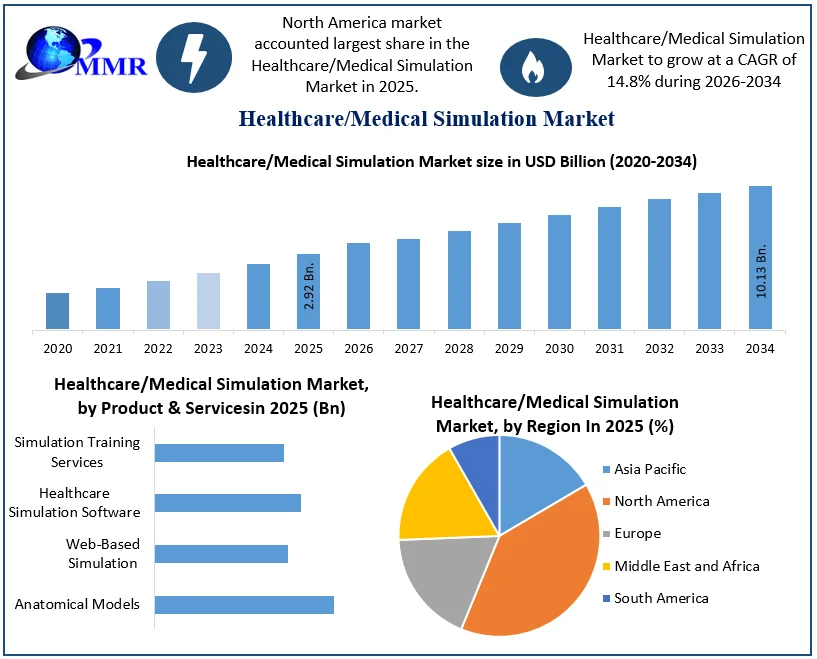
To know about the Research Methodology:-Request Free Sample Report
Healthcare/Medical Simulation Market Dynamics
The healthcare/medical simulation market is experiencing significant growth due to a variety of factors. One of the primary drivers is the increasing emphasis on patient safety and the growing concern for medical errors. Medical simulation provides a safe environment for healthcare professionals to practice and refine their skills without endangering patients. Technological advancements in medical simulation are another key growth driver.
Innovations such as high-fidelity mannequins, virtual reality (VR), augmented reality (AR), and haptic feedback systems are improving the realism of simulations, making them more effective training tools. These technologies not only provide an immersive learning experience but also help in assessing the performance of healthcare professionals, leading to better training programs. Medical schools and training institutes are integrating simulation-based training into their curricula to better prepare students for real-world medical scenarios. This shift in education strategies is driven by the growing recognition that traditional methods of learning, such as lectures and clinical observation, are insufficient for mastering complex medical procedures.
Simulation-based training creates opportunities in the Healthcare/Medical Simulation Market
The healthcare/medical simulation market is ripe with opportunities for growth and innovation. One of the most promising opportunities lies in the integration of artificial intelligence (AI) and machine learning (ML) into simulation systems.
AI can be used to create more personalized and adaptive training programs that respond to the individual needs and learning pace of healthcare professionals. Machine learning algorithms can also analyze performance data to provide real-time feedback and suggest areas for improvement, making the training process more effective. The growing adoption of telemedicine is another opportunity for the medical simulation market.
As healthcare services become increasingly digital, there is a need for healthcare professionals to be trained in remote patient care. Simulation-based training can play a crucial role in preparing healthcare workers for telemedicine by offering virtual simulations that mimic remote consultations and diagnosis.
Limited Accessibility of Simulation Technology
While urban healthcare institutions often have the resources to invest in advanced simulation systems, rural areas may lack the infrastructure and funding to implement these technologies. This creates a gap in healthcare training, which could potentially widen the disparity in healthcare quality between urban and rural regions. The fast pace of technological advancements presents a challenge for healthcare institutions trying to keep up with the latest simulation technologies. Regular updates, maintenance, and staff retraining are required to stay current with evolving systems, which strain financial and operational resources.
Healthcare/Medical Simulation Market Segment Analysis
Based on products and services, the healthcare simulation software segment held the largest market share of more than xx% in 2025. These simulators are proving to be beneficial in the research and manufacturing industry for conducting trials and permutations and combinations before finalizing design, processes, or systems, especially in the medical devices industry.
These factors are anticipated to contribute to the growth of the segment over the forecast period. Key factors driving this expansion include the provision of controlled and predictable learning environments, regulated access to simulation procedures, and the ability for healthcare professionals to participate in remote training and education activities. This approach breaks down geographical barriers, offering convenient learning opportunities. This healthcare simulation market trend of increasing adoption of online and remote learning, driven by technological advancements and the global shift towards digital platforms.
Based on the end-user, the academic institutes' segment held the largest share of xx% in 2025. The academic research institutions segment is likely to witness persistent growth due to the presence of several academic research groups that are involved in the study of complex biological systems using computer models.
Healthcare/Medical Simulation Market Research Methodology:
Bloomberg, Hoovers, and Factiva are some of the sites that are being referred to gain insights about Global Healthcare/Medical Simulation Market. Experts from top manufacturing companies along with other stakeholders have been considered. This is done to validate and collect critical information for evaluating trends related to this market during the forecast period. Top-down and bottom-up approaches have been used to estimate the global and regional size of this market. Data triangulation techniques along with other comparative analysis are also used to calculate the exact size of the Global Healthcare/Medical Simulation Market globally.
Healthcare/Medical Simulation Market, Key Highlights:
1. Global Healthcare/Medical Simulation Market analysis and forecast, in terms of value.
2. Comprehensive study and analysis of market drivers, restraints and opportunities influencing the growth of the Global Healthcare/Medical Simulation Market
3. Global Healthcare/Medical Simulation Market segmentation on the basis of type, source, end-user, and region (country-wise) has been provided.
4. Global Healthcare/Medical Simulation Market strategic analysis with respect to individual growth trends, future prospects along with the contribution of various sub-market stakeholders have been considered under the scope of study.
5. Global Healthcare/Medical Simulation Market analysis and forecast for five major regions namely North America, Europe, Asia Pacific, the Middle East & Africa (MEA) and Latin America along with country-wise segmentation.
6. Profiles of key industry players, their strategic perspective, market positioning and analysis of core competencies are further profiled.
7. Competitive developments, investments, strategic expansion and competitive landscape of the key players operating in the Global Healthcare/Medical Simulation Market are also profiled.
Healthcare/Medical Simulation Market Key Target Audience:
1. Venture Capitalists, Private Equity Firms, And Startup Companies
2. Academic medical centres/universities/hospitals
3. Simulation training service providers
4. Military
5. Hospitals and clinics
6. Credentialing organizations
7. Medical devices companies
8. Research and consulting firms
9. Research and consulting firms
10. Professional societies
11. Government Bodies And Healthcare Associations/Institutions
Healthcare/Medical Simulation Market Recent Development
| Date | Company | Development | Impact |
|---|---|---|---|
| 19 March 2025 | Surgical Science Sweden AB | Surgical Science completed the strategic acquisition of Intelligent Ultrasound Group PLC. | The acquisition enhances Surgical Science's portfolio with volumetric ultrasound simulation capabilities and expands its direct commercial presence in the UK market. |
| 09 October 2025 | MediSim VR | MediSim VR collaborated with the Himalayan Institute of Medical Sciences to establish Uttarakhand's first Center of Excellence in AI and VR-based Medical Simulation. | The center advances immersive, risk-free procedural training across regional healthcare and nursing education programs. |
| 16 February 2026 | Laerdal Medical | Laerdal Medical announced an agreement to acquire VitalsBridge to integrate physiological parameter hardware directly into its simulation platform. | The deal expands Laerdal’s ecosystem of real-time patient monitoring tools and elevates high-fidelity clinical training realism. |
| 13 March 2026 | Surgical Science Sweden AB | Surgical Science launched a major upgraded Endometriosis Simulation Module for its ScanTrainer and Ultrasound Mentor systems. | The module incorporates the IDEA protocol and sliding sign techniques to improve clinician diagnostic accuracy and shorten diagnostic delays. |
| 05 June 2026 | Haag-Streit Simulation | Haag-Streit released the new Eyesi Slit Lamp SLT Module for virtual reality ophthalmic simulation. | The software provides structured VR training for selective laser trabeculoplasty, reducing procedural risks in glaucoma patient management. |
Healthcare/Medical Simulation Industry Ecosystem
Healthcare/Medical Simulation Market Scope: Inquire before buying
| Healthcare/Medical Simulation Market | |||
|---|---|---|---|
| Report Coverage | Details | ||
| Base Year: | 2025 | Forecast Period: | 2026-2034 |
| Historical Data: | 2020 to 2025 | Market Size in 2025: | USD 2.92 Bn |
| Forecast Period 2026 to 2034 CAGR: | 14.8% | Market Size in 2034: | USD 10.13 Bn |
| Segments Covered: | by Product & Services | Anatomical Models Web-Based Simulation Healthcare Simulation Software Simulation Training Services |
|
| by End User | Academic Institutes Hospitals Military Organization Other end-users |
||
Healthcare/Medical Simulation Market, by Geography:
North America (United States, Canada and Mexico)
Europe (UK, France, Germany, Italy, Spain, Sweden, Austria and Rest of Europe)
Asia Pacific (China, South Korea, Japan, India, Australia, Indonesia, Malaysia, Vietnam, Taiwan, Bangladesh, Pakistan and Rest of APAC)
Middle East and Africa (South Africa, GCC, Egypt, Nigeria and Rest of ME&A)
South America (Brazil, Argentina Rest of South America)
Healthcare/Medical Simulation Market Key Players:
The Global Healthcare and Medical Simulation refers to the industry-wide ecosystem producing and utilizing artificial, tech-driven educational tools such as anatomical models, virtual reality (VR) software, and high-fidelity mannequins to replicate clinical scenarios safely, train medical professionals, and improve patient safety.
| Company/Organization | Headquarters | Core Competencies |
| American Heart Association | Dallas, Texas, USA | CPR, ACLS, BLS certification, simulation-based clinical training |
| American College of Surgeons | Chicago, Illinois, USA | Surgical education, simulation training, accreditation, and skills assessment |
| Society for Simulation in Healthcare | Washington, D.C., USA | Healthcare simulation standards, certification, education, and research |
| Association of American Medical Colleges | Washington, D.C., USA | Medical education, simulation-based learning, and academic collaboration |
| Mayo Clinic | Rochester, Minnesota, USA | Clinical simulation, physician training, patient safety, and healthcare education |
| Cleveland Clinic | Cleveland, Ohio, USA | Medical simulation, surgical training, and healthcare workforce development |
| Apollo Hospitals Enterprise Limited | Chennai, Tamil Nadu, India | Clinical simulation, medical education, and healthcare professional training |
| All India Institute of Medical Sciences | New Delhi, India | Medical education, simulation training, clinical research, and healthcare education |
| NHS England | London, England, United Kingdom | Healthcare workforce training, clinical simulation, and patient safety initiatives |
| World Health Organization | Geneva, Switzerland | Global healthcare capacity building, medical education, and patient safety programs |
| Defense Health Agency | Falls Church, Virginia, USA | Military healthcare, medical simulation, combat casualty training, and readiness |
| American Association of Critical-Care Nurses | Aliso Viejo, California, USA | Critical care nursing education, simulation-based training, and clinical competency |
Frequently Asked Questions:
1] Which region has the largest share in Global Market?
Ans. North America region held the highest share in 2025.
2] What is the growth rate of Global Market?
Ans. The Global Market is expected to grow at a CAGR of 14.8% during forecast period 2026-2034.
3] What is scope of the Global Healthcare/Medical Simulation market report?
Ans. Global Market report helps with the PESTEL, PORTER, Recommendations for Investors & Leaders, and market estimation of the forecast period.
4] Who are the key players in Global Healthcare/Medical Simulation market?
Ans. The important key players in the Global Market are – Medaphor, Simulaids, Simulab, Mentice, Limbs & Things, Kyoto Kagaku, Gaumard Scientific Company, Laerdal Medical, 3D Systems, CAE Ltd., Anesoft Corporation, 3B Scientific GmbH, B-Line Medical, Operative Experience, and Inc.
5] What is the study period of this market?
Ans. The Global Healthcare/Medical Simulation Market is studied from 2020 to 2034.