
Metal Casting Robots Market by Casting Type, End User, Enterprise Size Outlook and Region – Global Market Size Estimation, Industry-Wide Analysis, Competitive Landscape Assessment & Long-Term Forecast to 2032
Overview
Metal Casting Robots Market was valued at USD 10.31 Bn in 2025 and is expected to reach USD 23.35 Bn by 2032, at a CAGR of 12.39%.
Robots can do practically any programmable task in machining to metal casting, from milling dipping to grinding. Foundry industries in developing countries suffer from inadequate quality and productivity because of the involvement of a high number of process parameters. Even in the most meticulously controlled processes, casting faults occur, prompting the development of a robotic system for the autonomous pouring of molten metal. As a result of different analysis and calculations, an appropriate design was developed.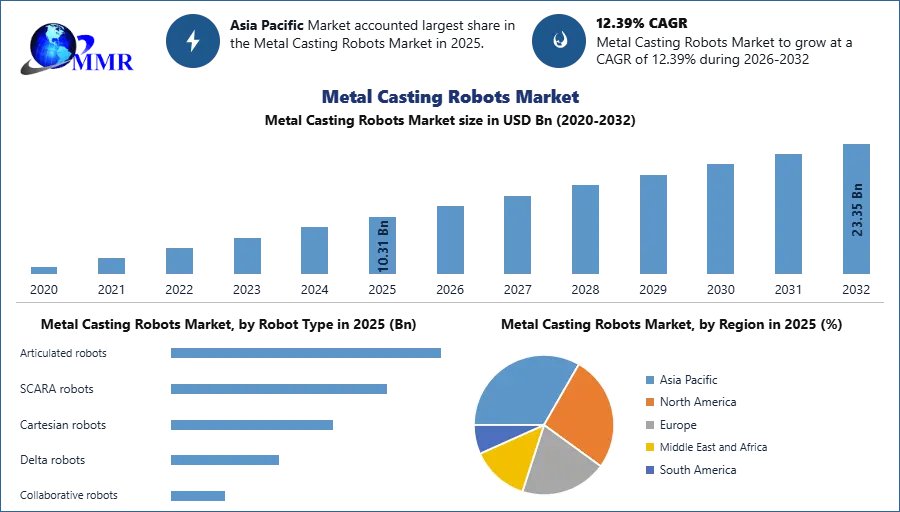 To know about the Research Methodology :- Request Free Sample Report
Modern foundries are constantly looking for ways to improve productivity, workplace safety, and flexibility. The use of robots makes it a lot easier to sustain a competitive advantage in the market by delivering essential productivity. The rise of robot-based automation in the metal foundry industry, which helps to maximize productivity, is driving the growth of the metal casting robots market.
However, the COVID-19 pandemic has had a negative impact on the market revenue pool, which is expected to drop. Due to COVID-19-induced stressors, the former growing rate of the Metal Casting Robots market size was predicted to be 12.39% CAGR through 2029, but that figure has been reduced to 13.6% CAGR.
Metal Casting Robots Market Dynamics:
Rising robot-based automation in the metal foundry industry to drive the Metal Casting Robots market
A major growth driver for the metal casting robots market is the higher payload capacity of the robots, which aids in the optimization of cycle times as compared to the traditional method of metal casting. As a result, advancements in technological innovation to reduce the time required to integrate a metal casting robot, as well as a wide range of application-specific options, are expected to stimulate the growing demand for metal casting robots over the forecast period. In addition, functions such as pouring molten aluminium into moulds, degating and material removal, and removing and degating castings are expected to boost metal casting robot demand in the coming years. This, in turn, over the forecast period is expected to have a beneficial effect on the metal casting robots market. Despite a number of driving factors, the metal casting robots market is predicted to contract and fluctuate in growth rate due to the fact that metal casting robots are only capable of casting metals, and softer materials. One of the primary restraints for the metal casting robots industry is the level of accuracy required while cutting the comparatively harder material. Exposed robot drives are difficult to protect from dust and liquids and hence act as a stumbling block to the increased use of metal casting robots. Lower production costs and scrap rates, as well as an increase in uptime and quality, are just a few of the compelling advantages of robots, which are likely to be important prospects for the metal casting robots market.
The report has profiled twenty-five key players in the market from different regions. However, the report has considered all market leaders, followers, and new entrants with investors while analyzing the market and estimation the size of the same. The manufacturing environment in each region is different and focus is given on the regional impact on the cost of manufacturing, supply chain, availability of raw materials, labor cost, availability of advanced technology, trusted vendors are analysis and report has come up with recommendations for a future hot spot in North America. Major country’s policies about manufacturing and their impact on Metal Casting Robots demand are covered in the report.
Metal Casting Robots Market Segment Analysis:
The automotive industry segment is expected to grow at a CAGR of 12.39% during the forecast period.
Based on the end-user, in 2025, the automotive industry segment has a market share of 12.39%, and it is expected to reach USD$ xx Mn by 2032. Emerging economies such as India, China, Malaysia, and South Korea, among others, have generated a favorable economic environment. With 3.49 million units sold in the passenger and commercial vehicle categories combined in 2025, India was the fifth-largest auto market. The domestic Indian car market is dominated by two-wheelers and passenger automobiles. Small and mid-sized cars account for the majority of passenger car sales. In 2021, two-wheelers and passenger cars accounted for 80.8 % and 12.9 % of the market share, respectively, with over 20.1 million vehicles sold. In March 2021, two-wheeler sales were 1,195,445 units, down from 1,846,613 units in March 2021, a 35.26 percent decrease. In March 2021, passenger vehicle (PV) sales totalled 279,745 units, up from 2,17,879 units in March 2021, a 28.39 percent increase. In 2021, luxury car sales are predicted to increase to 28,000-33,000 units, up from 20,000-21,000 units in 2021. In 2021, new manufacturers are expected to enter the market, as well as new product debuts. This has created many lucrative opportunities for the key players operating in this market especially in Asia Pacific countries.
Metal Casting Robots Market Regional Insights:
Asia Pacific to witness a high market growth rate and is expected to grow at a CAGR of XX% by 2032
The Asia Pacific market for Metal Casting Robots is expected to rise at a faster pace than the rest of the world by 2032. Many major corporations have increased their investments in countries such as India, China, Malaysia, Vietnam among others as a result of the rapid FDI cash inflow in the automotive industry, rise in the middle class and young population result in strong growth.
Several automakers have begun investing extensively in various parts of the business in the last few months in order to keep up with the growing demand. According to data given by the Department for Promotion of Industry and Internal Trade, the industry attracted US$ 25.40 billion in foreign direct investment (FDI) between April 2000 and December 2021. (DPIIT).
• Total passenger vehicle sales in 2021-22 reached 2.8 million units, up from 2.7 million in 2021.
• To encourage the adoption of electric vehicles, the Delhi government began the process of establishing 100 vehicle battery charge outlets across the state in February 2021.
• Fiat Chrysler Automobiles (FCA) announced a $250 million investment in India in January 2021 to strengthen its local product line-up.
• To satisfy India's electric vehicle (EV) objectives, a total expenditure of Rs. 12.5 trillion (US$180 billion) in vehicle production and charging infrastructure will be required until 2030.
The objective of the report is to present a comprehensive analysis of the global Metal Casting Robots Market to the stakeholders in the industry. The past and current status of the industry with the forecasted market size and trends are presented in the report with the analysis of complicated data in simple language. The report covers all the aspects of the industry with a dedicated study of key players that include market leaders, followers, and new entrants.
PORTER, SVOR, PESTEL analysis with the potential impact of micro-economic factors of the market have been presented in the report. External as well as internal factors that are supposed to affect the business positively or negatively have been analyzed, which will give a clear futuristic view of the industry to the decision-makers.
The report also helps in understanding the global Metal Casting Robots market dynamics, structure by analyzing the market segments and project the global Metal Casting Robots market size. Clear representation of competitive analysis of key players by product, price, financial position, product portfolio, growth strategies, and regional presence in the global Metal Casting Robots market make the report investor’s guide.
Metal Casting Robots Market Scope: Inquire before buying
| Metal Casting Robots Market | |||
|---|---|---|---|
| Report Coverage | Details | ||
| Base Year: | 2025 | Forecast Period: | 2026-2032 |
| Historical Data: | 2020 to 2025 | Market Size in 2025: | 10.31 USD Bn |
| Forecast Period 2026-2032 CAGR: | 12.39% | Market Size in 2032: | 23.35 USD Bn |
| Segments Covered: | by Casting Type | Sand casting Die casting Gravity casting Lost foam |
|
| by Enterprise Size | Small and medium enterprises (SMEs) Large enterprises |
||
| by Metal Type | Ferrous metals Non-ferrous metals |
||
| by Robot Type | Articulated robots SCARA robots Cartesian robots Delta robots Collaborative robots |
||
| by End User | Automotive industry Metal foundry industry Semiconductor industry Telecom industry Aerospace Defence industry Other End-Use |
||
Metal Casting Robots Market, by Region
North America (United States, Canada and Mexico)
Europe (UK, France, Germany, Italy, Spain, Sweden, Austria and Rest of Europe)
Asia Pacific (China, South Korea, Japan, India, Australia, Indonesia, Malaysia, Vietnam, Taiwan, Bangladesh, Pakistan and Rest of APAC)
Middle East and Africa (South Africa, GCC, Egypt, Nigeria and Rest of ME&A)
South America (Brazil, Argentina Rest of South America)
Metal Casting Robots Market Key Players are:
• ABB
• Fiat Chrysler Automobiles
• Yaskawa Electric
• Midea
• Fanuc
• KUKA
• Kawasaki Heavy Industries
• Nachi Robotic Systems
• Shanghai STEP Electric Corporation
• EFORT Intelligent Equipment
• Universal Robotics
• Mitsubishi Electric
• B+M Surface Systems GmbH
• Omron Adept Technologies
• Epson robots
• Staubli
• Dürr
• DENSO Corporation
• Nachi-Fujikoshi
• Comau Robotics
• Universal Robots
• Wittmann Battenfeld Group
• Yamaha
• Siasun Robot and Automation
• IGM
• Other key Player