
Medical Tourism Market Size, Share, Growth Trends and Forecast to 2034 by Treatment Type, End User, Service Provider, Type and Region 2034
Overview
The Global Medical Tourism Market was valued at USD 30.82 Billion in 2025 and is projected to reach USD 168.8 Billion by 2034, growing at a CAGR of 20.8% during the forecast period 2026–2034.
| Parameter | Value |
| Market Size (2025) | USD 30.82 Billion |
| Market Size (2034) | USD 168.8 Billion |
| CAGR | 20.8% |
| Historical Period | 2020 to 2025 |
| Forecast Period | 2026 to 2034 |
Medical tourism is described as a planned trip across international borders to receive medical care of some kind that is not available in the tourists' native country. Medical tourists cross international boundaries to maintain, improve, or restore their health by using low-cost healthcare facilities and treatments accessible in other nations that are less expensive in their own country. Medical tourists go to obtain treatments such as dental care, neurological care, and cardiovascular care.
Global Medical Tourism Market Overview
The Medical Tourism Market refers to domestic and international travel for affordable medical treatments, specialized healthcare services, and advanced surgical procedures. The Global Medical Tourism Market is valued at USD 30.82 Billion in 2025 and is projected to reach USD 168.8 Billion by 2034, growing at a CAGR of 20.8% during 2026–2034. Rising healthcare costs, shorter treatment waiting times, and demand for quality medical services drive market growth.
The Medical Tourism Industry is evolving through AI-powered healthcare platforms, telemedicine, robotic surgery, and integrated medical travel packages. International patients, insurance providers, private hospitals, and medical tourism facilitators support industry expansion. Growing demand for dental tourism, cosmetic surgery, fertility treatments, oncology, and orthopedic procedures creates opportunities across India, Thailand, Turkey, Malaysia, and Mexico.
North America leads the Global Medical Tourism Market, while Asia Pacific presents significant growth opportunities through affordable healthcare and expanding hospital infrastructure. Key players include Apollo Hospitals, Fortis Healthcare, Bumrungrad International Hospital, Raffles Medical Group, and KPJ Healthcare. Maximize Market Research (MMR) analyzes Medical Tourism Market size, share, treatment segments, growth drivers, regional opportunities, competitive landscape, and industry forecasts through 2034.
Medical Tourism Market Growth and Share Analysis

To know about the Research Methodology :- Request Free Sample Report
Global Medical Tourism Market Key Highlights
Medical Tourism Market Dynamics
Drivers: Rising Healthcare Costs and Increasing Demand for Affordable Medical Treatment Abroad Accelerate Medical Tourism Market Growth
The Global Medical Tourism Market is driven by increasing healthcare expenditure, rising demand for cost-effective medical treatments, shorter waiting periods, and growing accessibility of specialized healthcare services across international destinations. Significant treatment cost differences encourage patients to seek cross-border healthcare, international medical travel, cardiovascular surgery, orthopedic treatment, and affordable surgical procedures abroad. For example, knee replacement surgery in India typically costs approximately USD 5,000–7,000, compared with USD 35,000–50,000 in the United States, depending on hospital facilities and treatment complexity. Expanding international flight connectivity, improved hospital infrastructure, and growing availability of qualified medical specialists strengthen Medical Tourism Market demand, particularly across India, Thailand, Mexico, Turkey, and Malaysia.
Restraints: High Travel Expenses, Insurance Coverage Limitations and Visa Requirements Restrict Medical Tourism Market Expansion
The Medical Tourism Market faces restraints from international travel expenses, limited cross-border health insurance coverage, visa restrictions, and additional accommodation costs associated with overseas medical treatment. Medical tourists frequently incur expenses beyond the quoted surgical price, including airfare, diagnostic examinations, hospital transfers, medical travel insurance, and extended recovery accommodation. For example, a medical procedure quoted at USD 6,000 does not necessarily include transportation, postoperative rehabilitation, or companion accommodation, increasing the total treatment expenditure. Differences in international insurance reimbursement policies and medical visa processing requirements further restrict access to affordable healthcare abroad, particularly for patients requiring urgent treatment or extended hospital stays. These financial and administrative barriers influence patient decisions and limit international Medical Tourism Market accessibility.
Opportunities: Growing Fertility Tourism, Cosmetic Surgery Demand and Specialized Healthcare Services Create New Revenue Potential
The Global Medical Tourism Market presents significant opportunities through expanding demand for fertility tourism, IVF treatment abroad, cosmetic surgery tourism, dental tourism, oncology services, and specialized medical procedures. Private hospitals, specialty clinics, and medical tourism facilitators develop treatment-specific healthcare packages to attract international patients seeking specialized medical expertise. For example, one IVF treatment cycle in India costs approximately USD 2,500–4,500, compared with USD 15,000–25,000 in the United States, although medication, testing, and additional cycles affect total expenditure. Increasing investments in fertility clinics, aesthetic treatment centers, international patient departments, and specialized hospital networks create new opportunities across the Asia Pacific Medical Tourism Market and emerging healthcare destinations. Partnerships between healthcare providers, travel agencies, and international patient referral networks strengthen access to high-value medical services and support industry revenue diversification.
Challenges: Patient Safety, International Healthcare Accreditation and Postoperative Care Management Increase Operational Complexity
The Medical Tourism Industry faces challenges involving patient safety, healthcare quality standardization, postoperative complications, medical malpractice liability, and continuity of care across international healthcare systems. Hospitals and medical tourism service providers must address differences in clinical protocols, medical licensing requirements, infection-control standards, and international healthcare accreditation. Complex procedures such as cardiovascular surgery, cancer treatment, and joint replacement require coordinated follow-up care, with recovery monitoring potentially extending from several weeks to multiple months, depending on clinical needs. Language barriers, incomplete medical record transfers, and differences in treatment regulations complicate communication between overseas hospitals and domestic healthcare professionals. Maintaining transparent treatment outcomes, reliable emergency support, secure patient records, and effective clinical follow-up remains essential for strengthening international patient confidence and Medical Tourism Market competitiveness.
Trends: AI-Powered Medical Tourism Platforms, Telemedicine and Integrated Healthcare Travel Services Transform the Industry
The Global Medical Tourism Market is witnessing growing adoption of AI-powered medical tourism platforms, telemedicine consultations, digital patient management systems, robotic-assisted surgery, and personalized healthcare travel services. Hospitals and medical travel facilitators integrate digital appointment scheduling, virtual specialist consultations, multilingual patient support, electronic medical records, and remote postoperative monitoring to improve international patient coordination. Advanced medical tourism technology trends also include transparent treatment pricing, online hospital comparisons, integrated medical visa assistance, and customized treatment packages combining healthcare, accommodation, and recovery services. For example, digital patient management platforms coordinate pre-treatment consultations, hospital admission, and follow-up appointments across multiple stages of international medical travel. The Medical Tourism Market, valued at USD 30.82 Billion in 2025, is projected to reach USD 168.8 Billion by 2034 at a CAGR of 20.8%, reflecting expanding demand for technology-enabled cross-border healthcare services.
Global Medical Tourism Market Trends (2026–2034)
| Key Market Trends | Market Impact |
| AI-Powered Medical Tourism Platforms | Improves hospital selection, cost comparison, and patient coordination. |
| Robotic-Assisted Surgery Tourism | Increases demand for advanced, minimally invasive treatments. |
| Telemedicine and Digital Healthcare | Enables virtual consultations and remote postoperative care. |
| Growth in Fertility and Cosmetic Tourism | Expands demand for IVF, dental, and aesthetic procedures abroad. |
| Integrated Medical Travel Packages | Combines treatment, accommodation, travel, and recovery services. |
| Emerging Healthcare Destinations | India, Thailand, Turkey, and Mexico attract international patients. |
| Hospital Accreditation and Patient Safety | Strengthens healthcare quality, transparency, and patient confidence. |
| Medical Tourism Insurance Solutions | Supports treatment affordability and cross-border healthcare access. |
Medical Tourism Market Segment Analysis
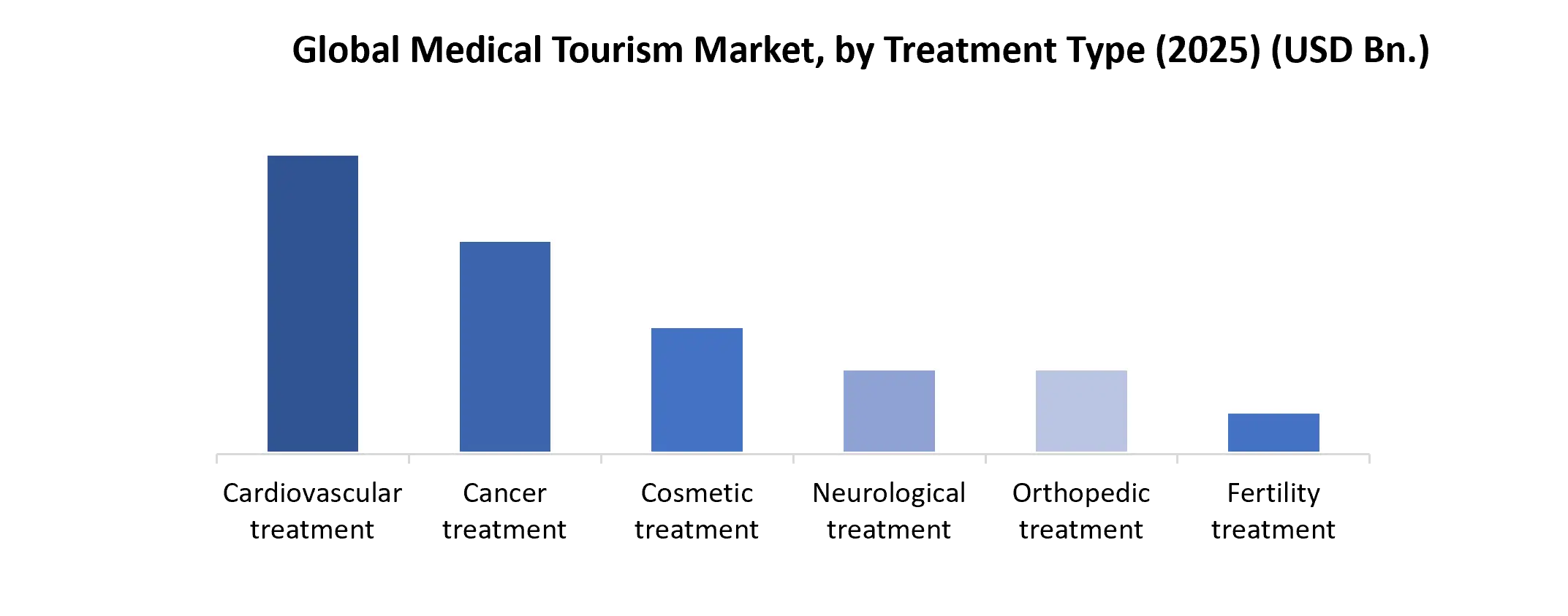
By Treatment Type, The Global Medical Tourism Market is segmented by treatment type into Cardiovascular Treatment, Cancer Treatment, Cosmetic Treatment, Neurological Treatment, Orthopedic Treatment, Fertility Treatment, and Other General Treatments. Cardiovascular treatment represents an important segment, driven by demand for affordable heart surgery, cardiac bypass procedures, angioplasty, and specialized cardiac care abroad. Cancer treatment medical tourism supports international patient demand for oncology services, chemotherapy, radiation therapy, and advanced cancer diagnostics. Cosmetic treatment tourism attracts patients seeking plastic surgery, hair transplantation, and aesthetic procedures, while neurological medical tourism focuses on brain surgery, spinal procedures, and specialized neurological care.
Orthopedic medical tourism benefits from demand for knee replacement, hip replacement, and joint reconstruction procedures. Fertility tourism expands through international demand for IVF treatment, assisted reproductive technology, and specialized fertility clinics. Other general treatments include dental procedures, diagnostic services, and routine medical care. Rising healthcare costs, international hospital accreditation, advanced medical infrastructure, and access to cost-effective treatments strengthen Medical Tourism Market growth, treatment-specific healthcare travel demand, and cross-border medical tourism opportunities through 2034.
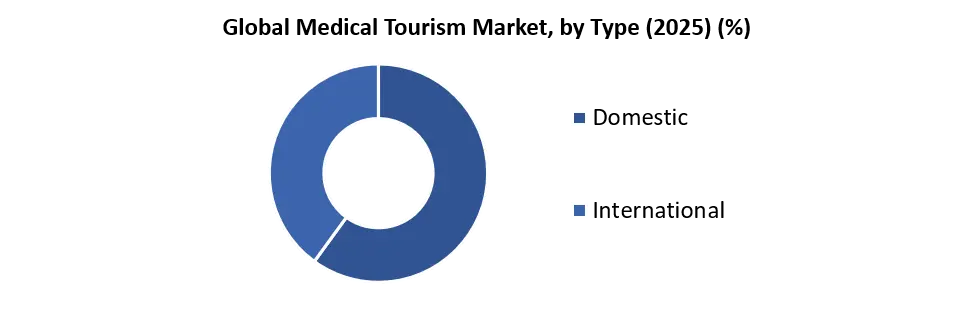
 By Type, The Global Medical Tourism Market is segmented by type into Domestic Medical Tourism and International Medical Tourism. Domestic medical tourism involves patients traveling within their own country to access specialized healthcare services, affordable medical treatments, advanced surgical procedures, and accredited hospitals. Rising demand for domestic healthcare travel, regional specialty hospitals, orthopedic surgery, cancer treatment, and cardiovascular care supports segment growth. International Medical Tourism involves cross-border healthcare travel for cost-effective medical procedures, specialized treatments, and shorter waiting times. Growing demand for international patient services, cosmetic surgery abroad, dental tourism, fertility treatments, and advanced medical care strengthen global healthcare travel. Countries such as India, Thailand, Turkey, Mexico, and Malaysia attract international patients through competitive treatment costs, modern hospital infrastructure, and specialized medical expertise. Expanding healthcare accessibility, digital medical tourism platforms, and integrated treatment packages create significant Medical Tourism Market growth opportunities through 2034.
 Medical Tourism Market Regional Insight
North America holds a leading position in the Medical Tourism Market, supported by advanced healthcare infrastructure, specialized medical treatments, international patient services, and growing demand for cross-border healthcare across the United States, Canada, and Mexico.
The Europe Medical Tourism Market benefits from increasing demand for cosmetic surgery, dental tourism, fertility treatments, and specialized healthcare services. Germany, Turkey, Spain, and the United Kingdom support regional medical travel demand.
The Asia Pacific Medical Tourism Market presents strong growth opportunities, driven by affordable medical treatments, advanced hospital facilities, and international patient inflows. India, Thailand, Malaysia, Singapore, and South Korea emerge as major medical tourism destinations.
The Middle East & Africa Medical Tourism Market expands through healthcare infrastructure investment, premium medical services, and specialized treatment facilities. The UAE, Saudi Arabia, and South Africa strengthen international healthcare tourism.
The South America Medical Tourism Market benefits from growing demand for affordable cosmetic surgery, dental procedures, fertility treatments, and orthopedic care. Brazil, Colombia, and Argentina support regional cross-border medical travel and healthcare tourism growth.
Medical Tourism Market Recent Industry Developments
| Published Date | Recent Developments |
| 8 September 2026 | IHH Healthcare Malaysia signs an MoU with Timor-Leste’s National Parliament to facilitate international patient referrals and access to specialist treatments at three Malaysian hospitals, strengthening cross-border medical tourism services. |
| 5 August 2026 | KPJ Healthcare Berhad signs a strategic partnership agreement with Singapore’s SingHealth to advance healthcare innovation, clinical research, medical education, and specialized healthcare capabilities. |
| 3 July 2026 | Fortis Healthcare signs an operations and management agreement with Dion Group to develop a 300-bed multispecialty hospital in Cuttack, Odisha, expanding advanced healthcare infrastructure in Eastern India. |
| 27 April 2026 | Apollo Hospitals launches its 76th hospital, a 400-bed smart healthcare facility in Hyderabad, expanding advanced medical treatment capacity and supporting India's position as an international healthcare destination. |
| 1 April 2026 | Acıbadem Healthcare Group announces a strategic partnership with İşbank involving the acquisition of an 80% stake in Bayındır Healthcare Group, adding three hospitals and six dental clinics under the Acıbadem-Bayındır brand in Turkey. |
Global Medical Tourism Market Competitive landscape
The Global Medical Tourism Market competitive landscape reflects increasing competition among international hospital groups, multispecialty healthcare providers, specialty clinics, and medical tourism service providers. Leading Medical Tourism Market key players, including Apollo Hospitals Enterprise Limited, Fortis Healthcare, Bumrungrad International Hospital, IHH Healthcare, KPJ Healthcare Berhad, Raffles Medical Group, and Acıbadem Healthcare Group, focus on international patient services, advanced medical treatments, hospital expansion, strategic partnerships, and digital healthcare innovation. Apollo Hospitals and Fortis Healthcare offer specialized cardiovascular, oncology, and orthopedic treatments, while Bumrungrad International Hospital focuses on international patient care and premium healthcare services. IHH Healthcare and KPJ Healthcare strengthen their competitive positioning through hospital networks and cross-border healthcare collaborations. Growing demand for affordable medical tourism, cosmetic surgery abroad, fertility treatment, dental tourism, robotic-assisted surgery, and specialized healthcare services intensify market competition. Companies emphasize internationally accredited hospitals, telemedicine, integrated medical travel packages, competitive treatment pricing, and personalized patient care to capture emerging Medical Tourism Market growth opportunities through 2034.
Medical Tourism Market Scope: Inquire before buying
| Medical Tourism Market | |||
|---|---|---|---|
| Report Coverage | Details | ||
| Base Year: | 2025 | Forecast Period: | 2026-2034 |
| Historical Data: | 2020 to 2025 | Market Size in 2025: | USD 30.82 Bn. |
| Forecast Period 2026 to 2034 CAGR: | 20.8% | Market Size in 2034: | USD 168.8 Bn. |
| Segments Covered: | by Treatment type | Cardiovascular treatment Cancer treatment Cosmetic treatment Neurological treatment Orthopedic treatment Fertility treatment Other general treatments |
|
| by End User | Food Diagnostics Research Laboratories Point of Care testing Others |
||
| by Service Provider | Public Private |
||
| by Type | Domestic International |
||
Medical Tourism Market, by Region
Asia Pacific (China, South Korea, Japan, India, Australia, Indonesia, Malaysia, Vietnam, Taiwan, Bangladesh, Pakistan and Rest of APAC)
Europe (UK, France, Germany, Italy, Spain, Sweden, Austria and Rest of Europe)
North America (United States, Canada and Mexico)
Middle East and Africa (South Africa, GCC, Egypt, Nigeria and Rest of ME&A)
South America (Brazil, Argentina Rest of South America)
Medical Tourism Market, Key Players
1. Apollo Hospitals Enterprise Limited – India
2. Fortis Healthcare Limited – India
3. Max Healthcare Institute Limited – India
4. Manipal Hospitals – India
5. Narayana Health – India
6. Global Health Limited (Medanta) – India
7. Aster DM Healthcare – India / UAE
8. Asian Heart Institute – India
9. MIOT International – India
10. Shalby Hospitals – India
11. Artemis Hospitals – India
12. HealthCare Global Enterprises Limited (HCG) – India
13. IHH Healthcare Berhad – Malaysia
14. KPJ Healthcare Berhad – Malaysia
15. Raffles Medical Group – Singapore
16. Sunway Medical Centre – Malaysia
17. Bangkok Dusit Medical Services (BDMS) – Thailand
18. Bumrungrad International Hospital – Thailand
19. Bangkok Chain Hospital PCL – Thailand
20. Vejthani International Hospital – Thailand
21. Yanhee International Hospital – Thailand
22. Vinmec Healthcare System – Vietnam
23. Asan Medical Center – South Korea
24. Samsung Medical Center – South Korea
25. Seoul National University Hospital – South Korea
26. Severance Hospital (Yonsei University Health System) – South Korea
27. MLP Care (Medical Park and Liv Hospital) – Turkey
28. Memorial Healthcare Group – Turkey
29. Medicana Health Group – Turkey
30. Florence Nightingale Hospitals Group – Turkey
31. Anadolu Medical Center – Turkey
32. Medipol Healthcare Group – Turkey
33. Dünyagöz Hospitals Group – Turkey
34. Mayo Clinic – United States
35. Cleveland Clinic – United States
36. Johns Hopkins Medicine – United States
37. CHRISTUS MUGUERZA – Mexico
38. Hospitales Ángeles – Mexico
39. Hospital Israelita Albert Einstein – Brazil
40. Hospital Sírio-Libanês – Brazil
41. Hospital Clínica Bíblica – Costa Rica
42. Burjeel Holdings – UAE
43. NMC Healthcare – UAE
44. Mediclinic Middle East – UAE
45. Saudi German Health – Saudi Arabia
46. American Hospital Dubai – UAE
47. Vaidam Health – India
48. Bookimed – Ukraine
49. PlacidWay – United States
50. Medical Tourism Corporation – United States
Frequently Asked Questions:
1. What is the Global Medical Tourism Market size in 2025?
The Global Medical Tourism Market is valued at USD 30.82 Billion in 2025, driven by affordable healthcare abroad, specialized medical treatments, and international patient travel.
2. What is the Medical Tourism Market CAGR and forecast for 2034?
The Medical Tourism Market is projected to reach USD 168.8 Billion by 2034, growing at a CAGR of 20.8% during 2026–2034.
3. What are the major drivers of Medical Tourism Market growth?
Rising healthcare costs, affordable medical treatments abroad, shorter waiting times, advanced surgical procedures, and increasing cross-border healthcare demand drive market growth.
4. Which treatment types are covered in the Medical Tourism Market?
Major treatment segments include cardiovascular, cancer, cosmetic, neurological, orthopedic, fertility, and other general medical treatments.
5. Which region dominates the Global Medical Tourism Market?
North America leads the Medical Tourism Market, while Asia Pacific offers significant growth opportunities across India, Thailand, Malaysia, Singapore, and South Korea.
6. What are the emerging trends and opportunities in the Medical Tourism Industry?
AI-powered medical tourism platforms, telemedicine, robotic-assisted surgery, dental tourism, fertility treatments, and integrated healthcare travel packages create growth opportunities.
7. Who are the leading companies in the Global Medical Tourism Market?
Key players include Apollo Hospitals, Fortis Healthcare, IHH Healthcare, Bumrungrad International Hospital, KPJ Healthcare, Raffles Medical Group, and Max Healthcare.