
Managed Services Market - Industry Structure Evaluation, Demand Drivers Analysis, Regional Growth Analysis and Identification, Competitive Positioning / Landscape Review & Global Market Size Forecast to 2032
Overview
The Managed Services Market size was valued at USD 304.16 Billion in 2025 and the total Managed Services revenue is expected to grow at a CAGR of 6.1% from 2026 to 2032, reaching nearly USD 460.38 Billion by 2032.
Global Managed Services Market:
The Managed Services Market relates to the ongoing management of business customers' technology environments through standardized service level agreements (SLAs). These services encompass critical functions at the core of business operations, enabling productivity enhancements through advancements in communication and IT while mitigating associated complexities. As the complexity of IT environments continues to escalate, many businesses are turning to managed service providers for assistance.
The Cloud, Hosting & Managed Services Market Monitor evaluates the competition, size, and anticipated growth of the managed services industry, covering both on-premises and cloud setups. Collaboration with managed services providers facilitates smoother operations, enhanced security, and improved performance. With the evolution of technology, strategic utilization of managed services becomes increasingly critical. Leveraging insights and projections from the Market Monitor empowers companies to effectively utilize managed services, ensuring resilience, adaptability, and competitiveness in today's dynamic business landscape.

To know about the Research Methodology :- Request Free Sample Report
Managed Services Market: Dynamics
Driver
Increasing Complexity of IT Environments Boost the Managed Services Market
The increasing complexity of IT environments significantly drives the growth of the managed services market. In today's digital era, businesses heavily rely on technology for their operations, making IT infrastructure a crucial element for success. However, managing this infrastructure has become progressively intricate due to several factors. Rapid technological innovation has led to a proliferation of diverse IT systems, platforms, and applications within organizations. From on-premises servers to cloud-based services and hybrid environments, businesses now face a wide array of infrastructure components to manage and integrate. Each of these components has its distinct requirements, configurations, and maintenance needs, contributing to the complexity of IT management.
The escalating threat landscape poses a significant challenge for businesses seeking to secure their IT environments. Cybersecurity threats such as malware, ransomware, and data breaches constantly evolve, necessitating organizations to implement strong security measures to safeguard their sensitive information and infrastructure. Managing security in such a complex IT environment demands specialized expertise and resources, prompting businesses to seek managed security services. The shift towards remote work and digital transformation initiatives has further heightened the complexity of IT environments.
With employees accessing corporate resources from diverse locations and devices, ensuring secure connectivity and seamless collaboration has become a top priority for organizations. Managed service providers offer tailored solutions to address these needs, including remote IT support, collaboration tools, and cybersecurity services. As the complexity of IT environments continues to rise, the demand for managed services is expected to grow, driving further growth of the Managed Services Market.
Restrain
Lack of Standardization and Interoperability Limits the Managed Services Market Growth
The managed services market faces a significant hurdle due to the absence of standardization and interoperability. With a multitude of providers offering diverse services, businesses struggle to integrate these solutions into their existing IT setups. This results in compatibility issues among platforms, systems, and applications, leading to inefficiencies, complexity, and increased costs. The lack of standardized frameworks and protocols complicates the adoption and deployment of managed services across organizations. Clients encounter challenges migrating data, managing workflows, and ensuring seamless communication between different systems, hampering the achievement of desired business outcomes.
The dearth of interoperability curtails flexibility and scalability, making it difficult for businesses to adapt their IT infrastructure to changing requirements or seamlessly integrate new technologies. Addressing these challenges necessitates collaborative efforts among industry stakeholders to establish common standards, protocols, and best practices. Such initiatives promote interoperability and facilitate the smooth integration of managed services Market into diverse IT environments.
Opportunity
Increasing Adoption of Cloud Services Creates Lucrative Growth Opportunities for the Market
The increasing adoption of cloud services presents a significant opportunity for the managed services market. Businesses are increasingly migrating their IT infrastructure to the cloud to leverage benefits such as scalability, flexibility, and cost-effectiveness. Managed service providers play an important role in facilitating this migration process and optimizing cloud environments to meet the unique needs of their clients. Managed cloud services encompass a range of offerings, including cloud migration, infrastructure management, security, and optimization. Providers offer expertise in selecting the right cloud platform, configuring resources, and ensuring seamless integration with existing systems. They also manage ongoing operations, monitor performance, and implement security measures to protect data and applications in the cloud.
Managed service providers help businesses navigate the complexities of multi-cloud and hybrid cloud environments, providing unified management and governance across disparate cloud platforms. They enable organizations to maximize the value of their cloud investments while minimizing risks and ensuring compliance with regulatory requirements. As the demand for cloud services continues to grow, the managed services market is poised to capitalize on this opportunity for growth and innovation
Managed Services Market Segment Analysis
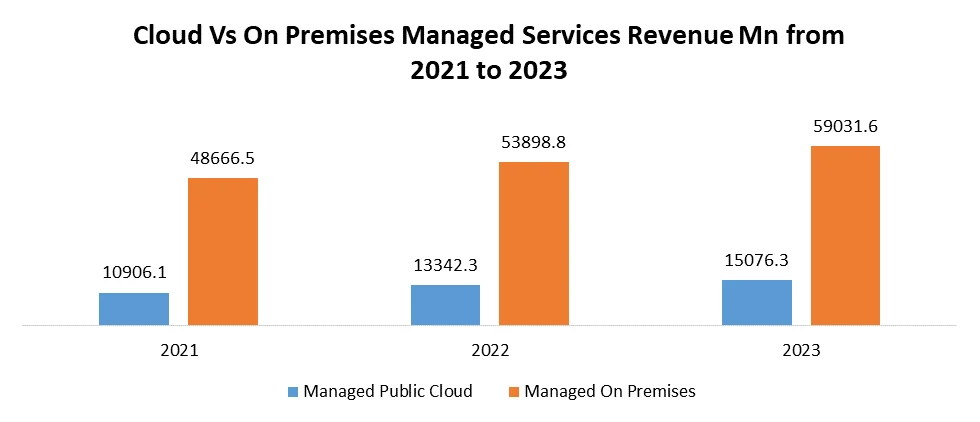
Based On Deployment, the Premises segment dominated the Deployment segment of the Managed Services Market in the year 2023. The premises segment dominates the deployment segment of the market. Many businesses have significant investments in on-premises infrastructure, including servers, networking equipment, and data centers, making it more practical to leverage these existing assets rather than transition entirely to cloud-based solutions. Certain industries, such as finance and healthcare, prioritize security and control over their data, favoring on-premises deployments where data remains within their physical premises.
Legacy systems and applications that are not easily migrated to the cloud further contribute to the prevalence of on-premises deployments. For applications with high-performance or low-latency requirements, on-premises deployments is more suitable than cloud-based alternatives, which is expected to boost the Managed Services Market growth. Cost considerations also play a role, as some businesses find on-premises deployments to be more cost-effective in the long run compared to cloud solutions with ongoing operational expenses. Managed services providers offer tailored solutions to support businesses' on-premises deployments, addressing security, performance, compliance, and cost optimization needs.

Managed Services Market Regional Analysis
North America region dominated the Managed Services Market in the year 2025.North America boasts a highly developed and technologically advanced business landscape, with a large number of enterprises across various industries relying heavily on sophisticated IT infrastructure and services. This creates a strong demand for managed services to optimize, secure, and maintain their IT environments. The region is home to many leading managed service providers (MSPs) with extensive expertise, innovative solutions, and a strong track record of delivering value to their clients.
These MSPs leverage North America's competitive advantage in technology innovation and talent to offer cutting-edge managed services that address the evolving needs of businesses. North America's regulatory environment and industry standards often drive the adoption of managed services, particularly in sectors such as healthcare, finance, and government, where compliance and data security are paramount. As a result, North America remains at the forefront of the managed services market, driving innovation, shaping industry trends, and setting the benchmark for service excellence on a global scale.
Global Managed Services Market Scope: Inquire before buying
| Global Managed Services Market | |||
|---|---|---|---|
| Report Coverage | Details | ||
| Base Year: | 2025 | Forecast Period: | 2026-2032 |
| Historical Data: | 2020 to 2025 | Market Size in 2025: | USD 304.16 Bn. |
| Forecast Period 2026 to 2032 CAGR: | 6.1% | Market Size in 2032: | USD 460.38 Bn. |
| Segments Covered: | by Service Type | Managed Network Services Managed Information Services Managed Security Services Managed Data Center Services Managed Mobility Services Managed IT Infrastructure Services |
|
| by Deployment Mode | Cloud On-Premises |
||
| by Organization Size | Small & Medium Enterprises Large Enterprises |
||
| by Vertical | BFSI Consumer Goods & Retail Manufacturing Healthcare & Life Sciences Media & Entertainment Telecom & IT Government & Public Energy & Utilities Education Others |
||
Global Managed Services Market, by Region
Asia Pacific (China, South Korea, Japan, India, Australia, Indonesia, Malaysia, Vietnam, Taiwan, Bangladesh, Pakistan and Rest of APAC)
Europe (UK, France, Germany, Italy, Spain, Sweden, Austria and Rest of Europe)
North America (United States, Canada and Mexico)
Middle East and Africa (South Africa, GCC, Egypt, Nigeria and Rest of ME&A)
South America (Brazil, Argentina Rest of South America)
Managed Services Market Key players
North America
1. IBM (Armonk, New York, USA)
2. Accenture (Dublin, Ireland)
3. Hewlett Packard Enterprise (HPE) (Houston, Texas, USA)
4. Cisco Systems (San Jose, California, USA)
5. DXC Technology (Tysons, Virginia, USA)
6. Rackspace Technology (San Antonio, Texas, USA)
7. Datapipe (Jersey City, New Jersey, USA)
8. Deloitte (New York City, New York, USA)
9. Cognizant (Teaneck, New Jersey, USA)
Europe
1. Atos (Bezons, France)
2. Capgemini (Paris, France)
3. Accenture (Dublin, Ireland)
4. Ericsson (Stockholm, Sweden)
Asia Pacific
1. Fujitsu (Tokyo, Japan)
2. NTT Ltd. (Tokyo, Japan)
3. Wipro Limited (Bengaluru, India)
4. Infosys (Bengaluru, India)
5. HCL Technologies (Noida, India)
6. Tata Consultancy Services (TCS) (Mumbai, India)
Frequently Asked Questions
1] What segments are covered in the Global Managed Services Market report?
Ans. The segments covered in the Managed Services Market report are based on, Service Type, Deployment Mode, Organization Size, Vertical and Regions.
2] Which region is expected to hold the highest share of the Global Managed Services Market?
Ans. The Europe region is expected to hold the highest share of the Managed Services Market.
3] What is the market size of the Global Managed Services Market by 2032?
Ans. The market size of the Managed Services Market by 2032 is expected to reach USD 460.38 Bn.
4] What was the market size of the Global Managed Services Market in 2025?
Ans. The market size of the Managed Services Market in 2025 was valued at USD 304.16 Bn.
5] Key players in the Managed Services Market.
Ans. IBM (Armonk, New York, USA), Accenture (Dublin, Ireland), Hewlett Packard Enterprise (HPE) (Houston, Texas, USA), Cisco Systems (San Jose, California, USA), and DXC Technology (Tysons, Virginia, USA).