
Lubricant Market Size by Component, Technology ,Application, End User, and Region - Segment-Level Market Assessment, Growth Opportunity Analysis, Competitive Mapping & Forecast to 2032
Overview
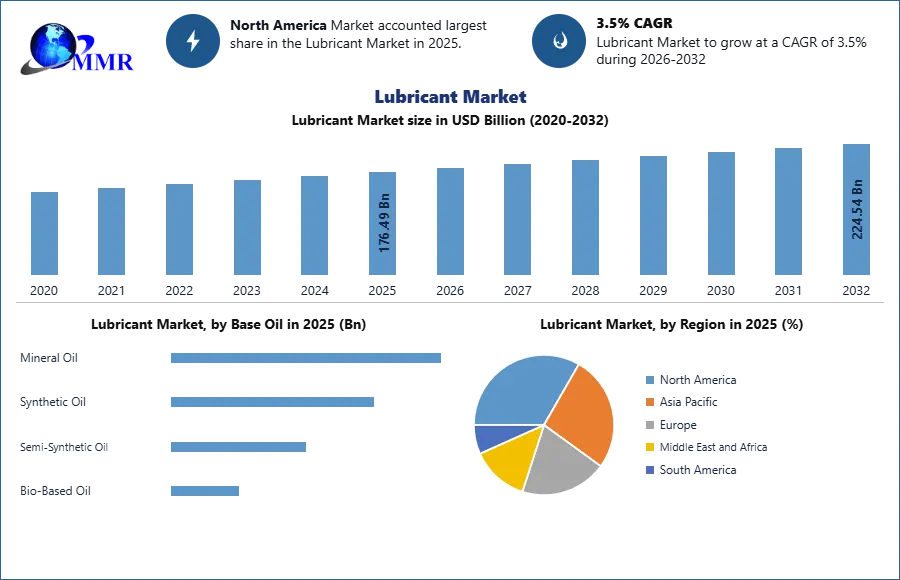
Lubricant Market size was valued at USD 176.49 Billion in 2025 and the total Global Lubricant Market revenue is expected to grow at a CAGR of 3.5% from 2026 to 2032, reaching nearly USD 224.54 Billion. Rising automotive demand, industrial growth, and advancements in synthetic and bio-based lubricants for enhanced performance and efficiency.
Lubricant Market Overview:
The global Lubricant market was valued at USD 176.49 Bn. in 2025, and it is expected to reach USD 224.54 Bn. by 2032 with a CAGR of 3.35% during the forecast period.
A lubricant is a material which, lowers friction between two surfaces in contact, lowering the amount of heat generated while the surfaces operate. It may have the potential to transfer forces, move foreign particles, and cool or heat surfaces. Lubricity is a quality that helps to reduce friction.
Lubricants are applied for a variety of purposes in addition to industrial applications. Cooking (baking to prevent food sticking, oils, and fats in frying pans), bio-applications on humans (e.g., lubricants for artificial joints), ultrasound examination, medical examination, and sexual relations are some of the other applications. It is primarily used to reduce friction and aid in the smooth and efficient operation of a device.
 To know about the Research Methodology :- Request Free Sample Report
2023 is considered a base year however 2023's numbers are on the real output of the companies in the market. Special attention is given to 2020 and the effect of lockdown on the demand and supply, and also the impact of lockdown for the next two years on the market. Some companies have done well in lockdown also and specific strategic analysis of those companies is done in the report.
Lubricant Market Dynamics:
The lubricant industry is evolving and growing as a result of increased demand for high-performance engines:
Internal combustion engines have come a long way since Ford designed the first commercial car in the early twentieth century. Thanks to engine improvements, the internal components of the engine are exposed to much higher tension and heat. This has also resulted in engines with extremely high RPMs, necessitating the use of higher-quality engine oil. Aside from that, car transmission systems have improved, with vehicles achieving speeds of up to 150 miles per hour. The technology of the gear system and bearings has also advanced. All of these advancements and evolutions need the use of more effective lubricants. Thus, lubricants have evolved and expanded driving the market growth.
Growing condom production, specifically in the Asia Pacific demands lubricants:
The surge in contraceptive product adoption rates among consumers around the world is driving up condom demand, particularly during the COVID-19 pandemic which, drive the demand for condoms suddenly. Lubricants like water-based, oil-based, and silicone-based lubricants respectively are used in the production of condoms which, helps to reduce friction during sexual acts. Also, rising awareness as a result of government initiatives, as well as comprehensive sex education programs aimed at reducing the prevalence of sexually transmitted illnesses, is driving global market growth which, directly uplifts the lubricant demand.
Hybrid vehicle demand is surging, as is battery price equivalence:
Hybrid vehicles combine a tiny internal combustion engine (ICE) with an electric motor to maximize power efficiency while lowering pollution. Lubricants, primarily engine oil and transmission fluid, are required by ICE inside a car. According to industry experts, the increased number of hybrid vehicles may reduce lubricant use per vehicle by nearly half. This reason, together with rising battery parity, may diminish the global lubricant market's volume. Electric vehicle batteries are expensive; but, as technology improves, the cost is decreasing and the driving range per charge is growing. These factors have affected lubricant consumption. According to industry experts, engine oil accounts for more than 40% of the total lubricant market.
Renewable energy demand may have a favorable impact on the lubricants market:
Industrial lubricants, ranging from turbine oil to transformer oil, are used extensively in the power industry. Lubricants are consumed in a variety of processes. The renewable energy sector is a promising sub-segment of the power generation sector. Wind power generation represents a very small portion of the entire energy mix, but the industry is increasing at a 10% annual rate, with a capacity of 596,556 megawatts in 2022, according to the World Wind Energy Association. Lubricants are required for optimal operation of wind turbines providing growth opportunities for the market to developed advanced lubricants.
Lubricant Market Trends:
• Bio-based and synthetic lubricants are seeing a comeback as a result of improved technologies and environmental concerns. To keep up with the oxygen-containing esters in the oils, the upgraded version of bio-based grease requires more suitable additives. Oils derived from algae or exotic plants that contain a blend of minerals, synthetic oils, or plant-based oils are growing demand for new lubricant feedstocks.
• With a USD 200 million investment, ExxonMobil launched the Port Allen lubricant factory. By 2040, demand for aviation fuels and lubricants is expected to climb by 55.24%. Advanced manufacturing processes are increasingly in demand, such as a high-speed quart line, in-line mixing, and flow-through racking. This technology aids in the improvement of electrical energy efficiency, resulting in increased demand in the lubricants industry.
• Royal Dutch Shell is one of the world's leading lubricant manufacturers. In the lubricants market, the company's growth strategy has been expansion. For example, the business launched its first lubricant laboratory in India in May 2021. The laboratory will cater to the expanding demand for new lubricating products in both the automotive and industrial sectors.
Lubricant Market Segment Analysis:
Based on Based Oil the market is segmented into Mineral Oil, Synthetic Oil, Semi-Synthetic Oil, Bio-Based Oil. Mineral Oil segment is dominated the market in 2025 & is expected to hold the largest market share during the forecast period. Its low cost, widespread availability, and sufficient performance for standard automotive and industrial applications. Its strong presence in developing regions and established use in conventional engines further support its leading market position.
Based on Product Type the market is segmented into Engine Oil, Hydraulic Oil, Gear Oil, Compressor Oil, Turbine Oil. Engine oil segment is dominated the market in 2025 & is expected to hold the largest market share during the forecast period. its critical role in automotive applications. It is widely used to reduce friction, prevent wear, and enhance the performance of internal combustion engines in passenger cars, commercial vehicles, and two-wheelers. Large global vehicle fleet and frequent oil change intervals, engine oil experiences consistent and high demand. Growth in vehicle ownership in emerging markets, along with a strong aftermarket service sector boosts consumption. Essential function and use make engine oil the leading lubricant product type in the market this year.
Regional Insights:
During the forecast period, the Asia Pacific is expected to hold a considerable share of xx% of the global lubricant market in terms of both volume and revenue. The region's growing population, together with expanding industrial investment and infrastructure advancements in China, India, and Indonesia's developing markets, is expected to make it an ideal destination for the lubricant market.
Europe is expected to hold the second-highest share of xx% of the global lubricant market in terms of both volume and value during the forecast period. The rise of numerous industrial sectors, together with the increasing number of automobiles in the countries, is the main reason for this. However, thanks to policy differences, Russia is expected to have the greatest growth rate of xx% among European countries. Because Russia is not a member of the European Union, it is exempt from the EU's strict auto regulations and standards.
The objective of the report is to present a comprehensive analysis of the global market to the stakeholders in the industry. The past and current status of the industry with the forecasted market size and trends are presented in the report with the analysis of complicated data in simple language. The report covers all the aspects of the industry with a dedicated study of key players that include market leaders, followers, and new entrants.
PORTER, PESTEL analysis with the potential impact of micro-economic factors of the market have been presented in the report. External as well as internal factors that are supposed to affect the business positively or negatively have been analyzed, which will give a clear futuristic view of the industry to the decision-makers.
The report also helps in understanding the global market dynamics, structure by analyzing the market segments and project the global market size. Clear representation of competitive analysis of key players by product, price, financial position, product portfolio, growth strategies, and regional presence in the global market makes the report investor's guide.
Recent Industry Developments
| Exact Date | Company | Development | Impact |
|---|---|---|---|
| 09 January 2026 | Chevron Corporation | The company successfully restarted its Pascagoula base-oil unit, effectively removing a major global supply bottleneck for premium additives. | This restoration of capacity stabilized global fill-rate norms and eased long-standing shortages in the high-performance lubricant segment. |
| 12 December 2025 | ExxonMobil Corporation | Launched a specialized range of biodegradable industrial lubricants specifically designed to meet stringent ESG and environmental regulations. | The expansion strengthens their competitive position in the rapidly growing bio-based segment, targeting forestry and offshore energy sectors. |
| 18 August 2025 | Shell India | Introduced a strategic initiative to transition the regional market toward synthetic Helix Ultra formulations, targeting a 20% market share shift. | This move accelerates the premiumization of the South Asian lubricant market, shifting consumer demand away from traditional mineral oils. |
| 14 May 2025 | TotalEnergies | Commercialized a new line of Environmentally Acceptable Lubricants (EALs) compliant with the latest U.S. Vessel General Permit for marine vessels. | This product launch captures early-mover benefits in the maritime sector as global operators face increasing pressure to adopt non-toxic fluids. |
| 01 March 2025 | API (American Petroleum Institute) | Officially implemented the ILSAC GF-7 and API SQ standards, mandating lower-viscosity 0W-20 and 0W-16 grades for new engines. | The new standards force an industry-wide shift toward high-margin synthetic formulations to improve global vehicle fuel economy. |
Lubricant Market Scope: Inquire before buying
| Lubricant Market | |||
|---|---|---|---|
| Report Coverage | Details | ||
| Base Year: | 2025 | Forecast Period: | 2026-2032 |
| Historical Data: | 2020 to 2025 | Market Size in 2025: | 176.49 USD Billion |
| Forecast Period 2026-2032 CAGR: | 3.5% | Market Size in 2032: | 224.54 USD Billion |
| Segments Covered: | by Base Oil | Mineral Oil Synthetic Oil Semi-Synthetic Oil Bio-Based Oil |
|
| by Product Type | Engine Oil Hydraulic Oil Gear Oil Compressor Oil Turbine Oil Greases |
||
| by Application | Automotive Industrial Marine Aerospace Construction |
||
| by Distribution Channel | OEM Aftermarket Online Direct Sales |
||
Lubricant Market, by Region
North America (United States, Canada and Mexico)
Europe (UK, France, Germany, Italy, Spain, Sweden, Austria and Rest of Europe)
Asia Pacific (China, South Korea, Japan, India, Australia, Indonesia, Malaysia, Vietnam, Taiwan, Bangladesh, Pakistan and Rest of APAC)
Middle East and Africa (South Africa, GCC, Egypt, Nigeria and Rest of ME&A)
South America (Brazil, Argentina Rest of South America)
Key Players / Competitors Profiles Covered in Brief in Global Lubricant Market Report in Strategic Perspective:
- Royal Dutch Shell PLC
- ExxonMobil Corporation
- British Petroleum Plc
- Chevron Corporation
- TotalEnergies SE
- PetroChina Company Limited
- Sinopec Limited
- Lukoil
- Fuchs Petrolub AG
- Idemitsu Kosan Co. Ltd
- Pennzoil
- Quaker Chemical Corp
- JX Nippon Oil & Energy Corp
- Phillips 66 Company
- Castrol
- Valvoline Global Operations
- Amalie Oil Co
- Petroliam Nasional Berhad (PETRONAS)
- Eni S.p.A.
- GS Caltex Corporation
- SK Enmove Co., Ltd.
- Motul
- Repsol
- Indian Oil Corporation Ltd (IOCL)
- Bharat Petroleum Corporation Limited (BPCL)