
Lubricant Anti-Wear Agents Market Size by Type, Application, Sales Channel, Region – Revenue Pool Analysis, Margin Structure Assessment, Capital Flow Trends, Competitive Benchmarking & Forecast to 2029
Overview
By 2029, the Global Lubricant Anti-Wear Agents Market is expected to reach US $818.43 Million, thanks to growth in the Type, Application, and Sales Channel segment. The report analyzes market dynamics by region and end-user industries.
Lubricant Anti-Wear Agents Market Overview:
The global lubricant anti-wear agents market was valued at US $698 Mn. in 2022, and it is expected to reach US $818.43 Mn. by 2029 with a CAGR of 2.3% during the forecast period.
Anti-wear agents, often known as AW additives. These are lubricating agents that prevent metal-to-metal friction between gears parts. One of the important drivers is the collaborations, as well as plant expansions by many prominent manufacturers in the lubricant anti-wear agent’s market. The lubricant anti-wear agents’ market is expected to grow at a CAGR of 2.3% during the forecast period, thanks to lucrative market opportunities in the BRIC (Brazil, Russia, India, and China) areas, as well as increased demand for renewable energy.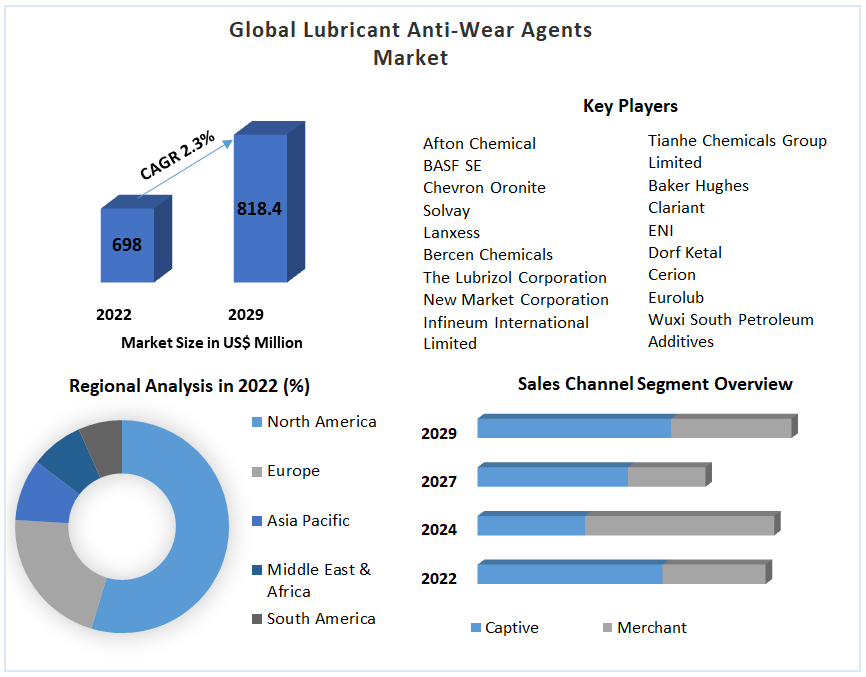 To know about the Research Methodology :- Request Free Sample Report
COVID–19 Influence on Global Lubricant Anti-Wear Agents Market:
The pandemic of COVID-19 spread to every nation in the world, causing the World Health Organization (WHO) to declare it a public health emergency. Every industry has been affected by the epidemic, including the lubricant anti-wear agents’ market. To prevent the spread of the virus, manufacturing operations were temporarily suspended or restricted in several nations under government-imposed lockdowns. As lubricants have a wide range of applications in manufacturing industries; thus, demand fell in the first half of 2020 but is expected to rise during the forecast period.
Lubricant Anti-Wear Agents Market Dynamics:
The automobile sectors lubricating oil agents market is driven by rising sales of passenger automobiles and commercial vehicles. Engine oil, gear oil, transmission fluid, and hydraulic fluid all contain lubricant anti-wear compounds to prevent adhesive wear and protect metal components. As per the EAMA, (European Automobile Manufacturers Association) total motor vehicles in the European Union grew by 6.030,000 automobiles from 302,461,697 in 2017 to 308,392,804 in 2018. Also, over the last five years, the pace of motorization in the Asia Pacific has been constantly rising. As a result, increased demand for automobiles is expected to drive up demand for lubricants, which in turn will drive up demand for lubricant anti-wear agents.
The consumption of petroleum products is related to global warming, which is a global issue. Their use has a variety of negative environmental effects, like rising sea levels, high temperatures, severe flooding, and droughts, which are all becoming prevalent. As per the UCS (Union of Concerned Scientists), trucks and cars contribute to around one-fifth of all US emission levels, releasing around 24 pounds of CO2 (Carbon dioxide) and other global-warming pollutants for each gallon of gas used. As a result, many forms of alternative fuels that can replace gasoline and reduce pollution have been developed. Thus, fuel alternatives like biodiesel, ethanol, natural gas, and others are replacing gasoline leading to limitations for the use of anti-wear agents.
During the forecast period, the BRICS countries (Brazil, Russia, India, China, and South Africa) are expected to account for a considerable market for lubricant anti-wear agents. As per the World Bank analysis, the BRICS nations contribute about 41% of the global population, which is 31% higher than the G7 countries (Canada, France, Germany, Italy, Japan, the United Kingdom, and the United States), and this number is expected to grow much more. The BRICS nations together contribute to nearly a fifth of the global economy. The BRICS countries are expected to contribute to over 50 % of global growth between 2016 and 2021. Governments in these countries place a high focus on industrial development to meet the demands of their huge populations. Thus, this is expected to drive all the associated sectors providing lucrative growth opportunities for the anti-wear agents’ market.
Since oil costs are so important in the lubricant agent industry, any structural changes in the oil market had an impact on the market for lubricant anti-wear agents. The fluctuation of crude oil prices puts lubricant anti-wear agent manufacturers in a difficult position, limiting earnings. Crude oil is the raw material for anti-wear agents, therefore volatile crude oil prices have impacted the lubricant anti-wear agent value chain in recent years. Oil prices have been above US $100 per barrel in countries that consume a lot of energy since 2011, and have recently dropped to almost US $50 per barrel in March 2022. As a result, lubricant anti-wear manufacturers are facing uncertainty related to shifting crude oil prices. The decision to buy crude oil becomes problematic due to shifting base oil prices, as manufacturers are unaware of the prices at which they should buy crude oil. Thus, it is challenging the growth of the anti-wear agent market globally.
Lubricant Anti-Wear Agents Market Segment Analysis:
Based on Type, the global Lubricant Anti-wear Agents market is segmented into six types as follows, Zinc Di-thiophosphate (ZDP), Zinc dialkyl Di-thiophosphate (ZDDP), Tricresyl phosphate (TCP), Halocarbons, Stearic acid, and Glycerol mono-oleate.
Based on Application, the global lubricant anti-wear agents market is segmented into seven types as follows, hydraulic oil, grease, metalworking fluid, automotive transmission fluid, automotive gear oil, engine oil, and others.
In 2022, the Engine oil segment was dominant and held xx% of the overall market share and it is expected to grow at a CAGR of xx% over the forecast period. Engine oil lubricants represent more than half of the lubricant market and so have a much higher demand. They primarily help to prolong the life of automobiles in a variety of situations, like pressure, temperature, and speed. Lubricant’s primary function is to reduce friction and heat generated by moving parts of vehicles, as well as to prevent various pollutants from causing harm.
Based on Sales Channel, the global lubricant anti-wear agents market is segmented into two types as follows, captive and merchant. In 2022, the Captive segment was dominant and held xx% of the overall market share and it is expected to grow at a CAGR of xx% over the forecast period. A captive sales channel is a company's operations unit that supports services like manufacturing and sales, among others. It is a separate legal entity that runs and collaborates with the parent company on operational affairs. This enables the organization to reduce total costs associated with the production of lubricants for diverse purposes while maintaining the appropriate additive quality standards. The function of additive suppliers such as lubricant additive component manufacturers and package makers that sell ready-to-use lubricant additive packages is reduced in a captive sales channel.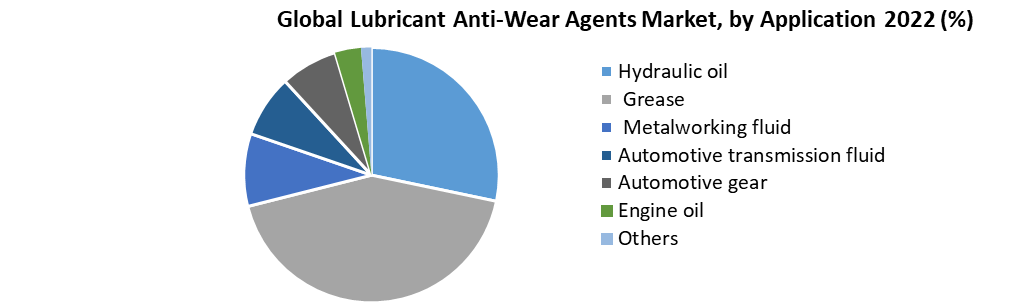
Lubricant Anti-Wear Agents Market Regional Insights:
In 2022, Asia Pacific was the dominant region and held the highest share 43.57% of the global Lubricant Anti-wear Agents market. During the forecast period, it is also expected to grow with the highest CAGR of xx%. This is mostly related to increased demand from the automotive industry as a result of the rising population. Lubricating oil agents are predominantly made and exported from the Asia Pacific given low labor and production costs. With over 27.8 million automobiles, China is the world's largest automaker. In addition, used automobile sales have seen a huge increase in the country. Automobile vehicle sales have been rising in India in recent years. As a result, the number of active automobiles has increased, resulting in an increasing need for lubricants.
Recent Advancements:
• In August 2022, Afton Chemical Company is expanding its blending capabilities for Gasoline Performance Additives (GPA) at its Singapore chemical additive manufacturing facility to focus on global lean supply chain solutions which will enable faster support and effective supply in Asia. This will also give the additional infrastructure required to support the company's global long-term expansion objectives.
• In July 2022, QuantiQ Distribuidora Ltd. will be Chevron Oronite's distributor in Brazil, according to the deal. QuantiQ Distribuidora Ltd will distribute Chevron Oronite lubricant additives under the contract, which would enhance the company's supply chain.
• In January 2022, InterActive S.A., which specializes in the distribution of lubricant additives in the Israeli, Greek, and Cypriot markets, was acquired by Krahn Chemie GmbH. Krahn Chemie Group is expected to gain a strong foothold in the Israeli market as a result of this strategic acquisition.
• In January 2022, Vertellus purchased Bercen Chemicals, which will contribute to the company's current portfolio and serve the North American lubricant additives industry.
• In October 2022, the expansion of Afton Chemical Corporation's Japan Technology Center in Tsukuba was completed. This will help to improve the testing capability for lubricant additives.
• In April 2022, a groundbreaking ceremony was performed by Mitsui Chemicals for a new factory for Lucant, a leading brand in the Lubrizol Additives business division. The new plant will help meet the increased demand for lubricants in the market.
The objective of the report is to present a comprehensive analysis of the global Lubricant Anti-wear Agents market to the stakeholders in the industry. The past and current status of the industry with the forecasted market size and trends are presented in the report with the analysis of complicated data in simple language. The report covers all the aspects of the industry with a dedicated study of key players that include market leaders, followers, and new entrants.
PORTER, PESTEL analysis with the potential impact of micro-economic factors of the market have been presented in the report. External as well as internal factors that are supposed to affect the business positively or negatively have been analyzed, which will give a clear futuristic view of the industry to the decision-makers.
The report also helps in understanding the global Lubricant Anti-wear Agents market dynamics, structure by analyzing the market segments and project the global Lubricant Anti-wear Agents market size. Clear representation of competitive analysis of key players by product, price, financial position, product portfolio, growth strategies, and regional presence in the global Lubricant Anti-wear Agents market make the report investor’s guide.
Global Lubricant Anti-Wear Agents Market Scope: Inquire before buying
| Global Lubricant Anti-Wear Agents Market | |||
|---|---|---|---|
| Report Coverage | Details | ||
| Base Year: | 2022 | Forecast Period: | 2023-2029 |
| Historical Data: | 2017 to 2022 | Market Size in 2022: | US $ 698 Mn. |
| Forecast Period 2023 to 2029 CAGR: | 2.3% | Market Size in 2029: | US $ 818.43 Mn. |
| Segments Covered: | by Type | • Zinc Di-thiophosphate (ZDP) • Zinc dialkyl Di-thiophosphate (ZDDP) • Tricresyl phosphate (TCP) • Halocarbons • Stearic acid • Glycerol mono-oleate |
|
| by Application | • Hydraulic oil • Grease • Metalworking fluid • Automotive transmission fluid • Automotive gear • Engine oil • Others |
||
| by Sales Channel | • Captive • Merchant |
||
Lubricant Anti-Wear Agents Market, by Region
• North America (United States, Canada and Mexico)
• Europe (UK, France, Germany, Italy, Spain, Sweden, Austria and Rest of Europe)
• Asia Pacific (China, South Korea, Japan, India, Australia, Indonesia, Malaysia, Vietnam, Taiwan, Bangladesh, Pakistan and Rest of APAC)
• Middle East and Africa (South Africa, GCC, Egypt, Nigeria and Rest of ME&A)
• South America (Brazil, Argentina Rest of South America)
Lubricant Anti-Wear Agents Market, Key Players are:
• Afton Chemical
• BASF SE
• Chevron Oronite
• Solvay
• Lanxess
• Bercen Chemicals
• The Lubrizol Corporation
• New Market Corporation
• Infineum International Limited
• Tianhe Chemicals Group Limited
• Baker Hughes
• Clariant
• ENI
• Dorf Ketal
• Cerion
• Eurolub
• Wuxi South Petroleum Additives
• Vanderbilt Chemicals
• Others
Frequently Asked Questions:
1. What is the forecast period considered for the Lubricant Anti-wear Agents market report?
Ans. The forecast period for the Lubricant Anti-wear Agents market is 2023-2029.
2. Which key factors are hindering the growth of the Lubricant Anti-wear Agents market?
Ans. The alternative for gasoline fuel like biodiesel, natural gas, ethanol, and many others are the key factors expected to hinder the growth of the Lubricant Anti-wear Agents market.
3. What is the compound annual growth rate (CAGR) of the Lubricant Anti-wear Agents market for the next 6 years?
Ans. The global Lubricant Anti-wear Agents market is expected to grow at a CAGR of 2.3% during the forecast period (2023-2029).
4. What are the key factors driving the growth of the Lubricant Anti-wear Agents market?
Ans. The increasing demand for anti-wear agents from the automobile sector is driving and expected to drive the growth of the market during the forecast period.
5. Which are the worldwide major key players covered for the Lubricant Anti-wear Agents market report?
Ans. Afton Chemical, BASF SE, Chevron Oronite, Solvay, Lanxess, Bercen Chemicals, The Lubrizol Corporation, New Market Corporation, Infineum International Limited, Tianhe Chemicals Group Limited, Baker Hughes, Clariant, ENI, Dorf Ketal, Cerion, Eurolub, Wuxi South Petroleum Additives, Vanderbilt Chemicals, and Others.