
Low Light Security Camera Market – Global Market Size, Strategic Growth Drivers, Risk Assessment Framework, Regulatory Landscape Review, Competitive Intensity Mapping & Long-Term Industry Outlook to 2034
Overview
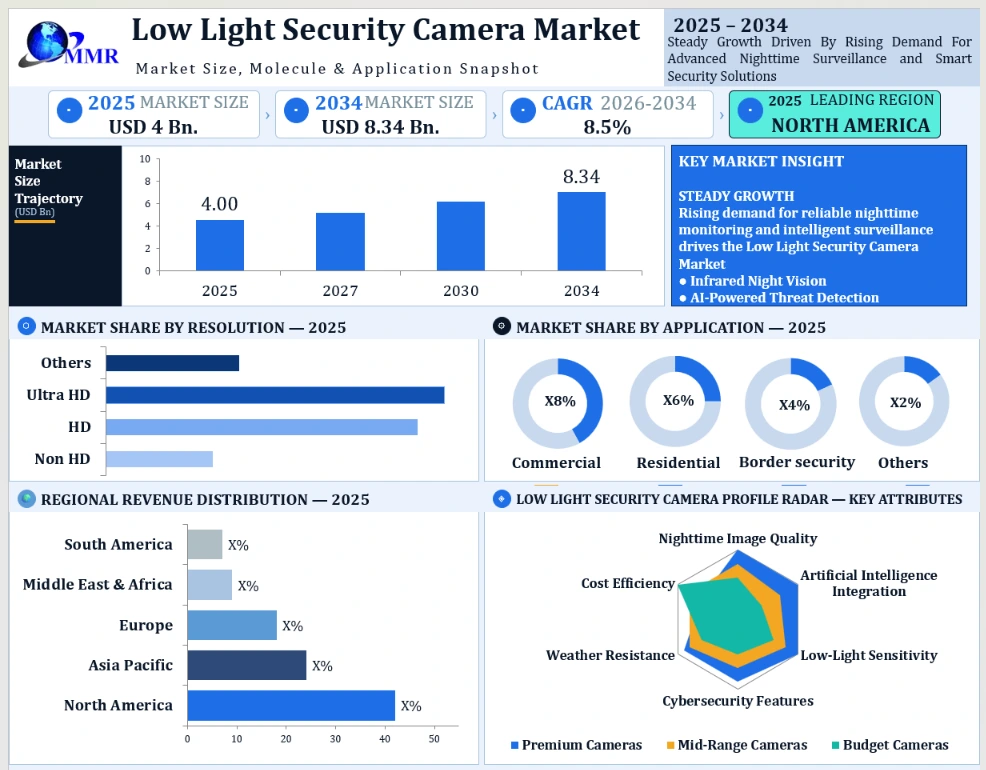
Global Low Light Security Camera Market is expected to grow at a CAGR of 8.5% during the forecast period. The Market Size is USD 4 Bn. in 2025 and it is expected to reach USD 8.34 Bn. by 2034.
Global Low Light Security Camera Market Overview
Low Light Security Camera Market refers to the industry focused on security cameras designed to capture clear and usable images in dimly lit environments, nighttime conditions, and areas with limited visibility. These cameras use technologies such as infrared imaging, starlight sensors, image enhancement, and advanced day-and-night monitoring to improve surveillance performance. Low light security cameras are increasingly important for residential security, commercial buildings, industrial facilities, transportation infrastructure, and public safety, where reliable monitoring helps detect suspicious activity, protect assets, and improve security management.
The Low Light Security Camera Market is evolving as security operators prioritize clearer nighttime surveillance, intelligent video monitoring, and dependable performance in challenging lighting conditions. Government agencies, commercial property owners, retailers, transport authorities, and industrial operators are investing in advanced security systems to improve incident detection and asset protection. For example, Axis Communications offers Lightfinder and OptimizedIR technologies that enhance image quality in low-light and dark environments. North America remains an important market for advanced surveillance adoption, while infrastructure modernization and smart city projects create further opportunities across Asia Pacific. The United States Department of Homeland Security’s Science and Technology Directorate has also published guidance on video security systems, including cameras, video analytics, cloud storage, and artificial intelligence, highlighting the importance of integrated surveillance solutions.
The Low Light Security Camera Market report by Maximize Market Research (MMR) examines market trends, competitive positioning, regional demand, technology adoption, and end-user purchasing patterns to identify commercially attractive opportunities. The research evaluates growth potential in AI-enabled low-light surveillance, smart infrastructure, industrial security, residential monitoring, and integrated video analytics, helping manufacturers, investors, distributors, and security solution providers understand emerging demand and make informed strategic decisions.
Low Light Security Camera Market Growth and Share Analysis
To know about the Research Methodology :- Request Free Sample Report
Global Low Light Security Camera Market Key Highlights
| Key Highlight | Insight |
|---|---|
| Market Growth Outlook | The Low Light Security Camera Market is estimated at USD 4.00 billion in 2025 and is projected to reach USD 8.34 billion by 2034, reflecting a CAGR of 8.5% during 2026–2034. |
| Leading Regional Market | North America leads the market, supported by demand for commercial surveillance, residential security, public safety monitoring, and critical infrastructure protection. |
| Dominant Technology | Infrared light-emitting diode technology remains a key solution for nighttime surveillance, while full-color low-light imaging and advanced image processing are improving visibility in dark environments. |
| Leading Application | Commercial security represents a major application area, driven by surveillance requirements across retail stores, offices, warehouses, parking facilities, and commercial buildings. |
| Competitive and Innovation Landscape | Hikvision, Dahua Technology, Axis Communications, Hanwha Vision, and Bosch Security Systems compete through improved nighttime image quality, artificial intelligence-based analytics, infrared illumination, and integrated surveillance solutions. |
Global Low Light Security Camera Market Dynamics
Driver: Rising Demand for Reliable Nighttime Surveillance Strengthens Low Light Security Camera Market Growth
The growing need for reliable nighttime surveillance is a major driver of the Low Light Security Camera Market, as residential communities, commercial buildings, industrial facilities, and public infrastructure require continuous monitoring under poor lighting conditions. Infrared imaging, starlight sensors, and advanced image processing help security cameras capture identifiable details in environments where conventional cameras struggle to produce clear footage. According to the United Nations Office on Drugs and Crime, effective crime prevention relies partly on improved public safety measures and appropriate security infrastructure, encouraging organizations to evaluate advanced surveillance solutions. Businesses operating across multiple shifts, logistics facilities running around the clock, and transport networks with limited nighttime lighting are creating demand for low light security cameras that improve incident detection, reduce blind spots, and strengthen property protection. These requirements are encouraging manufacturers to prioritize high-sensitivity sensors, improved image clarity, and dependable nighttime video recording.
Restraint: High Installation Costs and Maintenance Requirements Challenge Low Light Security Camera Market Adoption
The high initial cost of advanced low light security cameras remains a restraint, particularly for small businesses, residential users, and organizations managing large surveillance networks. Cameras featuring high-sensitivity sensors, infrared illumination, intelligent video analytics, and weather-resistant enclosures may require additional investment in network infrastructure, recording equipment, storage, and professional installation. For example, a surveillance deployment involving 100 cameras can require substantial expenditure on cabling, network switches, recording capacity, and ongoing maintenance beyond the camera purchase price. Infrared illumination may also have practical limitations in reflective environments, while poor positioning, glare, fog, and obstructions can reduce image quality. Organizations must therefore evaluate the total cost of ownership, power consumption, replacement requirements, and compatibility with existing security systems before investing in low light surveillance technology, potentially delaying adoption among price-sensitive customers.
Opportunity: Smart City Projects and Artificial Intelligence Create New Low Light Security Camera Market Opportunities
Smart city infrastructure, automated video monitoring, and artificial intelligence-based security applications are creating opportunities for low light security camera manufacturers and solution providers. Municipal authorities, transportation operators, commercial property developers, and industrial companies increasingly require surveillance systems capable of operating throughout the day and night while supporting faster incident assessment. The International Telecommunication Union's smart sustainable city initiatives highlight the role of information and communication technologies in improving urban services and infrastructure management, creating a relevant setting for advanced video surveillance deployments. For instance, projects covering street intersections, railway stations, parking facilities, warehouses, and public buildings can benefit from cameras that combine low-light imaging with motion detection, object classification, and automated alerts. Manufacturers can also target retrofit installations, edge-based video processing, energy-efficient infrared illumination, and cloud-connected monitoring systems, creating additional revenue opportunities through software integration, installation services, and long-term maintenance contracts.
Challenge: Image Accuracy and Cybersecurity Risks Remain Key Challenges for the Low Light Security Camera Market
Maintaining consistent image quality in near-dark environments while protecting surveillance data presents a major challenge for the Low Light Security Camera Market. Camera performance can deteriorate because of fog, rain, dust, glare, moving subjects, excessive infrared reflection, and sudden changes in illumination, making accurate identification more difficult. Manufacturers must balance sensor sensitivity, image resolution, frame rate, illumination range, and processing requirements without introducing excessive image noise or motion blur. At the same time, internet-connected surveillance cameras can create cybersecurity risks if organizations use weak passwords, outdated firmware, unsecured network connections, or insufficient access controls. The United States National Institute of Standards and Technology promotes cybersecurity guidance for Internet of Things devices, emphasizing security capabilities that are relevant to connected surveillance equipment. Camera suppliers must address these concerns through secure firmware updates, encrypted communications, controlled access, privacy-conscious recording practices, and rigorous testing to maintain buyer confidence and support dependable low light security camera deployment.
Global Low Light Security Camera Market Key Trends
| Market Trend | Description |
|---|---|
| Full-Color Imaging in Extremely Low Light | Security camera manufacturers are prioritizing full-color nighttime imaging that captures useful details without relying entirely on infrared illumination. Technologies such as Lightfinder from Axis Communications combine sensitive image sensors and image processing to improve visibility in dark environments. This trend is particularly relevant to parking areas, streets, warehouses, and commercial premises where identifying clothing and vehicle colors can support incident investigations. |
| Artificial Intelligence-Based Nighttime Threat Detection | Low light security cameras increasingly combine image enhancement with artificial intelligence to recognize people, vehicles, and unusual activity in poorly illuminated areas. Better nighttime image quality can improve object recognition and reduce unnecessary alerts, helping security teams focus on relevant incidents. Manufacturers are also incorporating analytics directly into cameras, reducing the need to send every video stream to a remote processing system. |
| Advanced Image Sensors for Improved Nighttime Clarity | Camera developers are adopting more light-sensitive sensors, improved optical components, and advanced image processing to capture clearer footage while reducing image noise and motion blur. Backside-illuminated and stacked complementary metal-oxide-semiconductor sensor designs are important areas of development in low-light imaging. These improvements are valuable for monitoring moving vehicles, industrial sites, transport infrastructure, and other environments where image detail matters more than resolution alone. |
| Adaptive Infrared Illumination and Reduced Light Pollution | Manufacturers are refining infrared illumination to provide more balanced nighttime visibility across different distances and scene conditions. Adaptive illumination can help reduce overexposure on nearby objects while improving visibility in darker parts of a scene. Cameras that perform effectively with less external lighting can also help organizations manage energy use and reduce unnecessary illumination around residential areas, commercial buildings, and sensitive infrastructure. |
| Edge-Based Video Analytics and Faster Incident Processing | Security operators are showing greater interest in cameras that process video locally and generate alerts without depending entirely on centralized servers or continuous cloud analysis. Edge-based analytics can reduce unnecessary data transmission, support quicker responses, and help manage bandwidth across large surveillance networks. This approach is particularly useful for remote industrial facilities, logistics centers, and public infrastructure where network connectivity or centralized monitoring capacity may be limited. |
| Cybersecurity, Interoperability, and Lifecycle Management | Buyers are increasingly considering secure software updates, encrypted data transmission, system compatibility, and long-term maintenance when selecting low light security cameras. Rather than evaluating products only on nighttime image quality, organizations are assessing how cameras integrate with video management platforms, access control systems, and existing security infrastructure. This trend creates opportunities for manufacturers offering open-platform compatibility, dependable firmware support, and integrated security management solutions. |
Market Strategies for the Low Light Security Camera Market
- Adaptive Night Vision as a Service: Manufacturers can offer cameras with automatically adjustable infrared illumination and image enhancement, supported by subscription-based monitoring and remote configuration services.
- Artificial Intelligence Based Predictive Surveillance: Companies can integrate intelligent video analytics to identify unusual nighttime movement, detect restricted-area entry, and alert security teams before incidents escalate.
- Low Light Camera Retrofit Solutions: Suppliers can develop upgrade kits that allow existing surveillance systems to adopt improved low-light imaging without replacing the entire camera infrastructure, reducing installation costs for commercial customers.
- Solar Powered Nighttime Surveillance: Integrating solar panels, energy-efficient infrared illumination, and battery storage can support low light security cameras in remote industrial facilities, border areas, farms, and infrastructure sites with limited electricity access.
- Privacy Focused Edge Processing: Manufacturers can process video directly within cameras, using privacy masking and selective event recording to reduce unnecessary data transmission and strengthen security for residential and commercial users.
- Dual Mode Infrared and Full Color Imaging: Combining infrared nighttime monitoring with low-light full-color imaging can help security operators obtain clearer visual details while minimizing unnecessary visible illumination around buildings, parking areas, and public spaces.
- Cybersecurity Led Product Differentiation: Companies can compete through secure device authentication, encrypted video transmission, signed firmware updates, and long-term software support, positioning trusted low light security cameras as a preferred choice for critical infrastructure and enterprise customers.
- Industry Specific Camera Solutions: Manufacturers can develop specialized low-light security cameras for warehouses, transport terminals, healthcare facilities, and industrial sites, tailoring lens selection, illumination range, weather resistance, and analytics to each operating environment.
Global Low Light Security Camera Market Segment Analysis
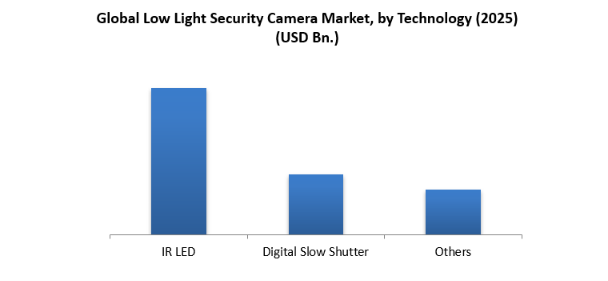
By Technology, Infrared light-emitting diode (IR LED) technology remains an important choice in the Low Light Security Camera Market because it enables nighttime surveillance in dark environments without requiring visible illumination. Its established use in residential security, commercial buildings, warehouses, and outdoor monitoring makes it suitable for customers seeking dependable nighttime visibility at a manageable cost. Digital slow shutter technology improves image brightness by allowing the camera sensor to collect light over a longer exposure period, making it useful in scenes with limited ambient lighting, although moving subjects may appear blurred. Among these technologies, IR LED is expected to remain the leading mainstream option due to its effectiveness in near-dark conditions and broad applicability, while digital slow shutter and other image-enhancement technologies serve specific surveillance needs. Manufacturers are also combining infrared illumination with sensitive image sensors and advanced processing to improve nighttime image clarity.
By Application, The commercial segment is expected to lead the Low Light Security Camera Market because retail stores, office complexes, hotels, warehouses, and commercial facilities require reliable surveillance during nighttime and low-occupancy hours. Businesses increasingly prefer low light security cameras that provide clear footage around entrances, parking areas, loading zones, and restricted spaces. Residential security is also gaining traction as homeowners adopt nighttime monitoring for driveways, entrances, and property perimeters. Border security remains a strategically important application, with demand for dependable surveillance across remote boundaries and poorly illuminated areas, where long-range monitoring and reliable detection are essential. Other applications include transportation infrastructure, public facilities, and selected industrial sites.
Global Low Light Security Camera Market Regional Analysis
North America is the leading region in Low Light Security Camera Market growth, which has strong demand for advanced commercial surveillance, residential security, public safety monitoring, and critical infrastructure protection. Businesses, government facilities, transport operators, and property managers increasingly rely on low light security cameras to maintain visibility during nighttime and in poorly illuminated environments. The adoption of artificial intelligence-based video analytics, infrared imaging, and network-connected security systems is encouraging upgrades to existing surveillance infrastructure. Demand from the United States and Canada is particularly relevant for applications requiring dependable nighttime monitoring, remote access, and integration with broader security management systems.
Asia Pacific is an important regional market for low light security cameras, supported by electronics manufacturing, urban development, commercial construction, and smart city initiatives. China, India, Japan, and South Korea provide opportunities through industrial facilities, residential developments, transportation networks, and public surveillance projects. Manufacturers benefit from established camera production capabilities and a broad supplier ecosystem, while increasing attention to property protection and infrastructure security encourages demand for affordable nighttime monitoring solutions. The region also offers opportunities for suppliers developing cameras that combine infrared illumination, improved image sensors, and intelligent video analysis.
Europe Low Light Security Camera Market demand is shaped by commercial property protection, public transport surveillance, industrial safety, and modernization of existing security systems. Countries such as Germany, the United Kingdom, France, and Italy provide opportunities for advanced low-light imaging technologies across manufacturing facilities, retail premises, transport infrastructure, and public buildings. Buyers increasingly consider image clarity, cybersecurity, privacy requirements, and compatibility with existing video management platforms when selecting surveillance equipment. These priorities create opportunities for manufacturers offering reliable nighttime performance alongside secure data handling and flexible system integration.
South America presents emerging opportunities for the Low Light Security Camera Market as businesses, residential communities, logistics operators, and public authorities invest in improved surveillance infrastructure. Brazil, Argentina, and Chile are relevant markets for monitoring commercial premises, parking facilities, transport hubs, warehouses, and urban public spaces. Demand is influenced by the need for reliable property protection and cost-effective security upgrades, encouraging interest in infrared cameras and practical nighttime monitoring solutions. Suppliers that provide durable equipment, straightforward installation, and accessible maintenance services can address the requirements of customers with different investment capacities.
The Middle East and Africa Low Light Security Camera Market is gaining opportunities from infrastructure development, commercial construction, transportation projects, industrial facilities, and protection of strategically important sites. Countries such as Saudi Arabia, the United Arab Emirates, and South Africa offer applications across commercial buildings, airports, logistics centers, energy facilities, and public infrastructure. Harsh weather, dust, high temperatures, and challenging outdoor lighting conditions increase the importance of durable camera designs and dependable nighttime image quality. Manufacturers that combine infrared imaging, weather-resistant enclosures, remote monitoring, and efficient maintenance support can address regional security requirements across urban and industrial environments.
Global Low Light Security Camera Market Competitive Landscape
The Low Light Security Camera Market comprises competition among established surveillance equipment manufacturers and technology providers that differentiate their offerings through infrared imaging, advanced image sensors, nighttime image clarity, intelligent video analytics, and network security capabilities. Key players include Hikvision, Dahua Technology, Axis Communications, Hanwha Vision, Bosch Security Systems, Teledyne FLIR, Panasonic, and Motorola Solutions. Competition increasingly focuses on delivering clear nighttime footage, reliable infrared illumination, improved performance in challenging lighting conditions, and compatibility with existing video management platforms. Manufacturers are also investing in artificial intelligence-based detection, edge processing, cybersecurity, and scalable surveillance solutions to meet the requirements of commercial properties, residential users, industrial facilities, and border security agencies. Product reliability, installation costs, distribution networks, after-sales support, and integration capabilities remain important competitive factors, while opportunities for differentiation arise from specialized low-light imaging technologies and customized surveillance systems for infrastructure and public safety applications.
Global Low Light Security Camera Market Recent Developments:
| Date | Company | Development | Impact |
|---|---|---|---|
| 07 January 2026 | Dreame Technology | Dreame unveiled its NAVO ELITE 1 OutCam featuring NightVivid full-color low-light imaging down to 0.001 lux at CES 2026. | The technology preserves true facial and clothing color detail in near darkness without relying on conventional monochrome infrared LEDs. |
| 24 March 2026 | VIVOTEK Inc. | VIVOTEK officially launched its Chroma24 low-light full-color AI camera series during ISC West 2026. | The series eliminates supplemental lighting needs while delivering 24/7 true-color clarity, reduced power consumption, and edge AI visual search. |
| 15 April 2026 | Canon Inc. | Canon launched the MS-510 ultra-high-sensitivity multi-purpose camera equipped with a 1-inch SPAD sensor capable of capturing color video at 0.0006 lux. | The photon-counting sensor enables long-distance full-color surveillance in extreme darkness for border security and critical infrastructure monitoring. |
| 08 June 2026 | Teledyne FLIR | Teledyne FLIR OEM launched the Boson SX8, an NDAA-compliant 8-micron pixel SXGA thermal imaging camera module for zero-light security applications. | The compact high-resolution module enhances long-range perimeter security and counter-UAS detection in complete darkness. |
| 18 September 2026 | Axis Communications AB | Axis Communications released three new rugged AI-powered onboard dome cameras integrating Lightfinder 2.0 and Forensic WDR technologies. | The cameras deliver sharp, low-noise color imagery in challenging low-light transportation environments alongside hardware-based cybersecurity. |
The Scope of Global Low Light Security Camera Market: Inquire before buying
| Low Light Security Camera Market | |||
|---|---|---|---|
| Report Coverage | Details | ||
| Base Year: | 2025 | Forecast Period: | 2026-2034 |
| Historical Data: | 2020 to 2025 | Market Size in 2025: | US $ 4 Bn. |
| Forecast Period 2026 to 2034 CAGR: | 8.5% | Market Size in 2034: | US $ 8.34 Bn. |
| Segments Covered: | by Resolution | Non HD HD Ultra HD Others |
|
| by Technology | IR LED Digital Slow Shutter Others |
||
| by Application | Commercial Residential Border Security Others |
||
Global Low Light Security Camera Market, by Region
- North America (United States, Canada and Mexico)
- Europe (UK, France, Germany, Italy, Spain, Sweden, Austria and Rest of Europe)
- Asia Pacific (China, South Korea, Japan, India, Australia, Indonesia, Malaysia, Vietnam, Taiwan, Bangladesh, Pakistan and Rest of APAC)
- Middle East and Africa (South Africa, GCC, Egypt, Nigeria and Rest of ME&A)
- South America (Brazil, Argentina Rest of South America)
Global Low Light Security Camera Market Key Players
- Hikvision Digital Technology Co. Ltd.
- Dahua Technology Co. Ltd.
- Axis Communications
- Hanwha Vision
- Bosch Security Systems
- Honeywell International Inc.
- Avigilon Corporation
- Teledyne FLIR
- Panasonic Corporation
- Sony Corporation
- Canon Inc.
- Cisco Systems Inc.
- Swann Communications
- Arecont Vision
- GeoVision Inc.
- Kintronics
- AvaLAN Networks
- Motorola Solutions Inc.
- Pelco
- Uniview Technologies
- VIVOTEK Inc.
- CP PLUS
- MOBOTIX AG
- Tiandy Technologies
- IDIS Co. Ltd.
- Infinova Corporation
- D-Link Corporation
- Arlo Technologies Inc.
- Lorex Technology
- Verkada Inc.
- Eagle Eye Networks
- Genetec Inc.
- Milestone Systems
- Johnson Controls International plc
- JVCKENWOOD Corporation
- Ubiquiti Inc.
- Reolink
- LTS Security
- Speco Technologies
- American Dynamics
- Eneo
- i-PRO Co. Ltd.
- Samsung Electronics
- Axis Technology
- ZKTeco
- Zhejiang Uniview Technologies
- Shenzhen Sunell Technology Corporation
- Brickcom Corporation
- Consistent Infosystems
- Lorex Corporation
Global low Light Security Camera Market - Frequently Asked Questions
1.Which region has the largest share in the Low Light Security Camera Market?
Ans: North America is considered the leading region in the Low Light Security Camera Market, driven by advanced surveillance adoption and security infrastructure investments.
2.What is the growth rate of the Low Light Security Camera Market?
Ans: The Low Light Security Camera Market is estimated to grow at a CAGR of 8.5% during the forecast period 2026–2034.
3.What is the scope of the Low Light Security Camera Market report?
Ans: The report covers market dynamics, segmentation, regional analysis, competitive landscape, PESTEL analysis, PORTER analysis, and strategic recommendations.
4.Who are the key players in the Low Light Security Camera Market?
Ans: Key players include Hikvision, Dahua Technology, Axis Communications, Hanwha Vision, Bosch Security Systems, Honeywell International, and Teledyne FLIR.
5.What is the study period of the Low Light Security Camera Market?
Ans: The Low Light Security Camera Market is studied from 2020 to 2034.